Have you ever written censor when you meant censure and wondered which word was actually correct? While Censor vs Censure may look and sound similar, these two words have very different meanings, uses, and contexts.
Censor usually means to examine information and remove, block, or restrict content considered offensive, harmful, or inappropriate. Censure, on the other hand, means to strongly criticize or formally express disapproval of someone or something.
Examples:
- The government may censor certain information.
- The committee voted to censure the official for his actions.
The confusion is understandable. Censor vs Censure are pronounced similarly and share the same Latin root, but they describe very different actions. People often search for censor vs censure meaning, difference between censor and censure, censor meaning, censure meaning, or censor vs censure examples because these words are easy to mix up. And here’s the kicker: one can involve removing someone’s words, while the other involves openly condemning someone’s actions.
In this guide, you’ll learn the complete Censor vs Censure difference, including their meanings, definitions, pronunciations, parts of speech, and correct usage. You’ll also discover clear censor vs censure examples, related forms, and an easy way to remember the difference between these commonly confused words.
Censor vs Censure: Quick Difference
| Word | Part of speech | Main meaning | Usually involves | Example |
| Censor | Noun, verb | To suppress, remove, block, or restrict content | Books, movies, speech, images, information, communications | The network censored the scene. |
| Censure | Noun, verb | To strongly criticize, condemn, or formally reprimand | People, conduct, decisions, policies, misconduct | The committee censured the official. |
Here’s another way to see the distinction:
Censor → content
Censure → conduct
If the issue is what people can see, hear, read, or access, censor is usually the word you need.
If the issue is what someone did and whether that behavior deserves condemnation, use censure.
Cambridge defines censor as preventing some or all of a communication from being seen or made available. It defines censure as strong criticism or disapproval.
The Difference in One Sentence
You censor something, but you censure someone or something for behavior you consider wrong.
For example:
- The publisher censored the controversial passage.
- The board censured the publisher for violating its rules.
The first sentence concerns content. The second concerns conduct.
What Does Censor Mean?
Censor means to remove, hide, block, alter, or restrict material that someone considers objectionable, harmful, sensitive, or secret.
The word can function as both a noun and a verb.
Cambridge lists censor as a noun for a person responsible for examining material and deciding whether it should be withheld from the public. It also recognizes a computer tool that can hide or prevent content from being shared. As a verb, censor means to prevent some or all of a communication from being seen or made available.
Censor as a Verb
When censor functions as a verb, it describes the act of suppressing or restricting content.
Common objects include:
- a book
- a movie
- a television program
- an image
- a photograph
- a document
- a letter
- a news report
- a social media post
- a website
- information
- speech
- language
- a passage
For example:
- The studio censored several scenes before releasing the film.
- The newspaper refused to censor the article.
- The platform censored the image because it violated its content rules.
- Officials censored parts of the report before publication.
- She censored herself during the interview.
The last example introduces an important use: self censoring.
When you censor yourself, you deliberately stop yourself from saying or publishing something. Cambridge specifically recognizes censor yourself as a use meaning to stop yourself from doing or saying something you consider unsuitable.
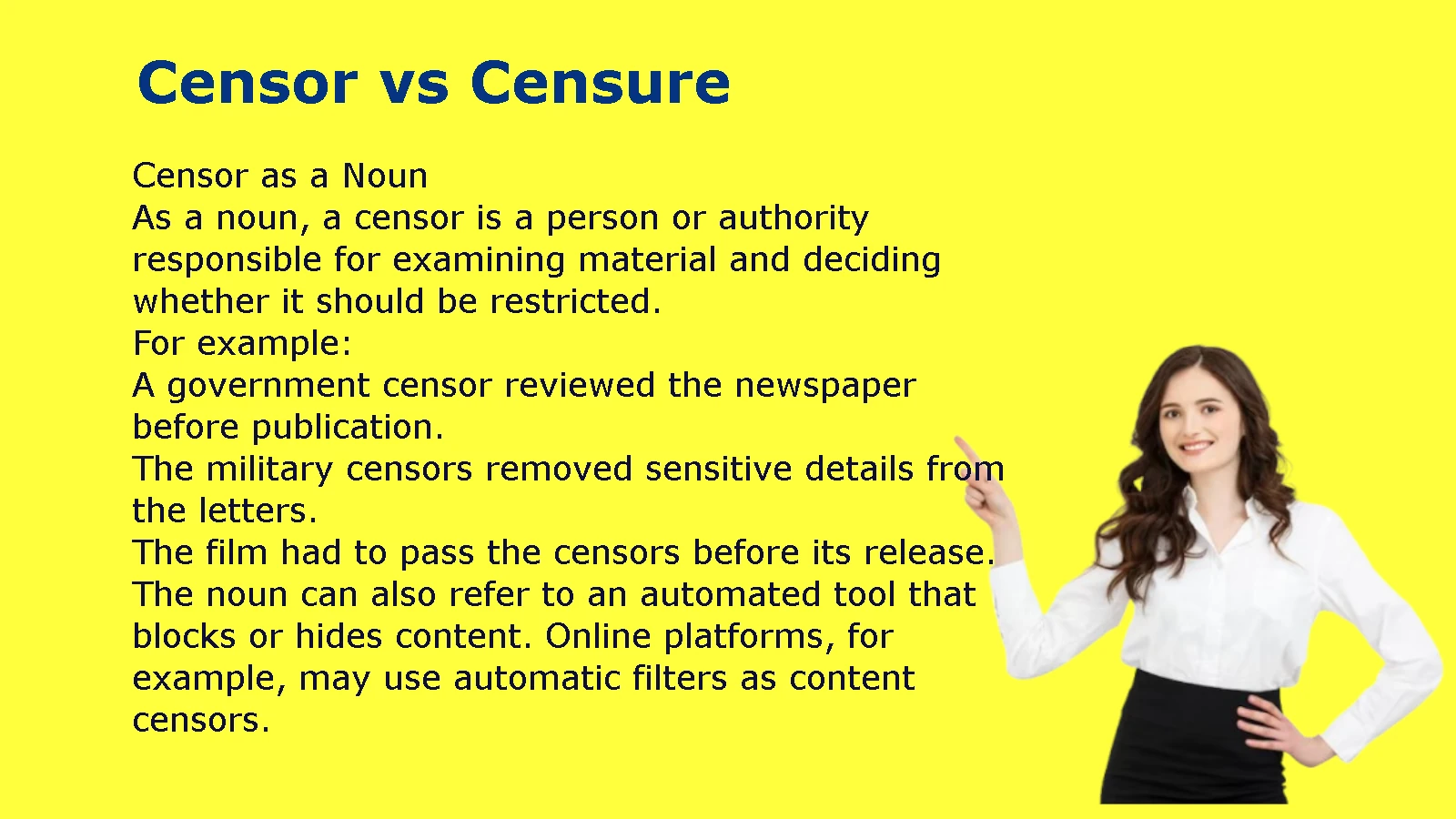
Censor as a Noun
As a noun, a censor is a person or authority responsible for examining material and deciding whether it should be restricted.
For example:
- A government censor reviewed the newspaper before publication.
- The military censors removed sensitive details from the letters.
- The film had to pass the censors before its release.
The noun can also refer to an automated tool that blocks or hides content. Online platforms, for example, may use automatic filters as content censors.
What Does Censorship Mean?
The related noun censorship refers to the practice or system of censoring.
So the relationship looks like this:
| Word | Meaning |
| Censor | A person, authority, or tool that suppresses content; also the act of suppressing content |
| Censoring | The act of suppressing content |
| Censorship | The broader practice or system of restricting content |
For example:
The government introduced strict censorship of the press.
Here, censorship refers to the broader practice, not a particular person performing the action. Cambridge defines censorship as preventing some or all of a communication from being seen or made available to the public.
What Does Censure Mean?
Censure means to express strong criticism, condemnation, or disapproval. It can also mean to formally reprimand someone.
Unlike censorship, censure doesn’t normally involve removing information.
Instead, it involves judgment and condemnation.
Cambridge classifies censure as a formal word for strong criticism or disapproval. Merriam Webster also gives it the meaning of an official reprimand.
Censure as a Verb
As a verb, censure means to criticize someone strongly or formally reprimand them.
For example:
- The committee censured the official for misconduct.
- The council censured the member for violating its rules.
- Lawmakers censured the president over the controversial decision.
- The organization censured the employee for serious misconduct.
- The board censured the director after the investigation.
Notice the pattern.
Censure + person + for + action
For example:
The committee censured the official for abusing his authority.
The official isn’t being censored. Nobody is necessarily deleting the official’s words or blocking his communication. Instead, the organization is condemning his conduct.
Censure as a Noun
As a noun, censure means strong criticism, condemnation, or an official reprimand.
For example:
- The decision attracted widespread censure.
- The official faced public censure.
- The committee issued a formal censure.
- His actions brought censure from the organization.
- The judge received a letter of censure.
Merriam Webster identifies three major modern noun senses: a judgment involving condemnation, stern blame or condemnation, and an official reprimand.
That formal sense matters.
A person can criticize you casually without censuring you. Censure usually suggests that the criticism carries greater weight, especially when an institution, governing body, or professional organization delivers it.
Censor vs Censure as Nouns
Both words can function as nouns, which creates another opportunity for confusion.
A Censor Is a Person or Tool
A censor examines material and decides whether some of it should be restricted.
For example:
The government appointed a censor to review the documents.
A censor might examine books, films, letters, artwork, news reports, or other communications. Modern technology has also introduced automated forms of content filtering.
A Censure Is Criticism or Reprimand
A censure, on the other hand, is the criticism or reprimand itself.
For example:
The committee issued a censure after the investigation.
You can think of the difference this way:
| Noun | What it represents |
| A censor | The person or tool that restricts content |
| A censure | The criticism or reprimand imposed on someone |
So these sentences mean very different things:
- The censor removed the passage.
- The official received a censure.
One involves content restriction. The other involves formal disapproval.
Censor vs Censure as Verbs
The verb forms become much easier when you focus on what receives the action.
Use Censor for Content
You can censor:
- information
- speech
- writing
- images
- movies
- books
- documents
- messages
- websites
- broadcasts
- posts
Examples:
The editor censored the offensive language.
The network censored the scene before broadcasting the program.
The agency censored sensitive information in the document.
In each example, something is being removed, hidden, blocked, or restricted.
Use Censure for People, Actions, or Conduct
You can censure:
- a person
- an official
- a politician
- an employee
- a leader
- an organization
- a decision
- conduct
- behavior
Examples:
The committee censured the director for violating policy.
The council censured the official after the investigation.
The organization censured the member for misconduct.
Here, the focus is not on hiding information. The focus is on condemning behavior.
A Useful Grammar Pattern
A very useful structure is:
censor + something
but
censure + someone + for something
Compare:
The editor censored the article.
The board censured the editor for publishing the article.
That grammatical contrast can help you choose the right word even when you’re writing quickly.
When to Use Censor
Use censor when someone removes, blocks, hides, alters, or restricts material.
The word commonly appears in discussions about:
- media
- government
- journalism
- entertainment
- publishing
- education
- social media
- internet platforms
- military communications
- personal expression
For example, if an editor removes a graphic image from an article, the editor censors the image.
If a movie distributor removes a scene before releasing a film, it censors the scene.
If someone deliberately avoids saying something because they believe it might be inappropriate, they censor themselves.
The central idea remains the same: something that could otherwise be communicated gets restricted.
When to Use Censure
Use censure when someone expresses serious disapproval of a person, decision, action, or behavior.
The word often appears in formal settings, including:
- government
- politics
- professional organizations
- corporate boards
- universities
- committees
- regulatory bodies
- courts and legal institutions
For example:
The committee voted to censure the member.
That means the committee formally expressed its disapproval.
Censure can be significant without being the same as removal from office, imprisonment, or another legal punishment. In institutional settings, it may function as a formal public statement of disapproval. Merriam Webster notes that an official censure does not necessarily carry an additional penalty.
Censor vs Censure Examples
Seeing the words side by side makes the distinction much clearer.
Censor Examples
- The publisher censored several passages from the book.
- The broadcaster censored the offensive language.
- The government censored parts of the report.
- The website automatically censored certain images.
- The filmmaker refused to censor the controversial scene.
- She censored herself before answering the question.
- The newspaper was accused of censoring important information.
- The platform censored the post for violating its rules.
Censure Examples
- The committee censured the official for misconduct.
- The board issued a formal censure.
- The politician faced censure after the investigation.
- The council censured the member for violating its code of conduct.
- The decision drew widespread censure.
- The organization censured its leader for the inappropriate remarks.
- The senator faced public censure.
- The judge received a formal censure.
Compare the Meaning
| Censor | Censure |
| The editor censored the passage. | The board censured the editor. |
| The passage was restricted. | The editor was criticized. |
| The network censored the scene. | Critics censured the network. |
| The scene was removed or altered. | The network was condemned. |
| The government censored the report. | Lawmakers censured the official. |
| Information was restricted. | Conduct was condemned. |
The contrast is especially useful because both actions can happen in the same situation.
Censor vs Censure in Sentences
Sometimes the best way to understand these words is to put them into the same scenario.
Example: A News Report
Suppose a newspaper removes sensitive information from a report.
The editor censored the report.
Now imagine a professional organization believes the editor acted improperly.
The organization censured the editor.
The first action concerns information. The second concerns the editor’s conduct.
Example: A Television Program
A broadcaster removes an offensive scene:
The network censored the scene.
Viewers then condemn the network’s decision:
Viewers censured the network for censoring the scene.
Notice how both words can appear naturally in one sentence. The network censored content, while people censured the network for doing so.
Example: A Government Official
Suppose officials remove sensitive information from a public document:
Officials censored parts of the report.
Now suppose lawmakers believe one official improperly ordered the removal:
Lawmakers censured the official.
Again, the distinction is simple once you separate the material being restricted from the person being criticized.
Censor or Censure: Which Word Should You Use?
When you’re unsure, ask one question:
What is being affected?
If content is being removed or restricted, choose censor.
If conduct is being condemned, choose censure.
Use Censor When:
- A passage gets removed.
- A scene gets cut.
- An image gets blocked.
- Information gets hidden.
- Speech gets restricted.
- A document gets redacted.
- A person holds back their own words.
Use Censure When:
- A person gets formally criticized.
- An official receives a reprimand.
- A committee condemns someone’s conduct.
- An organization expresses strong disapproval.
- A decision receives formal condemnation.
- A governing body votes to reprimand a member.
A compact memory aid works surprisingly well:
Censor content. Censure conduct.
It isn’t a complete dictionary definition, but it gives you the right direction when the two spellings start looking like twins.
Common Mistakes With Censor and Censure
These words often get mixed up because they share several letters and a historical connection.
Mistake: Using Censure for Removing Content
Incorrect:
The editor censured the offensive paragraph.
If the editor removed or altered the paragraph, censored is the correct word.
Correct:
The editor censored the offensive paragraph.
Mistake: Using Censor for Formal Criticism
Incorrect:
The committee censored the official for misconduct.
If the committee formally criticized or reprimanded the official, use censured.
Correct:
The committee censured the official for misconduct.
Mistake: Treating Censure as a Synonym for Censorship
Censure does not mean to suppress information.
A person can censure censorship. For example:
The organization censured the authorities for imposing censorship.
Here, censured means criticized or condemned.
The object of that criticism is censorship, which means the restriction of communication.
Mistake: Assuming Censor Always Means Government Censorship
Government censorship is an important use, but censor is much broader.
A publisher, television network, website, editor, school, organization, or individual can censor material.
Cambridge also recognizes self censorship, in which a person deliberately stops themselves from saying or doing something they consider unsuitable.
Censor vs Censure Pronunciation
The two words are close in pronunciation, but the ending differs.
For US English:
- censor: /ˈsen.sɚ/
- censure: /ˈsen.ʃɚ/
Cambridge gives these US pronunciations for the two words.
The important difference is the sound in the second syllable.
Censor uses an s sound.
Censure uses an sh sound.
That distinction can help you recognize the words when you hear them, although context remains the safest way to identify which meaning a speaker intends.
Censor vs Censure vs. Sensor
There’s a third word that deserves attention: sensor.
It looks almost identical to censor, but its meaning belongs to a completely different category.
| Word | Meaning | Example |
| Censor | Restricts or removes content | The editor censored the passage. |
| Censure | Strongly criticizes or reprimands | The committee censured the official. |
| Sensor | Detects or measures something | The motion sensor detected movement. |
A sensor is a device or mechanism that detects a physical condition or change.
For example:
- motion sensor
- temperature sensor
- light sensor
- pressure sensor
- proximity sensor
So:
The censor blocked the image.
is about content restriction.
The censure embarrassed the official.
is about condemnation.
The sensor detected movement.
is about detection.
Three similar spellings. Three different jobs.
Censor, Censure, and Censorship
These words belong to the same historical family, but modern English gives them distinct roles.
Censor
A censor can be a person, authority, or tool that restricts material. As a verb, censor means to suppress or restrict communication.
Censorship
Censorship describes the broader practice or system of restricting communication.
For example:
The newspaper faced government censorship.
Censure
Censure means strong criticism, condemnation, or formal reprimand.
For example:
The newspaper’s decision drew censure from the journalism organization.
The distinction can be summarized like this:
Censor → action
Censorship → system or practice
Censure → criticism or reprimand
Don’t treat censure as the noun form of censor. Censorship is the related noun for the practice of censoring.
Is Censure the Same as Criticism?
Not exactly.
Censure is a form of criticism, but it usually carries a stronger and more formal sense of disapproval.
You might criticize a restaurant because the food was disappointing. That doesn’t necessarily amount to censure.
By contrast, an organization might censure a member after determining that the member violated its rules.
Merriam Webster defines censure as finding fault with and criticizing someone as blameworthy. It also includes the more formal sense of reprimanding someone officially.
So the relationship is:
Criticism → broad category
Censure → strong or formal criticism
That distinction matters in professional and institutional writing.
Is Censure the Same as Censorship?
No.
The two words describe different actions.
Censure means to condemn or reprimand.
Censorship means to restrict or suppress communication.
Consider this sentence:
The committee censured the agency for its censorship of the report.
The committee censured the agency because it believed the agency’s censorship was wrong.
The words work together precisely because they don’t mean the same thing.
Can Censor and Censure Be Used in the Same Sentence?
Absolutely.
In fact, using them together can make their difference especially clear.
The committee censured the publisher for censoring the report.
Here:
- censured = criticized or formally reprimanded
- censoring = removing or restricting content
Another example:
Critics censured the network after it censored the documentary.
Again, the network censored the documentary, while critics censured the network.
This distinction is useful in journalism, politics, publishing, law, media criticism, and academic writing because the same event can involve both actions.
Censor vs Censure: A Practical Case Study
Consider a fictional but realistic publishing situation.
A magazine prepares an investigative article about a controversial organization. Before publication, its legal department removes several paragraphs containing sensitive information.
The magazine has censored part of the article.
Now imagine a professional journalism association investigates the decision and concludes that the editor violated its ethical standards. The association issues a formal statement condemning the editor’s conduct.
The association has censured the editor.
The two actions are related, but they’re not interchangeable.
| Stage | What happened? | Correct word |
| Content was removed | Information was suppressed | Censored |
| The decision was criticized | People condemned the action | Criticized |
| A formal reprimand was issued | The editor received official condemnation | Censured |
This is the central distinction in action:
Censoring changes access to information. Censuring expresses judgment about conduct.
The History Behind Censor and Censure
The similarity between the words isn’t accidental.
Both ultimately trace back to the Latin verb cēnsēre, which was associated with giving an opinion, assessing, and performing the duties of a Roman censor.
In ancient Rome, a censor was a public official with responsibilities that included conducting the census and assessing property. The office also became associated with supervising public morality and conduct. Over time, the word developed its modern associations with examining and restricting material.
Censure developed along a different semantic path. It became associated with judgment, condemnation, criticism, and official reprimand.
That shared origin explains why the words look so much alike. Their modern meanings, however, have separated.
Merriam Webster dates the first known use of the noun censure to 1539 and the verb to 1571.
The historical connection is useful because it explains the spelling, but you don’t need to memorize the Latin root to use the words correctly.
How to Remember Censor vs Censure
The simplest memory trick is:
Censor = Content
Think:
Censor → Content
If something gets blocked, cut, hidden, or restricted, think censor.
Censure = Criticism
Think:
Censure → Criticism
If someone gets strongly criticized or formally reprimanded, think censure.
Another Quick Memory Aid
Censor cuts.
Censure condemns.
The first deals with what gets communicated. The second deals with judgment about someone’s conduct.
Censor vs Censure: Quick Reference Table
| Question | Censor | Censure |
| Does it involve removing content? | Yes | No |
| Does it involve strong criticism? | No, not by definition | Yes |
| Can it be a verb? | Yes | Yes |
| Can it be a noun? | Yes | Yes |
| Can it refer to a person? | Yes, a censor | Yes, someone may receive censure |
| Common with books and movies? | Yes | Usually no |
| Common with misconduct? | Usually no | Yes |
| Related noun | Censorship | Censure |
| US pronunciation | /ˈsen.sɚ/ | /ˈsen.ʃɚ/ |
| Best memory aid | Censor content | Censure conduct |
Frequently Asked Questions About Censor vs Censure
What is the difference between censor and censure?
Censor means to remove, block, suppress, or restrict content. Censure means to strongly criticize, condemn, or formally reprimand someone or something.
For example:
The editor censored the article.
The board censured the editor.
The first concerns the article. The second concerns the editor’s conduct.
Does censor mean criticize?
Not usually.
Censor primarily refers to restricting or suppressing communication. Someone might criticize a decision to censor something, but the act of censoring itself isn’t simply criticism.
Does censure mean to ban something?
No.
Censure means to criticize, condemn, or formally reprimand. It does not inherently mean to remove, block, or ban material.
If content gets blocked or removed, censor is generally the appropriate word.
Is censor a noun or a verb?
Censor is both a noun and a verb.
As a noun, it can mean a person or tool that examines and restricts material.
As a verb, it means to remove, block, hide, or restrict material.
Is censure a noun or a verb?
Censure is also both a noun and a verb.
As a noun, it means strong criticism, condemnation, or an official reprimand.
As a verb, it means to criticize or formally reprimand someone.
What is the noun form of censor?
Censor itself can function as a noun, while censorship describes the practice or system of censoring.
For example:
The censor reviewed the film.
The film faced strict censorship.
What is the verb form of censure?
Censure is already the verb.
For example:
The committee censured the official.
The noun is also censure:
The official received a censure.
How do you remember censor and censure?
Use this simple pair:
Censor = content
Censure = criticism
If someone restricts what you can read, watch, hear, or access, think censor.
If an organization condemns someone’s behavior, think censure.
Are censor and censure pronounced differently?
Yes.
In US English, Cambridge gives censor as /ˈsen.sɚ/ and censure as /ˈsen.ʃɚ/. The key difference is the sound at the beginning of the second syllable.
What is the difference between censor and sensor?
A censor restricts content.
A sensor detects or measures something.
For example:
The censor removed the image.
The sensor detected movement.
Can someone censure censorship?
Yes.
In fact, this combination is perfectly logical:
The organization censured the authorities for censorship.
The organization censured the authorities, meaning it condemned them. The authorities were accused of censorship, meaning they restricted communication.
Final Takeaway: Censor vs Censure
The difference between censor and censure becomes simple once you focus on the action involved.
Censor means to suppress, remove, hide, block, or restrict content.
Censure means to strongly criticize, condemn, or formally reprimand.
Remember:
Censor content. Censure conduct.
If a scene disappears from a movie, it was censored.
If a committee formally condemns the person responsible for a decision, that person may be censured.
And if a device detects movement, neither word applies. That’s a sensor.
The spellings may be close, but their meanings have clear boundaries. Once you connect censor with content and censure with criticism, choosing the right word becomes much easier.