Have you ever wondered whether Wintry or Wintery is the correct spelling? Both forms look right at first glance, but only one is generally preferred in standard English. The confusion often comes up when describing something that feels, looks, or relates to winter.
Wintry is the standard and more common spelling. It means characteristic of winter or having the cold, bleak, or snowy qualities associated with winter. Wintery is also used, but it is much less common and is generally considered a variant spelling.
Examples:
- The wintry weather made the roads difficult to drive on.
- We enjoyed a beautiful wintry scene covered in snow.
The confusion is understandable. People often search for wintry or wintery, is it wintry or wintery, wintry meaning, or wintery meaning because the word comes directly from winter. And here’s the kicker: although adding y to winter seems perfectly natural, English spelling doesn’t always play by those rules.
In this guide, you’ll learn the difference between Wintry and Wintery, which spelling is correct, their meanings, pronunciation, usage, and examples in sentences. You’ll also discover why wintry is preferred, when wintery can be used, and how to choose the right spelling in your writing.
Wintry or Wintery: Which One Is Correct?
Wintry is the standard spelling.
The word wintry is an established adjective meaning something that is typical of, characteristic of, or associated with winter. Merriam Webster lists wintery as a variant but specifically identifies it as less common.
Cambridge Dictionary also uses wintry as its main entry. It defines the word as something “typical of winter” and gives examples such as wintry weather, wintry showers, and wintry conditions.
Here’s the simplest way to remember the distinction:
| Spelling | Status | Meaning | Best choice? |
| wintry | Standard form | Typical or characteristic of winter | Yes |
| wintery | Less common variant | Same basic meaning as wintry | Usually no |
| winterly | Older or less common form | Related to winter | Rare in modern use |
So, if you’re choosing between wintry or wintery, go with wintry.
Is Wintery Wrong?
Not exactly.
Calling wintery an outright misspelling would be too strong. Merriam Webster recognizes it as a variant of wintry. The important distinction is that recognized doesn’t mean equally preferred.
Merriam Webster explains that dictionary variants can differ in frequency. Its usage guidance notes that a form labeled “also” is less common than the main entry.
That makes the practical choice easy:
- Use wintry when you want the standard form.
- Recognize wintery as a legitimate but less common variant.
- Don’t assume that seeing wintery means the writer has necessarily made a spelling error.
What Does Wintry Mean?
Wintry is an adjective that describes something characteristic of winter.
It can refer directly to winter weather, such as cold temperatures, snow, sleet, ice, or strong winds. It can also describe the appearance or atmosphere associated with winter.
Cambridge defines wintry as “typical of winter.” Its American Dictionary expands that idea to describe the cold, windy, and snowy weather associated with the season.
For example:
- The city woke up to wintry weather.
- Heavy snow created wintry conditions on the roads.
- A wintry wind swept across the field.
- The mountains had a beautiful wintry appearance.
- The forecast calls for wintry precipitation tonight.
The word doesn’t necessarily mean snowy. That’s an important distinction.
A day can be wintry because it is bitterly cold, windy, gray, icy, or otherwise characteristic of winter even if no snow falls.
Wintry Does Not Always Mean Snowy
Consider these two sentences:
The town experienced a snowy morning.
This specifically tells you that snow occurred.
Now consider:
The town experienced a wintry morning.
That description is broader. The morning might involve snow, freezing temperatures, icy roads, biting wind, sleet, or a general winterlike atmosphere.
Cambridge similarly uses wintry for conditions that can include showers and mixed precipitation rather than limiting the word to snow.
That makes wintry a useful umbrella adjective when you want to evoke the overall character of winter.
What Does Wintery Mean?
Wintery means essentially the same thing as wintry.
The difference isn’t primarily meaning. It’s usage and preference.
Merriam Webster lists wintery under wintry as a “less commonly” used variant.
So these sentences communicate essentially the same idea:
- The region experienced wintry weather.
- The region experienced wintery weather.
However, the first version is the more conventional choice.
The spelling wintery may look more intuitive because the base word winter remains completely visible:
winter + y = wintery
That logic is easy to understand. English spelling, however, doesn’t always follow the most obvious pattern.
In the standard form, the word becomes:
winter → wintry
The e disappears.
Wintry vs. Wintery: Is There a Difference in Meaning?
For ordinary modern usage, there is no important difference in meaning between wintry and wintery.
Both forms can describe something associated with winter.
The real difference is their position in standard usage:
| Feature | Wintry | Wintery |
| Basic meaning | Related to or characteristic of winter | Related to or characteristic of winter |
| Part of speech | Adjective | Adjective |
| Dictionary recognition | Yes | Yes, as a variant |
| Relative frequency | Standard/main form | Less common |
| Best choice in formal writing | Yes | Usually avoid |
| Meaningfully different? | No | No |
Merriam Webster’s entry is especially useful here because it doesn’t treat wintery as a completely unrelated word. Instead, it places the variant directly alongside wintry.
That distinction matters.
A word can be real without being the most common or recommended form. English has many pairs like this. Dictionaries often record variations because real speakers and writers use them.
Why Do People Confuse Wintry and Wintery?
The confusion makes perfect sense once you look at the spelling.
The Base Word Is Winter
The noun is winter.
Cambridge defines winter as the coldest season between fall and spring.
When people want to turn winter into an adjective, wintery looks like the obvious construction:
winter + y → wintery
The spelling feels logical because the complete base word remains visible.
Yet English has a long history of forming adjectives in ways that don’t always preserve every letter of the original word. In this case, wintry is the established standard form.
The Pronunciation Reinforces the Confusion
Another reason the spellings cause trouble is pronunciation.
Cambridge gives wintry as:
/ˈwɪn.tri/
In simple terms, it sounds like:
WIN-tree
It is normally pronounced with two syllables.
The spelling wintery, by contrast, naturally suggests that the middle t and vowel structure of winter remain more fully pronounced.
So the eye and the ear can pull you in different directions.
Wintery Looks More Transparent
There’s also a simple visual reason.
Compare:
winter → wintery
with:
winter → wintry
The first looks like a straightforward word-building exercise. The second requires you to know that English traditionally uses the shorter form.
That’s why someone might instinctively write wintery even after hearing wintry many times.
How Do You Pronounce Wintry?
Wintry is pronounced:
WIN-tree
Cambridge gives the pronunciation as /ˈwɪn.tri/ in both its UK and US entries.
Wintry Pronunciation Breakdown
| Part | Sound |
| win | like win |
| try | sounds like tree in the standard pronunciation |
| Full word | WIN-tree |
For example:
We had a wintry weekend.
The word doesn’t normally sound like three distinct syllables. The pronunciation is compact, which helps explain why the spelling wintry works so naturally in speech.
How to Use Wintry in a Sentence
The easiest way to understand wintry is to see how it behaves in real sentences.
Wintry Weather
This is one of the most common combinations.
The wintry weather arrived earlier than expected.
Drivers struggled with the wintry weather.
The forecast warns of more wintry weather overnight.
Cambridge specifically uses wintry weather as an example of the word in context.
Wintry Conditions
Wintry conditions is another common phrase, particularly in weather reports and transportation notices.
The highway may close because of wintry conditions.
Travelers should prepare for difficult wintry conditions.
The storm created dangerous wintry conditions across the region.
The phrase is useful because wintry covers more than one type of winter weather. Conditions might involve ice, snow, freezing temperatures, sleet, or a combination of hazards.
Wintry Showers
A wintry shower refers to precipitation associated with cold winter weather. Cambridge gives wintry showers as an example and explains that these can involve snow mixed with rain.
For example:
Wintry showers are expected in the higher elevations.
Wintry Landscape
You can also use wintry to describe scenery.
The valley had a stark, wintry landscape.
Snow transformed the forest into a quiet wintry scene.
The bare trees gave the park a distinctly wintry appearance.
Here, wintry doesn’t simply mean “covered in snow.” It describes the overall visual character of winter.
Wintry Chill
The word also works naturally with sensations.
A wintry chill filled the room.
The morning air carried a sharp wintry chill.
This use highlights coldness rather than snow.
Wintry Can Have a Figurative Meaning
One of the more interesting features of wintry is that it doesn’t have to describe literal winter weather.
It can describe something cold, unfriendly, cheerless, or emotionally distant.
Cambridge labels this figurative use as literary and gives wintry smile as an example.
Merriam Webster likewise includes a sense meaning cheerless or chilling, with examples such as a wintry greeting.
Consider the difference:
She gave him a wintry smile.
This doesn’t mean her smile literally involved snow or freezing temperatures.
Instead, the smile suggests emotional coldness. Perhaps she was being polite but clearly wasn’t pleased. The word creates an image of warmth being replaced by distance.
Literal vs. Figurative Wintry
| Use | Meaning | Example |
| Literal | Typical of winter | The wintry weather continued all day. |
| Literal | Cold or winterlike | A wintry wind swept through the valley. |
| Figurative | Unfriendly or cold | He received a wintry greeting. |
| Figurative | Cheerless or chilling | She gave him a wintry smile. |
This figurative sense gives wintry more range than a simple synonym for cold.
Wintry vs. Winter: What’s the Difference?
Winter and wintry are related but serve different grammatical purposes.
Winter is primarily the name of a season. Cambridge lists it as a noun and also records a verb use.
Wintry is an adjective.
Compare:
Winter is coming.
Here, winter names the season.
The weather is becoming wintry.
Here, wintry describes the weather.
Quick Comparison
| Word | Function | Example |
| winter | Noun | Winter can be harsh here. |
| winter | Verb | Some people winter in warmer regions. |
| wintry | Adjective | The wintry air felt bitterly cold. |
The distinction becomes especially useful when choosing between phrases such as winter weather and wintry weather.
Both are grammatical, but they create slightly different effects.
Winter weather simply means weather occurring during winter or associated with the season.
Wintry weather emphasizes that the weather feels characteristically winterlike.
Wintry Weather vs. Winter Weather
These phrases overlap, but they’re not identical in emphasis.
It tells you that the weather is connected with the winter season.
The phrase can suggest cold, snow, ice, wind, sleet, or other distinctly winterlike conditions.
A simple way to remember it:
Winter identifies the season.
Wintry describes the character of something.
Is Wintery a Misspelling of Wintry?
Not necessarily.
This is where dictionary labeling matters.
Merriam Webster explicitly lists wintery as a variant of wintry and labels it less common.
So saying:
“Wintery is always incorrect.”
would oversimplify the evidence.
A more accurate statement is:
Wintery is a recognized but less common variant of wintry.
That distinction is especially important in grammar and spelling articles. A dictionary doesn’t simply divide every word into “correct” and “incorrect.” It records how words are actually used.
Merriam Webster explains that dictionaries primarily record language rather than regulate it. It also notes that dictionary variants can differ in frequency.
The Practical Rule
If you’re unsure which spelling to use:
Choose wintry.
It is the main dictionary form and the one readers are most likely to expect.
Wintry vs. Wintery in Formal Writing
For professional, academic, editorial, or general-purpose writing, wintry is the safest choice.
Consider these examples:
The region experienced severe wintry conditions.
The roads remained dangerous because of wintry weather.
The photograph captures a stark wintry landscape.
These forms sound natural and align with the main dictionary entry.
You could use wintery, but there is little practical reason to choose the less common variant when the standard form is readily available.
Where Wintry Is the Better Choice
Use wintry in:
- Academic assignments
- Business writing
- News articles
- Blog posts
- Weather reports
- Marketing copy
- Formal correspondence
- Technical writing
- Schoolwork
- Edited publications
The goal isn’t to make wintery disappear from the language. It’s simply to choose the form that creates the least friction for the reader.
Common Phrases With Wintry
Certain combinations occur naturally because wintry works especially well with words connected to weather, scenery, and atmosphere.
Common Wintry Collocations
- wintry weather
- wintry conditions
- wintry mix
- wintry showers
- wintry chill
- wintry wind
- wintry skies
- wintry landscape
- wintry scene
- wintry morning
- wintry storm
- wintry precipitation
- wintry atmosphere
- wintry appearance
Merriam Webster gives examples including wintry mix and wintry welcome, while Cambridge gives wintry weather, wintry showers, and wintry conditions.
The variety of these combinations shows why wintry is more flexible than simply saying snowy.
Wintry vs. Snowy: Are They Synonyms?
Not quite.
Snowy specifically relates to snow.
Cambridge defines snowy as “full of or like snow.”
Wintry is broader.
A wintry day might be:
- Snowy
- Icy
- Freezing
- Windy
- Gray
- Sleet-filled
- Cold and damp
- Generally characteristic of winter
So:
a snowy afternoon
tells you something specific about snow.
a wintry afternoon
creates a wider winter image.
This distinction becomes important when you want precise writing rather than relying on loosely interchangeable adjectives.
Wintry vs. Winterly
Winterly is another word that occasionally appears in dictionaries, but it isn’t the normal modern choice for everyday English.
Cambridge lists winterly as an old-fashioned form associated with wintry.
That makes the practical ranking fairly straightforward:
| Word | Modern usefulness |
| wintry | Standard and preferred |
| wintery | Recognized but less common |
| winterly | Old-fashioned or uncommon |
If the goal is natural modern American English, wintry is the clear choice.
There is no need to reach for winterly simply because it exists. A dictionary can preserve words that aren’t part of most people’s everyday vocabulary.
What Is the Comparative Form of Wintry?
The comparative form is wintrier.
The superlative is wintriest.
Merriam Webster explicitly lists both forms under wintry.
Wintrier
Use wintrier when comparing two things.
This January has been wintrier than last year.
The northern part of the state had a wintrier climate.
Wintriest
Use wintriest when describing the greatest degree within a group or period.
That was the wintriest morning of the season.
The mountain pass experiences some of the wintriest conditions in the region.
These forms follow the normal comparative and superlative pattern for this adjective.
What Is the Noun Form of Wintry?
The noun form is wintriness.
Merriam Webster lists wintriness as the noun associated with wintry.
For example:
The wintriness of the landscape made the photograph feel almost surreal.
However, wintriness is much less common in ordinary conversation than simply using a phrase such as winterlike conditions or the cold of winter.
The adjective wintry remains by far the more useful form.
Common Mistakes With Wintry and Wintery
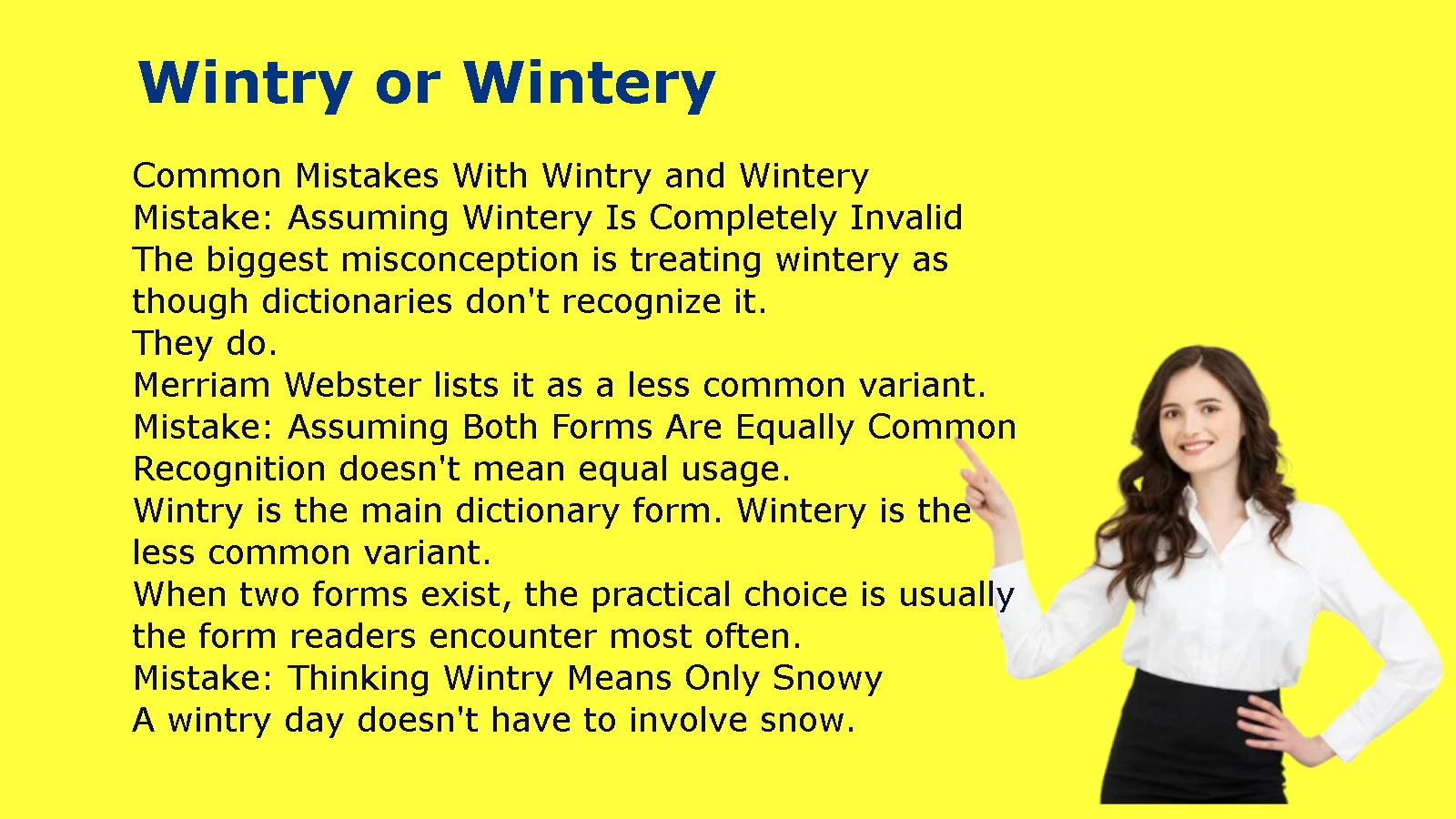
Mistake: Assuming Wintery Is Completely Invalid
The biggest misconception is treating wintery as though dictionaries don’t recognize it.
They do.
Merriam Webster lists it as a less common variant.
Mistake: Assuming Both Forms Are Equally Common
Recognition doesn’t mean equal usage.
Wintry is the main dictionary form. Wintery is the less common variant.
When two forms exist, the practical choice is usually the form readers encounter most often.
Mistake: Thinking Wintry Means Only Snowy
A wintry day doesn’t have to involve snow.
It can simply have the cold, bleak, windy, icy, or otherwise characteristic qualities of winter.
Mistake: Confusing Winter With Wintry
Remember:
- Winter = the season
- Wintry = characteristic of winter
For example:
Winter arrived early.
Wintry conditions arrived early.
The words are related, but they perform different grammatical jobs.
Mistake: Using Winterly as a Normal Alternative
Winterly exists, but Cambridge identifies it as old-fashioned.
For contemporary writing, wintry is much more natural.
Wintry or Wintery: Examples Side by Side
The fastest way to see the preference is to compare sentences.
| Preferred | Less common variant |
| The wintry weather continued all weekend. | The wintery weather continued all weekend. |
| Drivers faced wintry conditions. | Drivers faced wintery conditions. |
| A wintry wind swept through the valley. | A wintery wind swept through the valley. |
| The hills had a wintry appearance. | The hills had a wintery appearance. |
| She gave him a wintry smile. | She gave him a wintery smile. |
The meaning remains clear in the second column. The first column simply uses the standard form.
A Simple Case Study: Choosing the Right Word
Imagine you’re writing a weather update:
A strong storm will bring wintery conditions to the northern counties.
The sentence is understandable. However, changing one letter produces the standard form:
A strong storm will bring wintry conditions to the northern counties.
Why is the second version better?
- Wintry is the main dictionary form.
- It matches established expressions such as wintry conditions.
- Readers don’t have to wonder whether wintery is intentional.
- It follows conventional edited usage.
Now imagine a different sentence:
She gave him a wintry smile.
Here, the word has a figurative meaning. The smile isn’t literally cold. Instead, it suggests emotional distance or disapproval. Cambridge and Merriam Webster both recognize this figurative use.
That’s a useful reminder that wintry can describe an atmosphere as well as actual weather.
Why Wintry Is More Than a Fancy Way to Say Cold
Although wintry often describes cold weather, reducing it to cold loses some of its meaning.
Compare:
a cold morning
with:
a wintry morning
The first focuses primarily on temperature.
The second evokes a whole scene. You might imagine bare trees, pale sunlight, icy roads, sharp wind, heavy clouds, or snow on distant hills.
That’s why writers often choose wintry when they want to create atmosphere.
The word carries a little baggage with it. It brings winter along for the ride.
Wintry in Figurative and Literary Writing
The figurative use deserves special attention because it gives the word emotional weight.
A wintry smile can suggest:
- Disapproval
- Emotional distance
- Lack of warmth
- Cold politeness
- Restraint
- Unfriendliness
Similarly, a wintry greeting can sound technically polite while still feeling chilly or unwelcome.
Merriam Webster defines one figurative sense of wintry as cheerless or chilling.
This usage works because people commonly associate physical warmth with friendliness. When warmth disappears, language often turns to images of coldness.
That’s why expressions such as a cold reception and a wintry smile can communicate emotional meaning without directly saying, “This person was unfriendly.”
Wintry Spelling Rule to Remember
If spelling is the only thing you need to remember, keep this simple:
Winter → wintry
Not:
Winter → wintery
Although wintery is recognized as a less common variant, wintry is the standard form to reach for first.
A quick memory trick is:
Wintry is shorter, and it’s the standard form.
Think of the spelling as trimming the word down:
WINTER → WINTRY
The e drops out.
Frequently Asked Questions About Wintry or Wintery
Is wintry or wintery correct?
Wintry is the standard and preferred spelling. Wintery is a recognized but less common variant.
Is wintery a real word?
Yes. Wintery is recognized as a variant of wintry, although it is less common.
Is wintery a misspelling?
Not necessarily. Because dictionaries recognize wintery as a variant, it isn’t accurate to call it automatically incorrect. However, wintry is the better choice for standard writing.
What does wintry mean?
Wintry means typical of, characteristic of, or relating to winter. It can describe weather, landscapes, conditions, or even an unfriendly emotional atmosphere.
How do you pronounce wintry?
Wintry is pronounced WIN-tree, represented in the IPA as /ˈwɪn.tri/. Cambridge gives this pronunciation for both US and UK English.
Does wintry mean snowy?
Not necessarily. Snowy specifically relates to snow, while wintry can describe a broader range of winter characteristics, including cold, wind, ice, sleet, or a general winterlike atmosphere.
What is the comparative form of wintry?
The comparative form is wintrier.
This year has been wintrier than last year.
Merriam Webster lists wintrier as the comparative form.
What is the superlative form of wintry?
The superlative form is wintriest.
That was the wintriest day of the month.
Merriam Webster lists wintriest as the superlative form.
What is the noun form of wintry?
The noun is wintriness. Merriam Webster lists wintriness under the entry for wintry.
Is winterly a word?
Yes. Winterly is a real word, but Cambridge marks it as old-fashioned. It isn’t the normal choice in contemporary American English.
Can wintry describe a person’s behavior?
Yes. In literary or figurative use, wintry can describe something unfriendly, disapproving, cheerless, or emotionally cold.
For example:
She gave him a wintry smile.
Cambridge specifically records this figurative use.
Is wintry used in American English?
Yes. Cambridge’s American Dictionary includes wintry and defines it as typical of winter’s cold, windy, and snowy weather.
Wintry or Wintery: Final Verdict
When choosing between wintry or wintery, the answer is straightforward:
Use wintry.
It is the standard dictionary form and the one most appropriate for general modern writing. Wintery is not meaningless or entirely invalid. Major dictionary evidence recognizes it as a less common variant.
The difference can be summed up in one table:
| Question | Answer |
| Which spelling is standard? | Wintry |
| Is wintery recognized? | Yes |
| Is wintery as common as wintry? | No |
| Do they have different basic meanings? | No |
| How is wintry pronounced? | WIN-tree |
| What does wintry mean? | Typical or characteristic of winter |
| Can wintry be figurative? | Yes, meaning cold, cheerless, or unfriendly |
| Comparative form | Wintrier |
| Superlative form | Wintriest |
| Noun form | Wintriness |
| Best choice for formal writing | Wintry |
So, the next time you hesitate between wintry and wintery, there’s no need to wrestle with the extra e.
Write wintry.
It’s the standard form, it works naturally in American English, and it covers everything from wintry weather and wintry conditions to a metaphorically wintry smile.