Have you ever wondered whether endeavor and endeavour mean different things? At first glance, the two spellings can look like separate words, but Endeavor vs Endeavour is mainly a difference in American and British English.
Endeavor and endeavour both mean to try hard to achieve something or to make a serious effort. The meaning, pronunciation, and basic usage remain the same. The main difference is the spelling used in different varieties of English.
Examples:
- The team will endeavor to complete the project on time.
- The team will endeavour to complete the project on time.
The confusion is understandable. People often search for endeavor vs endeavour, endeavor or endeavour, endeavour meaning, or is endeavor British or American because the spelling changes depending on the English variety being used. And here’s the kicker: neither spelling is wrong. Endeavor is standard in American English, while endeavour is standard in British English and many other varieties of English.
In this guide, you’ll learn the complete difference between Endeavor vs Endeavour, including their meaning, definition, pronunciation, spelling, origin, and correct usage. You’ll also discover when to use endeavor or endeavour, see clear examples in sentences, and learn how the two forms compare in American and British English.
Endeavor vs Endeavour: Quick Answer
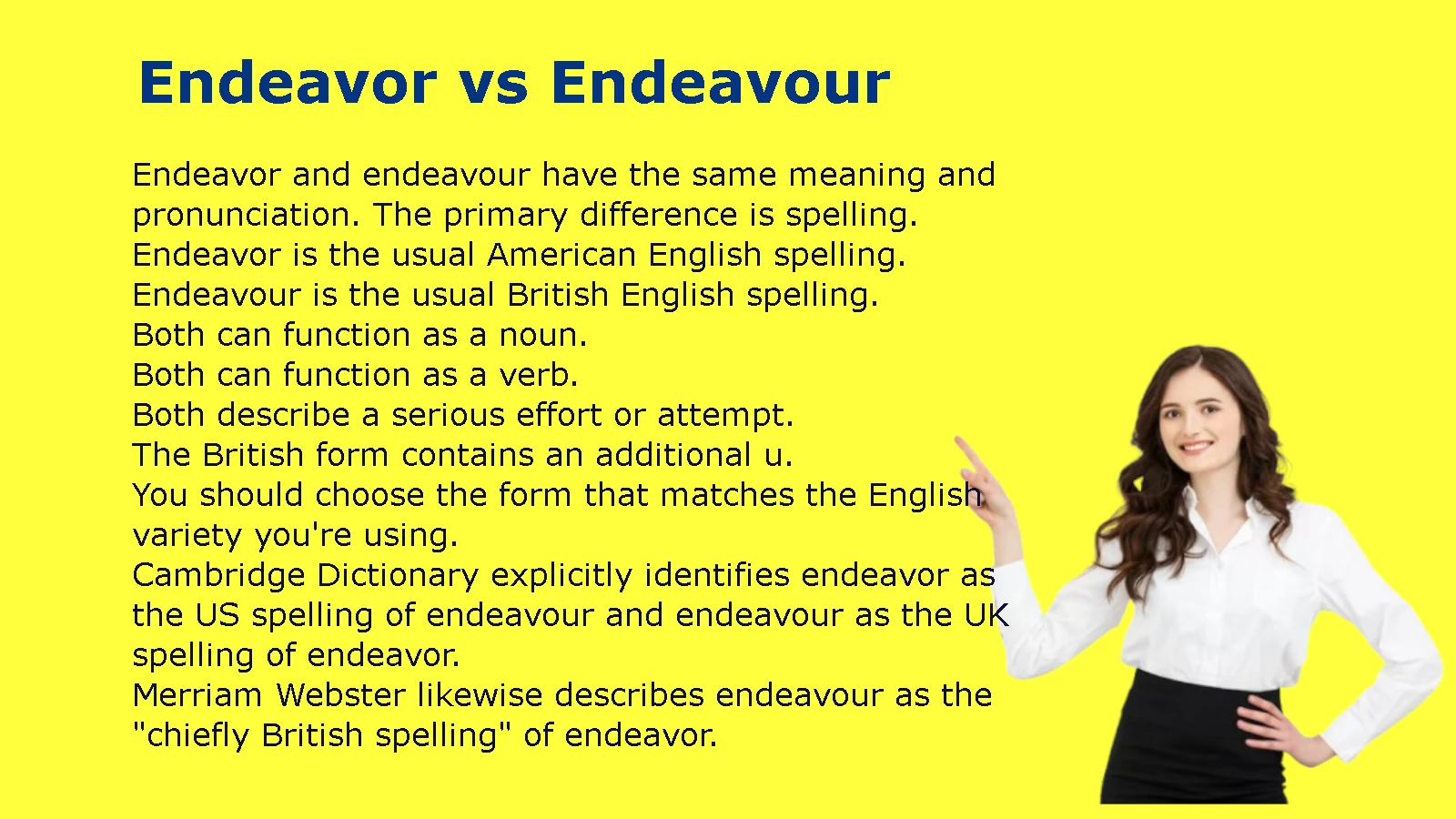
Endeavor and endeavour have the same meaning and pronunciation. The primary difference is spelling.
- Endeavor is the usual American English spelling.
- Endeavour is the usual British English spelling.
- Both can function as a noun.
- Both can function as a verb.
- Both describe a serious effort or attempt.
- The British form contains an additional u.
- You should choose the form that matches the English variety you’re using.
Cambridge Dictionary explicitly identifies endeavor as the US spelling of endeavour and endeavour as the UK spelling of endeavor.
Merriam Webster likewise describes endeavour as the “chiefly British spelling” of endeavor.
So, if you remember only one rule, make it this:
American English: endeavor
British English: endeavour
What Does “Endeavor” Mean?
Endeavor means a serious effort or attempt to accomplish something. As a verb, it means to try seriously or work toward a particular goal.
The word often suggests more effort, persistence, or difficulty than the simple verb try. Merriam Webster defines the noun as a “serious determined effort” and also uses it for an activity directed toward a goal. As a verb, it means to seriously or continually try to do something.
Endeavor as a noun
When endeavor acts as a noun, it refers to an effort, undertaking, or attempt.
For example:
- Starting a business is a challenging endeavor.
- Writing a novel can become a long term endeavor.
- The research project was a major scientific endeavor.
- Her latest artistic endeavor attracted international attention.
- The team succeeded through years of determined endeavor.
In each example, endeavor names an activity or effort.
The word can describe something small, but writers often use it for tasks that require meaningful commitment, persistence, or difficulty.
Endeavor as a verb
As a verb, endeavor means to try seriously to achieve something.
For example:
- We will endeavor to complete the project on time.
- The company will endeavor to improve customer service.
- She endeavored to explain the problem clearly.
- The researchers endeavored to find a practical solution.
- They are endeavoring to reduce unnecessary costs.
The verb usually appears in the structure endeavor to + verb.
We will endeavor to help.
She endeavored to finish the report.
They endeavor to provide accurate information.
Cambridge lists the verb as a formal way to say “to try to do something.”
What Does “Endeavour” Mean?
Endeavour has exactly the same core meaning as endeavor. The difference is the spelling convention.
British English uses endeavour, while American English generally uses endeavor. Cambridge identifies endeavour as the UK spelling and lists both noun and verb uses.
Endeavour as a noun
As a noun, endeavour means an attempt, effort, or undertaking.
Examples include:
- Learning a new language is a worthwhile endeavour.
- The expedition was a dangerous endeavour.
- Scientific endeavour has transformed modern medicine.
- Her latest artistic endeavour received critical praise.
- They succeeded after years of collective endeavour.
Endeavour as a verb
As a verb, endeavour means to make a serious attempt.
For example:
- We will endeavour to resolve the issue.
- She endeavoured to remain calm.
- The company endeavours to provide reliable service.
- The researchers endeavoured to identify the cause.
- They are endeavouring to improve the system.
Oxford gives endeavour to do something as a formal expression meaning “to try very hard to do something.”
Endeavor vs Endeavour: Key Differences
The spelling is the main distinction, but several practical details are worth understanding.
| Feature | Endeavor | Endeavour |
| English variety | American English | British English |
| Meaning | Serious effort or attempt | Serious effort or attempt |
| Noun | Yes | Yes |
| Verb | Yes | Yes |
| Pronunciation | Essentially the same | Essentially the same |
| Present tense | endeavor / endeavors | endeavour / endeavours |
| Past tense | endeavored | endeavoured |
| -ing form | endeavoring | endeavouring |
| Typical audience | US English readers | UK English readers |
The difference doesn’t change the definition. It simply reflects different spelling conventions.
The extra “u” is the key clue
The easiest way to remember the difference is to look at the middle of the word:
endeavor → no u
endeavour → includes u
This follows a wider pattern in English spelling:
- color → colour
- favor → favour
- honor → honour
- labor → labour
- neighbor → neighbour
These aren’t cases where one spelling represents a different word. They’re regional spelling differences.
Endeavor in American English
If you write in American English, use endeavor.
For example:
Starting a company is a demanding endeavor.
The organization will endeavor to meet its goals.
Her scientific endeavors have produced valuable results.
They endeavored to reach an agreement.
American dictionaries and learner dictionaries recognize endeavor as the American form. Cambridge labels it “US spelling of endeavour,” while Oxford’s American dictionary gives endeavor as the standard American form.
Common American forms of endeavor
The spelling stays consistent when the word changes form:
| Form | American English |
| Base form | endeavor |
| Third person | endeavors |
| Past tense | endeavored |
| Present participle | endeavoring |
For example:
- The organization endeavors to serve its customers.
- She endeavored to answer every question.
- They are endeavoring to improve the process.
- The project became a major endeavor.
Merriam Webster lists endeavored and endeavoring as standard forms.
Endeavour in British English
If you write in British English, use endeavour.
For example:
Starting a company is a demanding endeavour.
The organization will endeavour to meet its goals.
Her scientific endeavours have produced valuable results.
They endeavoured to reach an agreement.
Cambridge identifies endeavour as the UK form of endeavor, while Oxford lists its related forms as endeavours, endeavoured, and endeavouring.
Common British forms of endeavour
| Form | British English |
| Base form | endeavour |
| Third person | endeavours |
| Past tense | endeavoured |
| Present participle | endeavouring |
For example:
- The organization endeavours to help local communities.
- She endeavoured to resolve the dispute.
- They are endeavouring to improve the service.
- The project was a major endeavour.
Endeavor vs Endeavour Examples
Seeing the two spellings side by side makes the distinction much easier.
| American English | British English |
| It was a difficult endeavor. | It was a difficult endeavour. |
| We will endeavor to help. | We will endeavour to help. |
| Her latest endeavor was successful. | Her latest endeavour was successful. |
| They made every endeavor to succeed. | They made every endeavour to succeed. |
| His creative endeavors impressed the judges. | His creative endeavours impressed the judges. |
| She endeavored to explain the issue. | She endeavoured to explain the issue. |
| The team is endeavoring to improve. | The team is endeavouring to improve. |
Notice something important: the sentence meaning doesn’t change.
Only the regional spelling changes.
Endeavor vs Endeavour as a Noun
The noun refers to an effort, attempt, undertaking, or activity directed toward a goal.
Oxford describes the noun as an attempt to do something, especially something new or difficult. It also gives expressions such as field of endeavour, best endeavours, and make every endeavour.
Consider these examples:
An effort
Finishing the project in two weeks was a major endeavor.
Here, the word refers to the difficult effort required to finish the project.
An undertaking
Building the community center became a shared endeavor.
Here, endeavor describes a larger undertaking involving multiple people.
A goal directed activity
Scientific endeavor often requires patience and careful observation.
In this context, the word refers to the broader activity of scientific work.
The British equivalent works in exactly the same way:
Building the community center became a shared endeavour.
Scientific endeavour often requires patience and careful observation.
Endeavor vs Endeavour as a Verb
As verbs, both forms usually mean to make a serious effort to do something.
The structure is particularly important:
endeavor + to + base verb
Examples:
- endeavor to improve
- endeavor to understand
- endeavor to provide
- endeavor to resolve
- endeavor to complete
The British spelling follows the same grammatical structure:
- endeavour to improve
- endeavour to understand
- endeavour to provide
- endeavour to resolve
- endeavour to complete
Why “endeavor to” sounds formal
You could often replace endeavor to with try to.
Compare:
We will endeavor to resolve the issue.
We will try to resolve the issue.
The second sentence sounds more direct and conversational. The first sounds more formal.
That doesn’t make endeavor wrong or unnatural. It simply gives the sentence a more formal tone. Cambridge marks the verb as formal, and Oxford similarly labels it formal.
Endeavor vs Endeavour Spelling Forms
The spelling difference continues when the word takes different grammatical forms.
| Grammar | American | British |
| Base | endeavor | endeavour |
| Third person singular | endeavors | endeavours |
| Past tense | endeavored | endeavoured |
| Past participle | endeavored | endeavoured |
| Present participle | endeavoring | endeavouring |
This distinction matters because writers sometimes switch between forms.
For example, an American English document might say:
The organization endeavors to improve its services. It has endeavored to address customer concerns and is endeavoring to create a better experience.
A British English document would use:
The organization endeavours to improve its services. It has endeavoured to address customer concerns and is endeavouring to create a better experience.
The important thing isn’t simply knowing which spelling exists. You need to keep the spelling consistent throughout the document.
Why Does Endeavor Have Two Spellings?
The difference reflects the broader history of English spelling.
Endeavor comes from Middle English endeveren, meaning to exert oneself. Merriam Webster traces the word to a Middle English form connected with devoir, meaning duty. The word has been used in English since the 15th century.
Over time, English developed different spelling conventions in different regions.
American English later developed spelling preferences that often removed the u found in several traditional British spellings. The result is a familiar group of differences:
- American color vs British colour
- American favor vs British favour
- American honor vs British honour
- American labor vs British labour
- American neighbor vs British neighbour
- American endeavor vs British endeavour
So the extra u in endeavour isn’t an arbitrary addition. It belongs to the British spelling tradition.
Is Endeavor or Endeavour More Correct?
Neither one is universally more correct.
Endeavor is correct in American English.
Endeavour is correct in British English.
The mistake occurs when someone treats one regional spelling as an error in every context.
For example, if an American publication uses:
We will endeavor to improve our services.
the spelling is correct.
If a British publication uses:
We will endeavour to improve our services.
that spelling is also correct.
Merriam Webster explicitly identifies endeavour as a chiefly British spelling of endeavor, while Cambridge distinguishes the two forms by US and UK usage.
A simple rule to remember
Don’t ask which spelling is correct. Ask which variety of English you’re writing.
That question solves the problem immediately.
Endeavor vs Endeavour in Other English Varieties
The distinction becomes slightly less rigid outside the United States and United Kingdom.
Countries that commonly follow British English conventions may use endeavour, while Canadian English can show some variation. Cambridge, for example, specifically marks endeavor as “Cdn Br endeavour” in its intermediate entry.
For international writing, the safest approach is to follow the style guide or editorial standard required by the organization.
This matters especially in:
- Academic publishing
- Government documents
- Corporate communications
- Newspapers
- Websites
- Books
- Professional reports
If a publisher has chosen British English, use endeavour consistently. If its style uses American English, choose endeavor.
Endeavor vs Endeavour in Formal Writing
Both forms work in formal writing. The spelling doesn’t determine whether the word sounds formal.
Instead, endeavor/endeavour itself tends to have a formal tone, especially when used as a verb.
Compare these sentences:
We will try to resolve the problem.
We will endeavor to resolve the problem.
Both communicate an attempt. The second sounds more official.
That’s why you’ll often encounter the word in:
- Business statements
- Legal documents
- Academic writing
- Government communications
- Institutional reports
- Formal correspondence
However, formal doesn’t always mean better.
If you’re writing a friendly email, try may sound more natural:
We’ll try to finish the report today.
A formal report might instead say:
The team will endeavor to complete the report within the agreed timeframe.
Choose the word based on the tone you actually need.
Common Expressions With Endeavor and Endeavour
Certain phrases appear frequently with this word.
Best endeavors / best endeavours
This expression refers to making the greatest reasonable effort.
American English:
We will use our best endeavors to resolve the matter.
British English:
We will use our best endeavours to resolve the matter.
Every endeavor / every endeavour
This means making every possible effort.
We made every endeavor to contact the client.
British:
We made every endeavour to contact the client.
Field of endeavor / field of endeavour
This refers to an area of activity, work, or study.
Medicine is a demanding field of endeavor.
British:
Medicine is a demanding field of endeavour.
Human endeavor / human endeavour
This phrase describes human effort or achievement broadly.
Space exploration represents one of humanity’s greatest endeavors.
British:
Space exploration represents one of humanity’s greatest endeavours.
Oxford lists phrases such as field of endeavour, best endeavours, and make every endeavour among common uses of the word.
Endeavor vs Endeavour: Common Mistakes
Even though the distinction is straightforward, several mistakes appear regularly.
Treating endeavour as a misspelling
If you primarily use American English, endeavour may look unusual. That doesn’t make it incorrect.
It’s the standard British spelling.
Treating endeavor as incorrect
The reverse mistake happens too. A British English writer may see endeavor and assume the writer made a spelling error.
In American English, however, endeavor is standard.
Mixing the forms
A document should generally follow one spelling convention.
For example, this looks inconsistent:
The company will endeavor to improve its services and has made every endeavour to address complaints.
Unless you’re intentionally discussing regional spelling, there’s no good reason to switch between the two.
Choose one form and stick with it.
Assuming the meanings differ
They don’t.
Endeavor and endeavour don’t describe different levels of effort. They aren’t separate concepts. They’re regional spellings of the same word.
Assuming the pronunciation changes
The spelling changes, but the pronunciation remains essentially the same. Cambridge provides US and UK pronunciation forms that reflect accent differences rather than a different word.
Endeavor vs Endeavour: A Practical Writing Guide
When you’re unsure which spelling to use, work through these questions.
Are you writing for an American audience?
Use:
endeavor
Example:
The company will endeavor to provide faster support.
Are you writing for a British audience?
Use:
endeavour
Example:
The company will endeavour to provide faster support.
Are you writing for an international publication?
Check the publication’s style guide.
If it uses American English, choose endeavor.
If it uses British English, choose endeavour.
Are you writing academic content?
Follow the required style guide or your institution’s preferred English variety.
Don’t switch spelling simply because one form looks more formal.
Are you writing for a website?
Match the site’s established language style.
Consistency improves readability and prevents your article from looking careless.
Endeavor vs Endeavour: Case Study in Consistency
Imagine a US based company publishes this statement:
Our team will endeavor to deliver exceptional service. We believe every endeavor should begin with a clear purpose.
That spelling fits American English.
Now imagine a British company publishes:
Our team will endeavour to deliver exceptional service. We believe every endeavour should begin with a clear purpose.
That spelling fits British English.
Neither company needs to change its wording merely because another English variety uses a different spelling.
The same principle applies to websites. If an article uses color, favor, labor, and neighbor, switching to endeavour would create an unnecessary British spelling inside an otherwise American English article.
Likewise, a British article that consistently uses colour, favour, and labour should normally use endeavour.
The real goal isn’t choosing the “better” spelling. It’s maintaining a consistent English variety.
Endeavor vs Endeavour and Similar Spelling Differences
The pair belongs to a much larger group of American and British spelling differences.
| American English | British English |
| endeavor | endeavour |
| color | colour |
| favor | favour |
| honor | honour |
| labor | labour |
| neighbor | neighbour |
| catalog | catalogue |
| theater | theatre |
These differences can look significant at first glance. Once you recognize the patterns, however, they become much easier to understand.
For writers, the lesson is simple: regional spelling isn’t a quality judgment.
Endeavor vs Endeavour: Which One Should You Use?
Use endeavor if you’re writing in American English.
Use endeavour if you’re writing in British English.
Here’s the simplest decision chart:
Which English variety?
|
+———-+———-+
| |
American English British English
| |
ENDEAVOR ENDEAVOUR
| |
no “u” spelling “u” spelling
Use “endeavor” when:
- Your audience primarily uses US English.
- Your publication follows American spelling.
- Your organization uses American English.
- You’re following an American style guide.
- Your surrounding words use American spellings.
Use “endeavour” when:
- Your audience primarily uses British English.
- Your publication follows British spelling.
- Your organization uses British English.
- You’re following a British style guide.
- Your surrounding words use British spellings.
Endeavor vs Endeavour in Everyday Sentences
Here are more examples to show how naturally the word works in different contexts.
Business
American:
The company will endeavor to respond to all inquiries within two business days.
British:
The company will endeavour to respond to all enquiries within two business days.
Notice that regional spelling can extend beyond a single word. British English may also use enquiries, while American English commonly uses inquiries.
Education
American:
Learning another language can be a rewarding endeavor.
British:
Learning another language can be a rewarding endeavour.
Science
American:
Scientific endeavor depends on careful observation and testing.
British:
Scientific endeavour depends on careful observation and testing.
Personal goals
American:
Training for a marathon is a demanding endeavor.
British:
Training for a marathon is a demanding endeavour.
Professional communication
American:
We will endeavor to resolve your concern as quickly as possible.
British:
We will endeavour to resolve your concern as quickly as possible.
The meaning stays intact in every example.
Is Endeavor a Formal Word?
Yes. Endeavor is generally more formal than try.
That doesn’t mean you should avoid it. It simply means that context matters.
Consider these three sentences:
The first sounds casual and natural.
The second sounds somewhat more formal.
The third sounds formal and deliberate.
Merriam Webster’s synonym discussion notes that endeavor emphasizes exertion and difficulty compared with try or attempt.
That distinction gives the word a useful place in professional and formal writing.
Endeavor vs Endeavour: Synonyms
Depending on the context, you can replace the word with several alternatives.
As a noun
- effort
- attempt
- undertaking
- enterprise
- pursuit
- project
- venture
- undertaking
As a verb
- try
- attempt
- strive
- work
- pursue
- seek
However, these words aren’t always perfect substitutes.
For example, strive often emphasizes persistent effort against difficulty. Try is broader and more casual. Attempt focuses on the act of trying. Endeavor often carries a stronger sense of serious or sustained effort. Merriam Webster specifically distinguishes these shades of meaning among related words.
Frequently Asked Questions About Endeavor vs Endeavour
Is “endeavor” correct in American English?
Yes. Endeavor is the standard American English spelling. Cambridge identifies it as the US spelling of endeavour.
Is “endeavour” correct in British English?
Yes. Endeavour is the standard British English spelling. Cambridge identifies it as the UK spelling of endeavor.
Are endeavor and endeavour the same word?
Yes. They are regional spellings of the same word.
Do endeavor and endeavour have the same meaning?
Yes. Both mean a serious effort, attempt, or undertaking. As verbs, both mean to make a serious effort to accomplish something.
Is endeavor an American spelling?
Yes. Endeavor is the standard American spelling.
Is endeavour a British spelling?
Yes. Endeavour is the standard British spelling.
Can endeavor be a noun and a verb?
Yes.
As a noun:
The project was a difficult endeavor.
As a verb:
We will endeavor to help.
Can endeavour be a noun and a verb?
Yes.
As a noun:
The project was a difficult endeavour.
As a verb:
We will endeavour to help.
Are endeavors and endeavours both correct?
Yes. Endeavors is the American plural, while endeavours is the British plural.
Is “endeavored” American or British?
Endeavored is the American spelling.
The British form is endeavoured.
Is “endeavoring” American or British?
Endeavoring is the American spelling.
The British form is endeavouring.
Does the spelling affect pronunciation?
No meaningful difference exists between the two forms as words. Accent can affect pronunciation, but adding the u doesn’t create a different word. Cambridge provides US and UK pronunciation forms for the two regional spellings.
Which is better: endeavor or endeavour?
Neither is inherently better.
Choose endeavor for American English and endeavour for British English.
Should an American article use “endeavor”?
Yes. If the article follows American English conventions, endeavor is the appropriate choice.
Should a British article use “endeavour”?
Yes. If the article follows British English conventions, endeavour is the appropriate choice.
Final Verdict: Endeavor or Endeavour?
The endeavor vs endeavour debate has a surprisingly simple answer.
Endeavor is the standard American English spelling.
Endeavour is the standard British English spelling.
| If you write in… | Use… |
| 🇺🇸 American English | endeavor |
| 🇬🇧 British English | endeavour |
The best rule is also the easiest one: choose the English variety that fits your audience, then stay consistent.
So if you’re writing for readers in the United States, write endeavor. If you’re following British English conventions, write endeavour. Neither spelling needs an apology. Both have earned their place in English.