Have you ever wondered why you see both Gynecology and Gynaecology and questioned whether they mean different things? While Gynecology vs Gynaecology may look like two different medical terms, they refer to the same branch of medicine. The main difference is the spelling, which depends on the variety of English being used.
Gynecology is the standard American English spelling for the medical specialty that focuses on the female reproductive system, including the uterus, ovaries, fallopian tubes, cervix, and vagina. Gynaecology is the British English spelling of the same term and is commonly used in the UK, Australia, and other regions that follow British spelling conventions.
Examples:
- She is studying gynecology at a medical school in the United States.
- She works in gynaecology at a hospital in the United Kingdom.
The confusion is understandable. People often search for gynecology vs gynaecology, gynecology or gynaecology, which spelling is correct, and what is the difference between gynecology and gynaecology because the spelling changes between American and British English. And here’s the kicker: neither spelling is wrong. The correct choice depends mainly on the English variety you are using.
In this guide, you’ll learn the complete Gynecology vs Gynaecology difference, including their meaning, definition, pronunciation, spelling, and correct usage. You’ll also discover which spelling is used in American and British English, how to remember the difference, and whether gynecologist or gynaecologist follows the same spelling pattern.
Gynecology vs Gynaecology: The Quick Answer
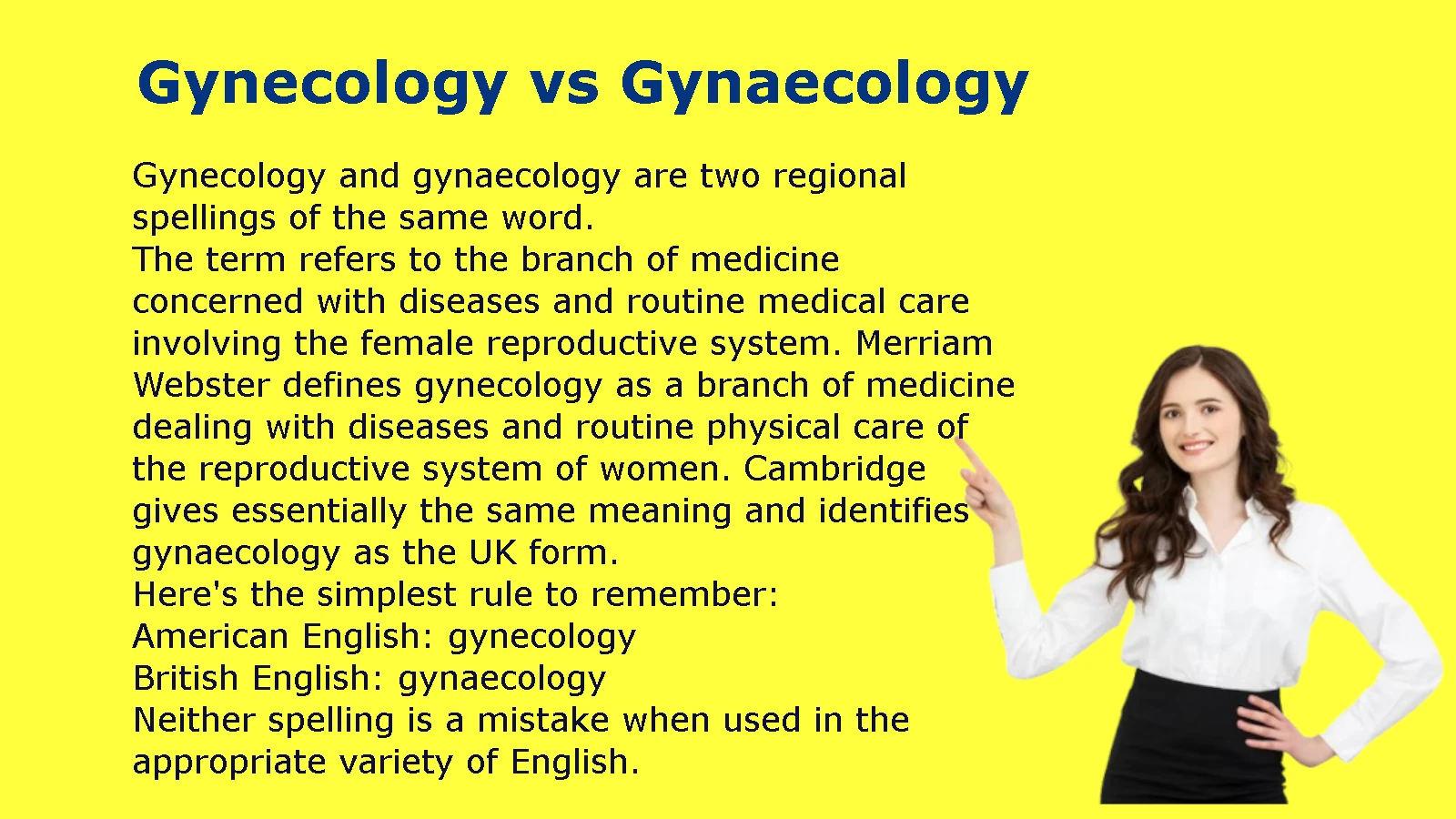
Gynecology and gynaecology are two regional spellings of the same word.
The term refers to the branch of medicine concerned with diseases and routine medical care involving the female reproductive system. Merriam Webster defines gynecology as a branch of medicine dealing with diseases and routine physical care of the reproductive system of women. Cambridge gives essentially the same meaning and identifies gynaecology as the UK form.
Here’s the simplest rule to remember:
American English: gynecology
British English: gynaecology
Neither spelling is a mistake when used in the appropriate variety of English.
Gynecology vs Gynaecology at a Glance
| Question | Answer |
| Do gynecology and gynaecology mean the same thing? | Yes |
| Which spelling is American? | Gynecology |
| Which spelling is British? | Gynaecology |
| Does the extra “a” change the meaning? | No |
| Is one spelling medically more correct? | No |
| US specialist | Gynecologist |
| UK specialist | Gynaecologist |
| US adjective | Gynecological / gynecologic |
| UK adjective | Gynaecological / gynaecologic |
The important point is that the spelling reflects English variety, not a difference in medical practice.
What Does Gynecology Mean?
Gynecology is a medical specialty focused on the health of the female reproductive system.
It covers the prevention, diagnosis, treatment, and ongoing care of many conditions involving reproductive organs and related health concerns. Cambridge describes gynecology as the area of medicine involving the treatment of women’s diseases, particularly those affecting the reproductive organs.
The field can involve care related to structures such as:
- Ovaries
- Fallopian tubes
- Uterus
- Cervix
- Vagina
- Vulva
- Pelvic floor
Gynecology also covers a wide range of health concerns that can occur at different stages of life. Depending on the patient’s needs, gynecologic care can involve menstrual problems, contraception, infertility evaluation, menopause, pelvic pain, abnormal bleeding, infections, and certain cancers.
The American College of Obstetricians and Gynecologists describes obstetrics and gynecology as a discipline providing broad medical and surgical care across women’s lives. It also notes that preventive counseling and health education form an important part of ob-gyn practice.
What Does a Gynecologist Do?
A gynecologist is a physician who specializes in gynecology. Merriam Webster defines the term as a physician specializing in gynecology and lists gynaecologist as the chiefly British variant.
Depending on their training and practice, gynecologists may evaluate or treat issues such as:
- Abnormal menstrual bleeding
- Pelvic pain
- Endometriosis
- Fibroids
- Ovarian conditions
- Cervical conditions
- Vaginal conditions
- Menopausal symptoms
- Certain reproductive health concerns
- Some gynecologic cancers
- Problems affecting the pelvic floor
Some gynecologists also perform surgical procedures. ACOG notes that ob-gyn training encompasses diagnostic, therapeutic, and operative procedures across obstetrics, gynecology, and women’s health care.
Examples of Gynecology in a Sentence
Here are a few natural examples using the American spelling:
- She wants to specialize in gynecology.
- The hospital recently expanded its gynecology department.
- Her doctor referred her to a gynecology specialist.
- He completed his training in obstetrics and gynecology.
- The clinic provides routine gynecologic care.
Notice that the spelling stays consistent with American English.
What Does Gynaecology Mean?
Gynaecology has the same meaning as gynecology.
The only major difference is the spelling. Cambridge labels gynaecology as the UK form and gynecology as the US form.
The British spelling contains ae:
gyn + aecology
The American spelling simplifies this to:
gyn + ecology
That spelling difference doesn’t create a new specialty. A doctor working in gynaecology is working in the same general medical field described as gynecology in American English.
Examples of Gynaecology in a Sentence
In British English, you might see sentences such as:
- She works in gynaecology at a London hospital.
- The patient was referred to the gynaecology department.
- He is training in obstetrics and gynaecology.
- The clinic provides specialist gynaecological care.
- She was referred to a gynaecologist for further assessment.
These sentences communicate the same basic ideas as their American English equivalents.
Why Is It Spelled Gynecology in American English and Gynaecology in British English?
The difference comes from regional spelling conventions.
English has developed different spelling traditions in the United States and Britain. Some words keep letters in British English that American English often removes or simplifies. Gynecology/gynaecology follows this broader pattern.
The distinction is especially visible in the letters e and ae:
- US: gynecology
- UK: gynaecology
Merriam Webster’s entry traces gynecology to earlier forms associated with German and New Latin terminology. It also records gynaecology as the chiefly British variant. The dictionary gives 1828 as the first known use of gynecology in English in the modern medical sense defined by the entry.
The word’s history is more complicated than simply saying that one country “changed” the other spelling. Medical terminology passed through several languages and forms before entering modern English. The practical point for today’s writer, however, is straightforward: the two modern spellings refer to the same field.
Gynecology vs Gynaecology Pronunciation
The spelling differs, but the words remain closely related in pronunciation.
Cambridge provides separate US and UK pronunciations for the term. The US pronunciation is represented as /ˌɡaɪ.nəˈkɑː.lə.dʒi/, while the UK pronunciation is represented as /ˌɡaɪ.nəˈkɒl.ə.dʒi/.
For readers who don’t use phonetic symbols, a rough guide is:
- Gynecology: gy-nuh-KAH-luh-jee
- Gynaecology: gy-nuh-KOL-uh-jee
These are only simplified pronunciation guides. Actual pronunciation can vary by speaker and accent.
How to Pronounce Gynecology
In American English, the final middle vowel tends to sound like the vowel in “cot” for many speakers.
The stress falls on the “col” portion of the word:
gy-nuh-KAH-luh-jee
How to Pronounce Gynaecology
In British English, the corresponding vowel has the pronunciation represented by Cambridge’s UK transcription.
The stress remains in roughly the same place:
gy-nuh-KOL-uh-jee
The difference you hear may therefore reflect both spelling conventions and accent.
Gynecology vs Gynaecology in American and British English
The easiest way to understand the relationship is to compare the entire word family.
| Meaning | American English | British English |
| Medical specialty | gynecology | gynaecology |
| Medical specialist | gynecologist | gynaecologist |
| Adjective | gynecological | gynaecological |
| Alternative adjective | gynecologic | gynaecologic |
Merriam Webster identifies gynaecology as a chiefly British variant and similarly lists gynaecologist as a chiefly British variant of gynecologist. It also records gynaecologic and gynaecological as chiefly British forms.
This matters when you’re editing a document. Changing only one word isn’t always enough if the surrounding terminology follows a different regional spelling system.
For example:
American: She is a gynecologist specializing in gynecological surgery.
British: She is a gynaecologist specializing in gynaecological surgery.
Both versions are internally consistent.
Gynecologist vs Gynaecologist
A gynecologist is a physician who specializes in gynecology.
In British English, the same professional is generally called a gynaecologist.
The spelling changes in the same way as the name of the specialty:
gynecology → gynecologist
gynaecology → gynaecologist
Merriam Webster confirms that gynecologist means a physician specializing in gynecology and lists gynaecologist as the chiefly British variant.
Examples
American English:
The patient scheduled an appointment with her gynecologist.
British English:
The patient scheduled an appointment with her gynaecologist.
The difference is spelling rather than professional role.
Is a Gynecologist the Same as a Gynaecologist?
Yes.
A gynecologist and a gynaecologist are described using different regional spellings of the same professional title.
If you’re reading a British medical article, you’ll likely encounter gynaecologist. In an American article, gynecologist is more likely.
Gynecological vs Gynaecological
The adjective follows the same regional pattern.
American English commonly uses:
gynecological
British English commonly uses:
gynaecological
You may also encounter the shorter adjective forms gynecologic and gynaecologic. Merriam Webster lists both sets and identifies the forms beginning with gynae as chiefly British.
Examples of the Adjective Forms
| American English | British English |
| gynecological examination | gynaecological examination |
| gynecological condition | gynaecological condition |
| gynecological surgery | gynaecological surgery |
| gynecologic care | gynaecologic care |
| gynecologic oncology | gynaecologic oncology |
The choice depends on the English variety and the conventions of the publication or institution.
Is Gynecology or Gynaecology Correct?
Both are correct.
The right choice depends on which form of English you’re using.
Choose gynecology for American English.
Choose gynaecology for British English.
Calling one universally “correct” would miss the main point. Regional English varieties often use different spellings for the same word. What matters in professional writing is accuracy and consistency.
For example, a US health website would normally use:
Gynecology Department
A British hospital or health organization may use:
Gynaecology Department
Neither spelling makes the medical service different.
Which Spelling Should You Use?
Your audience should usually determine the spelling.
If you’re writing an article for readers in the United States, gynecology is the natural choice. If you’re writing for readers in the United Kingdom, gynaecology fits British English conventions.
Use Gynecology When:
- Your content follows American English.
- Your primary audience is in the United States.
- You’re following an American style guide.
- You’re writing for a US medical organization.
- Related terms in the document already use American spelling.
Use Gynaecology When:
- Your content follows British English.
- Your primary audience is in the United Kingdom.
- You’re following British spelling conventions.
- You’re writing for a UK organization that uses the British form.
- Related medical terminology follows British spelling.
What About International Audiences?
International websites sometimes need to make a deliberate choice.
If the website primarily targets US readers, gynecology is usually the better keyword and spelling choice. If it targets UK readers, gynaecology makes more sense.
For a global website, either form can work. The important thing is to establish a consistent editorial standard rather than switching randomly between regional spellings.
Gynecology vs Gynaecology in Medical Terms
The difference becomes particularly useful when you encounter longer medical expressions.
Consider these examples:
| American English | British English |
| gynecology clinic | gynaecology clinic |
| gynecology department | gynaecology department |
| gynecologist | gynaecologist |
| gynecological care | gynaecological care |
| gynecologic surgery | gynaecologic surgery |
| obstetrics and gynecology | obstetrics and gynaecology |
The meaning remains stable across the two versions.
This consistency also helps prevent a common editing problem: mixing spelling systems without realizing it.
For example, if an article uses gynaecology in one paragraph and gynecologist in another, the reader may notice the inconsistency even though both words are individually understandable.
Gynecology and Gynaecology in “Obstetrics and Gynecology”
One of the most common places you’ll see the word is in the medical specialty obstetrics and gynecology.
In American English, the standard form is:
obstetrics and gynecology
In British English, you’ll commonly see:
obstetrics and gynaecology
The two fields are closely connected, but they aren’t identical.
Obstetrics focuses primarily on pregnancy, childbirth, and care related to the period surrounding birth.
Gynecology, meanwhile, focuses on reproductive health and conditions involving the female reproductive system outside the specific scope of obstetric care.
The combined specialty brings the two areas together. The National Cancer Institute describes obstetrics and gynecology as a branch of medicine concerned with pregnancy and childbirth as well as the diagnosis and treatment of diseases affecting the female reproductive organs. It also includes areas such as menopause, hormone problems, contraception, and infertility.
What Does OB/GYN Mean?
In American English, OB/GYN is a common abbreviation for obstetrics and gynecology or for a physician trained in that combined field.
The National Cancer Institute uses ob/gyn as another name for obstetrics and gynecology.
Merriam Webster also lists gyn as an abbreviation for gynecologic, gynecologist, or gynecology.
The exact abbreviation can vary by country, organization, and context, so formal writing should follow the conventions of the intended audience.
What Does Gynecology Cover?
Although the spelling question is simple, the medical field itself is broad.
Gynecology can involve preventive care, diagnosis, treatment, procedures, and long term management. ACOG describes obstetrics and gynecology as encompassing broad medical and surgical care across the lifespan and notes that practitioners can focus on specific areas of specialization.
Some areas associated with gynecologic care include:
- Menstrual health
- Contraception
- Reproductive health
- Pelvic pain
- Endometriosis
- Uterine fibroids
- Ovarian conditions
- Cervical health
- Vaginal health
- Menopause
- Pelvic floor disorders
- Gynecologic surgery
- Gynecologic oncology
The exact services offered by an individual physician or clinic depend on training, certification, location, and scope of practice.
Gynecology Is More Than Routine Checkups
The word gynecology sometimes gets reduced to routine examinations. That’s too narrow.
The specialty also includes the evaluation and treatment of medical conditions. ACOG’s gynecology data definitions cover areas ranging from adnexal torsion and bacterial vaginosis to high risk HPV testing, infertility terminology, menopause, urinary incontinence, and pelvic floor related conditions.
That breadth explains why gynecologic medicine includes both preventive care and complex diagnosis and treatment.
Gynecology vs Gynaecology: Common Mistakes
Because the difference is only a few letters, several misconceptions appear frequently.
Mistake: Thinking They Are Different Specialties
They aren’t.
Gynecology and gynaecology refer to the same medical field. The spelling tells you which English convention the writer follows.
Mistake: Assuming Gynaecology Is Incorrect
It isn’t.
Gynaecology is the standard British spelling. Cambridge specifically labels it UK (US gynecology).
Mistake: Assuming Gynecology Is Incorrect Outside the US
That’s also incorrect.
Gynecology is widely understood internationally. However, writers should still follow the spelling conventions expected by their audience.
Mistake: Mixing Regional Spellings
A document can become visually inconsistent when it jumps between American and British spellings without a reason.
For example:
The patient visited a gynaecology clinic and later saw a gynecologist.
The meaning is clear, but the spelling changes halfway through the terminology.
A consistent version would be:
The patient visited a gynaecology clinic and later saw a gynaecologist.
Or:
The patient visited a gynecology clinic and later saw a gynecologist.
Mistake: Confusing Gynecology With Obstetrics
These fields overlap, but they aren’t synonyms.
Gynecology focuses on reproductive health and related diseases and conditions.
Obstetrics focuses on pregnancy and childbirth.
A physician may train in both, which explains the widespread term obstetrics and gynecology.
Gynecology vs Gynaecology Examples in Sentences
Seeing the two forms in real sentences makes the distinction much easier.
| American English | British English |
| She works in gynecology. | She works in gynaecology. |
| He is a gynecologist. | He is a gynaecologist. |
| She had a gynecological examination. | She had a gynaecological examination. |
| The hospital has a gynecology department. | The hospital has a gynaecology department. |
| He specializes in gynecologic surgery. | He specializes in gynaecologic surgery. |
| She is studying obstetrics and gynecology. | She is studying obstetrics and gynaecology. |
The sentences don’t change in meaning. The spelling changes to match the regional variety of English.
Gynecology vs Gynaecology and Other British American Spelling Differences
The spelling difference becomes less surprising when you compare it with other familiar US and UK forms.
| American English | British English |
| color | colour |
| center | centre |
| theater | theatre |
| catalog | catalogue |
| gynecology | gynaecology |
| gynecologist | gynaecologist |
These examples illustrate a broader truth about English: the language has multiple standard varieties.
American and British English developed their own spelling conventions over time. Neither variety represents a lower quality version of English.
That matters when choosing between gynecology and gynaecology. The choice isn’t about finding the “better” spelling. It’s about matching your language variety and audience.
A Simple Way to Remember Gynecology vs Gynaecology
There’s an easy memory trick:
US English = gynecology
UK English = gynaecology
Think of the British version as the one that keeps the A:
gynAeCology
The American version drops that a:
gynECology
The same pattern carries into related words:
- gynecologist → gynaecologist
- gynecological → gynaecological
- gynecologic → gynaecologic
Once you remember the first pair, the rest becomes much easier.
Case Study: Choosing the Right Spelling for Two Websites
Consider two fictional medical websites.
Website A: A US Health Clinic
A clinic in the United States publishes an article titled:
What Is Gynecology?
Throughout the article, it uses:
- gynecology
- gynecologist
- gynecological
- obstetrics and gynecology
That approach matches American English conventions.
Website B: A UK Hospital
A hospital serving patients in the United Kingdom publishes:
What Is Gynaecology?
Its terminology uses:
- gynaecology
- gynaecologist
- gynaecological
- obstetrics and gynaecology
That approach matches British English conventions.
What Does This Show?
Neither website needs to change its spelling simply because the other website uses a different form.
The audience determines the appropriate regional spelling.
This is especially important for websites, educational materials, patient information, and professional publications where consistency affects readability and editorial quality.
Gynecology vs Gynaecology: Which One Is More Common?
The answer depends heavily on where the English is being used.
In the United States, gynecology is the standard form.
In the United Kingdom, gynaecology is the standard form.
Cambridge explicitly presents the relationship as gynecology: US, gynaecology: UK and gynaecology: UK, gynecology: US.
Merriam Webster takes the same position from the American dictionary perspective by treating gynaecology as a chiefly British variant.
So there isn’t one global spelling that makes the other “wrong.”
Why Consistency Matters in Professional Writing
Spelling consistency may seem like a tiny detail, but it matters in professional communication.
Imagine reading a medical guide that uses American spelling in one section and British spelling in another. You can still understand it, but the inconsistent terminology makes the document feel less carefully edited.
A consistent approach helps with:
- Professional credibility
- Editorial quality
- Reader expectations
- Brand consistency
- Search targeting
- Medical publishing
- Academic writing
The simplest strategy is to choose your English variety before you start writing.
If the audience is American, use American spelling throughout. If the audience is British, follow British spelling throughout.
Frequently Asked Questions About Gynecology vs Gynaecology
Is gynecology and gynaecology the same thing?
Yes. Gynecology and gynaecology refer to the same branch of medicine. Gynecology is the standard American English spelling, while gynaecology is the standard British English spelling.
Which is correct, gynecology or gynaecology?
Both are correct. Use gynecology in American English and gynaecology in British English.
Is gynecology American or British?
Gynecology is the standard American English spelling. Cambridge identifies it as the US form and gives gynaecology as the UK equivalent.
Is gynaecology American or British?
Gynaecology is the standard British English spelling. Cambridge labels it UK and lists gynecology as the US form.
How do you spell gynecologist in British English?
The British spelling is gynaecologist. Merriam Webster lists this as the chiefly British variant of gynecologist.
How do you spell gynecological in British English?
The British form is gynaecological. You may also encounter gynaecologic in British medical writing.
Does gynecology have a different meaning from gynaecology?
No. The two spellings have the same medical meaning. The difference is regional spelling rather than medical definition.
Which spelling should I use in American English?
Use gynecology.
For example:
She is training in gynecology.
Which spelling should I use in British English?
Use gynaecology.
For example:
She is training in gynaecology.
Is a gynecologist the same as a gynaecologist?
Yes. Both terms describe a physician who specializes in gynecology. Gynecologist is the American spelling, while gynaecologist is the British spelling.
Is gynecology part of obstetrics?
Gynecology and obstetrics are related but distinct areas. Gynecology deals with reproductive health and related diseases and conditions, while obstetrics focuses on pregnancy and childbirth. Many physicians train in the combined specialty of obstetrics and gynecology.
Why does gynaecology have an extra “a”?
The British spelling retains the ae sequence found in the traditional form of the term, while American English uses the shorter e form. The result is gynaecology in British English and gynecology in American English.
Final Verdict: Gynecology or Gynaecology?
The gynecology vs gynaecology question has a straightforward answer.
Gynecology is the standard American English spelling.
Gynaecology is the standard British English spelling.
Both words describe the same medical specialty. The extra a doesn’t create a different meaning, medical discipline, or type of doctor.
The same regional pattern appears in related terms:
| American English | British English |
| gynecology | gynaecology |
| gynecologist | gynaecologist |
| gynecological | gynaecological |
| gynecologic | gynaecologic |
So, when you’re deciding which form to use, don’t ask which one is “more correct.” Ask which English variety your readers expect.
For a US audience, choose gynecology.
For a UK audience, choose gynaecology.
Once that choice is made, keep the related terms consistent. That’s the whole difference, and it really is as simple as that.