Discreet and discrete are commonly confused because they look and sound almost identical, but they have different meanings. Discreet means careful, private, or unlikely to attract attention, while discrete means separate, distinct, or individually different.
The confusion is understandable because people often search for discreet vs discrete, discreet meaning, discrete meaning, or wonder which word to use in a sentence. A simple way to remember the difference is that discreet relates to being careful or private, while discrete describes things that are separate or distinct.
| Question | Answer |
|---|---|
| What is the difference between discreet and discrete? | Discreet means careful or private, while discrete means separate or distinct. |
| What does discreet mean? | Discreet means careful, tactful, or not attracting attention. |
| What does discrete mean? | Discrete means separate, distinct, or individually identifiable. |
| Is discreet or discrete correct? | Both are correct, but they have different meanings. |
| How can I remember the difference? | Discreet is associated with privacy and careful behavior; discrete refers to separate or distinct things. |
| :::writing::: |
Discreet vs Discrete at a Glance
Here is the quickest way to tell the words apart:
| Word | Meaning | Common Uses | Example |
| Discreet | Careful, tactful, private, or unobtrusive | Behavior, conversations, information, actions, appearance | Please be discreet about the news. |
| Discrete | Separate, distinct, or individually identifiable | Parts, groups, categories, stages, objects, data | The study examined four discrete groups. |
A simple rule works in most situations:
Discreet protects privacy or avoids attention. Discrete describes separation or distinction.
Merriam Webster summarizes the difference especially neatly: “Discrete means ‘separate,’ while discreet means ‘unobtrusive.’”
A Quick Memory Trick
Think of discrete as the word for separate.
The spelling contains two e’s with a t between them:
discrE T e
The t separates the e’s, just as discrete describes things that are separate.
For discreet, think about discretion. Someone who uses discretion knows when to stay quiet, avoid embarrassment, or handle sensitive information carefully.
What Does “Discreet” Mean?
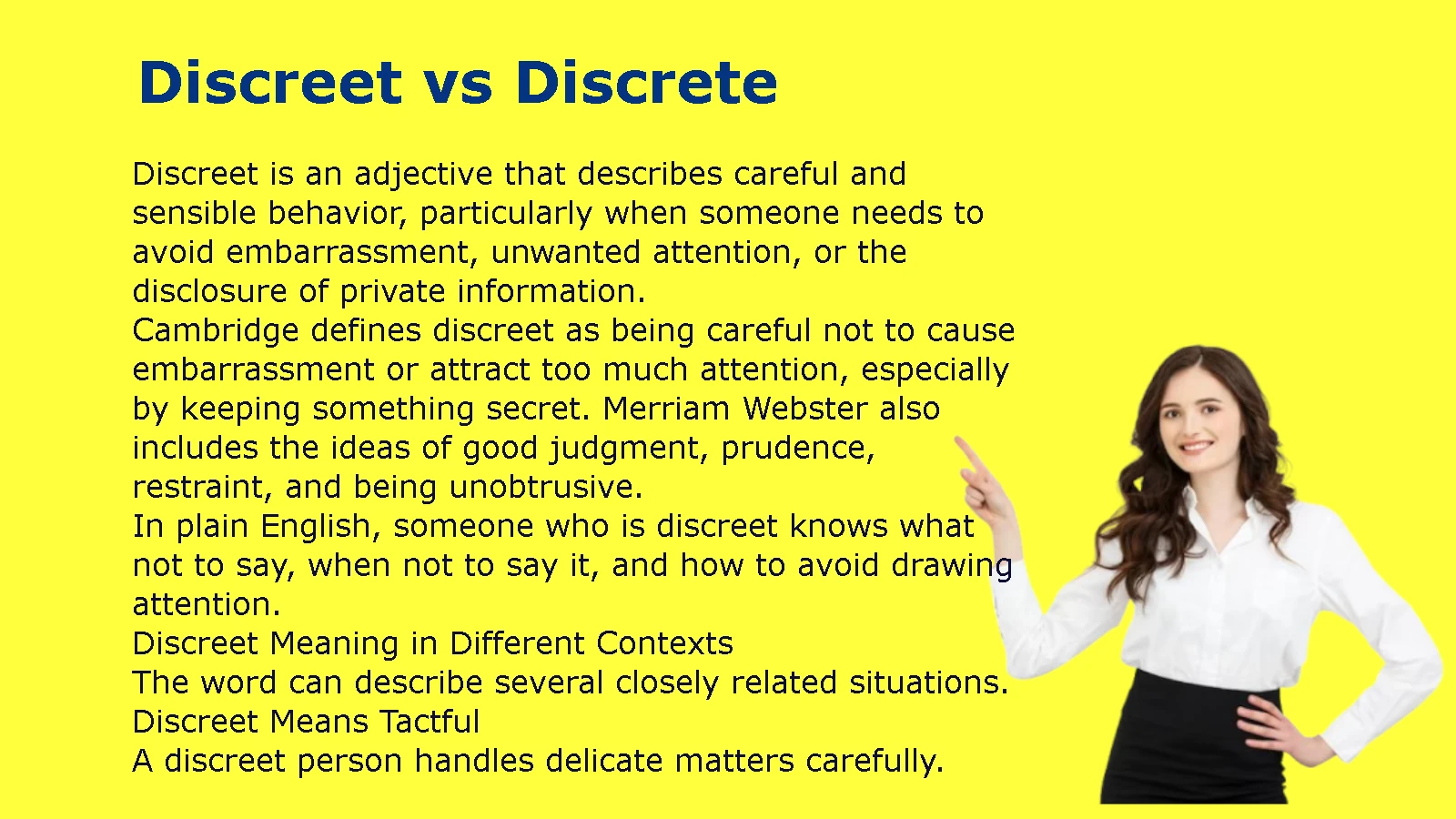
Discreet is an adjective that describes careful and sensible behavior, particularly when someone needs to avoid embarrassment, unwanted attention, or the disclosure of private information.
Cambridge defines discreet as being careful not to cause embarrassment or attract too much attention, especially by keeping something secret. Merriam Webster also includes the ideas of good judgment, prudence, restraint, and being unobtrusive.
In plain English, someone who is discreet knows what not to say, when not to say it, and how to avoid drawing attention.
Discreet Meaning in Different Contexts
The word can describe several closely related situations.
Discreet Means Tactful
A discreet person handles delicate matters carefully.
Discreet Means Private
The word often appears when information should remain confidential.
Please be discreet about the company’s plans.
Here, discreet suggests that the person should avoid revealing the information unnecessarily.
Discreet Means Unobtrusive
Something can also be discreet if it doesn’t attract much attention.
The security cameras were installed in discreet locations.
The cameras aren’t necessarily hidden. They are simply positioned so they don’t stand out.
Discreet Can Describe a Modest Appearance
Merriam Webster also records a sense involving something unpretentious or modest.
For example:
The room had discreet lighting and simple furniture.
The lighting isn’t flashy or dominant. It blends into the setting.
Examples of “Discreet” in a Sentence
The best way to understand discreet is to see how it behaves in real sentences.
- She was discreet about her friend’s personal problems.
- Please be discreet when discussing the investigation.
- The hotel offers discreet service for high profile guests.
- He made a discreet inquiry about the available position.
- She gave him a discreet signal from across the room.
- The photographer kept a discreet distance from the family.
- They wanted a discreet way to handle the complaint.
- The assistant was discreet and never repeated confidential conversations.
- A discreet entrance leads to the private dining room.
- He made a discreet exit before the argument became heated.
Notice the common thread. None of these examples means separate.
Instead, they involve privacy, tact, restraint, subtlety, or avoiding attention.
When Should You Use “Discreet”?
Use discreet when the sentence involves one or more of these ideas:
- Privacy
- Confidentiality
- Tact
- Good judgment
- Restraint
- Subtlety
- Avoiding attention
- Avoiding embarrassment
- Quiet or unobtrusive behavior
A useful test is to replace discreet with tactful, private, careful, or unobtrusive.
If the sentence still makes sense, discreet may be the word you need.
For example:
She made a discreet inquiry.
You could say:
She made a private inquiry.
Or:
She made a tactful inquiry.
The exact nuance changes slightly, but the central idea remains intact.
What Does “Discrete” Mean?
Discrete means separate, distinct, or individually identifiable.
Cambridge defines it as something that is clearly separate or different in shape or form. Merriam Webster likewise defines it as constituting a separate entity or item and describes its technical use for distinct or noncontinuous elements.
Think of discrete as putting things into separate boxes.
Discrete Means Separate
The factory has five discrete production areas.
Each area exists as a distinct unit.
Discrete Means Distinct
The researchers identified three discrete patterns.
The patterns can be distinguished from one another.
Discrete Means Individually Identifiable
The telescope detected several discrete objects.
Each object can be treated as a separate entity rather than as one continuous mass.
This sense appears frequently in academic, scientific, and technical writing.
Examples of “Discrete” in a Sentence
Here are practical examples from several contexts:
- The report contains four discrete sections.
- The machine consists of several discrete components.
- The researchers studied three discrete populations.
- The course is divided into six discrete units.
- The process has four discrete stages.
- The software stores the information in discrete fields.
- The map shows several discrete regions.
- The study identified two discrete groups.
- The system records discrete events.
- The equipment contains several discrete electrical components.
In each case, the word describes something that can be viewed as separate or distinct.
Discrete in Mathematics, Statistics, and Science
The word discrete takes on an especially important technical meaning in mathematics and statistics.
A discrete quantity has separate, distinct possible values. A continuous quantity, by contrast, can vary across a continuous range.
For example, the number of books on a shelf is discrete. You can have 20 books or 21 books, but you can’t normally have 20.6 physical books on the shelf.
Height is different. A person’s height can be measured at increasingly fine levels, such as 5 feet, 5 feet 0.5 inches, or 5 feet 0.51 inches.
Discrete vs. Continuous
| Discrete | Continuous |
| Number of students | Height of students |
| Number of cars | Speed of a car |
| Number of customers | Temperature |
| Number of calls received | Time spent on a call |
| Number of defects | Weight of an object |
The distinction isn’t simply about whether something is measured or counted in everyday language. It concerns the mathematical structure of the possible values.
Merriam Webster specifically includes discrete probabilities and discrete random variables among the technical uses of the word.
Discrete Mathematics
Discrete mathematics is the branch of mathematics concerned with structures that are fundamentally discrete rather than continuous.
Its topics include areas such as:
- Logic
- Set theory
- Graph theory
- Combinatorics
- Algorithms
- Number theory
- Discrete probability
So when you see discrete mathematics, the spelling is not a variation of discreet mathematics. The word means that the subject deals with distinct mathematical structures and values.
Discreet vs Discrete: Key Differences
The biggest mistake is treating these words as interchangeable because they sound identical.
They aren’t.
Difference in Meaning
Discreet means:
- Careful
- Tactful
- Private
- Restrained
- Unobtrusive
- Not attracting unnecessary attention
Discrete means:
- Separate
- Distinct
- Individual
- Independent
- Clearly distinguishable
- Noncontinuous in technical contexts
Difference in Usage
Discreet often describes:
- People
- Behavior
- Conversations
- Questions
- Actions
- Information
- Services
- Gestures
- Locations
- Appearance
Discrete often describes:
- Parts
- Groups
- Categories
- Units
- Stages
- Events
- Objects
- Variables
- Components
- Mathematical structures
The categories overlap only in form, not in meaning.
Discreet vs Discrete Examples Side by Side
Paired examples make the distinction easier to see because they put the two words under the same spotlight.
| Discreet | Discrete |
| Please be discreet about the surprise. | The report contains three discrete sections. |
| She made a discreet inquiry. | The study identified three discrete groups. |
| He gave her a discreet signal. | The machine contains several discrete components. |
| They arranged a discreet meeting. | The process consists of five discrete stages. |
| The assistant was extremely discreet. | The software uses discrete data fields. |
| The hotel has a discreet entrance. | The map divides the area into discrete regions. |
| She made a discreet exit. | The researchers recorded discrete events. |
| He kept a discreet distance. | The course contains several discrete modules. |
A More Subtle Pair
Consider:
The company installed discreet cameras.
The cameras are designed or positioned so that they don’t attract much attention.
Now change one letter:
The company installed discrete cameras.
This could mean the cameras are separate individual units rather than one integrated system.
The second sentence is grammatically possible, but its meaning changes. That’s why context matters.
“Discreet Conversation” vs. “Discrete Conversation”
This pair reveals the difference particularly well.
Discreet Conversation
They had a discreet conversation about the employee’s complaint.
The conversation was private or carefully handled.
Discrete Conversations
The researcher analyzed the three discrete conversations separately.
The conversations are separate events.
The first sentence focuses on how the conversation was handled.
The second focuses on the fact that there were separate conversations.
That’s the central distinction in action.
“Discreet Parts” vs. “Discrete Parts”
This distinction also appears in descriptions of products and systems.
Discreet Parts
This phrase would suggest parts that are subtle or unobtrusive.
For example:
The designer added discreet decorative details to the interior.
The details don’t dominate the design.
Discrete Parts
This means separate components.
The machine contains several discrete parts that can be replaced individually.
Here, the parts are distinct physical units.
Discrete is the natural choice when you’re talking about components as separate entities.
“Discreet Information” vs. “Discrete Information”
These phrases can look almost identical, yet they point in different directions.
Discreet Information
The assistant handled the discreet information carefully.
This suggests information that requires privacy or careful handling.
Discrete Information
The database organizes customer records into discrete fields.
Here, the information is separated into distinct units or categories.
The distinction is subtle but important: discreet concerns the manner or sensitivity of handling information, while discrete concerns the information’s separation into distinct units.
Are Discreet and Discrete Pronounced the Same?
Yes.
In standard English, discreet and discrete are homophones. They have the same pronunciation:
/dɪˈskriːt/
Cambridge gives the same pronunciation for both words.
That explains why spelling errors are so common. You can’t rely on sound to tell the words apart.
When someone says:
“The groups are discrete.”
you cannot identify the spelling from pronunciation alone.
The surrounding meaning provides the clue.
Why Pronunciation Causes Confusion
English contains many homophones, including:
- Their / there / they’re
- Principal / principle
- Complement / compliment
- Stationary / stationery
- Discreet / discrete
With discreet and discrete, the problem becomes even trickier because the spellings are nearly identical.
Only one letter separates them.
Why Are Discreet and Discrete So Easy to Confuse?
The confusion isn’t random. These words have a shared history.
Merriam Webster explains that both words trace back to the Latin discretus, related to the idea of separating or distinguishing. Both entered English in the 14th century.
The words also once had overlapping spellings and meanings. Medieval English spelling wasn’t standardized in the way modern English spelling is.
Over time, the two forms developed different conventional spellings and meanings.
Discrete became associated with separation and distinctness.
Discreet developed toward discernment, prudence, tact, and careful behavior.
Merriam Webster notes that the consistent distinction between the two spellings developed later, with discrete becoming more closely associated with its classical Latin form and meaning.
So the similarity isn’t a coincidence. The words are linguistic relatives that eventually went their separate ways.
Ironically, discrete and discreet became a perfect example of words that look almost inseparable on the page but have distinctly separate meanings.
Discreet vs Discrete Word Forms
The difference continues into related forms.
| Base Word | Related Form | Meaning |
| Discreet | Discreetly | In a careful, private, or unobtrusive way |
| Discreet | Discreetness | The quality of being discreet |
| Discrete | Discretely | Separately or distinctly |
| Discrete | Discreteness | The quality of being discrete |
Discreetly
Discreetly means in a way that avoids attention, embarrassment, or unnecessary disclosure.
She discreetly corrected his mistake.
The correction was handled tactfully.
Cambridge defines discreetly as acting carefully so as not to cause embarrassment or attract too much attention.
Discretely
Discretely means separately or distinctly.
The three components were analyzed discretely.
Each component was considered separately.
Cambridge explicitly warns readers not to confuse discretely with discreetly.
Discreetness
Discreetness refers to the quality of being discreet.
Her discreetness made her a trusted adviser.
Discreteness
Discreteness refers to the quality of being separate or distinct.
The discreteness of the categories made the data easier to analyze.
Discreet vs Discrete: Common Mistakes
These errors are easy to make because both words sound identical. The best defense is to focus on meaning rather than pronunciation.
Mistake: “Please Be Discrete”
Suppose someone writes:
Please be discrete about the surprise.
If the intended meaning is keep the surprise private, the correct word is:
Please be discreet about the surprise.
Why?
Because the sentence concerns confidentiality, not separation.
Mistake: “Three Discreet Groups”
Now consider:
The researchers studied three discreet groups.
If the intended meaning is that the researchers studied three separate groups, the preferred word is:
The researchers studied three discrete groups.
The groups are distinct units.
Mistake: “Discreet Categories”
Consider:
The data was divided into four discreet categories.
If the writer means that the categories are separate or distinct, discrete is the better choice:
The data was divided into four discrete categories.
Mistake: “Discretely” When You Mean Quietly
This sentence has a different problem:
She discretely asked about his health.
If the intended meaning is that she asked carefully and privately, use:
She discreetly asked about his health.
Discretely means separately. Discreetly means tactfully or unobtrusively.
A Practical Case Study: Business Communication
Imagine a manager needs to discuss an employee’s performance problem.
The manager sends this message:
Please be discreet when discussing the matter with the rest of the team.
That wording makes sense because the manager wants the employee’s information handled carefully.
Now imagine a report that analyzes the same workplace issue:
The researchers divided the employees into four discrete groups.
Again, the word fits because the groups are treated as separate categories.
The subject hasn’t changed. The relationship between the word and the idea has changed.
| Situation | Correct Word | Why |
| Protect an employee’s privacy | Discreet | The focus is confidentiality |
| Divide employees into separate groups | Discrete | The focus is separation |
| Ask a sensitive question tactfully | Discreet | The focus is behavior |
| Analyze groups independently | Discrete | The focus is distinct units |
This is a useful writing lesson: don’t choose the word because it sounds right. Choose it because its meaning fits the relationship you’re describing.
A Practical Case Study: Technology and Data
Technology writing provides another clear distinction.
Suppose a database stores a customer’s information in separate fields. A technical document might say:
The application stores the data in discrete fields.
Each field represents a distinct unit.
Now imagine an employee needs to investigate a sensitive security issue without drawing unnecessary attention. A manager might advise:
Handle the investigation discreetly.
The first sentence concerns structure.
The second concerns behavior.
That’s often the fastest way to choose between the words.
The Rule
Ask:
Am I describing how something is separated?
Use discrete.
Am I describing how someone handles something carefully or privately?
Use discreet.
A Practical Case Study: Everyday Conversation
Picture a family planning a surprise birthday party.
Someone says:
Be discreet when you talk about the party.
That means don’t reveal the secret.
Now imagine a researcher studying several conversations about the party:
The researcher examined the discrete conversations separately.
That means each conversation was treated as an individual event.
One letter changes the word, but the conceptual difference is clear:
discreet = careful behavior
discrete = separate things
How to Choose Between Discreet and Discrete
When you’re unsure, don’t stare at the spelling and hope inspiration strikes. Use a meaning test.
Ask Whether Privacy Is Involved
If the sentence involves secrecy, tact, confidentiality, restraint, or avoiding attention, choose discreet.
She was discreet about the confidential discussion.
Ask Whether Separation Is Involved
If the sentence describes separate things, distinct categories, individual components, or identifiable units, choose discrete.
The program has five discrete modules.
Look for a Technical Context
If you’re writing about mathematics, statistics, computer science, data, or scientific measurement, discrete often has its technical meaning.
The model uses a discrete random variable.
Try a Substitute
Replace the word mentally.
If private, tactful, or unobtrusive fits, choose discreet.
If separate, distinct, or individual fits, choose discrete.
Discreet vs Discrete: Synonyms
Synonyms can reinforce the distinction.
Synonyms for Discreet
Depending on context, discreet can mean:
- Tactful
- Careful
- Prudent
- Cautious
- Private
- Reserved
- Subtle
- Unobtrusive
- Restrained
- Circumspect
Merriam Webster lists terms such as prudent, judicious, cautious, and unobtrusive among the related meanings and synonyms of discreet.
Synonyms for Discrete
Depending on context, discrete can mean:
- Separate
- Distinct
- Individual
- Independent
- Separable
- Unconnected
- Noncontinuous
Cambridge lists independent and separate as synonyms in its definition of discrete.
The synonym test is useful because it exposes the underlying idea.
Discreet → tactful
Discrete → separate
Is “Discreet” the Opposite of “Indiscreet”?
Yes.
Indiscreet means not discreet. It describes behavior that reveals information carelessly or causes embarrassment through a lack of judgment.
For example:
His indiscreet comment revealed the confidential plan.
Cambridge defines indiscreet as saying or doing things that reveal information that should remain secret or that embarrass people.
Merriam Webster similarly defines it as not discreet and associates it with imprudent or tactless behavior.
This relationship creates a helpful word family:
discreet → careful and tactful
indiscreet → careless or tactless
That family is unrelated to the basic meaning of discrete, which concerns separation.
Is “Discrete” the Opposite of “Continuous”?
In many technical contexts, yes.
This is especially common in mathematics, statistics, and computer science.
A discrete system or quantity consists of distinct values or units.
A continuous system or quantity changes across a continuous range.
For example:
- Number of employees → discrete
- Number of books → discrete
- Temperature → typically continuous
- Time → typically continuous
- Distance → typically continuous
The exact classification can depend on how a variable is modeled or measured, so technical writing should use the terms precisely rather than treating every count as automatically discrete in every context.
Still, the basic contrast is straightforward:
Discrete = distinct values or units.
Continuous = an uninterrupted range.
Frequently Asked Questions About Discreet vs Discrete
What is the difference between discreet and discrete?
Discreet means careful, tactful, private, or unobtrusive. Discrete means separate, distinct, or individually identifiable.
A discreet person protects sensitive information. A discrete group is separate from another group.
Are discreet and discrete pronounced the same?
Yes. Both are commonly pronounced /dɪˈskriːt/ in English. They are homophones, so pronunciation won’t tell you which spelling to use.
Is it discreet or discrete information?
It depends on the meaning.
Use discreet when the information needs careful or private handling.
Use discrete when the information exists as separate or distinct units.
Is it discreet or discrete parts?
Use discrete parts when you mean separate components.
The machine contains several discrete parts.
Is it discreet or discrete groups?
Usually use discrete groups when you mean groups that are separate or distinct.
The researchers analyzed four discrete groups.
Use discreet only if you’re describing the groups or their behavior as tactful or unobtrusive.
What is the difference between discreetly and discretely?
Discreetly means carefully, privately, or unobtrusively.
Discretely means separately or distinctly. Cambridge specifically distinguishes the two forms.
What is the difference between discretion and discreteness?
Discretion concerns good judgment, especially in deciding what to say or do and what information to keep private.
Discreteness concerns the quality of being separate or distinct.
Is discrete used in mathematics?
Yes. Discrete is a standard technical term in mathematics and statistics. It appears in phrases such as discrete mathematics, discrete random variable, and discrete probability.
Can discrete mean individual?
Yes. Something can be discrete when it exists as an individual, distinct unit.
For example:
The system tracks each customer as a discrete record.
Can discreet mean secret?
Sometimes, but private, careful, or unobtrusive is usually more precise.
Discreet often describes the way someone handles something secret rather than simply meaning that the thing itself is secret.
Final Thoughts on Discreet vs Discrete
The difference between discreet and discrete becomes simple once the two core ideas are separated.
Discreet is about careful behavior. It describes someone or something that avoids embarrassment, protects privacy, exercises restraint, or doesn’t attract unnecessary attention.
Discrete is about separation. It describes things that are distinct, separate, individual, or independently identifiable.
Keep this quick rule in mind:
Discreet = tactful or unobtrusive.
Discrete = separate or distinct.
If you’re asking someone to keep a secret, choose discreet.
If you’re describing separate groups, categories, stages, components, or mathematical values, choose discrete.
And when the two spellings start to blur together, remember the useful visual clue: the “t” in discrete separates the two “e’s.” Merriam Webster uses essentially this same spelling based memory aid.
One letter separates the spellings. More importantly, one meaning separates the words.