Summarize vs summarise refers to two correct spellings of the same verb, meaning to give a short version of the main points. Summarize is the preferred spelling in American English, while summarise is commonly used in British English.
| Question | Answer |
| What does summarize mean? | To give the main points of something briefly. |
| What is the difference between summarize and summarise? | The meaning is the same; the spelling depends on the type of English used. |
| Is summarize American or British English? | Summarize is mainly used in American English. |
| Is summarise correct? | Yes, summarise is correct in British English. |
Summarize vs Summarise: Quick Answer
. Cambridge gives this definition for summarize and identifies summarise as the usual UK form.
Here’s the difference at a glance:
| Word | English variety | Meaning |
| summarize | American English | Give the main points briefly |
| summarise | British English | Give the main points briefly |
| summarized | American English | Past tense of summarize |
| summarised | British English | Past tense of summarise |
| summarizing | American English | Present participle of summarize |
| summarising | British English | Present participle of summarise |
The key distinction is the letter z versus s.
US English: summarize
British English: summarise
Neither spelling is inherently more correct. The right choice depends on the variety of English you’re using and the style you need to follow.
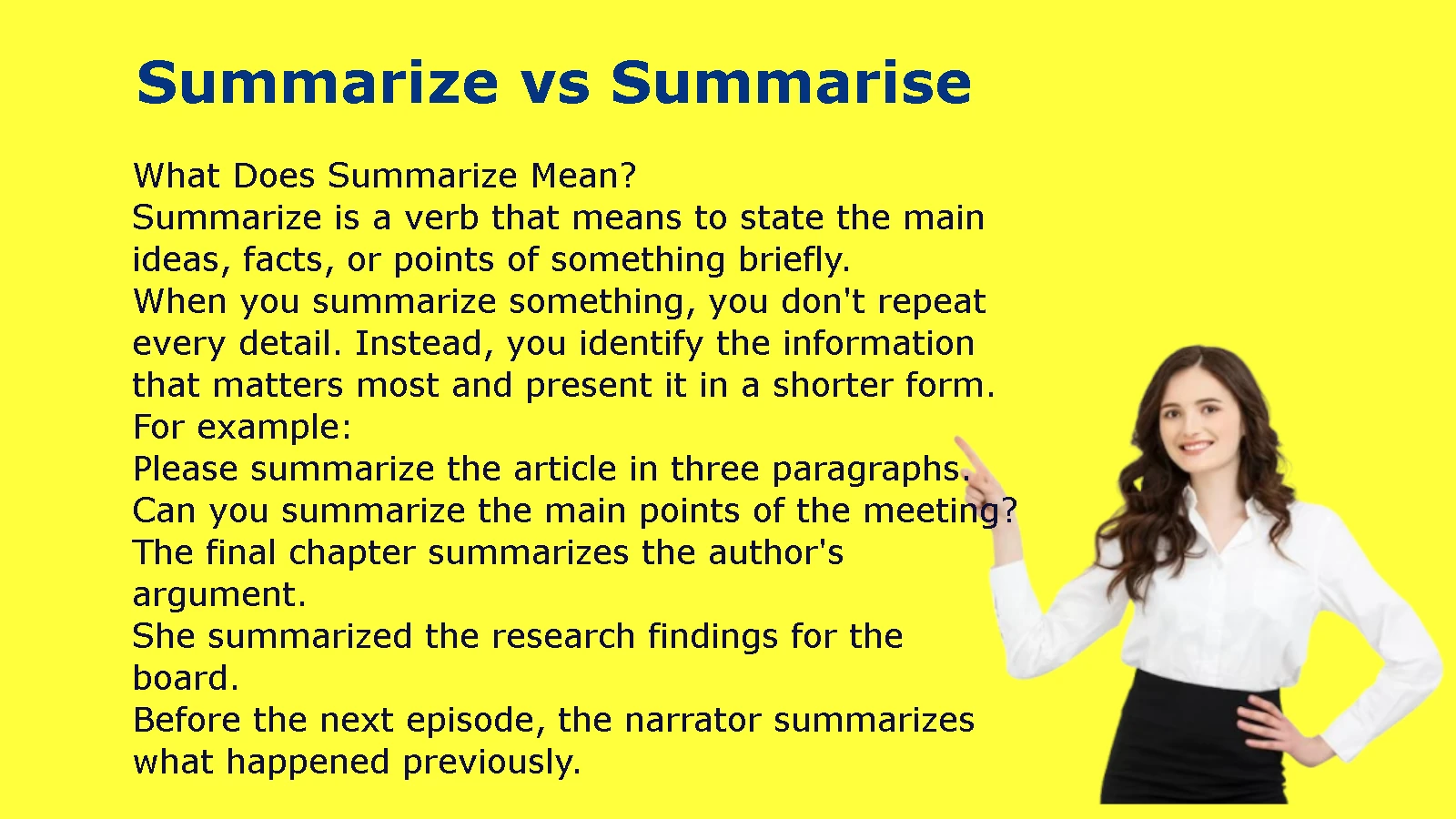
What Does Summarize Mean?
Summarize is a verb that means to state the main ideas, facts, or points of something briefly.
When you summarize something, you don’t repeat every detail. Instead, you identify the information that matters most and present it in a shorter form.
For example:
- Please summarize the article in three paragraphs.
- Can you summarize the main points of the meeting?
- The final chapter summarizes the author’s argument.
- She summarized the research findings for the board.
- Before the next episode, the narrator summarizes what happened previously.
Cambridge defines summarize as expressing the most important facts or ideas about something in a short and clear form. Oxford similarly defines it as giving a summary of something.
Summarize in a Sentence
Here are examples of summarize in different contexts:
- Academic: Students must summarize the chapter before class.
- Business: The report summarizes the company’s financial performance.
- Workplace: Could you summarize what we decided during the meeting?
- Everyday conversation: Can you summarize the movie for me?
- News: The presenter summarized the day’s biggest stories.
- Research: This section summarizes the study’s key findings.
- Writing: The conclusion summarizes the main argument.
Notice that the meaning stays the same even though the contexts change.
What Does Summarise Mean?
Summarise is the British English spelling of the same verb.
It means exactly what summarize means: to reduce a larger amount of information to its essential points.
For example:
- Please summarise the article in three paragraphs.
- Can you summarise the main points of the meeting?
- The final chapter summarises the author’s argument.
- She summarised the research findings for the board.
Cambridge labels summarise as the usual UK form, while Oxford lists summarise as a British English form of summarize.
Summarise in a Sentence
Here are several examples:
- Please summarise the report before tomorrow’s meeting.
- The professor asked the students to summarise the article.
- She summarised the key findings in a short presentation.
- Could you summarise what happened during the discussion?
- The final paragraph summarises the author’s main argument.
- This section summarises the evidence presented in the study.
These sentences would normally use summarize instead if they followed American English spelling.
Summarize vs Summarise: Difference in American and British English
The main difference between summarize and summarise comes down to regional spelling conventions.
American English generally uses -ize in this word:
summarize
British English commonly uses -ise:
summarise
The same pattern appears in several other words:
| American English | British English |
| organize | organise |
| recognize | recognise |
| realize | realise |
| apologize | apologise |
| summarize | summarise |
| analyze | analyse |
However, there’s an important detail here. British English spelling isn’t completely uniform about -ize and -ise.
For example, Oxford University says its own style uses -ise/-yse/-isation rather than -ize/-yze/-ization, while Oxford University Press follows a different convention in some cases.
That means it’s too simplistic to say that British English always uses -ise. Different British publishers, institutions, dictionaries, and style guides can follow different conventions.
For summarize vs summarise, however, the practical rule is straightforward: summarize is standard in American English, and summarise is usual in British English.
Is Summarize or Summarise Correct?
Both are correct.
The choice depends on the English variety you’re using.
If you’re writing in American English, use:
summarize
If you’re writing in British English, use:
summarise
The spelling doesn’t change the definition, pronunciation in any meaningful lexical sense, grammatical role, or basic usage.
Think of it like color vs colour. The extra letter doesn’t create a different concept. It reflects a different spelling convention.
The same principle applies here:
- American English → summarize
- British English → summarise
Why Consistency Matters
Although both forms are correct, switching between them in the same document can make your writing look inconsistent.
Imagine reading a report that says:
The first section summarizes the evidence. The next section summarises the opposing argument.
Nothing is grammatically wrong with either sentence. Yet the sudden spelling change suggests that two different writing conventions have been mixed.
A cleaner approach is to choose one style and stick with it.
Which Is Correct in American English?
For standard American English, summarize is the preferred spelling.
Cambridge’s American English dictionary gives summarize with the past tense summarized and present participle summarizing. Oxford’s American English dictionary likewise uses these forms.
American English Forms of Summarize
| Grammatical form | American spelling | Example |
| Base form | summarize | Please summarize the report. |
| Third person singular | summarizes | She summarizes the findings. |
| Past tense | summarized | He summarized the meeting. |
| Past participle | summarized | The results were summarized clearly. |
| Present participle | summarizing | She is summarizing the article. |
| Gerund | summarizing | Summarizing long reports takes practice. |
The z remains part of the spelling throughout these forms.
Examples of American English Usage
- The introduction summarizes the purpose of the study.
- The manager summarized the discussion.
- She summarizes complex ideas clearly.
- The researchers have summarized their findings.
- He is summarizing the report now.
If you’re writing an American English article, essay, report, email, or assignment, summarize is the straightforward choice.
Which Is Correct in British English?
In British English, summarise is the usual spelling.
Its related forms follow the same spelling pattern:
| Grammatical form | British spelling | Example |
| Base form | summarise | Please summarise the report. |
| Third person singular | summarises | She summarises the findings. |
| Past tense | summarised | He summarised the meeting. |
| Past participle | summarised | The results were summarised clearly. |
| Present participle | summarising | She is summarising the article. |
| Gerund | summarising | Summarising long reports takes practice. |
Cambridge specifically marks summarise as the usual UK form.
An Important British English Detail
British spelling conventions can vary by publication or style guide.
Oxford University, for instance, states that its house style prefers -ise spellings and gives examples such as organise, analyse, and authorisation.
Other British references may accept or use -ize forms in certain words.
So, if a university, employer, publisher, or journal gives you a style guide, follow that guide rather than relying on a blanket rule.
Summarize vs Summarise Examples
The easiest way to see the difference is to place the two forms side by side.
| American English | British English |
| Please summarize the report. | Please summarise the report. |
| She summarizes the main points. | She summarises the main points. |
| He summarized the meeting. | He summarised the meeting. |
| The article summarizes the research. | The article summarises the research. |
| We summarized the results. | We summarised the results. |
| She is summarizing the chapter. | She is summarising the chapter. |
| The report has been summarized. | The report has been summarised. |
The sentences communicate the same ideas.
Only the regional spelling changes.
More Examples in Context
American English:
The final section summarizes the major findings and explains their practical significance.
British English:
The final section summarises the major findings and explains their practical significance.
The difference is easy to spot. The sentence structure and meaning remain the same.
Summarize vs Summarise Verb Forms
Understanding the complete word family helps prevent spelling mistakes.
| Form | US English | UK English |
| Base verb | summarize | summarise |
| Third person | summarizes | summarises |
| Past tense | summarized | summarised |
| Past participle | summarized | summarised |
| Present participle | summarizing | summarising |
| Noun for the process | summarization | summarisation |
Cambridge lists summarization as the American form and notes summarisation as the usual UK form.
One useful detail stands out here: the -ize/-ise difference affects more than the base verb.
Compare:
- summarize → summarise
- summarizes → summarises
- summarized → summarised
- summarizing → summarising
- summarization → summarisation
Once you identify the English variety you’re using, the pattern becomes much easier to maintain.
Summarized vs Summarised
Summarized is the American English spelling.
Summarised is the usual British English spelling.
Both are the past tense and past participle forms of the verb. Cambridge identifies summarized as the past simple and past participle of summarize.
Examples
US English:
- She summarized the article.
- The report summarized the available evidence.
- The discussion was summarized in two paragraphs.
British English:
- She summarised the article.
- The report summarised the available evidence.
- The discussion was summarised in two paragraphs.
Don’t treat summarized and summarised as two different tenses. They aren’t. They’re regional spelling variants.
Summarizing vs Summarising
The same distinction appears in the -ing form.
American English uses:
summarizing
British English commonly uses:
summarising
For example:
| American English | British English |
| I am summarizing the chapter. | I am summarising the chapter. |
| Summarizing research takes time. | Summarising research takes time. |
| She is summarizing the evidence. | She is summarising the evidence. |
Cambridge identifies summarizing as the present participle of summarize.
This is particularly useful when you’re writing instructions, academic material, or educational content.
Summary vs Summarize vs Summarise
These words are closely related, but they don’t perform the same grammatical job.
Summary is a noun.
Summarize is the American English verb.
Summarise is the usual British English verb.
Oxford defines summary as a short statement that gives the main points of something without the details.
Compare these sentences:
- I wrote a summary of the article.
- I summarized the article.
- I summarised the article.
The first sentence uses a noun. The second and third use verbs.
Summary Examples
- The teacher asked for a one page summary.
- The report includes a summary of the findings.
- Read the summary before reviewing the full document.
- The executive summary highlights the most important results.
The noun summary doesn’t become summarise or summarize. It remains summary in both American and British English.
Summarize vs Paraphrase
Summarizing and paraphrasing aren’t the same thing.
This distinction matters in academic writing because the two techniques serve different purposes.
When you summarize, you reduce the amount of information and focus on the main ideas.
When you paraphrase, you restate an idea in your own words while generally preserving a similar level of detail.
Consider this original idea:
A long report explains that remote work can improve employee flexibility, but it may also create communication challenges when teams lack clear processes.
A summary might be:
The report says remote work offers flexibility but can create communication problems.
A paraphrase could preserve much more of the original information:
The report explains that working remotely gives employees greater flexibility while also creating communication difficulties when teams don’t establish effective processes.
The first version compresses the idea. The second mainly changes how the idea is expressed.
Why the Difference Matters
If an assignment asks you to summarize a chapter, rewriting every paragraph in different words isn’t enough. A good summary selects the important information and leaves less important detail behind.
Think of it this way:
Paraphrasing changes the packaging. Summarizing reduces the package.
That distinction becomes especially important when you work with research papers, textbooks, legal documents, business reports, and lengthy articles.
Summarize vs Sum Up
Another useful comparison is summarize vs sum up.
Both can mean giving the main points of something.
Oxford lists sum up as a synonym for summarize when it means stating the main points of something in a short and clear form.
Compare:
- Let me summarize the main points.
- Let me sum up the main points.
Both are grammatical.
However, sum up often sounds more conversational, while summarize works comfortably in both formal and informal contexts.
For example:
To sum up, we need more time.
sounds natural in conversation.
Meanwhile:
The final section summarizes the study’s findings.
fits naturally into an academic paper.
Summarize vs Summarise in Academic Writing
Academic writing requires consistency more than it requires choosing one universal spelling.
If you’re writing for an American institution or following an American style guide, summarize is the natural choice.
If you’re writing for a British institution that follows -ise spelling, use summarise.
American Academic Example
This section summarizes the primary findings of the experiment and considers their implications.
British Academic Example
This section summarises the primary findings of the experiment and considers their implications.
Neither sentence is better simply because of the spelling.
The important thing is to match the required English variety.
What About International Academic Writing?
International journals and universities can have their own style requirements.
Before submitting academic work, check:
- The institution’s style guide
- The journal’s author guidelines
- The required citation style
- The publisher’s house style
- Previous articles from the same publication
A style guide is the final referee when conventions differ.
Summarize vs Summarise in Professional Writing
The same rule applies to business communication.
If your company uses American English, write summarize.
If your organization follows British English, summarise may be the expected spelling.
For example, an American business email might say:
Could you summarize the client’s concerns before the meeting?
A British business email might say:
Could you summarise the client’s concerns before the meeting?
The choice doesn’t affect professionalism. Consistency does.
Where You Might See These Forms
You can encounter the word in:
- Business reports
- Meeting notes
- Emails
- Presentations
- Research papers
- News articles
- Technical documentation
- School assignments
- University essays
- Executive summaries
- Book reviews
- Project updates
In each case, the regional spelling rule remains the same.
Common Mistakes With Summarize and Summarise
Although the spelling difference is straightforward, several mistakes appear regularly.
Mixing the Two Spellings
Using summarize in one paragraph and summarise in another isn’t automatically grammatically wrong. However, it creates an inconsistent style when both appear in a document that follows one English variety.
Choose one convention and stay with it.
Assuming Summarise Is Wrong
Summarise isn’t a misspelling.
It’s the usual British English spelling. Cambridge explicitly labels it as the usual UK form.
Assuming Summarize Is Wrong in British English
British English has variation in -ize/-ise spellings. Some British style systems use -ise, while other British references accept or use -ize for certain words.
So calling summarize universally “wrong in British English” would be too broad.
Confusing Summary With Summarize
Remember the grammatical difference:
- summary = noun
- summarize = US verb
- summarise = UK verb
You can write a summary or summarize an article.
Changing the Meaning
The spelling doesn’t change the meaning.
There isn’t a special meaning attached to the z version or the s version.
How to Remember Summarize vs Summarise
A simple memory trick can save you from checking the dictionary every time.
US English → summarize → Z
British English → summarise → S
You can connect the spelling to other familiar pairs:
- organize / organise
- recognize / recognise
- apologize / apologise
- summarize / summarise
If you’re writing American English, the z spelling will usually fit this pattern.
If you’re following a British -ise style, the s spelling will usually fit that convention.
The trick isn’t perfect for every English word because spelling conventions have exceptions. Still, it works well for summarize vs summarise.
A Practical Case Study: One Report, Two English Styles
Imagine a company has offices in New York and London. Both offices need the same quarterly report.
The American version might contain:
This section summarizes the results from the customer survey.
The British version might say:
This section summarises the results from the customer survey.
Nothing about the survey changed.
Nothing about the data changed.
The writers simply followed different spelling conventions.
Now imagine the same report contains summarize on one page and summarise on another. Readers can still understand it, but the document looks less polished.
The lesson is simple: when regional spelling matters, consistency is part of good editing.
Facts About Summarize and Summarise
Here are the key facts in one place:
- Summarize is the standard American English spelling.
- Summarise is the usual British English spelling.
- Both words function as verbs.
- Both mean to give the main points of something briefly.
- Summarized is the American past tense and past participle.
- Summarised is the usual British equivalent.
- Summarizing is the American -ing form.
- Summarising is the usual British -ing form.
- Summary is the related noun in both varieties.
- British English spelling conventions for -ize/-ise can vary by style guide.
Frequently Asked Questions About Summarize vs Summarise
Is summarize American or British?
Summarize is the standard spelling used in American English. It is also recognized in British English, although summarise is the usual UK form according to Cambridge.
Is summarise British or American?
Summarise is primarily associated with British English. Cambridge specifically labels it as the usual UK form of summarize.
Are summarize and summarise the same word?
Yes. Summarize and summarise have the same meaning and grammatical function. The difference is mainly regional spelling.
Is summarize correct in American English?
Yes. Summarize is the standard American English spelling.
Is summarise correct in American English?
Summarise isn’t the standard American spelling. American English normally uses summarize.
Is summarize acceptable in British English?
Yes, depending on the British style convention being followed. British English has variation in -ize/-ise spellings, although summarise is the usual UK form listed by Cambridge.
Which spelling should I use in the US?
Use summarize.
For example:
Please summarize the main findings.
Which spelling should I use in the UK?
Use summarise when following the usual British convention.
For example:
Please summarise the main findings.
What is the past tense of summarize?
The past tense is summarized.
She summarized the report yesterday.
What is the past tense of summarise?
The past tense is summarised.
She summarised the report yesterday.
What is the present participle of summarize?
The -ing form is summarizing.
He is summarizing the results.
What is the present participle of summarise?
The -ing form is summarising.
He is summarising the results.
What is the noun form of summarize?
The most common related noun is summary. Another noun, summarization, refers to the act or process of summarizing. Cambridge lists summarization with summarisation as the usual UK form.
Is summarise a misspelling?
No. Summarise is a legitimate spelling used in British English.
Does summarize mean the same as summarize?
If the intended comparison is summarize vs summarise, yes. Both mean to present the main points of something briefly and clearly.
Is summarizing or summarising correct?
Both are correct, depending on the English variety:
- summarizing → American English
- summarising → British English
Should academic writing use summarize or summarise?
Use whichever spelling matches the required English variety or style guide. American academic writing generally uses summarize, while British academic writing commonly uses summarise.
Summarize vs Summarise: Final Verdict
The summarize vs summarise difference is much simpler than it first appears.
Summarize is the standard American English spelling.
Summarise is the usual British English spelling.
Both mean to give the main points of something clearly and briefly. Neither spelling changes the word’s fundamental meaning.
| Writing for | Preferred choice |
| United States | summarize |
| American English | summarize |
| United Kingdom | summarise |
| British English | summarise |
| US academic writing | summarize |
| UK academic writing | summarise |
| US business writing | summarize |
| UK business writing | summarise |
The related forms follow the same pattern:
summarize → summarized → summarizing
summarise → summarised → summarising
When in doubt, don’t ask which spelling is “more correct.” Ask which English variety are you writing in?
That one question usually settles it.