Traumatize or traumatise? Both spellings are correct, but they follow different regional spelling conventions. American English generally uses traumatize, while British English commonly uses traumatise. Both words mean to cause someone severe emotional distress or psychological trauma.
Understanding the difference also helps you use traumatized or traumatised, recognize the noun trauma, find suitable traumatize synonyms, and pronounce the word correctly. This guide covers American and British spelling, definitions, grammar, sentence examples, and common responses to traumatic experiences.
Traumatize or Traumatise: What’s the Difference?
Traumatize is the standard spelling in American English, whereas traumatise is common in British English. Both forms have the same meaning and generally share the same pronunciation. The difference comes from regional spelling conventions, particularly the use of -ize in American English and -ise in British English.
For example:
- American English: The accident traumatized the young child.
- British English: The accident traumatised the young child.
Neither sentence is incorrect. The spelling simply reflects the variety of English the writer follows.
Traumatize Is the American English Spelling
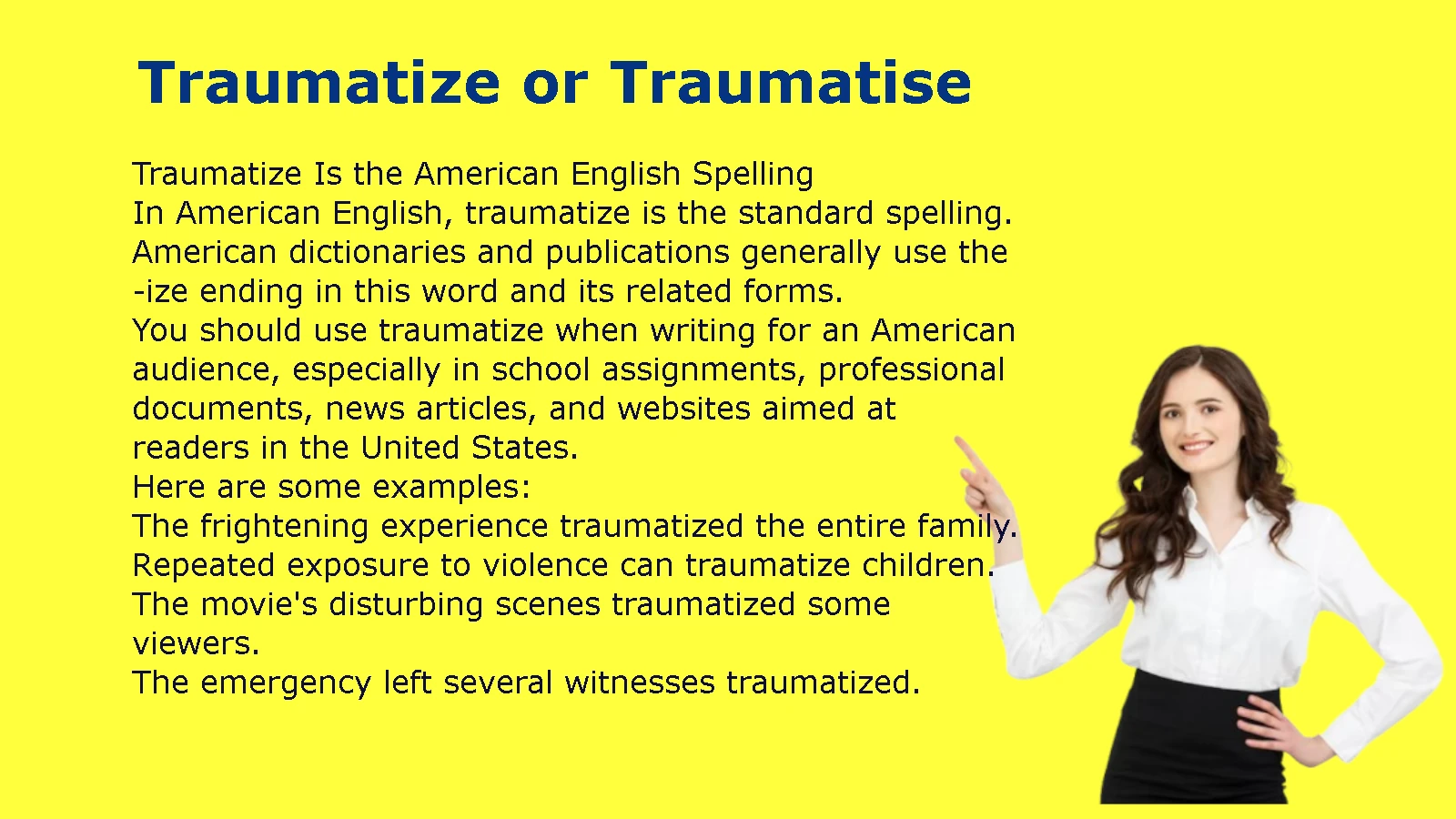
In American English, traumatize is the standard spelling. American dictionaries and publications generally use the -ize ending in this word and its related forms.
You should use traumatize when writing for an American audience, especially in school assignments, professional documents, news articles, and websites aimed at readers in the United States.
Here are some examples:
- The frightening experience traumatized the entire family.
- Repeated exposure to violence can traumatize children.
- The movie’s disturbing scenes traumatized some viewers.
- The emergency left several witnesses traumatized.
Notice how the spelling stays consistent when the word changes form. American English uses traumatized, traumatizing, and traumatizes.
Traumatise Is the British English Spelling
Traumatise is a common British English spelling. It appears in British writing alongside other words that use the -ise ending, such as organise, realise, and recognise.
If your audience lives in the United Kingdom, traumatise and traumatised will generally fit the expected spelling conventions.
Examples include:
- The accident traumatised several passengers.
- The experience may traumatise a child.
- Witnessing violence can traumatise vulnerable people.
- The documentary describes how war traumatises families.
British spelling conventions are not entirely uniform. Some British publishers and style guides also accept or prefer -ize forms in certain words. However, traumatise remains a familiar and widely used British spelling.
Traumatised or Traumatized: Which One Is Correct?
Both traumatised and traumatized are correct. American English generally uses traumatized, while British English commonly uses traumatised. Both forms describe someone who has experienced psychological trauma or the effects of a deeply distressing event.
Compare these examples:
| American English | British English |
| Traumatize | Traumatise |
| Traumatized | Traumatised |
| Traumatizing | Traumatising |
| Traumatizes | Traumatises |
The meaning does not change when you switch the spelling.
For example, “She was traumatized by the accident” and “She was traumatised by the accident” communicate the same idea.
Writing tip: Choose one regional spelling system and apply it consistently throughout your article, essay, or website. Avoid switching between traumatized and traumatised without a clear reason.
Traumatize vs. Traumatise at a Glance
| Feature | Traumatize | Traumatise |
| Main spelling association | American English | British English |
| Part of speech | Verb | Verb |
| Meaning | To cause psychological trauma | To cause psychological trauma |
| Past tense | Traumatized | Traumatised |
| Present participle | Traumatizing | Traumatising |
| Example | The event traumatized him. | The event traumatised him. |
| Pronunciation | Generally the same | Generally the same |
The simplest rule is to use traumatize for American audiences and traumatise for British audiences unless your publication follows a different style guide.
What Does Traumatize Mean?
Traumatize is a verb that means to cause someone severe emotional distress or psychological trauma. It often describes the effects of a frightening, violent, overwhelming, or deeply distressing experience. The effects may last beyond the event itself, although people respond to difficult experiences in different ways.
For example, a person might feel traumatized after witnessing a serious accident, experiencing violence, or surviving a frightening event.
The word carries more weight than ordinary expressions such as upset or annoy. It suggests a serious emotional impact rather than a brief moment of disappointment.
Consider the difference:
- Upset: The canceled trip upset the children.
- Disturb: The disturbing news affected her mood.
- Traumatize: Witnessing the serious accident left him deeply distressed.
These words are not interchangeable in every situation. Traumatize is generally the stronger term and should reflect the seriousness of the experience being described.
Traumatize Meaning in Different Contexts
The meaning of traumatize depends partly on the situation. It can describe serious psychological harm, an intense emotional response, or an exaggerated reaction in casual conversation.
Psychological context
In psychology and everyday discussions of mental health, traumatize describes causing psychological trauma.
Example: The violent incident traumatized several witnesses, who continued to struggle with fear afterward.
Family and childhood context
The word may describe the impact of frightening or harmful experiences on children. Children can respond to distress differently from adults, and their reactions may change as they grow.
Example: The counselor explained how repeated exposure to domestic violence can traumatize a child.
Accidents and emergencies
People may use the word to describe the lasting emotional effects of a serious accident, natural disaster, or other emergency.
Example: The train accident traumatized passengers who feared they might not survive.
Entertainment and everyday conversation
People sometimes use traumatize informally to exaggerate their reaction to something unpleasant or shocking.
Example: That horror movie traumatized me for a week.
In casual conversation, the speaker may simply mean that the movie frightened them. However, in serious writing, the word should not minimize genuine psychological trauma.
What Does It Mean to Be Traumatized?
Being traumatized generally means experiencing significant psychological or emotional distress following an overwhelming event or series of events. A person may feel frightened, emotionally numb, unusually alert, or troubled by memories of what happened.
For example, someone who survives a serious car crash might feel anxious when traveling in a vehicle afterward. Another person who experiences the same accident might recover emotionally without developing lasting difficulties.
A few important distinctions help clarify the meaning:
- Experiencing a traumatic event: A person goes through an event that feels frightening, threatening, or overwhelming.
- Feeling traumatized: The person experiences a significant emotional or psychological impact.
- Developing a trauma-related condition: The person experiences a pattern of symptoms that may require professional assessment.
These descriptions are related, but they do not mean exactly the same thing. Not everyone who experiences a traumatic event develops a lasting mental health condition.
Is Traumatize a Verb or a Noun?
Traumatize is a verb, not a noun. It describes the action of causing psychological trauma. The related noun is trauma, which refers to a deeply distressing experience or its psychological impact. Traumatized is commonly used as the past tense of the verb and as an adjective describing a person’s state.
Compare these sentences:
- Verb: The accident may traumatize the passengers.
- Noun: The accident caused lasting trauma.
- Adjective: The traumatized passengers received support.
Each word serves a different grammatical purpose.
Traumatize Is a Verb
A verb expresses an action, event, or state. In this case, traumatize describes the act of causing psychological trauma.
The verb can appear in different tenses.
Present tense: The incident traumatizes everyone who witnesses it.
Past tense: The incident traumatized several witnesses.
Future tense: The frightening experience may traumatize the child.
Present progressive: Repeated exposure to disturbing events is traumatizing the workers.
Present perfect: The experience has traumatized the family for years.
The form you choose depends on when the action occurs and how you want to describe it.
Trauma Is the Noun
Trauma is the noun associated with traumatize. It can refer to an overwhelming experience or to the psychological effects that follow such an experience. In medical contexts, the word can also refer to physical injury.
Examples:
- The child experienced trauma after the accident.
- The therapist helped her discuss the emotional trauma.
- The medical team treated the patient’s physical trauma.
The context determines which meaning applies.
In everyday discussions of mental health, trauma often refers to psychological distress. In emergency medicine, it may refer to bodily injury caused by an accident, impact, or other physical force.
Related Word Forms of Traumatize
Learning the related forms makes it easier to use the word accurately.
| Word form | Part of speech or function | Example |
| Traumatize | Base verb | The event could traumatize him. |
| Traumatizes | Present-tense verb | The experience traumatizes some witnesses. |
| Traumatized | Past-tense verb or adjective | The event traumatized her. |
| Traumatised | British spelling of the past-tense form or adjective | He felt traumatised after the incident. |
| Traumatizing | Present participle or adjective | It was a traumatizing experience. |
| Traumatising | British spelling of the present participle or adjective | The experience was traumatising. |
| Trauma | Noun | She received help for her trauma. |
The distinction between a verb and an adjective is especially useful.
In “The experience traumatized him,” traumatized describes an action that occurred. In “He is traumatized,” the same form describes his condition.
How to Use Traumatize in a Sentence
Use traumatize when you want to describe an experience that causes serious emotional distress or psychological harm. The word can appear in the present, past, or future tense, while traumatized and traumatised can also function as adjectives.
The examples below show how the word works in different situations.
Examples of Traumatize in Everyday English
Here are original sentences using traumatize in the base or present-tense form.
- A frightening encounter can traumatize someone long after the danger has passed.
- Parents should avoid exposing children to violent content that may traumatize them.
- The sudden explosion could traumatize people who witnessed it.
- Repeated bullying can traumatize students and make school feel unsafe.
- The director warned viewers that some scenes might traumatize sensitive audiences.
- A serious workplace accident can traumatize employees who witness it.
- The family worried that the frightening experience would traumatize their youngest child.
- Hearing distressing news can deeply affect someone who is already under pressure.
Each sentence uses the verb to describe a possible or actual cause of psychological distress.
Examples Using Traumatized or Traumatised
These examples show how to use the past-tense form or adjective.
American English examples
- The child was traumatized by the frightening incident.
- She felt traumatized after witnessing the crash.
- Several workers were traumatized by the emergency.
- He sought professional support because he remained traumatized by the experience.
British English examples
- The child was traumatised by the frightening incident.
- She felt traumatised after witnessing the crash.
- Several workers were traumatised by the emergency.
- He sought professional support because he remained traumatised by the experience.
The examples have the same meaning. Only the spelling changes.
Examples Using Traumatizing or Traumatising
The -ing form can function as part of a verb phrase or as an adjective.
Examples:
- The experience was traumatizing for everyone involved.
- Repeated threats can be traumatizing for a child.
- She described the incident as a deeply traumatizing experience.
- The documentary contains potentially traumatizing footage.
- The traumatising event affected how he felt about traveling.
- They discussed ways to reduce children’s exposure to traumatizing situations.
Use traumatizing in American English and traumatising when following a British -ise spelling convention.
Common Mistakes When Using Traumatize
Several mistakes can make your writing less accurate or consistent.
Confusing trauma with traumatize
Incorrect: The event caused her to experience a traumatize.
Correct: The event caused her to experience trauma.
Trauma is the noun, while traumatize is the verb.
Mixing regional spelling conventions
Less consistent: The accident traumatized him, and he remained traumatised afterward.
More consistent in American English: The accident traumatized him, and he remained traumatized afterward.
More consistent in British English: The accident traumatised him, and he remained traumatised afterward.
The mixed version is understandable, but consistent spelling makes polished writing easier to read.
Using traumatize when upset is more accurate
If someone dislikes a song or feels disappointed about a canceled event, upset, annoy, or disappoint may express the feeling more precisely.
For example:
- Overstated: The delayed delivery traumatized me.
- More natural: The delayed delivery frustrated me.
Of course, context matters. A delayed delivery could have serious consequences in an unusual situation. Choose words that accurately reflect the person’s experience rather than automatically treating every unpleasant event as trauma.
Assuming everyone responds to trauma in the same way
People can react differently to the same event. Avoid claiming that every person who witnesses a frightening experience will develop lasting psychological symptoms.
Traumatize Synonyms and Alternatives
Synonyms for traumatize include distress, devastate, shock, deeply upset, and cause psychological harm. However, these alternatives differ in intensity and meaning. Choose one based on the situation, the degree of emotional impact, and whether you want to emphasize fear, sadness, shock, or lasting psychological effects.
Synonyms for Traumatize in Serious Contexts
The following alternatives may work when describing a deeply distressing experience.
| Synonym or phrase | Main emphasis | Example |
| Distress | Significant worry or emotional pain | The incident distressed the witnesses. |
| Devastate | Overwhelming emotional impact | The sudden loss devastated the family. |
| Shock | A sudden, intense reaction | The unexpected event shocked the community. |
| Deeply upset | Strong sadness or distress | The frightening incident deeply upset her. |
| Cause psychological harm | The damaging effect on mental well-being | Repeated abuse can cause psychological harm. |
| Wound emotionally | Lasting emotional pain | His cruel remarks wounded her emotionally. |
These words overlap with traumatize, but they are not perfect replacements.
For example, someone can be shocked by surprising news without experiencing psychological trauma. Similarly, a person can feel devastated by a loss, but that description alone does not establish a trauma-related condition.
Less Intense Alternatives to Traumatize
Sometimes, a milder word better captures the situation.
- Upset: The cancellation upset the children.
- Disturb: The disturbing scene bothered several viewers.
- Frighten: The sudden noise frightened the dog.
- Alarm: The unusual warning alarmed the residents.
- Shake: The unexpected confrontation shook her confidence.
- Trouble: His harsh comments troubled his colleague.
- Disconcert: The unfamiliar situation disconcerted the new employee.
These alternatives help you communicate the intended emotion without overstating the experience.
For example, a person might say, “That awkward meeting traumatized me,” as a joke. In a more formal account, “That awkward meeting embarrassed me” may be more precise.
How to Choose the Right Synonym
Use the context to decide which alternative fits best.
| If you want to emphasize… | Consider using… |
| Fear or immediate danger | Frighten, terrify, alarm |
| Emotional pain | Distress, upset, hurt |
| A powerful reaction | Shock, devastate, overwhelm |
| Lasting emotional effects | Cause psychological harm, traumatize |
| Mild discomfort | Bother, trouble, unsettle |
| Loss of confidence | Shake, discourage, dishearten |
Practical example: Imagine that a student receives harsh criticism in front of a class. If the student feels embarrassed for the rest of the day, upset or humiliated may be appropriate. If the incident contributes to persistent fear and serious distress, stronger language may be justified. The wording should reflect the actual impact.
How to Pronounce Traumatize and Traumatise
Traumatize and traumatise generally have the same pronunciation. The spelling difference does not usually change the sounds. Both words have three syllables, and English accents may produce small differences in vowel quality.
A common American English IPA transcription is /ˈtrɔːməˌtaɪz/. Pronunciation can vary by accent, particularly in the first vowel.
To pronounce the word more comfortably:
- Start with the consonant cluster at the beginning.
- Move through the unstressed middle syllable.
- Finish with the sound represented by -tize or -tise.
The final syllable rhymes with size.
Traumatize Pronunciation
In American English, the stress generally falls on the first syllable. The middle syllable is less prominent, while the final syllable contains the diphthong /aɪ/.
The spelling can look complicated, but breaking the word into three spoken parts makes it easier to recognize.
Related forms follow a similar pronunciation pattern:
- Traumatize
- Traumatized
- Traumatizing
The added endings change the word’s grammatical form but do not fundamentally change the pronunciation of its base.
Does Traumatise Have a Different Pronunciation?
No major pronunciation difference normally separates traumatize from traumatise. The final s in traumatise represents the same voiced /z/ sound found in traumatize.
The two spellings therefore sound alike for most speakers.
This is different from some English spelling pairs in which a letter change affects pronunciation. Here, the distinction is primarily a matter of regional spelling preference.
What Are the Symptoms of Being Traumatized?
Being traumatized can involve emotional, psychological, behavioral, and physical responses after a deeply distressing experience. Possible reactions include anxiety, intrusive memories, nightmares, avoidance, emotional numbness, and heightened alertness. However, symptoms vary widely, and no single symptom or checklist can determine whether someone has a trauma-related disorder.
Common Emotional and Psychological Responses
People respond to traumatic experiences in different ways. Some reactions appear immediately, while others develop or become more noticeable later.
Possible responses include:
- Anxiety or fear: A person may feel unsafe even when the immediate danger has passed.
- Intrusive memories: Unwanted memories may return unexpectedly.
- Nightmares: Distressing dreams may involve the event or related fears.
- Avoidance: Someone may avoid people, places, conversations, or activities that remind them of what happened.
- Emotional numbness: A person may feel detached from their emotions or from people around them.
- Heightened alertness: They may startle easily or feel constantly on guard.
- Sleep difficulties: Falling asleep or staying asleep may become difficult.
- Concentration problems: Distress can make it harder to focus on work, study, or daily tasks.
- Irritability: Some people become more easily frustrated or emotionally reactive.
Not everyone experiences these responses. Their presence also does not automatically mean someone has post-traumatic stress disorder (PTSD).
How Trauma Responses Can Differ Between People
Two people can experience the same frightening event and respond differently. One may regain a sense of safety relatively quickly, while another may continue to struggle with distress or reminders of the experience.
Several factors can influence a person’s response, including the nature of the event, previous experiences, available support, ongoing stress, and individual circumstances.
Consider this example:
A family survives a serious house fire. One family member feels anxious for a few days but gradually returns to normal routines. Another has persistent nightmares and avoids entering the house, even after repairs finish. Their responses differ, and neither reaction should be judged simply by comparing it with the other person’s experience.
Recovery does not follow one universal timeline. People may benefit from supportive relationships, stable routines, and professional help when distress persists.
When Should Someone Seek Support?
Consider seeking help from a qualified mental health professional when distress continues, becomes difficult to manage, or interferes with everyday life. Professional support may also help when a person struggles with sleep, relationships, work, school, or a persistent sense of danger.
Useful next steps may include:
- Talking with a trusted person who listens without judgment.
- Maintaining basic routines around sleep, meals, and daily activities when possible.
- Limiting exposure to reminders that feel overwhelming while seeking appropriate guidance.
- Contacting a licensed mental health professional for an assessment.
- Seeking urgent help if there is an immediate risk of harm.
Avoid diagnosing yourself or another person based on a short list of symptoms. A mental health professional can consider the person’s experience, symptoms, duration, and circumstances before recommending appropriate care.
Traumatized or Traumatised: Which Spelling Should You Use?
Use traumatized in standard American English and traumatised in common British English usage. Both spellings refer to the same idea. Your choice should depend on your audience, publication requirements, and the spelling conventions used elsewhere in your writing.
Use Traumatized in American English
American English generally favors -ize in this word family.
Examples:
- The traumatized child received emotional support.
- Several passengers felt traumatized after the crash.
- The therapist worked with people who had experienced traumatic events.
- The family discussed the emotional effects of the accident.
For a US-focused website, use traumatize, traumatized, and traumatizing consistently.
Use Traumatised in British English
British English commonly uses -ise in this word family.
Examples:
- The traumatised child received emotional support.
- Several passengers felt traumatised after the crash.
- The therapist worked with people who had experienced traumatic events.
- The family discussed the emotional effects of the accident.
The same regional pattern appears in other related words, such as organise and organize. However, British spelling conventions vary across publishers, so follow the style guide that applies to your work.
Keep Your Spelling Consistent
Consistency matters most when readers expect a particular regional variety of English.
Use these guidelines:
- US audience: Prefer traumatize, traumatized, and traumatizing.
- UK audience: Prefer traumatise, traumatised, and traumatising if your style guide follows the -ise convention.
- International audience: Choose one style and apply it consistently.
- Quoted material: Preserve the original spelling when reproducing a person’s exact words.
- SEO content: Include both spellings naturally when they answer genuine search questions, but keep the article’s main spelling system consistent.
You do not need to create separate articles for traumatize and traumatise solely because of this spelling difference. A comprehensive page can address both forms while answering the same underlying question.
Frequently Asked Questions
Is Traumatize or Traumatise Correct?
Both are correct. Traumatize is standard in American English, while traumatise is common in British English. The words have the same meaning and generally the same pronunciation.
Is It Traumatised or Traumatized in the UK?
Traumatised is a common and standard British English spelling. However, some British publishers accept or prefer -ize spellings, so follow the style guide relevant to your writing.
Is Traumatize a Noun?
No. Traumatize is a verb that means to cause psychological trauma. The related noun is trauma, while traumatized can function as a past-tense verb or an adjective.
What Is a Synonym for Traumatize?
Possible alternatives include distress, devastate, shock, and cause psychological harm. The best choice depends on the severity and type of emotional impact. For mild distress, upset or disturb may be more accurate.
How Do You Pronounce Traumatize?
Traumatize has three syllables and generally carries stress on the first syllable. The ending sounds like size. Traumatise usually has the same pronunciation despite the different spelling.
What Are Common Symptoms of Being Traumatized?
Possible responses include anxiety, intrusive memories, nightmares, avoidance, emotional numbness, sleep difficulties, and heightened alertness. These reactions vary, and a symptom list alone cannot establish a mental health diagnosis.
Conclusion: Traumatize or Traumatise?
The difference between traumatize and traumatise comes down to regional spelling, not meaning. American English generally uses traumatize, while British English commonly uses traumatise. The same pattern applies to traumatized and traumatised, as well as traumatizing and traumatising.
Remember these key points:
- Traumatize: The common American English spelling.
- Traumatise: The common British English spelling.
- Trauma: The related noun.
- Traumatized / traumatised: The past-tense form or adjective.
- Traumatizing / traumatising: The present participle or adjective.
When writing, choose the spelling that suits your audience and use it consistently. If you are describing a distressing experience, select words that accurately reflect its emotional impact.