Grinded vs Ground is a common grammar question because both forms appear in everyday conversations, video games, and sports. However, ground is the standard past tense and past participle of the verb grind. You would normally say, “I ground the coffee beans,” or “I have ground the spices.” The word grinded appears in informal slang, especially in gaming, but it is not the preferred form in standard English.
Understanding the difference between grind, ground, and grinded helps you choose the right word for your sentence. It also clears up related expressions such as ground coffee, grinding for XP, and grounded. Although these terms look or sound similar, they serve different purposes depending on the context.
This guide explains the grammatical rule, compares real-world examples, explores informal usage in gaming and sports, and answers common questions about the past tense of grind.
Is It Grinded or Ground?
Ground is the standard past tense of grind. Use it when describing an action that happened in the past, such as grinding coffee beans, sharpening a tool, or crushing spices. Ground also serves as the past participle after helping verbs such as have, has, and had. Grinded occurs mainly in informal speech and certain subcultures.
Ground Is the Correct Past Tense of Grind
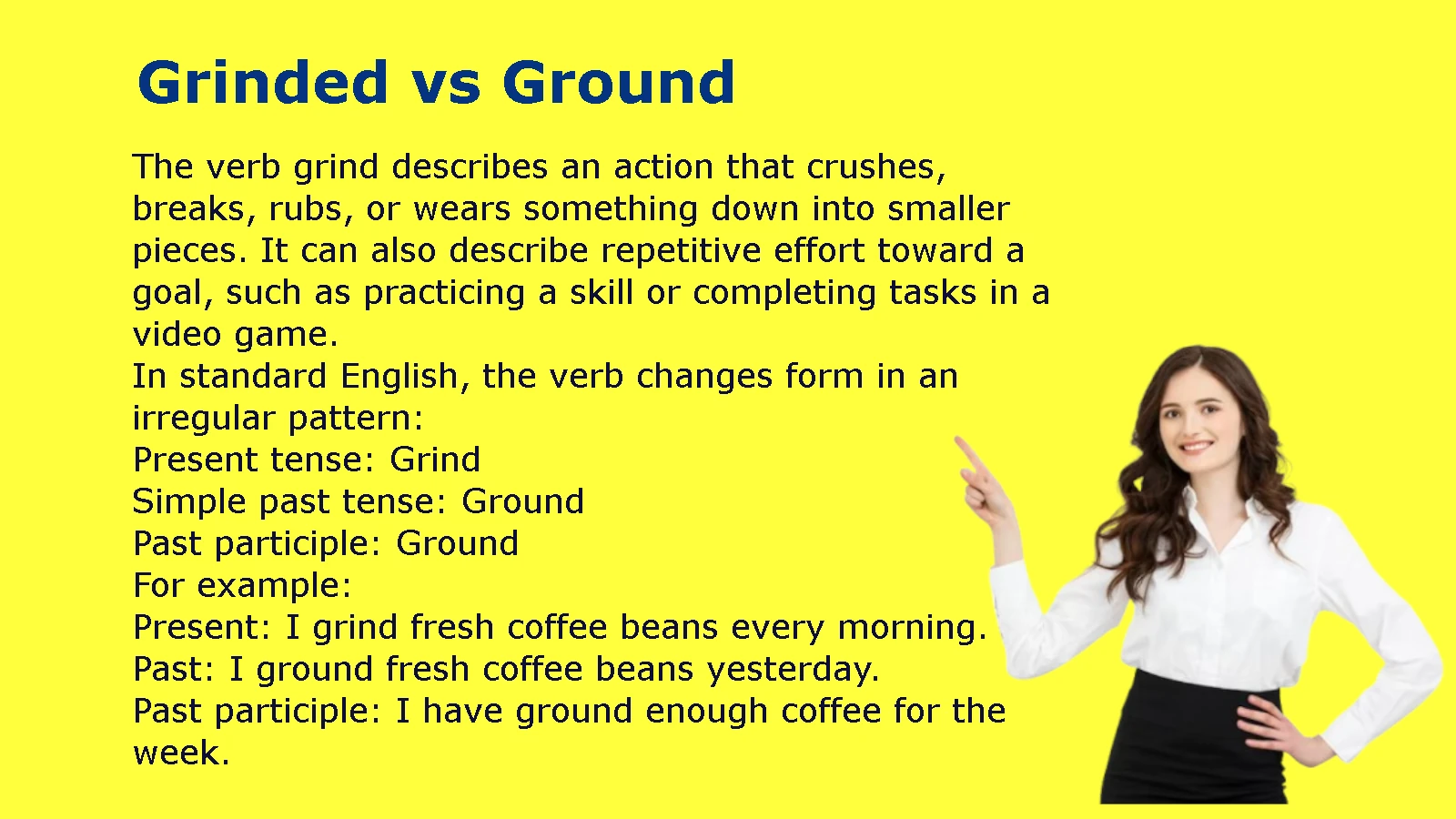
The verb grind describes an action that crushes, breaks, rubs, or wears something down into smaller pieces. It can also describe repetitive effort toward a goal, such as practicing a skill or completing tasks in a video game.
In standard English, the verb changes form in an irregular pattern:
- Present tense: Grind
- Simple past tense: Ground
- Past participle: Ground
For example:
- Present: I grind fresh coffee beans every morning.
- Past: I ground fresh coffee beans yesterday.
- Past participle: I have ground enough coffee for the week.
Notice that the past tense does not use the usual -ed ending. Instead, grind changes to ground. This pattern is similar to other irregular verbs, including find → found and bind → bound.
If you are writing an essay, preparing a report, or publishing an article, ground is the form you should choose.
Is Grinded Ever Correct?
Grinded appears in informal English, particularly in video game discussions, online communities, and some action-sports conversations. People use it to describe repetitive work, progress toward a goal, or a completed physical maneuver.
For example:
- “I grinded for hours to unlock the new character.”
- “He grinded the rail during the skate session.”
- “We grinded all weekend to prepare for the competition.”
These sentences reflect how some speakers use the word informally. However, the standard grammatical form remains ground.
It is helpful to distinguish between a word that people use and the form that standard edited English recommends. A slang expression can communicate a meaning clearly without being the best choice for formal writing.
For example, a gamer might naturally write, “I grinded all night for rare items,” in a casual chat. In a school assignment or formal article, “I ground all night to earn rare items” follows the standard irregular verb pattern, although a writer might choose a more natural alternative such as “I spent all night grinding for rare items.”
The right choice depends on your audience, purpose, and tone.
Grinded vs Ground: The Quick Answer
Use this table when you need a quick decision.
| Context | Preferred word | Example |
| Cooking and food preparation | Ground | I ground the coffee beans before breakfast. |
| Meat and spices | Ground | We bought ground turkey for dinner. |
| Tools and manufacturing | Ground | He ground down the sharp metal edges. |
| Formal writing | Ground | She ground the ingredients into a powder. |
| Video game slang | Ground or grinded | I grinded all weekend to level up. |
| Present participle | Grinding | She is grinding coffee beans. |
| Past participle | Ground | The beans have been ground. |
| Restricting someone’s activities | Grounded | My parents grounded me for a week. |
Quick rule: If you are unsure whether to write grinded or ground, choose ground. It is the standard past tense and past participle of grind.
Why Is Ground the Past Tense of Grind?
The word ground follows an irregular verb pattern that English speakers learn through common usage. Unlike regular verbs, which generally form their past tense by adding -ed, irregular verbs change in different ways. The forms grind, ground, ground are the accepted standard forms.
Grind, Ground, Ground: The Irregular Verb Pattern
English has many irregular verbs. Some change their vowels, while others change more dramatically.
Consider these examples:
| Present tense | Simple past | Past participle |
| Grind | Ground | Ground |
| Find | Found | Found |
| Bind | Bound | Bound |
| Wind | Wound | Wound |
| Break | Broke | Broken |
| Speak | Spoke | Spoken |
| Write | Wrote | Written |
| Eat | Ate | Eaten |
These verbs do not follow one universal pattern. You must learn their accepted forms individually or recognize familiar patterns.
For grind, the correct sequence is straightforward:
- Grind: Use it for the present tense.
- Ground: Use it for the simple past.
- Ground: Use it as the past participle.
Examples:
Present tense: The machine grinds coffee beans into a fine powder.
Simple past: The machine ground the beans in seconds.
Past participle: The machine has ground thousands of beans this morning.
The same rule applies whether you grind food, sharpen metal, or describe repetitive effort. The meaning may change, but the standard verb forms remain the same.
When to Use Ground as the Past Participle
The past participle is a verb form used with helping verbs to create perfect tenses and certain other constructions. For grind, that form is ground.
You will commonly see it with have, has, and had.
Present perfect:
- I have ground the coffee beans.
- She has ground the spices.
- They have ground the material into smaller particles.
Past perfect:
- I had ground the beans before the guests arrived.
- The workers had ground the metal smooth before applying the finish.
- She had ground the ingredients before the recipe called for them.
The distinction between the simple past and the past participle becomes clearer when you compare sentences.
| Sentence | Verb form | Why it works |
| I ground the coffee yesterday. | Simple past | Describes a completed past action. |
| I have ground the coffee. | Past participle | Follows the helping verb have. |
| She had ground the spices earlier. | Past participle | Follows the helping verb had. |
| He is grinding the beans. | Present participle | Uses the -ing form. |
A common mistake is writing “I have grinded the beans.” In standard English, the correct version is “I have ground the beans.”
This rule applies even when the sentence refers to an activity that takes considerable time. The duration of the action does not change the verb’s standard past participle.
Common Examples of Ground in Everyday English
The verb grind appears in several everyday situations. Recognizing its meaning in different contexts makes the correct past-tense form easier to remember.
Cooking and food preparation
- I ground black pepper over the salad.
- She ground the coffee beans just before brewing.
- We ground the spices to release their aroma.
- The butcher ground the beef for the burgers.
Tools and manufacturing
- The technician ground down the rough edge.
- The mechanic ground the damaged surface smooth.
- The factory ground the material into a fine powder.
- The workers ground the metal until it met the required specifications.
Mechanical movement and friction
- The gears ground against each other.
- The old machine ground noisily during operation.
- The brakes ground against the damaged component.
Teeth grinding
- He ground his teeth while sleeping.
- She ground her teeth during a stressful meeting.
In each example, ground is the standard simple past form. The verb can describe crushing, sharpening, rubbing, or pressing, but the grammatical pattern does not change.
When Is Grinded Used in Modern English?
Although ground is the standard form, grinded appears in certain informal settings. Its use often reflects the vocabulary and habits of a particular community rather than standard grammar. Gaming, skateboarding, BMX, and casual online conversations provide useful examples of how this happens.
Grinded in Video Games
In gaming, grinding means repeating an activity to gain experience points (XP), earn currency, collect equipment, unlock rewards, or improve a character.
Players may repeat the same mission, defeat the same enemies, or complete similar challenges many times. The process can require hours of effort, so the word grind has become a familiar part of gaming vocabulary.
For example:
- “I grinded for three hours to reach level 50.”
- “She grinded missions all weekend to earn better equipment.”
- “We spent the entire evening grinding for rare items.”
- “He has been grinding ranked matches to improve his score.”
These sentences reflect informal usage. In standard English, the past-tense form would use ground, but many players use grinded in casual communication.
A writer does not always need to replace community slang. If you are writing dialogue for a character who is a gamer, using grinded may help preserve the character’s natural voice. The same may apply to a community post where readers expect gaming terminology.
However, if you are writing a grammar guide, academic paper, or formal publication, use the standard form or rephrase the sentence.
For example:
- Informal: “I grinded all night for XP.”
- Standard: “I ground all night to earn XP.”
- More natural formal alternative: “I spent all night grinding for XP.”
The third version is often the smoothest choice because it preserves the familiar gaming term without forcing an awkward sentence.
Practical tip: When describing gaming effort, you can often avoid the disagreement entirely by using spent hours grinding, worked toward the next level, or repeated missions to earn rewards.
Grinded in Skateboarding and BMX
In skateboarding and BMX, a grind is a maneuver in which a rider slides along an edge, rail, ledge, or similar surface using a skateboard’s trucks or parts of a bicycle.
The noun and verb are well established in action-sports vocabulary. The disagreement concerns the past-tense form.
Consider these examples:
- “He grinded the handrail during practice.”
- “She grinded along the ledge before landing the trick.”
- “The rider has grinded that rail several times.”
These sentences reflect informal usage found in some conversations. In standard edited English, the corresponding forms are ground and has ground.
For example:
- Standard: “He ground along the rail.”
- Standard: “She has ground along the ledge several times.”
However, an editor should also consider natural phrasing. In a sports article, “He completed a rail grind” or “She performed a clean grind along the ledge” may communicate the action more naturally than either past-tense construction.
The key is to distinguish the sport-specific meaning from the grammatical rule. The word grind can name a trick or describe the action, but that does not automatically make grinded the standard past-tense form.
Grinded in Dance and Pop Culture
In dance and pop culture, grinding can refer to a style of close-contact dancing involving rhythmic body movements. Informal speech may use grinded to describe a completed dance or movement.
For example:
- “They grinded on the dance floor all night.”
- “The crowd cheered while the performers danced.”
- “They were grinding to the music.”
The first sentence reflects colloquial usage. The third uses the -ing form, which is standard.
If you are writing a formal description, you can often choose a clearer alternative:
- “They danced together throughout the night.”
- “The performers moved rhythmically to the music.”
- “The couple spent the evening dancing.”
These alternatives avoid a potentially distracting grammatical choice while preserving the intended meaning.
Context also matters because grind has several meanings. It can describe physical movement, repetitive effort, or the act of crushing something. A reader should be able to tell which meaning you intend from the surrounding sentence.
Should You Use Grinded in Formal Writing?
For formal writing, use ground as the past tense and past participle of grind. This choice follows standard English grammar and avoids distracting readers who expect the conventional irregular form.
Use ground in:
- School essays and academic assignments.
- Professional reports and business communications.
- News articles and informational blog posts.
- Technical instructions and manufacturing documentation.
- Edited fiction and general explanatory writing.
You may retain grinded when reproducing informal speech, quoting a person, or writing dialogue that deliberately reflects a character’s language.
For example, a grammar article might explain that some players say, “I grinded all weekend.” There is no need to change the quotation if the wording accurately represents what the speaker said.
Similarly, a novelist might use grinded in dialogue to convey a character’s voice. That is a stylistic decision, not a reason to change the standard verb rule.
Editorial rule: Use ground by default. Keep grinded only when the informal wording serves a clear purpose.
Ground vs. Grounded: What Is the Difference?
The words ground and grounded look similar, but they do not always come from the same verb. Ground is the standard past tense of grind. Grounded is the regular past-tense and past-participle form of the separate verb to ground.
Understanding the difference prevents mistakes in sentences about food, punishment, electrical systems, and other subjects.
Ground as the Past Tense of Grind
When ground means that someone crushed, sharpened, rubbed, or reduced something, it is the past tense of grind.
Examples:
- I ground the coffee beans before breakfast.
- The chef ground the spices for the sauce.
- The worker ground the rough metal surface.
- The machine ground the material into fine particles.
The past participle is also ground:
- I have ground the coffee beans.
- The chef has ground the spices.
- The workers had ground the surface before polishing it.
In these examples, ground describes the action or its result. It does not mean that someone has received a punishment or that an electrical connection has been made.
Grounded as the Past Tense of To Ground
The separate verb to ground can mean to restrict someone’s activities, prevent an aircraft from flying, or connect an electrical system to ground for safety.
Its usual past-tense form is grounded.
Punishment or restriction
- My parents grounded me for missing curfew.
- She grounded her teenager for breaking the rules.
- His parents had grounded him for the weekend.
Aviation
- Bad weather grounded several flights.
- The airline grounded the aircraft for inspection.
- The pilot was grounded until the medical review was complete.
Electrical safety
- The electrician grounded the appliance.
- The technician checked whether the equipment was properly grounded.
- The metal enclosure must be grounded according to the applicable installation requirements.
Compare these examples:
| Sentence | Verb | Meaning |
| I ground the coffee beans. | Grind | Crush the beans. |
| I ground the beans yesterday. | Grind | Past-tense action. |
| My parents grounded me. | Ground | Restricted my activities. |
| The electrician grounded the appliance. | Ground | Connected it to an electrical grounding system. |
Although the verbs share the spelling ground, their meanings and grammatical patterns differ.
Ground as a Noun
Ground is also a common noun. It can refer to the earth, the surface beneath your feet, a particular area of land, or a basis for an argument.
Examples include:
- The children played on the ground.
- The hikers covered several miles of uneven ground.
- The school has large sports grounds.
- She had good grounds for questioning the decision.
- The gardener prepared the ground for planting.
In electrical contexts, ground can also refer to an electrical reference point or grounding connection.
These meanings are separate from the past-tense form of grind. Their shared spelling is one reason readers may find the word confusing, but context usually makes the intended meaning clear.
For example, in “The coffee was ground this morning,” the word describes a completed action. In “The cup fell to the ground,” it identifies a surface.
Grinded vs Ground: Examples in Real Sentences
The easiest way to learn the difference is to compare complete sentences. Pay attention to the meaning of grind, the tense of the sentence, and whether the situation calls for standard English or informal slang.
Correct Examples Using Ground
Here are examples of ground used as the simple past tense:
- “I ground fresh coffee before the guests arrived.”
- “The chef ground the pepper over the finished dish.”
- “The mechanic ground the sharp edge off the metal.”
- “The factory ground the raw material into a fine powder.”
- “The gears ground together as the machine started.”
- “She ground her teeth during the stressful conversation.”
- “The workers ground the surface until it was smooth.”
The word also appears as a past participle:
- “I have ground enough coffee for everyone.”
- “The spices had been ground before the cooking began.”
- “The material has been ground into smaller particles.”
- “The beans were freshly ground that morning.”
Notice the phrase freshly ground coffee. It describes coffee beans that someone has already ground. The past participle remains ground, even when an adverb such as freshly appears before it.
Informal Examples Using Grinded
The following examples show how grinded may appear in informal contexts:
- “I grinded for hours to unlock the final reward.”
- “He grinded all weekend to improve his character.”
- “She grinded ranked matches until she reached the next division.”
- “He grinded the rail during the skate session.”
- “They grinded on the dance floor all evening.”
These examples illustrate colloquial usage rather than the standard grammatical pattern. In formal prose, you would generally use ground where the sentence calls for the simple past or past participle of grind.
However, not every sentence needs a direct word-for-word replacement. Sometimes rewriting the sentence produces a more natural result.
| Informal sentence | Standard alternative |
| I grinded for hours to level up. | I spent hours grinding to level up. |
| She grinded all weekend for rewards. | She spent the weekend grinding for rewards. |
| He grinded the rail during practice. | He performed a rail grind during practice. |
| They grinded on the dance floor. | They danced together on the dance floor. |
This approach is especially useful for SEO articles, instructional content, and professional writing. It preserves the meaning while keeping the language natural.
Common Mistakes to Avoid
Several mistakes appear repeatedly when people compare grinded and ground.
Mistake: Using grinded in standard past-tense sentences
Incorrect for standard English: “I grinded the coffee beans.”
Correct: “I ground the coffee beans.”
The standard past tense is irregular. Adding -ed does not produce the conventional form.
Mistake: Using grinded after have, has, or had
Nonstandard: “She has grinded the spices.”
Standard: “She has ground the spices.”
The same rule applies to all perfect tenses.
Mistake: Writing freshly grinded coffee
Nonstandard: “We used freshly grinded coffee.”
Standard: “We used freshly ground coffee.”
Here, ground acts as a past participle describing the condition of the coffee.
Mistake: Confusing ground with grounded
Incorrect for the intended grinding meaning: “I grounded the coffee beans.”
Correct: “I ground the coffee beans.”
The form grounded belongs to the separate verb to ground. It may be correct in another context, such as “My parents grounded me.”
Mistake: Assuming every informal expression belongs in formal writing
A word can be common in a particular community without being the preferred form in standard edited English. When writing for a broad audience, use the conventional form unless you have a good reason to preserve the informal expression.
How to Choose Between Grinded and Ground
Choosing the correct word becomes easier when you consider three things: the verb’s meaning, the sentence’s grammatical structure, and the audience.
Use Ground in Standard English
Use ground when you describe a completed grinding action in ordinary writing.
Examples:
- “I ground the coffee beans.”
- “The technician ground the metal.”
- “She has ground the spices.”
- “The material had been ground into powder.”
This rule applies whether the action involves food, machinery, physical friction, or another ordinary meaning of grind.
When in doubt, identify the base verb first. If the intended verb is grind, the standard past tense is ground, and the past participle is also ground.
Consider Grinded in Informal Community Contexts
In casual conversations, grinded may reflect how a person or community naturally speaks. Gaming forums, private chats, and informal dialogue can use vocabulary that differs from formal edited English.
For example, a player might write:
“I grinded for six hours to get that rare item.”
Readers familiar with the gaming context will likely understand the intended meaning. A formal article, however, would normally use a different construction:
“I spent six hours grinding for that rare item.”
The revised sentence sounds natural and avoids a debate about the past tense.
Use the informal form thoughtfully. If you are quoting a player, reproducing dialogue, or writing for a community where the expression is familiar, retaining grinded may be appropriate. If you are explaining grammar or publishing formal material, choose standard usage.
A Simple Rule to Remember
If you are unsure, use ground.
Remember the three main forms:
- Grind: Present tense.
- Ground: Simple past tense.
- Ground: Past participle.
A short memory trick can help: you grind today, you ground the beans yesterday, and you have ground them already.
For example:
- Today: “I grind coffee every morning.”
- Yesterday: “I ground coffee before work.”
- Already completed: “I have ground the coffee.”
This simple pattern covers the overwhelming majority of standard English situations involving the verb grind.
Frequently Asked Questions About Grinded vs Ground
Is Grinded a Real Word in the Dictionary?
Grinded appears in some informal and specialized uses, although dictionary treatment varies. Its appearance in a reference or online conversation does not make it the preferred standard past tense of grind. In general writing, ground remains the conventional choice.
Do You Say Freshly Ground Coffee or Freshly Grinded Coffee?
The standard expression is freshly ground coffee. Here, ground is the past participle of grind and describes coffee beans that have already been crushed. For example, “I prefer freshly ground coffee because I can grind the beans just before brewing.”
What Is the Past Tense of Grind in Gaming?
The standard past tense is ground, including when discussing video games. However, some players use grinded informally to describe repeating tasks for XP, rewards, or progress. For formal writing, use ground or rephrase the sentence as “spent hours grinding.”
Is Grinded Grammatically Correct?
In standard English, grinded is generally treated as a nonstandard alternative to ground when it is used as the past tense or past participle of grind. It still appears in informal speech and certain community-specific settings. Use ground in formal writing unless you are deliberately preserving slang or dialogue.
What Is the Past Participle of Grind?
The past participle of grind is ground. Use it with helping verbs such as have, has, and had. For example, “I have ground the beans,” “She has ground the spices,” and “They had ground the material before the inspection.”
Is It Ground or Grounded in a Sentence?
Use ground for the past tense of grind, as in “I ground the coffee beans.” Use grounded for the separate verb to ground, as in “My parents grounded me” or “The electrician grounded the appliance.” The correct form depends on the verb’s meaning.
Conclusion: Grinded vs Ground
The difference between Grinded vs Ground comes down to standard grammar and context. Ground is the accepted past tense and past participle of grind. Use it in sentences about grinding coffee, crushing spices, sharpening metal, or describing other grinding actions.
Grinded appears in informal language, particularly in gaming and some action-sports communities. Readers may understand it in those settings, but it is not the preferred form in standard edited English. You can preserve it in dialogue or community-specific writing when it serves a clear purpose.
Keep this rule in mind: grind → ground → ground. If you are writing an essay, article, report, or professional message, choose ground. If you encounter grinded in a casual conversation, consider the context before judging the speaker’s meaning.