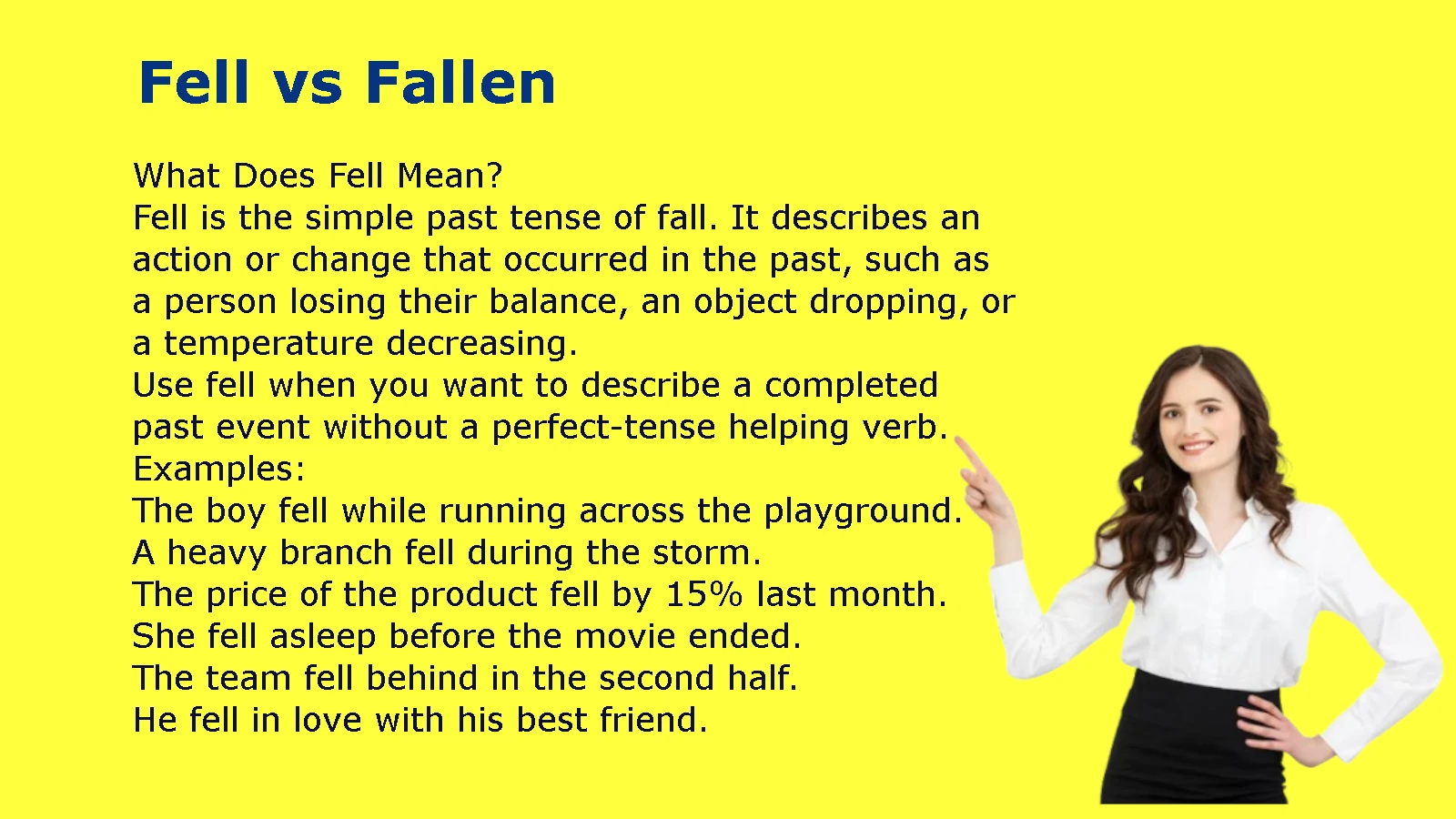
Fell vs Fallen is a common English grammar question because both words come from the verb fall, but they serve different grammatical purposes. Fell is the simple past tense of fall, while fallen is its past participle, used with helping verbs such as have, has, and had. Understanding this difference helps you choose the correct form in sentences such as “She fell yesterday” and “She has fallen before.”
The same rule applies to common expressions such as fell in love vs. fall in love, fell down vs. fall down, and have fallen vs. have fell. You also need to distinguish fell vs. feel, since these words have different meanings and verb forms. Once you understand how the base form, simple past tense, and past participle work together, you can use each word correctly in everyday conversations, school assignments, emails, and professional writing.
Fell vs Fallen: What’s the Difference?
Fell is the simple past tense of fall and describes an action that happened in the past. Fallen is the past participle of fall and usually appears with have, has, or had. For example, “The glass fell” describes a past event, while “The glass has fallen” uses the present perfect tense.
The difference depends on the grammatical structure of your sentence, not simply on when the action happened.
| Word | Grammatical form | Example |
| Fall | Base form | Leaves fall from the trees. |
| Falls | Present tense, third-person singular | The temperature falls at night. |
| Fell | Simple past tense | The temperature fell yesterday. |
| Fallen | Past participle | The temperature has fallen. |
| Falling | Present participle | The temperature is falling. |
These forms express different grammatical relationships. You cannot freely substitute one for another without changing the sentence or making it grammatically incorrect.
What Does Fell Mean?
Fell is the simple past tense of fall. It describes an action or change that occurred in the past, such as a person losing their balance, an object dropping, or a temperature decreasing.
Use fell when you want to describe a completed past event without a perfect-tense helping verb.
Examples:
- The boy fell while running across the playground.
- A heavy branch fell during the storm.
- The price of the product fell by 15% last month.
- She fell asleep before the movie ended.
- The team fell behind in the second half.
- He fell in love with his best friend.
In each example, fell reports something that happened in the past.
Notice that the action does not always involve physically dropping to the ground. English also uses fall in figurative expressions, including fall asleep, fall behind, fall apart, and fall in love.
For example, “The company fell behind its competitors” means that the company lost ground in its progress or performance. It does not mean that the company physically fell.
What Does Fallen Mean?
Fallen is the past participle of fall. It commonly appears after have, has, or had to form perfect tenses. It can also function as an adjective, as in “fallen leaves.”
Use fallen when the sentence requires a past participle rather than the simple past tense.
Examples:
- The boy has fallen asleep.
- Several branches have fallen during the storm.
- The price had fallen before the company introduced its discount.
- She has fallen in love with someone new.
- The fallen leaves covered the garden path.
- The old building has fallen into disrepair.
The first four examples use fallen in perfect-tense constructions. The last two illustrate its use as an adjective or part of an established expression.
The helping verb determines which form you need. You would say “She has fallen,” not “She has fell,” in standard English.
However, you do not always need a helping verb before fallen. In the phrase “fallen leaves,” the word describes the leaves. It functions as a participial adjective.
Fell vs Fallen Examples in Sentences
Comparing similar sentences makes the difference easier to remember.
| Fell | Fallen | Why the form changes |
| The glass fell off the table. | The glass has fallen off the table. | Simple past vs. present perfect |
| He fell asleep early. | He had fallen asleep before I arrived. | Simple past vs. past perfect |
| The leaves fell overnight. | The leaves have fallen overnight. | Simple past vs. present perfect |
| She fell in love last year. | She has fallen in love. | Simple past vs. present perfect |
| The temperature fell sharply. | The temperature has fallen sharply. | Simple past vs. present perfect |
Both columns can describe past events. The distinction is grammatical: the simple past uses fell directly, while the perfect tenses use fallen with a form of have.
Consider these two sentences:
- “The price fell yesterday.”
- “The price has fallen since Monday.”
The first sentence places the event in a completed past period. The second describes a change that has occurred over a period extending to the present. In American English, a specific finished time expression such as yesterday generally calls for the simple past rather than the present perfect.
What Is the Past Tense and Past Participle of Fall?
The simple past tense of fall is fell, and its past participle is fallen. The complete principal forms are fall – fell – fallen. Use fell for a simple past action and fallen with helping verbs such as have, has, and had.
Fall Verb Forms: Fall, Fell, Fallen, and Falling
The verb fall is irregular because it does not form its past tense by simply adding -ed. Instead, it changes to fell in the simple past and fallen in the past participle.
| Verb form | Name | Example |
| Fall | Base form | Be careful not to fall. |
| Falls | Third-person singular present | Snow falls in winter. |
| Fell | Simple past | Snow fell last night. |
| Fallen | Past participle | Snow has fallen overnight. |
| Falling | Present participle or gerund | Snow is falling now. |
Each form has a specific role.
Fall: Use the base form after to, most modal verbs, and plural subjects in the simple present.
- I want to fall asleep.
- They fall behind when they miss practice.
- You might fall if you run on the wet floor.
Falls: Use this form with a singular third-person subject in the simple present.
- The temperature falls after sunset.
- He falls asleep quickly.
- The stock price falls when demand weakens.
Fell: Use this form for a simple past event.
- The temperature fell overnight.
- He fell asleep during the lecture.
- The stock price fell last week.
Fallen: Use this form with a perfect-tense helping verb or as a participial adjective.
- The temperature has fallen.
- He had fallen asleep before the call.
- Fallen branches blocked the road.
Falling: Use this form in continuous tenses or as a gerund.
- The temperature is falling.
- Falling rocks can damage vehicles.
- She is falling behind in her studies.
Is Fell the Past Tense of Fall?
Yes. Fell is the standard simple past tense of fall. English has many irregular verbs that change their spelling instead of adding -ed. Examples include go – went, see – saw, and take – took.
The same pattern applies to fall:
- Present: I fall when I lose my balance.
- Past: I fell when I lost my balance yesterday.
- Present perfect: I have fallen before.
Do not write “I falled” in standard English. The correct form is “I fell.”
The word fell also exists as a separate verb meaning to cut down a tree or bring something down. That verb follows a different pattern:
- Present: Workers fell trees.
- Past: Workers felled a tree yesterday.
- Past participle: Workers have felled several trees.
This distinction matters because fell can be either the past tense of fall or the base form of a different verb. Context tells you which meaning applies.
Is Fallen the Past Participle of Fall?
Yes. Fallen is the past participle of fall, and standard perfect-tense constructions use it after have, has, or had.
The three main perfect-tense patterns are:
| Tense | Structure | Example |
| Present perfect | Have/has + fallen | The child has fallen asleep. |
| Past perfect | Had + fallen | The child had fallen asleep before dinner. |
| Future perfect | Will have + fallen | By midnight, the temperature will have fallen. |
The present perfect connects a past event to the present. The past perfect places an event before another past event. The future perfect describes an event expected to be complete by a future point.
Examples:
- Present perfect: Several trees have fallen during the storm.
- Past perfect: Several trees had fallen before the rescue team arrived.
- Future perfect: By morning, the snow will have fallen for twelve hours.
In each case, fallen remains unchanged. The helping verb carries the tense information.
Have Fallen or Have Fell: Which Is Correct?
Have fallen is correct in standard English, while have fell is generally considered a grammatical error. The verb have requires a past participle in perfect-tense constructions, and fallen is the past participle of fall. Use fell when you form the simple past without a perfect-tense helping verb.
Have Fallen vs. Have Fell
The correct phrase is have fallen, not have fell.
Compare the examples below:
| Incorrect | Correct |
| I have fell down. | I have fallen down. |
| They have fell behind. | They have fallen behind. |
| We have fell asleep. | We have fallen asleep. |
| You have fell into a trap. | You have fallen into a trap. |
Why does this happen? English perfect tenses follow a common structure:
Subject + have/has/had + past participle
For example:
- I have written the report.
- She has gone home.
- They had seen the movie.
- We have fallen behind.
You would not normally write “She has went home” or “They have saw the movie.” The same grammatical principle makes “have fell” incorrect in standard English.
If you do not need a perfect-tense construction, use the simple past:
- I fell down yesterday.
- They fell behind last week.
- We fell asleep during the flight.
The choice depends on the sentence structure, not on whether the event seems recent or distant.
Has Fallen or Has Fell?
Has fallen is the correct form when the subject is singular and the sentence uses the present perfect tense.
Use has with he, she, it, and singular nouns. Then add the past participle fallen.
Correct examples:
- She has fallen behind in her coursework.
- The vase has fallen off the shelf.
- My brother has fallen asleep.
- The temperature has fallen below freezing.
- The company has fallen into financial difficulty.
Incorrect examples include “She has fell behind” and “The vase has fell off the shelf.”
Remember the pattern:
- I have fallen.
- You have fallen.
- We have fallen.
- They have fallen.
- He has fallen.
- She has fallen.
- It has fallen.
The participle does not change to match the subject. Only the helping verb changes between have and has in the present perfect tense.
Had Fallen or Had Fell?
Had fallen is correct in the past perfect tense. Use it to describe an action that had already happened before another past event.
Examples:
- The child had fallen asleep before the guests arrived.
- The price had fallen before the store announced its sale.
- Several trees had fallen by the time the storm ended.
- She had fallen in love with him long before they married.
The past perfect often helps readers understand the order of events.
Compare:
- “When I arrived, he fell asleep.”
- “When I arrived, he had fallen asleep.”
In the first sentence, the wording suggests that he fell asleep around the time of your arrival, though context can refine the meaning. In the second, he was already asleep before you arrived.
The structure remains the same for every subject:
Subject + had + fallen
Examples:
- I had fallen.
- You had fallen.
- He had fallen.
- We had fallen.
- They had fallen.
Do not use had fell in standard past perfect constructions.
Common Mistakes With Fell and Fallen
Writers often choose the wrong form because they focus on the action rather than the grammatical structure. Checking the word immediately before the verb can prevent most mistakes.
| Common mistake | Correct form | Reason |
| I have fell down. | I have fallen down. | Have requires the past participle. |
| She has fell asleep. | She has fallen asleep. | Has requires the past participle. |
| They had fell behind. | They had fallen behind. | Had requires the past participle. |
| I fallen yesterday. | I fell yesterday. | Simple past does not need a helping verb. |
| He will fallen soon. | He will fall soon. | A modal construction uses the base form. |
| She is fell down. | She has fallen down. / She is falling down. | Choose the construction that matches the intended meaning. |
A useful editing technique is to identify the helping verb first.
If the sentence contains have, has, or had as a perfect-tense auxiliary, check whether the next verb needs a past participle. If the sentence describes a completed past action without a perfect auxiliary, fell is usually the right choice.
Fell or Fall in Love: Which Is Correct?
Fall in love is the base-form expression, fell in love is the simple past, and fallen in love is the past participle construction. Choose the form according to the tense and sentence structure. For example, “They want to fall in love,” “They fell in love last year,” and “They have fallen in love” are all correct.
Fall in Love
Use fall in love when the sentence requires the base form of the verb. This often happens after to, modal verbs, or verbs that take an infinitive.
Examples:
- They hope to fall in love someday.
- You might fall in love when you least expect it.
- Some people fall in love quickly.
- She wants to fall in love again.
- It is easy to fall in love with a place that feels like home.
The expression can describe a future possibility, a general experience, or a process that someone hopes to experience.
You can also use the present continuous form to describe a developing experience:
- They are falling in love.
- I think she is falling in love with him.
The word fall stays in its base form after to and most modal verbs, but the sentence can take other forms when its grammar changes.
Fell in Love
Use fell in love to describe a past event.
Examples:
- They fell in love during college.
- She fell in love with the city after her first visit.
- I fell in love with that song when I heard it.
- My grandparents fell in love when they worked together.
- He fell in love with photography as a teenager.
The simple past works especially well when you include a finished time reference, such as last year, during college, or when they first met.
Compare these sentences:
- “They fall in love easily.” This describes a general tendency.
- “They fell in love last summer.” This describes a past event.
- “They have fallen in love.” This describes a past development connected to the present.
Each sentence is grammatical, but each communicates a different time relationship.
Fallen in Love
Use fallen in love after a suitable helping verb, such as have, has, or had.
Examples:
- She has fallen in love with her new home.
- They have fallen in love with each other.
- He had fallen in love before he realized what was happening.
- By the time they married, they had fallen in love deeply.
The present perfect often emphasizes a current state or a change that has occurred. The past perfect helps place the experience before another past event.
A common mistake is writing “She has fell in love.” The correct form is “She has fallen in love” because has requires the past participle.
Fell or Fall Down: What’s the Difference?
Fall down uses the base form of the verb, while fell down uses its simple past form. Use fall down after to and modal verbs or for present-tense instructions. Use fell down to report a completed past event.
When to Use Fall Down
Use fall down when the sentence needs the base form of fall.
Examples:
- Be careful not to fall down.
- I might fall down if I walk on that ice.
- Small children sometimes fall down while learning to walk.
- You should sit down before you fall down.
- The old wall could fall down during another storm.
The phrase can refer to a physical fall or, figuratively, to something collapsing or failing.
For example, “The plan could fall down at the final stage” may mean that the plan could fail. However, in everyday American English, speakers often prefer more specific alternatives such as fall apart, break down, or fail, depending on the context.
The base form also appears after to:
- I do not want to fall down.
- She tried not to fall down.
When to Use Fell Down
Use fell down to describe a past event.
Examples:
- I fell down while jogging yesterday.
- The picture fell down from the wall.
- The child fell down but got up immediately.
- Several boxes fell down when the shelf broke.
- The old wall fell down during the storm.
The phrase often takes a time expression that establishes when the action occurred.
For example, “He fell down this morning” reports a completed event. You do not need have before fell because the simple past tense already expresses the past action.
Compare:
- Correct: “She fell down during practice.”
- Correct: “She has fallen down several times.”
- Incorrect in standard English: “She has fell down several times.”
Fall Down vs. Fell Down vs. Fallen Down
The three expressions share the same base verb but appear in different grammatical structures.
| Expression | Usage | Example |
| Fall down | Base form or present tense | Try not to fall down. |
| Falls down | Simple present, third-person singular | The loose shelf falls down whenever someone bumps it. |
| Fell down | Simple past | The shelf fell down yesterday. |
| Has fallen down | Present perfect | The shelf has fallen down twice. |
| Had fallen down | Past perfect | The shelf had fallen down before we repaired it. |
| Is falling down | Present continuous | The damaged shelf is falling down. |
You can use this table as a quick reference when writing about accidents, damaged objects, or physical movement.
One additional point: fall down and fall over often overlap, but they are not always identical in emphasis. Fall down highlights movement toward the ground, while fall over often emphasizes tipping from an upright position.
For example:
- The child fell down on the pavement.
- The empty bottle fell over on the table.
Both phrases can describe physical movement, but the surrounding context helps determine the more natural choice.
Fell vs. Feel: Meaning, Grammar, and Examples
Fell is the simple past tense of fall, while feel is a present-tense verb meaning to experience a sensation, emotion, or impression. The simple past of feel is felt, not fell. These words can sound similar in some accents, but their meanings and grammatical forms are different.
Fell Meaning and Examples
When fell comes from fall, it describes a past movement, decrease, or change of state.
Examples:
- The ball fell into the river.
- The temperature fell overnight.
- She fell asleep during the movie.
- The team fell behind after halftime.
- He fell in love with music at an early age.
The word can also refer to bringing down a tree when used as the simple present form of the separate verb fell. In that context, the past tense is felled.
For example:
- Present: The workers fell old trees.
- Past: The workers felled an old tree yesterday.
This is a different meaning from the past tense of fall.
Feel Meaning and Examples
Feel describes a physical sensation, an emotional experience, or an impression about something.
Examples:
- I feel tired after work.
- She feels happy about the news.
- This fabric feels soft.
- I feel that we should wait.
- They feel nervous before an important interview.
The simple past tense is felt.
Examples:
- I felt tired after work yesterday.
- She felt happy when she heard the news.
- The fabric felt rough.
- We felt nervous before the interview.
The past participle is also felt, so you would say “I have felt this way before,” not “I have fell this way before.”
Fell vs. Feel: Quick Comparison
| Word | Meaning | Verb form | Example |
| Fall | Move downward or decrease | Base form | Leaves fall in autumn. |
| Fell | Past action involving falling | Simple past of fall | The leaves fell yesterday. |
| Fallen | Used in perfect tenses or as an adjective | Past participle of fall | The leaves have fallen. |
| Feel | Experience a sensation or emotion | Base form | I feel cold. |
| Felt | Past experience or sensation | Simple past and past participle of feel | I felt cold yesterday. |
A simple memory trick can help:
- Fall – fell – fallen: movement, decline, or a change of state.
- Feel – felt – felt: sensations, emotions, and impressions.
Try comparing these examples:
- “I fell on the stairs.” This describes a physical accident.
- “I felt pain in my knee.” This describes a physical sensation.
- “I have fallen on these stairs before.” This uses the past participle of fall.
- “I have felt pain in my knee before.” This uses the past participle of feel.
The difference becomes clear when you connect each word to its meaning.
What Does Fell Mean? Other Meanings Explained
The word fell has more than one meaning in English. It most commonly serves as the past tense of fall, but it can also be the base form of a verb meaning to cut down a tree. In addition, fell appears as a literary adjective and as a regional noun.
Fell as the Past Tense of Fall
This is the meaning most readers have in mind when they search for fell meaning.
Examples include:
- The book fell off the desk.
- The temperature fell below zero.
- He fell asleep on the sofa.
- The company fell behind its competitors.
- Their relationship fell apart after years of disagreement.
In these sentences, fell describes a past event or change. It can be literal, as with a book dropping, or figurative, as with a relationship ending.
The past participle for this meaning is fallen.
- The book has fallen off the desk.
- The temperature has fallen below zero.
- He has fallen asleep.
Fell as a Verb Meaning to Cut Down
To fell a tree means to cut it down. This is a separate verb from fall, even though the two words share the same spelling in the present tense.
Its main forms are:
| Form | Example |
| Base form: fell | Workers fell trees for timber. |
| Simple past: felled | Workers felled a tree yesterday. |
| Past participle: felled | The storm has felled several trees. |
| Present participle: felling | The crew is felling damaged trees. |
Notice the distinction:
- “The tree fell during the storm.” The tree came down by itself or as a result of the storm.
- “The workers felled the tree.” The workers deliberately cut it down.
- “The workers have felled the tree.” The past participle of the separate verb is felled.
This difference can change the meaning of a sentence significantly. In forestry, land management, and news reporting, choosing the correct form helps readers understand whether something fell naturally or someone brought it down.
Fell as an Adjective or Noun
The word fell also appears in less common uses.
As an adjective, fell can mean fierce, cruel, or destructive. This usage is mainly literary or formal.
Example:
- The hero faced a fell enemy.
Here, fell describes the enemy as dangerous or cruel. It does not refer to falling.
As a noun, fell can refer to a high, open area of upland, particularly in northern England.
Example:
- The hikers crossed the fell before sunset.
This regional meaning appears in place names, landscape descriptions, and writing about upland areas. It is less common in everyday American English than the verb forms of fall.
When you encounter fell, check the surrounding words to identify its grammatical role. A sentence such as “The tree fell” uses a verb, while “a fell enemy” uses an adjective.
How to Choose Between Fall, Fell, and Fallen
The easiest way to choose between fall, fell, and fallen is to examine the structure of your sentence. Use fall as the base form, fell for a simple past action, and fallen when a perfect-tense construction requires the past participle. A quick check of the helping verb usually resolves the problem.
Use Fall for the Base Form and Present Tense
Use fall when the sentence needs the base form of the verb.
Common situations include:
- After to: “I want to fall asleep.”
- After modal verbs: “You might fall.”
- With plural subjects in the simple present: “Leaves fall in autumn.”
- In commands: “Do not fall!”
- After do, does, and did in questions or negatives: “Did you fall?”
Be especially careful with questions and negatives in the simple past. The helping verb did already carries the past tense, so the main verb returns to its base form.
Correct:
- Did she fall?
- He did not fall.
- They did not fall behind.
Incorrect in standard English:
- Did she fell?
- He did not fell.
The same principle applies to other verbs: “Did you go?” is standard, not “Did you went?”
Use Fell for a Completed Past Action
Use fell when you describe an event in the simple past without a perfect-tense auxiliary.
Examples:
- I fell yesterday.
- The book fell off the shelf.
- The temperature fell overnight.
- She fell in love during college.
- The company fell behind its schedule.
Finished-time expressions often make the simple past a natural choice.
Common expressions include:
- Yesterday
- Last night
- Last week
- Two days ago
- In 2024
- When I was younger
For example, “The price fell last week” is more natural in standard American English than “The price has fallen last week” because last week identifies a completed past period.
Use Fallen With Have, Has, or Had
Use fallen when a perfect-tense construction requires the past participle.
Examples:
- I have fallen before.
- She has fallen behind.
- They had fallen asleep before the film ended.
- The leaves have fallen from the trees.
- By the end of the storm, several trees will have fallen.
Remember that the helping verb carries the tense. The participle stays the same.
| Helping verb | Correct construction | Example |
| Have | Have fallen | We have fallen behind. |
| Has | Has fallen | He has fallen asleep. |
| Had | Had fallen | She had fallen before I reached her. |
| Will have | Will have fallen | The temperature will have fallen by dawn. |
| May have | May have fallen | The package may have fallen off the truck. |
The final two examples show that other auxiliary combinations can also require the past participle.
You can use the same principle with feel:
- She felt tired yesterday.
- She has felt tired all week.
The simple past is felt, and the past participle is also felt. By contrast, fall has two different forms: fell and fallen.
A Simple Decision Guide
When you are unsure which form to use, follow these steps.
Step one: Check whether the sentence needs the base form.
If the sentence contains to, a modal verb, or a construction that requires the base form, use fall.
Example: “I might fall if I run too quickly.”
Step two: Check whether the sentence describes a simple past event.
If you are reporting something that happened in the past without a perfect-tense auxiliary, use fell.
Example: “I fell while running yesterday.”
Step three: Look for a perfect-tense helping verb.
If the sentence uses have, has, or had to form a perfect tense, use fallen.
Example: “I have fallen while running before.”
Step four: Check for another verb construction.
Continuous tenses use falling, while the separate verb meaning to cut down uses felled in the past tense.
Examples:
- I am falling behind.
- The workers felled the tree.
Practice Exercise: Fall, Fell, or Fallen?
Choose the correct form for each sentence before checking the answers.
- Yesterday, the glass ___ off the table.
- The glass has ___ off the table.
- Be careful not to ___ on the wet floor.
- She had ___ asleep before the movie started.
- The temperature is ___ quickly.
- The workers ___ the tree last week.
Answers:
| Sentence | Correct answer | Explanation |
| Yesterday, the glass ___ off the table. | Fell | Simple past |
| The glass has ___ off the table. | Fallen | Present perfect |
| Be careful not to ___ on the wet floor. | Fall | Base form after to |
| She had ___ asleep before the movie started. | Fallen | Past perfect |
| The temperature is ___ quickly. | Falling | Present continuous |
| The workers ___ the tree last week. | Felled | Simple past of the verb meaning to cut down |
The last example tests the separate verb fell, which means to cut down a tree. Its past tense is felled, not fell.
Frequently Asked Questions
Is It Fell or Fallen?
Both words are correct, but they serve different grammatical roles. Fell is the simple past tense of fall, while fallen is its past participle. Say “I fell yesterday” for a completed past event and “I have fallen before” when using the present perfect tense.
Is It Have Fallen or Have Fell?
Have fallen is correct in standard English. The helping verb have requires the past participle fallen, not the simple past fell. For example, write “They have fallen behind,” not “They have fell behind.”
What Is the Past Tense and Past Participle of Fall?
The simple past tense is fell, and the past participle is fallen. The three principal forms are fall – fell – fallen. For example, “Leaves fall,” “Leaves fell yesterday,” and “Leaves have fallen.”
Is It Fell in Love or Fallen in Love?
Both forms are correct in different sentence structures. Use fell in love for a completed past event, as in “They fell in love last year.” Use fallen in love after a suitable helping verb, as in “They have fallen in love.”
Is It Fell Down or Fall Down?
Use fall down when the sentence requires the base form and fell down when describing a simple past event. For example, “Be careful not to fall down” is correct, while “I fell down yesterday” describes a past accident.
What Is the Difference Between Fell and Feel?
Fell is the simple past tense of fall, while feel describes a sensation, emotion, or impression. The past tense of feel is felt. For example, “I fell on the floor” describes an accident, while “I felt tired” describes a physical state.
Conclusion: Remember the Difference Between Fell and Fallen
The difference between Fell vs Fallen comes down to verb form and sentence structure. Fell is the simple past tense of fall, while fallen is the past participle used in perfect-tense constructions. The base form fall appears after to and modal verbs, and the present participle falling appears in continuous constructions.
Keep these three examples in mind:
- Fall: I might fall.
- Fell: I fell yesterday.
- Fallen: I have fallen before.
The same rules apply to expressions such as fall in love and fall down. Remember that feel has a different meaning and follows the pattern feel – felt – felt. Also, when fell means to cut down a tree, its past tense is felled.













