Drank vs drunk is a common English grammar question because both words come from the verb drink, but they serve different grammatical roles. Drank is the simple past tense, while drunk is the past participle, which usually appears with helping verbs such as have, has, and had. Understanding this difference helps you write sentences such as “I drank water yesterday” and “I have drunk enough water today” correctly.
The three forms of the verb are drink, drank, and drunk. Each form follows a different pattern, and choosing the right one depends on the sentence structure. You also need to understand how drunk works as an adjective, how it differs from tipsy and drunken, and why “Have you drunk?” is the standard grammatical construction.
This guide explains the rules with original examples, comparison tables, pronunciation tips, and practical answers to common questions.
Drank vs Drunk: What’s the Difference?
Drank is the simple past tense of drink, used to describe a completed action in the past. Drunk is the past participle, typically used with have, has, or had. For example, “She drank the juice yesterday” is correct, as is “She has drunk the juice.” The correct form depends on the tense and sentence structure.
What Does Drank Mean?
Drank is the simple past tense of the verb drink. Use it when you want to describe an action that happened at a particular time in the past or a past event that you present as complete.
You generally use drank without a helping verb such as have or has in an ordinary affirmative sentence.
Examples:
- I drank two glasses of water after my workout.
- Maya drank coffee before her morning meeting.
- We drank lemonade while sitting in the garden.
- He drank the last cup of tea before leaving.
- They drank hot chocolate during the winter storm.
In each example, drank describes an action that occurred in the past.
You can also use it with time expressions that establish when the action happened.
For example:
- I drank milk an hour ago.
- She drank tea yesterday morning.
- We drank fresh juice last weekend.
The key rule is simple: use drank when the sentence calls for the simple past tense of drink.
What Does Drunk Mean?
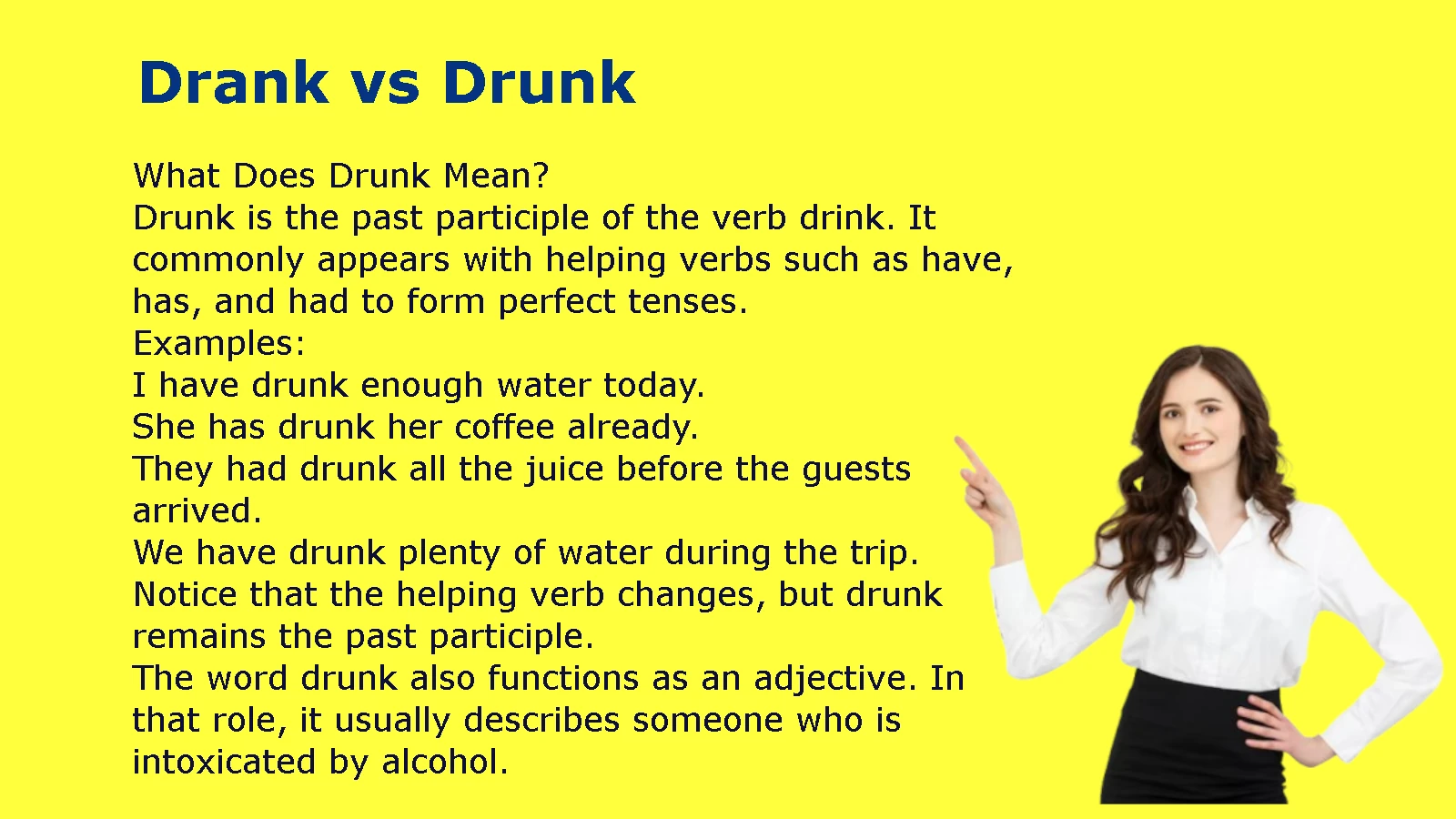
Drunk is the past participle of the verb drink. It commonly appears with helping verbs such as have, has, and had to form perfect tenses.
Examples:
- I have drunk enough water today.
- She has drunk her coffee already.
- They had drunk all the juice before the guests arrived.
- We have drunk plenty of water during the trip.
Notice that the helping verb changes, but drunk remains the past participle.
The word drunk also functions as an adjective. In that role, it usually describes someone who is intoxicated by alcohol.
For example:
- The drunk passenger spoke loudly.
- He was drunk when he arrived home.
- The police stopped a drunk driver.
These sentences use drunk to describe a person’s condition rather than to form a perfect tense.
Context tells you which meaning applies.
Drank vs Drunk Examples at a Glance
The following table compares the two forms in common sentence patterns.
| Sentence | Correct form | Why? |
| I ___ water yesterday. | drank | Simple past tense |
| I have ___ enough water. | drunk | Past participle after have |
| She ___ coffee this morning. | drank | Simple past tense |
| She has ___ her coffee. | drunk | Past participle after has |
| They had ___ all the milk. | drunk | Past participle after had |
| He ___ tea before work. | drank | Simple past tense |
| He was ___ when we met him. | drunk | Adjective describing intoxication |
A useful way to remember the distinction is to examine the words surrounding the blank. If the sentence uses have, has, or had to form a perfect tense, choose drunk. If the sentence needs the simple past tense, choose drank.
Drink, Drank, Drunk: The Three Forms of the Verb
The verb drink is an irregular verb, which means it does not form its past tense by simply adding -ed. Instead, it follows the pattern drink → drank → drunk.
Each form has a specific grammatical purpose. Learning the complete sequence makes it easier to choose the correct word without memorizing dozens of separate sentences.
What Is the Past Tense of Drink?
The past tense of drink is drank.
Use drank to describe a drinking action that happened in the past. Unlike a present-perfect construction, the simple past often appears with a specific past-time expression.
Examples:
- I drank a glass of water after lunch.
- Daniel drank tea while reading the newspaper.
- The children drank orange juice at breakfast.
- She drank a bottle of water during the hike.
- We drank coffee together last Friday.
The word drank does not change according to the subject. You use the same form with I, you, he, she, it, we, and they.
| Subject | Correct example |
| I | I drank water. |
| You | You drank water. |
| He | He drank water. |
| She | She drank water. |
| We | We drank water. |
| They | They drank water. |
This consistency makes the simple past easy to use once you remember the irregular form.
Common mistake: Writing “I drinked water yesterday.”
The correct sentence is “I drank water yesterday.” The verb drink does not take the regular -ed ending.
What Is the Past Participle of Drink?
The past participle of drink is drunk.
A past participle is a verb form that helps create perfect tenses and can also appear in passive constructions or adjective-like expressions. For drink, the past participle is drunk, not drank.
Examples of perfect-tense constructions:
- I have drunk three glasses of water today.
- She has drunk her tea.
- We had drunk the juice before dinner.
- They will have drunk all the water by the end of the trip.
The final example uses the future perfect tense. Although the time reference changes, the past participle remains drunk.
You can also encounter the participle in passive constructions, although they are less common when describing drinking.
For example:
- The juice was drunk before anyone noticed it was missing.
Here, was drunk is a passive construction. It means someone consumed the juice, but the sentence does not identify who did so.
Drink vs Drank vs Drunk: Comparison Table
Use this table as a quick reference when choosing the right form.
| Verb form | Grammatical role | Common pattern | Example |
| Drink | Base form | I/you/we/they drink; do/did + drink | I drink water every morning. |
| Drank | Simple past | Subject + drank | I drank water yesterday. |
| Drunk | Past participle | Have/has/had + drunk | I have drunk enough water. |
| Drunk | Adjective | Be/seem/look + drunk | He seemed drunk. |
The base form drink also appears after modal verbs such as will, can, should, and might.
Examples:
- I will drink more water tomorrow.
- You should drink enough water throughout the day.
- She can drink tea without sugar.
- They might drink coffee after dinner.
The base form also follows did in questions and negative statements.
- Did you drink the juice?
- I did not drink any coffee.
- She didn’t drink enough water.
Understanding these patterns helps you avoid confusing the three forms.
Have You Drank or Drunk? Which Is Correct?
Have you drunk? is the standard grammatical form when asking whether someone has consumed a drink. The helping verb have requires the past participle drunk in the present perfect tense. By contrast, Did you drink? is also correct because did takes the base form drink, not drank or drunk.
Have You Drunk or Have You Drank?
In standard written English, “Have you drunk?” is the expected form.
The present perfect tense uses have or has followed by a past participle. Since drunk is the past participle of drink, it fits this construction.
Correct examples:
- Have you drunk enough water today?
- Have you drunk your coffee yet?
- Have you drunk anything since breakfast?
- Have you drunk the medicine with water?
Incorrect in standard written English:
- Have you drank enough water today?
- Have you drank your coffee yet?
- Have you drank anything since breakfast?
You may hear have you drank in some regional dialects and informal speech. However, if you’re writing an essay, report, professional email, or grammar exercise, use have you drunk.
Also, the question can be grammatically complete without naming the drink if the context already makes it clear.
For example:
“I’m feeling thirsty.”
“Have you drunk enough today?”
The second speaker does not need to specify water because the conversation supplies the context.
Did You Drink or Did You Drank?
The correct form is “Did you drink?”
When you use did to form a past-tense question or negative statement, the main verb returns to its base form. The word did already marks the past tense, so the main verb does not need another past-tense form.
Correct:
- Did you drink the water?
- Did she drink the coffee?
- Did they drink anything at the meeting?
- I did not drink the juice.
- He didn’t drink his tea.
Incorrect in standard English:
- Did you drank the water?
- Did she drunk the coffee?
- I did not drank the juice.
Think of did as carrying the past-tense signal. The verb that follows stays in its base form.
Compare these two sentences:
- You drank the water. — Simple past statement.
- Did you drink the water? — Simple past question.
Both refer to the past, but their grammatical structures differ.
When to Use Have, Has, and Had Drunk
The helping verb determines the tense, while drunk remains the past participle.
Have drunk
Use have drunk with I, you, we, and they in the present perfect tense.
Examples:
- I have drunk two cups of tea.
- You have drunk enough water.
- We have drunk all the lemonade.
- They have drunk their coffee already.
Has drunk
Use has drunk with he, she, and it in the present perfect tense.
Examples:
- He has drunk his morning coffee.
- She has drunk a glass of water.
- The dog has drunk all the water in its bowl.
Had drunk
Use had drunk to describe an action that happened before another past event.
Examples:
- I had drunk my coffee before the meeting started.
- She had drunk all the water before we reached the campsite.
- They had drunk their tea by the time the guests arrived.
Compare:
“She drank her coffee before work.”
“She had drunk her coffee before the meeting began.”
Both sentences describe past actions. The second explicitly connects the drinking to another past event and presents it as the earlier action.
Drank vs Drunk Pronunciation
Drank and drunk have different vowel sounds, even though they share the same first and final consonants. In many varieties of English, drank rhymes with bank, while drunk rhymes with trunk. Recognizing the vowel difference helps you distinguish the words when speaking and listening.
How to Pronounce Drank
The word drank is commonly pronounced /dræŋk/ in IPA.
Its vowel sound /æ/ is the same vowel found in words such as cat, back, and bank in many English accents.
To pronounce it:
- Start with the consonant cluster /dr/.
- Open your mouth for the short vowel /æ/.
- Finish with the /ŋk/ sound, as in bank.
Practice with these sentences:
- I drank a glass of water.
- She drank tea before leaving.
- We drank lemonade at lunch.
Pay attention to the vowel in drank. It should sound different from the vowel in drunk.
How to Pronounce Drunk
The word drunk is commonly pronounced /drʌŋk/ in IPA.
Its vowel sound /ʌ/ appears in words such as cup, luck, and trunk in many English accents.
To pronounce it:
- Begin with /dr/.
- Use the short central vowel /ʌ/.
- Finish with /ŋk/, as in trunk.
Practice with these sentences:
- I have drunk enough water.
- She has drunk her tea.
- He was drunk when he arrived.
Accent differences can affect the precise sound of these vowels, but drank and drunk remain distinct forms in standard English.
Are Drank and Drunk Pronounced the Same?
No. Drank and drunk have different vowel sounds, and they also have different grammatical roles.
| Word | IPA | Rhymes with (in many accents) |
| Drank | /dræŋk/ | Bank, tank |
| Drunk | /drʌŋk/ | Trunk, skunk |
You can practice by saying each word in a complete sentence rather than repeating it alone.
- Yesterday, I drank some juice.
- By noon, I had drunk enough water.
This exercise reinforces both the pronunciation difference and the grammatical distinction.
Drunk Meaning: Verb Form vs Adjective
The word drunk has two common grammatical uses. It is the past participle of drink, as in “I have drunk my coffee,” and it is an adjective describing someone affected by alcohol, as in “He was drunk.” The surrounding words help you identify which meaning the sentence expresses.
Drunk as a Verb Form
As a verb form, drunk usually appears after a helping verb.
Examples:
- I have drunk three glasses of water.
- She has drunk her tea.
- They had drunk all the milk.
- We will have drunk enough water by the end of the hike.
In these examples, drunk describes the act of consuming liquid. It does not mean intoxicated.
The distinction matters because readers sometimes assume every use of drunk relates to alcohol. In reality, you can drink water, tea, coffee, milk, juice, or any other liquid.
For instance, “I have drunk two bottles of water” uses drunk as a past participle. It says nothing about alcohol.
Drunk as an Adjective
As an adjective, drunk describes a person who is intoxicated by alcohol.
Examples:
- The drunk man struggled to find his keys.
- She appeared drunk at the party.
- The driver was drunk, so his friend called a taxi.
- They left when the drunk guests became disruptive.
In these sentences, drunk describes a condition rather than forming a perfect tense.
The adjective can appear after linking verbs such as be, seem, and look.
For example:
- He was drunk.
- She seemed drunk.
- They looked drunk.
The adjective can also appear before a noun, as in “a drunk passenger.” However, this use can sound blunt or judgmental when describing a person, so more neutral wording may be preferable in sensitive contexts.
How to Identify the Meaning of Drunk in a Sentence
Use the sentence structure to work out the meaning.
Ask yourself whether the word describes an action or a condition.
| Sentence | Meaning of drunk | Grammatical role |
| I have drunk the water. | Consumed the water | Past participle |
| She had drunk her coffee. | Consumed her coffee | Past participle |
| He was drunk after the party. | Intoxicated by alcohol | Adjective |
| The drunk passenger sat quietly. | An intoxicated passenger | Adjective |
| They have drunk all the juice. | Consumed all the juice | Past participle |
A practical test is to look at the helping verb. If drunk follows have, has, or had in a perfect-tense construction, it is the past participle. If it describes someone’s condition, it is an adjective.
Drunk vs Tipsy: What’s the Difference?
Tipsy usually describes mild effects from drinking alcohol, while drunk generally suggests more noticeable intoxication. The words differ in degree and tone, but neither provides a precise measure of impairment. A person’s actual impairment depends on several factors, and someone who describes themselves as tipsy may still have reduced coordination and judgment.
Tipsy Meaning and Usage
Tipsy is an informal adjective that usually means slightly affected by alcohol.
Someone who is tipsy might feel relaxed, unusually talkative, light-headed, or less coordinated than usual. The word often suggests a milder degree of intoxication than drunk.
Examples:
- After one glass of wine, she felt tipsy.
- He became a little tipsy at the wedding.
- My friend was tipsy and started telling funny stories.
- They felt tipsy after the celebration.
The word often appears in casual conversation because it can sound softer than drunk.
However, tipsy does not guarantee that a person can drive safely or make sound decisions. People can underestimate the effects of alcohol, even when they feel only mildly affected.
Drunk Meaning and Usage
Drunk generally describes a person who is intoxicated by alcohol. In everyday conversation, it often suggests more pronounced effects than tipsy.
Examples:
- He was drunk and needed help getting home.
- She realized her friend was too drunk to drive.
- The man sounded drunk during the phone call.
- They called a taxi because one member of their group was drunk.
The word can describe different levels of intoxication in ordinary speech, so context matters.
It can also carry a negative or judgmental tone, depending on the situation. In formal or sensitive writing, phrases such as intoxicated or under the influence of alcohol may be more suitable.
Drunk vs Tipsy: Comparison Table
| Feature | Tipsy | Drunk |
| General meaning | Mildly affected by alcohol | Intoxicated by alcohol |
| Typical implication | Relatively mild effects | Often more noticeable effects |
| Tone | Casual and often softer | Direct and sometimes blunt |
| Common context | Informal conversations and social settings | Casual conversation and descriptions of intoxication |
| Example | She felt tipsy after a glass of wine. | He was drunk and couldn’t walk steadily. |
The distinction is useful for understanding everyday language, but it is not a reliable scale of impairment. Avoid treating either word as a medical measurement or as proof that someone is safe to drive.
Drunk vs Drunken: Is Drunken a Word?
Yes, drunken is a real English word. It functions as an adjective associated with drinking alcohol or behavior influenced by alcohol. Drunk is more common when describing a person’s condition, while drunken frequently modifies nouns such as behavior, argument, celebration, or stupor.
What Does Drunken Mean?
Drunken is an adjective that usually describes something connected with intoxication or alcohol-related behavior.
Examples:
- The neighbors complained about the drunken behavior outside the building.
- They witnessed a drunken argument at the restaurant.
- The novel describes a drunken celebration after the team’s victory.
- The report mentioned a drunken disturbance near the entrance.
In these examples, drunken modifies a noun. It describes the type or character of the behavior, argument, celebration, or disturbance.
The word often sounds more formal or literary than drunk. You may encounter it in journalism, fiction, reports, and formal descriptions.
Drunk vs Drunken: When Should You Use Each?
Choose drunk when describing a person’s condition. Choose drunken when describing behavior, an event, or another noun associated with alcohol.
| Expression | Meaning | Natural usage |
| He was drunk. | He was intoxicated. | Common everyday English |
| A drunken argument | An argument influenced by alcohol | Common descriptive phrase |
| A drunken celebration | A celebration involving intoxicated people | Descriptive writing |
| She looked drunk. | She appeared intoxicated. | Common everyday English |
| Drunken behavior | Behavior associated with intoxication | Formal or descriptive writing |
Both adjectives can describe situations involving alcohol, but they do not always fit the same sentence equally well.
For example, “He was drunken” is not the usual way to describe a person’s current condition in modern everyday English. “He was drunk” is the natural choice.
By contrast, “He displayed drunken behavior” is a natural construction because drunken modifies the noun behavior.
Is Drunken the Past Tense of Drink?
No. Drunken is not the past tense or past participle of drink.
The correct three-form sequence is:
- Drink: Base form
- Drank: Simple past tense
- Drunk: Past participle
The word drunken is an adjective, not another form in this verb sequence.
Compare these sentences:
- She drank the juice yesterday.
- She has drunk the juice already.
- The guests displayed drunken behavior.
Each bold word serves a different grammatical purpose. Keeping those roles separate prevents confusion when you write.
Common Mistakes When Using Drank and Drunk
Most errors involving drank and drunk occur because writers choose a verb form without checking the rest of the sentence. The easiest way to avoid these mistakes is to identify the tense, look for helping verbs, and then select the form that matches the grammatical structure.
Using Drank After Have or Has
In standard English, use the past participle drunk after have or has when forming the present perfect tense.
Incorrect: I have drank all my water.
Correct: I have drunk all my water.
Incorrect: She has drank her coffee.
Correct: She has drunk her coffee.
The same principle applies to had in the past perfect tense.
Incorrect: They had drank the juice before lunch.
Correct: They had drunk the juice before lunch.
Remember: Have, has, and had typically pair with drunk in perfect-tense constructions.
Using Drank After Did
When you use did in a question or negative statement, choose the base form drink.
Incorrect: Did you drank the milk?
Correct: Did you drink the milk?
Incorrect: He didn’t drank any water.
Correct: He didn’t drink any water.
The reason is that did already carries the past-tense meaning. You do not need to put the main verb into the simple past again.
This rule applies to many irregular verbs, not just drink.
For example:
- Did you go? Not Did you went?
- Did she eat? Not Did she ate?
- Did they see it? Not Did they saw it?
Recognizing this broader pattern helps you correct several common grammar mistakes at once.
Confusing Drunk as a Verb and an Adjective
Because drunk has two common grammatical roles, its meaning can confuse writers.
Compare:
- I have drunk two cups of coffee.
- He was drunk at the party.
In the first sentence, drunk is the past participle of drink. In the second, it is an adjective describing intoxication.
Here is another comparison:
- She had drunk the water before leaving.
- The drunk guest left before dinner.
The first sentence describes an action. The second describes a person.
To choose the right interpretation, examine the words around drunk and ask what the sentence communicates.
A Simple Trick to Remember Drank vs Drunk
Use this memory pattern:
Drink → Drank → Drunk
Then connect each form with a simple example.
- Drink: I drink water every day.
- Drank: I drank water yesterday.
- Drunk: I have drunk water today.
You can also use this short rule:
Yesterday, I drank. I have drunk.
The first phrase uses the simple past. The second uses the present perfect.
For extra practice, fill in the blanks below before checking the answers.
| Sentence | Correct answer |
| We ___ tea yesterday. | drank |
| Have you ___ enough water? | drunk |
| Did she ___ the juice? | drink |
| He has ___ his coffee. | drunk |
| They ___ milk last night. | drank |
| I had ___ the water before the walk. | drunk |
The pattern becomes easier to remember when you practice it in complete sentences instead of memorizing the words in isolation.
Conclusion: Choose Drank or Drunk Correctly
The difference between drank vs drunk comes down to grammar. Drank is the simple past tense of drink, while drunk is its past participle, usually used with have, has, or had. The base form drink follows helping verbs such as did, will, and can.
Remember these examples:
- I drink water every morning.
- I drank water yesterday.
- I have drunk enough water today.
Also, remember that drunk can function as an adjective describing intoxication, while drunken typically modifies nouns such as behavior or argument. And although tipsy often suggests milder effects from alcohol than drunk, neither word precisely measures impairment.
Your next step: Practice the three forms by writing three original sentences about your daily routine. Use drink for a general habit, drank for a completed past action, and drunk in a sentence with have, has, or had. This simple exercise will help you apply the rule naturally in your writing.
Frequently Asked Questions
Is It Correct to Say “I Have Drank” or “I Have Drunk”?
“I have drunk” is the standard grammatical form. The present perfect tense uses have followed by the past participle, and drunk is the past participle of drink. Although I have drank occurs in some dialects and informal speech, use I have drunk in standard written English.
Is Drank Ever Correct?
Yes. Drank is the correct simple past tense of drink. For example, “I drank a glass of water yesterday” is grammatically correct. Use it when describing a completed action in the past without a perfect-tense helping verb.
What Is the Past Tense and Past Participle of Drink?
The simple past tense is drank, and the past participle is drunk. The base form is drink. The complete sequence is drink, drank, drunk.
Is “Have You Drank?” Grammatically Correct?
In standard written English, “Have you drunk?” is the expected form because have takes the past participle drunk in the present perfect tense. You may encounter “Have you drank?” in some dialects, but it is not the standard form generally expected in formal writing or grammar tests.
What Is the Difference Between Drunk and Drunken?
Drunk commonly describes a person’s condition, as in “He was drunk.” Drunken usually modifies a noun, as in “a drunken argument” or “drunken behavior.” Both words relate to alcohol, but they typically appear in different grammatical patterns.