Theory and hypothesis are both scientific terms, but they serve different purposes. A hypothesis is a testable prediction or proposed explanation, while a theory is a well-supported explanation backed by extensive evidence and repeated testing. When comparing Theory vs Hypothesis, a hypothesis can develop into a theory only after strong scientific support.
The confusion is understandable. Many people assume a theory is just a guess or that a hypothesis is simply another word for an opinion. But here’s the kicker: mixing them up can lead to misunderstandings in classrooms, research papers, and professional discussions.
In this guide, you’ll learn the difference between Theory vs Hypothesis, explore the meaning of theory and hypothesis, understand theory vs hypothesis in science, and discover when to use theory or hypothesis correctly. You’ll also find real-life examples, scientific definitions, and an easy comparison to help you remember the difference with confidence.
By the end, you’ll know exactly what sets a theory apart from a hypothesis and how to use both terms accurately in any context.
Theory vs Hypothesis: Quick Comparison
The easiest way to understand the difference between a theory and hypothesis is to compare their purpose, evidence, and scientific role.
| Feature | Hypothesis | Scientific Theory |
| Definition | A testable explanation or prediction | A well-supported explanation based on extensive evidence |
| Stage of science | Early stage of investigation | Advanced stage of scientific understanding |
| Evidence required | Some initial observations or reasoning | Large amounts of repeated evidence |
| Main purpose | Tests a possible explanation | Explains broad patterns and relationships |
| Scope | Usually narrow and specific | Often broad and comprehensive |
| Can it change? | Yes, especially after testing | Yes, but usually through refinement rather than replacement |
| Example | “Plants grow faster with more sunlight” | Theory of evolution explaining changes in living organisms |
A hypothesis begins the investigation. A theory explains the bigger picture.
What Is a Hypothesis?
A hypothesis is a scientific statement that proposes a possible explanation for an observation. Scientists create hypotheses because they want to investigate questions and discover how or why something happens.
However, a hypothesis is not simply a guess.
The phrase “educated guess” is often used to describe a hypothesis, but that description can be misleading. A scientific hypothesis must come from existing knowledge, observations, or previous research.
For example, a scientist might notice that plants near windows seem healthier than plants kept in dark rooms. Instead of simply assuming sunlight helps plants grow, the scientist creates a hypothesis:
“Plants exposed to more sunlight will grow taller than plants exposed to less sunlight.”
This statement can be tested through an experiment.
The scientist can control the amount of sunlight each plant receives, measure growth, collect data, and determine whether the evidence supports the hypothesis.
Characteristics of a Good Scientific Hypothesis
A strong hypothesis has several important qualities. Scientists do not create hypotheses randomly. They design them carefully so they can be tested and evaluated.
A Hypothesis Must Be Testable
A scientific hypothesis must allow researchers to collect evidence.
For example:
Testable hypothesis:
“Increasing fertilizer use will increase plant growth.”
Scientists can test this by comparing plants with different amounts of fertilizer.
Not a scientific hypothesis:
“Beautiful plants grow because nature likes them.”
This statement cannot be measured or tested scientifically.
A Hypothesis Must Be Falsifiable
One of the most important features of a scientific hypothesis is that it must be possible to prove it wrong.
This idea is called falsifiability.
A hypothesis should make a clear prediction that evidence can either support or challenge.
For example:
“A new medicine reduces fever faster than an existing medicine.”
Researchers can test this claim by comparing the two treatments.
If the new medicine does not perform better, the hypothesis may be rejected.
A hypothesis that cannot be challenged does not help scientific progress.
A Hypothesis Should Identify Variables
Scientific hypotheses often involve relationships between variables.
A variable is something that can change or be measured.
For example:
Hypothesis:
“Students who sleep eight hours before an exam will score higher than students who sleep fewer hours.”
Variables:
| Type | Example |
| Independent variable | Amount of sleep |
| Dependent variable | Exam score |
| Controlled factors | Study time, difficulty level, test conditions |
Identifying variables helps scientists design accurate experiments.
What Is a Scientific Theory?
A scientific theory is a well-established explanation that connects many observations, experiments, and discoveries into a single framework.
Unlike the everyday use of the word “theory,” a scientific theory is not just an opinion.
When scientists refer to the theory of evolution, the theory of gravity, or germ theory, they are describing explanations supported by enormous amounts of evidence.
A scientific theory answers deeper questions:
- Why does this happen?
- How does this process work?
- What patterns connect different observations?
A theory does more than describe what happens. It explains why it happens.
Scientific Theory Meaning: What Makes a Theory Strong?
A scientific theory becomes accepted because it consistently matches evidence from many sources.
Strong theories usually have several characteristics.
A Theory Has Extensive Evidence Behind It
Scientific theories develop over many years.
Researchers collect evidence through:
- Experiments
- Observations
- Mathematical models
- Field studies
- Laboratory research
- Independent investigations
For example, the theory of evolution is supported by evidence from:
- Fossils
- DNA comparisons
- Anatomy
- Genetics
- Observed changes in populations
No single discovery created evolutionary theory. Thousands of studies contributed to its development.
A Theory Explains Many Observations
A hypothesis usually focuses on one specific question.
A theory connects many different findings.
For example:
A hypothesis might ask:
“Does a specific gene affect eye color?”
A broader genetic theory explains how inheritance works across generations.
The theory provides the larger framework that helps scientists understand many individual discoveries.
A Theory Makes Predictions
A powerful scientific theory does not only explain existing evidence. It also helps scientists predict future discoveries.
For example, Einstein’s theory of relativity predicted certain effects involving gravity and light before scientists directly observed them.
Later observations supported those predictions.
This ability to make accurate predictions strengthens scientific theories.
Theory vs Hypothesis: The Main Differences Explained
Understanding the difference between a theory vs hypothesis becomes easier when you look at how scientists use each concept.
Difference in Evidence and Support
The biggest difference between a hypothesis and a theory is the amount of evidence supporting each one.
A hypothesis represents an idea that needs investigation.
A theory represents an explanation that has already passed many tests.
| Hypothesis | Theory |
| Needs testing | Has been tested repeatedly |
| May be rejected quickly | Usually refined over time |
| Often explains a specific situation | Explains broad scientific patterns |
| Based on early evidence | Based on extensive evidence |
A hypothesis can fail. That does not make it useless.
In science, a failed hypothesis often teaches researchers something valuable and helps guide future studies.
Difference in Purpose
A hypothesis and theory serve different roles.
A hypothesis helps scientists begin research.
It acts like a question turned into a prediction.
For example:
“Does increasing exercise improve heart health?”
A hypothesis might suggest:
“People who exercise regularly will have lower resting heart rates.”
A theory explains larger relationships.
For example:
The theory of evolution explains how populations change over generations through mechanisms such as natural selection.
Difference in Scope
A hypothesis is usually limited in scope.
It focuses on a specific relationship.
Example:
“A certain type of fertilizer increases tomato production.”
A theory has a much wider scope.
Example:
Plant biology theories explain how plants grow, reproduce, adapt, and interact with their environment.
A hypothesis is like studying one puzzle piece. A theory helps explain the entire picture.
Theory vs Hypothesis: How Scientific Ideas Develop Over Time
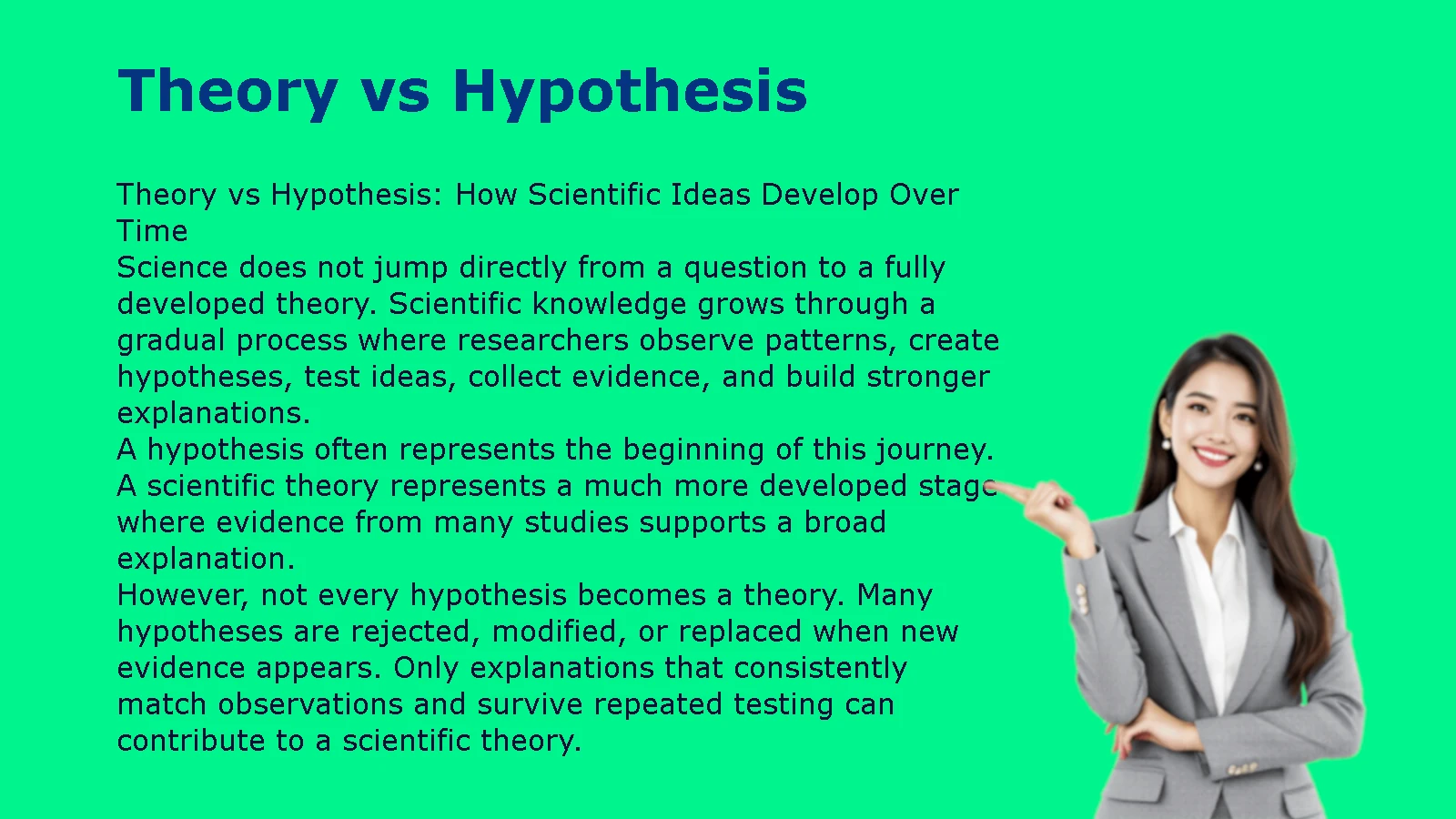
Science does not jump directly from a question to a fully developed theory. Scientific knowledge grows through a gradual process where researchers observe patterns, create hypotheses, test ideas, collect evidence, and build stronger explanations.
A hypothesis often represents the beginning of this journey. A scientific theory represents a much more developed stage where evidence from many studies supports a broad explanation.
However, not every hypothesis becomes a theory. Many hypotheses are rejected, modified, or replaced when new evidence appears. Only explanations that consistently match observations and survive repeated testing can contribute to a scientific theory.
How Does a Hypothesis Become a Theory?
The path from a hypothesis to a theory involves several important steps.
Scientists Begin With Observations
Every scientific discovery starts with curiosity.
Scientists observe something happening in the world and ask questions about it.
For example:
- Why do some plants grow faster than others?
- Why do certain diseases spread between people?
- Why do objects fall toward Earth?
An observation does not immediately provide an answer. Instead, it creates a starting point for investigation.
Researchers Develop a Hypothesis
After making observations, scientists create a possible explanation.
For example:
Observation:
Some plants grow taller when placed near sunlight.
Hypothesis:
Plants exposed to more sunlight will grow faster because sunlight provides energy needed for photosynthesis.
This hypothesis gives scientists something specific to test.
Scientists Test the Hypothesis
Testing separates science from speculation.
Researchers design experiments to determine whether the evidence supports their prediction.
A typical scientific investigation may involve:
- Creating a research question
- Developing a hypothesis
- Designing an experiment
- Collecting data
- Analyzing results
- Drawing conclusions
For example, researchers studying plant growth might:
- Use identical plants
- Give each plant different amounts of sunlight
- Measure growth over several weeks
- Compare results
If the evidence supports the hypothesis, scientists continue studying it. If the results do not match the prediction, they revise or reject the hypothesis.
Evidence Accumulates Over Time
A single experiment rarely creates a scientific theory.
Theories develop when many researchers independently collect evidence that supports the same explanation.
For example, germ theory did not emerge from one discovery alone. Scientists conducted numerous experiments showing that microorganisms play a role in causing disease.
Over time, the evidence became so strong that germ theory became one of the foundations of modern medicine.
A Scientific Community Reviews the Evidence
Science depends on collaboration and verification.
Before ideas become widely accepted, other scientists examine research, repeat experiments, and evaluate whether the evidence supports the explanation.
This process helps prevent errors and strengthens scientific understanding.
A theory gains acceptance because many independent researchers find that it accurately explains observations.
Real-World Examples of Theory vs Hypothesis
The best way to understand the difference between a hypothesis and theory is to look at real scientific examples.
Example: Evolutionary Theory vs Evolution Hypotheses
Hypothesis Example
A researcher might propose:
“Bird populations living in areas with different food sources will develop different beak sizes over generations.”
This is a specific prediction that can be tested by studying bird populations.
Scientists can measure:
- Beak size
- Available food sources
- Population changes over time
Theory Example
The theory of evolution explains how living organisms change over generations.
It combines evidence from:
- Genetics
- Fossil records
- Biology
- Ecology
- Comparative anatomy
Evolutionary theory explains many observations, including why species share common characteristics and how populations adapt to changing environments.
The theory provides the larger explanation while individual hypotheses test specific parts of that explanation.
Example: Gravity Theory vs Gravity Hypotheses
Gravity provides another useful example of theory vs hypothesis.
Hypothesis Example
A scientist might ask:
“Does the mass of an object affect how quickly it falls?”
This question can lead to experiments measuring falling objects.
Theory Example
Theories of gravity explain the relationship between mass, motion, and gravitational forces.
Scientific understanding of gravity developed through the work of researchers such as:
- Isaac Newton, who developed classical theories describing gravitational forces.
- Albert Einstein, whose theory of general relativity expanded our understanding of gravity.
Modern physics continues to refine ideas about gravity as scientists discover new evidence.
Example: Germ Theory vs Disease Hypotheses
Before germ theory became established, scientists proposed different explanations for disease.
Some early ideas suggested illness came from environmental factors or imbalances in the body.
Researchers later developed hypotheses suggesting microorganisms might cause infections.
Through experiments and observations, scientists gathered evidence showing that microbes contribute to disease.
Today, germ theory explains:
- How infections spread
- Why sterilization prevents contamination
- How antibiotics and vaccines help control diseases
A simple hypothesis about microorganisms eventually contributed to a powerful scientific theory.
Common Misconceptions About Theory and Hypothesis
Many misunderstandings about science come from confusing everyday meanings with scientific definitions.
Let’s clear up the most common mistakes.
Misconception: “A Theory Is Just a Guess”
This is probably the biggest misunderstanding about scientific theories.
In everyday conversation, people often use “theory” to mean a personal idea.
For example:
“I have a theory about why my phone battery dies quickly.”
This usually means:
“I have a possible explanation.”
However, a scientific theory means something completely different.
A scientific theory requires:
- Strong evidence
- Repeated testing
- Support from many studies
- Ability to explain observations
Calling a scientific theory “just a guess” ignores the years of research behind it.
Misconception: “A Hypothesis Is Not Scientific Because It Might Be Wrong”
Some people assume that a hypothesis must be correct to be valuable.
That is not how science works.
A hypothesis is valuable because scientists can test it.
A wrong hypothesis can still provide important information.
For example:
- A failed medical treatment study may reveal what does not work.
- A rejected physics idea may lead researchers toward a better explanation.
Science advances by learning from both successful and unsuccessful investigations.
Misconception: “Scientific Theories Become Facts”
People sometimes ask:
“If a theory is proven, doesn’t it become a fact?”
The answer is more complicated.
Facts and theories serve different purposes.
A fact describes something that has been observed or measured.
A theory explains why or how something happens.
For example:
Fact:
- Living organisms change over generations.
Theory:
- Evolution explains the processes behind those changes.
Theories do not become facts because they already represent a different type of scientific knowledge.
Theory vs Hypothesis vs Law: Understanding the Difference
Another common confusion involves scientific laws.
People often assume the scientific hierarchy looks like this:
Hypothesis → Theory → Law
However, that is incorrect.
A theory does not become a law after gaining more evidence.
They perform different roles.
| Scientific Concept | Meaning | Purpose | Example |
| Hypothesis | A testable explanation | Investigates a question | A prediction about plant growth |
| Theory | A broad explanation supported by evidence | Explains why something happens | Theory of evolution |
| Law | A description of a consistent pattern | Describes what happens | Newton’s laws of motion |
Scientific Laws Describe Patterns
A scientific law explains what happens under certain conditions.
For example:
Newton’s laws of motion describe relationships between force, mass, and movement.
However, the laws themselves do not fully explain why those relationships exist.
Scientific Theories Explain Causes
Scientific theories focus on explanations.
For example:
- Evolutionary theory explains biological changes.
- Germ theory explains disease transmission.
- Relativity theory explains relationships between space, time, and gravity.
A law tells you what happens.
A theory explains why it happens.
Why Understanding Theory vs Hypothesis Matters
Knowing the difference between a theory and hypothesis helps you interpret scientific information more accurately.
Science appears everywhere in modern life:
- Medicine
- Technology
- Environmental research
- Engineering
- Education
- Public health
When you understand scientific terms correctly, you can better evaluate claims and separate evidence-based explanations from unsupported opinions.
The Importance of Theory and Hypothesis in Scientific Research
Both concepts play essential roles.
A hypothesis encourages exploration.
It allows scientists to ask:
- “What might explain this?”
- “What prediction can we test?”
- “What evidence would support this idea?”
A theory organizes knowledge.
It helps scientists understand:
- “Why does this happen?”
- “How are different discoveries connected?”
- “What predictions can we make?”
Without hypotheses, science would lack new questions.
Without theories, science would lack a framework for understanding discoveries.
How Scientists Improve Theories Over Time
A common misconception is that changing a theory means the theory was wrong.
In reality, scientific theories often become stronger as researchers discover new information.
For example:
Early theories of the atom changed as scientists discovered:
- Electrons
- Neutrons
- Protons
- Quantum behavior
Science improves by updating explanations when new evidence appears.
A stronger theory does not mean earlier scientists failed. It means human knowledge continues to grow.
When Should You Use “Theory” and “Hypothesis”?
Although theory vs hypothesis describes a scientific difference, these words also appear in everyday writing, research papers, education, and conversations. Using them correctly helps you communicate ideas more clearly.
A simple way to remember the difference:
- Use hypothesis when you are describing a specific idea that still needs testing.
- Use theory when you are describing a broad explanation supported by strong evidence.
Let’s look at when each term fits best.
Use “Hypothesis” When You Have a Testable Prediction
A hypothesis works best when you are making a prediction that can be investigated.
Examples:
- “Researchers created a hypothesis that increased exercise may improve memory performance.”
- “The scientist’s hypothesis predicted that warmer temperatures would increase bacterial growth.”
- “The study tested the hypothesis that plants exposed to blue light would grow differently.”
In each example, the idea is specific and measurable.
A hypothesis usually answers a question like:
- What might happen?
- What factor causes a change?
- What relationship exists between two variables?
Use “Theory” When Explaining a Larger Scientific Concept
A theory is appropriate when discussing a well-established explanation supported by extensive research.
Examples:
- “The theory of evolution explains how populations change over generations.”
- “Germ theory explains how microorganisms contribute to disease.”
- “The theory of relativity changed scientists’ understanding of space and time.”
These explanations do not rely on one experiment. They combine evidence from many areas of research.
Why the Difference Between Theory and Hypothesis Matters in Everyday Life
Understanding scientific theory vs hypothesis is not only useful in classrooms. It also helps you understand information you encounter every day.
News articles, social media posts, and online discussions often use scientific terms incorrectly.
For example, someone might say:
“Scientists only have a theory about climate change.”
This statement creates the false impression that scientists are simply guessing.
In reality, climate science is supported by extensive evidence from:
- Temperature records
- Ocean measurements
- Ice core data
- Atmospheric studies
- Computer modeling
The word “theory” in science does not mean uncertainty. It often represents one of the strongest explanations available.
Theory vs Hypothesis Examples in Different Fields
The difference becomes clearer when you see how scientists use these terms across various disciplines.
Biology: Evolution and Genetics
Biology provides some of the clearest examples of theory vs hypothesis.
Hypothesis Example
A biologist may propose:
“A specific environmental condition causes a certain trait to become more common in a population.”
Researchers can test this by observing changes over time.
Theory Example
Evolutionary theory explains how inherited traits change within populations through processes such as:
- Natural selection
- Genetic variation
- Mutation
- Inheritance
The theory connects thousands of individual discoveries into one explanation.
Medicine: Disease and Treatment Research
Medical science relies heavily on hypotheses and theories.
Hypothesis Example
A medical researcher might suggest:
“A new treatment reduces recovery time for patients with a specific condition.”
The researcher then conducts clinical studies to test the idea.
Theory Example
The germ theory of disease explains how microorganisms can cause infections.
This theory supports many modern medical practices, including:
- Sterilization procedures
- Infection control
- Vaccine development
- Hygiene practices
Physics: Motion and the Universe
Physics shows how scientific explanations can become more detailed over time.
Hypothesis Example
A physicist may develop a hypothesis about how a particle behaves under certain conditions.
The idea is tested through experiments.
Theory Example
Theories in physics explain large-scale patterns involving:
- Matter
- Energy
- Space
- Time
- Forces
These theories help scientists build technologies and understand natural phenomena.
Chemistry: Atoms and Chemical Reactions
Chemistry also depends on both concepts.
Hypothesis Example
A chemist may predict:
“Increasing pressure will change the reaction rate of a chemical process.”
This prediction can be tested in a laboratory.
Theory Example
Atomic theory explains how matter is made of atoms and how atoms interact to form substances.
Frequently Asked Questions About Theory vs Hypothesis
Is a theory stronger than a hypothesis?
Yes, in terms of scientific support.
A theory generally has much more evidence behind it than a hypothesis.
However, they serve different purposes.
A hypothesis begins an investigation.
A theory explains a broad scientific concept after extensive testing.
Can a hypothesis become a theory?
A hypothesis does not automatically become a theory.
Many hypotheses never develop into theories because evidence may not support them.
For a hypothesis to contribute to a theory, it must:
- Be repeatedly tested
- Receive strong scientific support
- Help explain observations
- Fit with existing evidence
Even then, theories usually develop from many related discoveries, not one single hypothesis.
Is a scientific theory 100% proven?
Science usually does not describe theories as absolutely proven.
Instead, scientists say theories are strongly supported by evidence.
Scientific knowledge remains open to improvement if new evidence appears.
However, this does not mean scientific theories are weak.
A well-supported scientific theory represents one of the most reliable forms of knowledge humans have developed.
What comes first, a hypothesis or a theory?
Usually, a hypothesis comes first when scientists investigate a specific question.
The general process looks like this:
Observation
↓
Question
↓
Hypothesis
↓
Testing and Evidence Collection
↓
Scientific Explanation
↓
Theory Development
However, scientists may also use existing theories to create new hypotheses.
The relationship works both ways.
Are theories just opinions?
No.
An opinion is a personal belief that may not require evidence.
A scientific theory is built from:
- Research
- Experiments
- Data analysis
- Peer review
- Repeated confirmation
The two words have very different meanings.
Key Takeaways: Theory vs Hypothesis Explained Simply
The difference between a theory vs hypothesis becomes easier when you remember their roles.
A hypothesis:
- Is a testable idea
- Makes a prediction
- Starts scientific investigation
- Can be supported or rejected
- Usually focuses on a specific question
A scientific theory:
- Explains broad patterns
- Has extensive evidence behind it
- Combines many discoveries
- Helps scientists make predictions
- Represents a strong scientific explanation
Here is a simple comparison:
| Question | Hypothesis | Theory |
| What is it? | A testable idea | A well-supported explanation |
| When is it used? | Early research stages | After extensive evidence exists |
| How broad is it? | Narrow and specific | Broad and comprehensive |
| What does it do? | Tests possibilities | Explains patterns |
| Example | “This treatment may improve recovery” | Germ theory explains disease transmission |
Final Thoughts on Theory vs Hypothesis
The difference between a theory and hypothesis is not about one being a “good idea” and the other being a “better idea.” They represent different stages and purposes in scientific thinking.
A hypothesis is where investigation begins. It gives scientists a direction and a question to explore.
A theory is where many discoveries come together. It provides a reliable explanation supported by years of research and evidence.
When someone says a scientific theory is “just a theory,” they are using the everyday meaning of the word rather than the scientific one.
In science, theories are not guesses. They are carefully tested explanations that help us understand the world around us.
Whether you are studying biology, physics, medicine, or simply reading about scientific discoveries, knowing the difference between a hypothesis vs theory helps you understand how knowledge grows.
Science begins with questions. Hypotheses help test possible answers. Theories help explain what we learn. Together, they form the foundation of scientific discovery.