Misspell or mispell—which spelling is correct? Misspell is the correct spelling, while mispell is a common spelling mistake. The verb misspell means to spell a word incorrectly, as when someone writes recieve instead of receive. Understanding the difference also helps you use misspelled, misspelt, and misspelling correctly in everyday English.
| Question | Answer |
| Is it misspell or mispell? | Misspell is correct; mispell is incorrect. |
| What does misspell mean? | To spell a word incorrectly. |
| Is misspell a noun or a verb? | It is primarily a verb. Misspelling is a noun. |
| Is it misspelled or misspelt in the UK? | Both are accepted, although misspelt is especially associated with British English. |
| What is the past tense of misspell? | Misspelled or misspelt. |
Misspell or Mispell: Which One Is Correct?
Misspell is the correct spelling in standard English. The word contains two consecutive s’s at the point where the prefix mis- joins the word spell. By contrast, mispell drops one of those letters and does not follow the standard spelling.
Both forms may look similar, but only misspell belongs in formal writing, school assignments, business emails, and published content.
Why Is Misspell the Correct Spelling?
The word misspell combines the prefix mis-, which means wrongly or incorrectly, with the verb spell. Together, they form a verb meaning to spell something incorrectly.
The spelling retains both s’s from the combination of mis- and spell:
- Mis- means wrongly or incorrectly.
- Spell refers to writing or naming the letters of a word in the correct order.
- Misspell means to spell a word incorrectly.
For example:
- Correct: I sometimes misspell unfamiliar words.
- Correct: She tends to misspell complicated surnames.
- Incorrect: I sometimes mispell unfamiliar words.
The double s is not optional. You must include both letters when writing the standard form.
Why Is Mispell Incorrect?
Mispell is a common spelling error caused by leaving out one s. It may look reasonable because the prefix mis- already ends in s, but the following word, spell, begins with another s.
Standard English preserves both letters in the combined word.
Consider these examples:
| Incorrect sentence | Correct sentence |
| I often mispell difficult words. | I often misspell difficult words. |
| He mispelled my surname. | He misspelled my surname. |
| The email contains a mispelling. | The email contains a misspelling. |
Notice that correcting the base word also affects its other forms. The correct spellings are misspells, misspelled, misspelt, and misspelling.
Misspell vs. Mispell at a Glance
| Feature | Misspell | Mispell |
| Spelling status | Correct | Incorrect |
| Meaning | To spell incorrectly | Intended as a misspelling of misspell |
| Suitable for formal writing | Yes | No |
| Example | Please do not misspell my name. | Please do not mispell my name. |
Remember: If you are unsure, start with spell and add the prefix mis- without dropping either s. This simple check can prevent a frequent typing error.
Misspell Meaning and Definition
Misspell means to write or spell a word incorrectly. It is a verb that describes a spelling mistake, whether someone makes the error while writing a letter, completing a form, typing a message, or preparing a document. For example, writing freind instead of friend means you have misspelled the word.
What Does Misspell Mean?
To misspell something means to use the wrong sequence of letters when writing a word.
For example, if you write enviroment instead of environment, you have misspelled the word. The meaning of the intended word may remain clear, but its written form is incorrect.
The term focuses specifically on spelling rather than every kind of writing mistake.
Compare these examples:
- Spelling error: She misspelled necessary as neccessary.
- Grammar error: She wrote “They was late” instead of “They were late.”
- Word-choice error: He wrote accept when he meant except.
These errors differ because spelling concerns the letters within a word, grammar concerns how words work together, and word choice concerns selecting the appropriate word for the intended meaning.
A sentence can contain more than one type of error, but the verb misspell refers specifically to incorrect spelling.
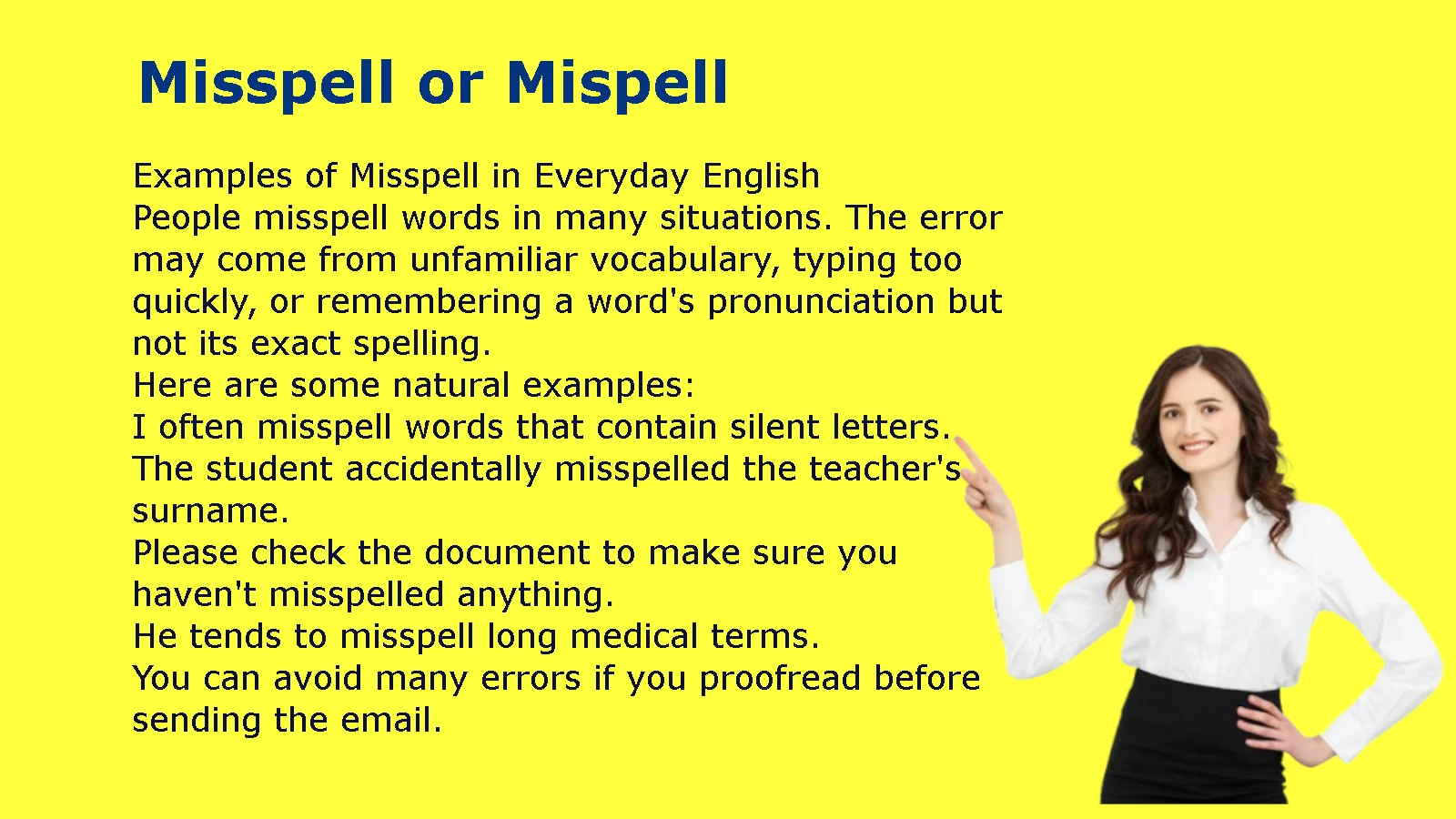
Examples of Misspell in Everyday English
People misspell words in many situations. The error may come from unfamiliar vocabulary, typing too quickly, or remembering a word’s pronunciation but not its exact spelling.
Here are some natural examples:
- I often misspell words that contain silent letters.
- The student accidentally misspelled the teacher’s surname.
- Please check the document to make sure you haven’t misspelled anything.
- He tends to misspell long medical terms.
- You can avoid many errors if you proofread before sending the email.
The word also appears in instructions and advice.
For example, an editor might say, “Do not misspell the author’s name in the headline.” A teacher might write, “You misspelled three words in this paragraph.”
In both cases, the verb identifies an error in the written form of a word.
Synonyms and Related Words for Misspell
Several expressions can communicate the same basic idea as misspell, although their grammar and tone may differ.
| Alternative | Typical use | Example |
| Spell incorrectly | Neutral and clear | She spelled the word incorrectly. |
| Spell wrong | Informal conversation | I always spell that word wrong. |
| Make a spelling mistake | General writing | He made a spelling mistake in the report. |
| Write incorrectly | Broad; may include other errors | She wrote the name incorrectly. |
| Make a typo | Usually a typing or keyboard error | I made a typo in the email. |
These expressions are related, but they are not always interchangeable.
A typo often results from an accidental typing error, such as hitting the wrong key. A misspelling may also happen because someone does not know the correct spelling. Meanwhile, write incorrectly can refer to punctuation, grammar, names, numbers, or other written information.
For formal writing, spell incorrectly and make a spelling mistake offer clear alternatives when you do not want to repeat misspell.
Is Misspell a Noun or a Verb?
Misspell is primarily a verb, not a noun. It describes the action of spelling a word incorrectly. The noun misspelling refers to an incorrectly spelled word or the act of spelling something incorrectly, while misspeller describes a person who misspells words.
Misspell as a Verb
A verb describes an action or state. In this case, misspell describes the action of producing an incorrect spelling.
The base form appears with subjects such as I, you, we, and they in the simple present. It also follows modal verbs such as can, may, and might.
Examples:
- I sometimes misspell unfamiliar names.
- They misspell the same word in every assignment.
- You might misspell the address if you type too quickly.
- We should check the document to ensure we do not misspell any names.
The verb changes according to tense and subject.
For example, “She misspells difficult words” uses the third-person singular present form. “She misspelled a difficult word yesterday” uses the past tense.
Misspelling as a Noun
Misspelling can function as a noun when it identifies a spelling error.
For example:
- There is a misspelling in the first paragraph.
- The editor corrected every misspelling before publication.
- One misspelling changed the meaning of the sentence.
- I noticed several misspellings in the application.
In these sentences, misspelling names something rather than describing an action performed by a subject.
The word can also function as the -ing form of the verb:
- She is misspelling several words because she is typing too quickly.
Here, is misspelling describes an ongoing action.
Context helps you distinguish the two grammatical functions.
What Is the Noun Form of Misspell?
The most useful noun forms are misspelling and misspeller.
- Misspelling: An incorrectly spelled word or the act of spelling incorrectly.
- Misspeller: A person who misspells words.
Examples:
- The report contains a serious misspelling.
- The student is a frequent misspeller of unfamiliar words.
The distinction matters because misspell itself normally functions as a verb in standard English. If you want to refer to the error, use misspelling. If you want to refer to the person making the error, use misspeller.
Misspell in a Sentence: Examples and Usage
The easiest way to learn how to use misspell is to compare its different forms in complete sentences. Misspell is the base verb, misspells is the third-person singular present form, and misspelled and misspelt are accepted past-tense forms.
Simple Sentences With Misspell
Use misspell when describing an action in the present or after a modal verb.
Examples:
- I sometimes misspell words when I am tired.
- We should not misspell a customer’s name on an invoice.
- They often misspell words with silent letters.
- You can misspell a word even if you understand its meaning.
- I do not want to misspell anything in my application.
- Students sometimes misspell words they have only heard aloud.
In the sentence “I sometimes misspell words when I am tired,” the word misspell is the main verb. It explains what the subject, I, sometimes does.
In “You can misspell a word,” the modal verb can comes before the base form. You should not write “You can misspells a word” because modal verbs take the base form of the following verb.
Sentences With Misspells
Use misspells with a third-person singular subject in the simple present tense, such as he, she, it, or a singular noun.
Examples:
- She misspells unfamiliar surnames.
- My brother misspells the word beautiful regularly.
- The software sometimes misspells names that are not in its dictionary.
- He misspells words when he rushes through his homework.
- This student rarely misspells common words.
The grammar rule is straightforward: add -s to the base verb for a third-person singular subject in the simple present.
Compare:
- I misspell words.
- They misspell words.
- She misspells words.
- The student misspells words.
This rule applies to many regular verbs, including write/writes, read/reads, and check/checks.
Sentences With Misspelled
Misspelled is the standard American English past-tense and past-participle form of misspell. It can describe an action completed in the past or a word that has been spelled incorrectly.
Examples:
- I misspelled your name in the invitation.
- She misspelled the address on the envelope.
- The report contains a misspelled word.
- He has misspelled the same term several times.
- The teacher corrected the misspelled words.
- I accidentally misspelled the company’s name in the subject line.
Compare these two sentences:
- “I misspelled the word yesterday.” The verb describes a completed past action.
- “The misspelled word appears in the headline.” The word modifies the noun word.
In the second sentence, misspelled acts as an adjective. It describes the condition of the word rather than serving as the main verb.
Sentences With Misspelling
Use misspelling when referring to a spelling error as a thing or describing the ongoing action of spelling incorrectly.
Examples:
- The editor found a misspelling in the opening paragraph.
- One misspelling made the company name look unprofessional.
- Please correct the misspelling before submitting the form.
- I noticed two misspellings in the final draft.
- He is misspelling several words in the document.
A helpful test is to check whether the word names an error or describes an action.
In “The report contains a misspelling,” the word names an error. In “He is misspelling the word,” it forms part of the verb phrase.
Misspelled Words: Correct Forms and Common Examples
Misspelled words are words written with an incorrect sequence of letters. Common examples include recieve instead of receive and definately instead of definitely. Recognizing recurring mistakes can improve your writing, especially when you prepare professional emails, academic assignments, applications, or published content.
Commonly Misspelled Words in English
English spelling can be difficult because pronunciation does not always reveal the correct letter sequence. Silent letters, unfamiliar combinations, and words borrowed from other languages often cause confusion.
Here are some frequently encountered spelling mistakes:
| Incorrect spelling | Correct spelling | Common source of confusion |
| Mispell | Misspell | Missing the second s |
| Recieve | Receive | Confusing ie and ei |
| Definately | Definitely | Replacing the middle vowel pattern |
| Seperate | Separate | Confusing the vowel in the middle |
| Accomodate | Accommodate | Missing one c |
| Neccessary | Necessary | Adding an extra c |
| Occured | Occurred | Missing a repeated r |
| Untill | Until | Adding an extra l |
| Begining | Beginning | Missing one n |
| Enviroment | Environment | Omitting the n before the m |
These examples illustrate different error patterns. Some involve missing letters, while others involve inserting extra letters or rearranging them.
The best correction method depends on the mistake. For example, remembering that necessary has one c and two s’s may help you avoid repeating that particular error.
Why Do People Misspell Words?
Misspellings happen for several reasons. They do not always indicate that someone lacks vocabulary knowledge or writing ability.
Common causes include:
- Confusing pronunciation: Words such as definitely may be misspelled because their spoken forms do not make every letter obvious.
- Similar letter patterns: Writers may confuse receive with the incorrect form recieve.
- Typing too quickly: A writer may omit a letter while using a keyboard or touchscreen.
- Unfamiliar names: Surnames, place names, and company names may follow spelling patterns that differ from familiar words.
- Memory errors: Someone may recognize a word when reading it but struggle to reproduce its exact spelling.
- Autocorrect mistakes: A device may replace a correct but unfamiliar name with a more common word.
For example, a person may understand a technical term perfectly but still misspell it in a report. The problem lies in reproducing the letter sequence, not necessarily in understanding the term.
Recognizing the source of an error makes it easier to correct the problem. If you repeatedly type a word incorrectly, a personal correction list may help. If you struggle with unfamiliar names, checking the original source is more reliable than relying on memory.
How to Avoid Misspelling Words
You do not need to memorize every spelling rule to become a more accurate writer. A consistent proofreading routine can catch many common errors.
Try these practical steps:
- Check unfamiliar words: Look up a word when you are uncertain instead of guessing.
- Use spell-check tools: Run a spelling check before sending important documents.
- Proofread slowly: Read the final version separately from the drafting process.
- Check names individually: Verify names against an official email, form, or source document.
- Keep a correction list: Record recurring mistakes and review the correct forms.
- Read the text again after editing: A change made to one sentence can introduce a new typo elsewhere.
- Do not rely entirely on autocorrect: It may replace a name or technical term with a familiar but incorrect alternative.
A useful approach is to review a document in separate passes. First, check spelling. Next, review grammar and punctuation. Finally, verify names, dates, email addresses, and other details that spell-check tools may not recognize as errors.
This process is especially helpful for resumes, job applications, invoices, and customer communications, where a small mistake can affect how carefully the document appears to have been prepared.
Misspelled or Misspelt: British vs. American English
Misspelled and misspelt are both accepted forms of the past tense and past participle of misspell. American English generally favors misspelled, while misspelt is particularly associated with British English. However, British writers also use misspelled, so the difference reflects usage preference rather than a strict rule separating the two varieties.
Is Misspelt Correct in British English?
Yes. Misspelt is a correct English spelling, particularly in British usage. It is an alternative form of misspelled, not a different word with a different meaning.
For example:
- British usage: She misspelt my surname on the invitation.
- American usage: She misspelled my surname on the invitation.
Both sentences communicate the same idea. The difference lies in the form of the verb.
British English includes several verbs with alternative past-tense forms ending in -t, such as spelt and learnt. However, these alternatives do not mean every British writer must use them. Forms ending in -ed remain common in British writing.
When writing for a specific audience, consistency matters more than treating one accepted form as universally correct.
Misspelled vs. Misspelt Examples
The following examples show how the two forms work in context.
| With misspelled | With misspelt |
| I misspelled the word in my essay. | I misspelt the word in my essay. |
| The teacher corrected the misspelled name. | The teacher corrected the misspelt name. |
| She has misspelled the address twice. | She has misspelt the address twice. |
| Several words were misspelled in the report. | Several words were misspelt in the report. |
The meaning stays the same in each pair. Neither form changes the basic grammar of the sentence.
Both forms can also function as adjectives, as in a misspelled word and a misspelt word.
Which Form Should You Use?
Choose the form that fits your audience and the style of the publication.
- For American English: Prefer misspelled.
- For British English: Either misspelled or misspelt is acceptable; follow the publication’s preferred style.
- For international audiences: Misspelled is a clear choice because it is widely recognized across English varieties.
- For academic or professional writing: Follow the organization’s spelling guide and use one form consistently.
Imagine you are editing a report for an American company. Using misspelled throughout the document would be a straightforward choice. If you were editing a British publication that consistently prefers forms such as spelt and learnt, misspelt might fit its house style.
The goal is not to correct an accepted regional variant. It is to make sure your writing follows the spelling convention you intend to use.
Misspell Word Forms and Grammar Rules
The verb misspell has several related forms, and each serves a different grammatical purpose. Learning these forms helps you distinguish an action from a completed event, an adjective, and a noun referring to a spelling error.
Misspell, Misspells, Misspelled, and Misspelling
Use this table as a quick reference:
| Word form | Grammatical use | Example |
| Misspell | Base verb | I sometimes misspell unfamiliar words. |
| Misspells | Third-person singular present | He misspells the same term repeatedly. |
| Misspelled | Past tense or past participle | She misspelled the address. |
| Misspelt | Alternative past tense or past participle | She misspelt the address. |
| Misspelling | Noun or -ing verb form | I noticed a misspelling in the letter. |
| Misspellings | Plural noun | The editor corrected several misspellings. |
| Misspeller | Noun referring to a person | The exercise helps frequent misspellers improve. |
The form you need depends on the sentence.
For example, “She misspells names” describes a recurring action in the present. “She misspelled a name” describes a completed action in the past. “The misspelling was corrected” identifies the error itself.
Is Misspelled One Word?
Yes. Misspelled is written as one word, without a space or hyphen.
Correct examples:
- The form contains a misspelled surname.
- I accidentally misspelled the product name.
- The misspelled word confused the reader.
Incorrect forms include miss spelled and miss-spelled in ordinary standard usage.
The same principle applies to misspell. The prefix mis- combines with spell to create one word.
Is Misspelling One Word?
Yes. Misspelling is also written as one word.
Examples:
- The editor found a misspelling in the article.
- Please correct the misspelling before publication.
- The document contains three misspellings.
Do not confuse misspelling with miss spelling. The latter may occur when the words are used separately in a different grammatical construction, but it is not the standard spelling of the noun meaning an error.
When you refer to an incorrectly written word, use misspelling as one word.
Common Mistakes When Using Misspell
The most common mistakes involve dropping a letter, confusing grammatical forms, or assuming that regional alternatives are errors. Understanding these distinctions makes it easier to write accurately and edit other people’s work.
Confusing Misspell With Misspelling
Misspell is a verb, while misspelling often functions as a noun. Using one in place of the other can make a sentence ungrammatical.
Compare:
- Correct: I often misspell difficult words.
- Correct: I often make misspellings when I type too quickly.
- Incorrect: I often misspelling difficult words.
The first sentence describes an action. The second refers to errors. In the third, misspelling does not fit the sentence because the verb structure is incomplete.
You could write “I am misspelling difficult words” if you want to describe an action currently in progress.
Confusing Misspelled With Misspelt
Both forms are correct, so choosing misspelt does not automatically make a sentence wrong.
For example:
- Correct: The student misspelled the word.
- Correct: The student misspelt the word.
The main issue is consistency. If your article uses American spelling, misspelled is usually the better choice. If your publication prefers British forms, misspelt may suit its style.
Do not change every instance of misspelt to misspelled on the assumption that the former is incorrect.
Using Mispell in Formal Writing
The form mispell is incorrect in standard English. Leaving it in a published article, application, or business email can distract readers and undermine the appearance of careful proofreading.
Suppose you are preparing an email that says:
“Please let me know if I mispell your surname.”
The corrected version is:
“Please let me know if I misspell your surname.”
For important writing, check the base word and its related forms:
- misspell, not mispell
- misspells, not mispells
- misspelled, not mispelled
- misspelling, not mispelling
A spelling tool can catch many of these errors, but a final manual review is still useful. Names, product terms, and specialist vocabulary may not appear in a tool’s dictionary.
Frequently Asked Questions
Is It Misspell or Mispell?
Misspell is correct, while mispell is a misspelling. The correct word combines mis- with spell, retaining both s’s. Use misspell in formal writing, emails, assignments, and published content.
What Does Misspell Mean?
Misspell means to spell a word incorrectly. For example, writing recieve instead of receive means you have misspelled the word. The verb describes a spelling error rather than a general grammar or punctuation mistake.
Is Misspell a Noun or a Verb?
Misspell is primarily a verb. It describes the action of spelling a word incorrectly. The noun misspelling refers to a spelling error or the act of spelling incorrectly, while misspeller refers to someone who misspells words.
How Do You Use Misspell in a Sentence?
You can write, “I sometimes misspell unfamiliar names.” Use misspell with subjects such as I, you, we, and they in the simple present. With he, she, or it, use misspells.
Is It Misspelled or Misspelt in the UK?
Both forms are accepted in British English. Misspelt is particularly associated with British usage, while misspelled is also common. Follow your publication’s preferred spelling style and use it consistently.
What Is the Difference Between Misspelled and Misspelt?
There is no basic difference in meaning. Both are past-tense and past-participle forms of misspell. American English generally favors misspelled, while misspelt is a familiar alternative in British English.
Final Thoughts on Misspell or Mispell
The correct spelling is misspell, not mispell. It means to spell a word incorrectly and functions primarily as a verb. Its related forms include misspells, misspelled, misspelt, and misspelling.
Keep these points in mind:
- Write misspell with two consecutive s’s.
- Use misspelling when referring to a spelling error.
- Choose misspelled or misspelt according to your preferred English variety or style guide.
- Proofread names, unfamiliar words, and important documents before submitting them.
If you are editing an article, preparing an assignment, or writing a professional email, check these forms before publishing or sending your work. A quick spelling review can prevent avoidable errors and help your writing look clear, accurate, and professional.