Mischievous vs mischievious is a common spelling and pronunciation question, but only one form is standard English. Mischievous is the correct spelling in both American and British English, while mischievious is a common misspelling that often results from how people pronounce the word. The adjective describes someone or something playfully troublesome, naughty, or inclined to cause mischief. Understanding its meaning, pronunciation, synonyms, spelling, and etymology will help you use it correctly in speech and writing.
| Question | Answer |
| Which spelling is correct: mischievous or mischievious? | Mischievous is correct; mischievious is a nonstandard spelling. |
| How do you pronounce mischievous? | Usually MIS-chuh-vuhs, with three syllables and stress on the first. |
| Is mischievous spelled differently in the UK? | No. Mischievous is standard in both British and American English. |
| What does mischievous mean? | Playfully troublesome, naughty, or inclined to cause mischief. |
| What are some synonyms for mischievous? | Playful, impish, naughty, cheeky, and prankish, depending on context. |
Mischievous vs Mischievious: Which Spelling Is Correct?
Mischievous is the correct spelling in standard English. Mischievious is a common misspelling, not an accepted British or American spelling variant. Although some speakers pronounce the word as if it contains an extra syllable, that pronunciation does not change the standard spelling.
The distinction matters in school assignments, professional emails, articles, and other edited writing. Spell-checkers may catch the error, but understanding why it occurs makes it easier to avoid.
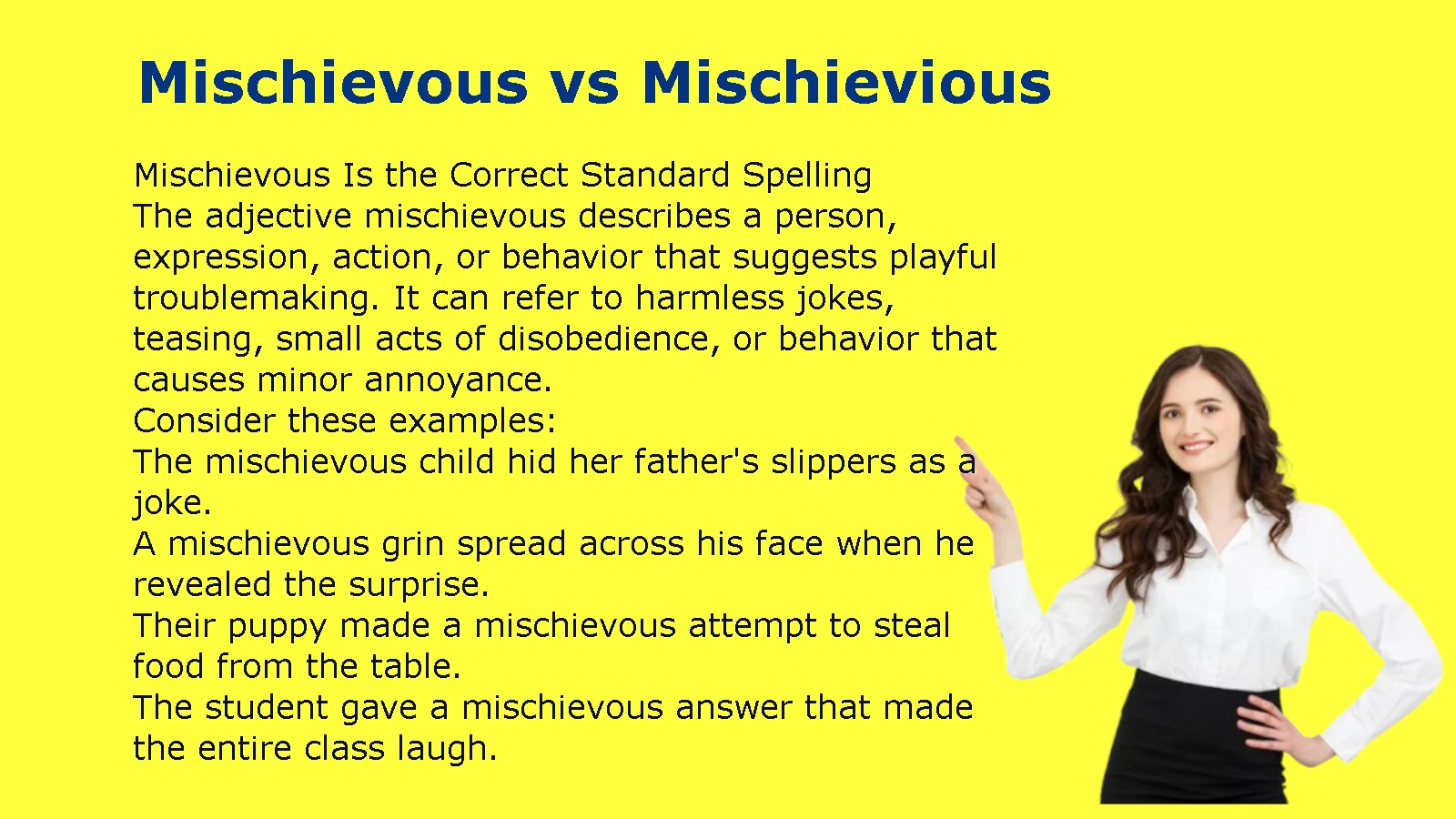
Mischievous Is the Correct Standard Spelling
The adjective mischievous describes a person, expression, action, or behavior that suggests playful troublemaking. It can refer to harmless jokes, teasing, small acts of disobedience, or behavior that causes minor annoyance.
Consider these examples:
- The mischievous child hid her father’s slippers as a joke.
- A mischievous grin spread across his face when he revealed the surprise.
- Their puppy made a mischievous attempt to steal food from the table.
- The student gave a mischievous answer that made the entire class laugh.
In every example, mischievous is spelled without the extra i found in mischievious.
A simple way to remember the correct form is to connect it with the noun mischief. Both words share the same central spelling pattern: mischief and mischievous. The adjective adds -ous to the related word form without introducing an extra i.
Mischievous vs Mischievious in British and American English
British and American English both use mischievous as the standard spelling. Unlike pairs such as colour/color and realise/realize, this word does not have a standard regional spelling difference.
| Feature | Mischievous | Mischievious |
| Standard spelling | Yes | No |
| British English | Correct | Nonstandard |
| American English | Correct | Nonstandard |
| Grammatical role | Adjective | Intended as the same adjective |
| Meaning | Playfully troublesome or inclined to cause mischief | Usually intended to mean the same thing |
| Formal writing | Recommended | Avoid |
For example, a British writer might describe a child as mischievous, and an American writer would use exactly the same spelling.
Remember: The correct spelling stays the same regardless of where you live or which variety of English you write.
Why Do People Spell Mischievous as Mischievious?
People often write mischievious because they pronounce mischievous as though it contains an additional syllable. That extra sound can make the spelling seem logical, especially to someone who has heard the word more often than they have read it.
English spelling also encourages confusion because many adjectives end in -ious, as in curious, serious, and delicious. A writer may unconsciously apply that familiar pattern to mischievous.
Three practical reminders can prevent this mistake:
- Remember the base word: Mischief is spelled without the extra i.
- Count the syllables: The standard pronunciation has three syllables.
- Learn the whole word: Memorize mischievous as one spelling rather than trying to build it from the sound.
For example, if you write, “The mischievous puppy chewed my shoe,” the spelling is correct. Writing “The mischievious puppy chewed my shoe” introduces an unnecessary i.
Mischievous Pronunciation: How Do You Say Mischievous?
The standard pronunciation of mischievous has three syllables, with the primary stress on the first syllable. In IPA, a common pronunciation is /ˈmɪstʃɪvəs/. You can remember it as MIS-chuh-vuhs. The common mistake is to add another syllable, often making the word sound as though it were spelled mischievious.
The Correct Pronunciation of Mischievous
To pronounce the word naturally, divide it into three spoken parts:
MIS – chuh – vuhs
The first syllable carries the strongest stress. The remaining syllables are shorter and less prominent.
| Pronunciation feature | Explanation |
| Word | Mischievous |
| IPA | /ˈmɪstʃɪvəs/ |
| Syllable count | Three |
| Main stress | First syllable |
| Easy pronunciation guide | MIS-chuh-vuhs |
The first sound resembles the beginning of mist. The middle syllable contains the “ch” sound heard in chip. The final syllable has a relaxed vowel, similar to the ending of nervous.
Try saying the word slowly once, then repeat it at a natural conversational speed. Keep the first syllable clear without stretching the middle into an additional beat.
Example: “The mischievous boy smiled when his sister discovered the hidden cookies.”
In this sentence, the word should flow naturally without a separate fourth syllable.
Mischievous vs Mischievious Pronunciation
The spelling difference often reflects a pronunciation difference, but spelling and pronunciation are not the same thing.
Mischievous is the standard written form. Some speakers say it with an extra syllable, making it sound closer to mis-CHEE-vee-us. That pronunciation helps explain why people sometimes write mischievious, even though the spelling is nonstandard.
| Form | What to know |
| Mischievous | Correct spelling; standard pronunciation commonly has three syllables |
| Mischievious | Nonstandard spelling, often influenced by an extra-syllable pronunciation |
| Three-syllable pronunciation | The usual recommended form for learners and formal speech |
| Four-syllable pronunciation | Commonly heard, but best avoided in careful standard speech |
If you have used the longer pronunciation for years, you may need practice to change the habit. Start by slowing the word down and emphasizing the first syllable. Then use it in short phrases such as mischievous child, mischievous grin, and mischievous behavior.
Are There Two Ways to Pronounce Mischievous?
Speakers do vary in how they pronounce mischievous, but that does not mean every pronunciation has the same status in standard English. Accent differences are normal, and some people use a four-syllable version. However, the recommended pronunciation for formal speech and English learners has three syllables.
The key distinction is between a regional or personal pronunciation habit and the standard form taught in careful speech.
For example, you might hear a speaker use a longer pronunciation during casual conversation. That does not automatically make the speaker’s spelling correct or establish mischievious as a regional spelling variant.
If you are preparing for an English exam, recording a presentation, or reading aloud in a formal setting, use the three-syllable pronunciation.
How to Remember the Correct Pronunciation
Use this short practice routine:
- Start with the stress: Say the first syllable clearly and strongly.
- Keep the middle short: Avoid adding a separate syllable after the first part.
- Finish lightly: Let the final syllable remain unstressed.
- Practice in context: Say, “That was a mischievous trick,” several times at a natural pace.
A useful memory link is mischief → mischievous. The related words share a spelling pattern, and the adjective does not need an extra syllable to make sense.
Mischievous Meaning and Definition
Mischievous means playfully troublesome, naughty, or inclined to cause mischief. It often describes behavior intended to amuse, tease, or test limits rather than cause serious harm. The word can also describe a facial expression, a joke, or an action that hints at playful intentions.
Its exact tone depends on context. A mischievous smile may seem charming, while a mischievous prank may irritate the person who becomes its target.
What Does Mischievous Mean?
The word usually describes behavior that involves playful disobedience, trickery, teasing, or minor troublemaking. It often carries a lighthearted tone, particularly when someone acts out of curiosity or wants to make others laugh.
However, mischievous does not always mean harmless. A prank can upset someone, and a troublesome act can have real consequences. The word often suggests a lighter or more playful intention than words such as malicious or cruel.
Consider these differences:
- A child hides a toy to surprise a sibling. The action is mischievous.
- A friend changes a harmless group-chat message to make everyone laugh. The joke may be mischievous.
- Someone deliberately spreads a damaging lie to hurt a colleague. Malicious is more precise than mischievous.
The context helps readers decide whether the word expresses affection, mild criticism, or disapproval.
Mischievous Examples in Sentences
These examples show how the word works in everyday situations.
When Describing a person
- The mischievous toddler emptied a box of tissues across the living room.
- My mischievous cousin always finds a way to turn ordinary games into competitions.
- Their mischievous neighbor rang the doorbell and ran away before anyone answered.
Describing a facial expression
- She gave me a mischievous smile before revealing the birthday surprise.
- A mischievous twinkle appeared in his eyes when he mentioned the secret plan.
- His mischievous grin suggested that he knew something the rest of us did not.
Describing an action or idea
- The team came up with a mischievous plan to decorate the manager’s office for her birthday.
- A mischievous prank left colorful paper stars all over the classroom.
- The advertisement used a mischievous sense of humor to capture attention.
when Describing animals
- The mischievous kitten knocked a pen off the desk.
- Our dog made a mischievous dash toward the unattended sandwich.
- A mischievous monkey grabbed a visitor’s hat and carried it away.
These sentences show that mischievous can describe people, animals, expressions, plans, and individual actions.
Mischievous as an Adjective
Mischievous is an adjective, which means it describes a noun rather than naming an action or thing by itself.
It commonly appears before a noun:
- A mischievous child
- A mischievous expression
- A mischievous prank
- A mischievous idea
It can also appear after a linking verb:
- The children were mischievous during the trip.
- His smile looked mischievous.
- The puppy seemed mischievous whenever someone opened the pantry.
The word does not change form to agree with a singular or plural noun. You can write a mischievous child or mischievous children. The adjective remains the same.
Do not confuse it with mischief, which is a noun. You might say, “The children got into mischief,” or “The children were mischievous.” Both sentences are correct, but the words serve different grammatical functions.
Mischievous Synonyms and Similar Words
Several words can replace mischievous, but they do not all express the same attitude. Playful sounds friendly, naughty suggests disobedience, and impish often describes clever, teasing behavior. Choose a synonym based on the action, the person’s intention, and the tone you want to convey.
Common Synonyms for Mischievous
| Synonym | Meaning or nuance | Example |
| Playful | Lighthearted and fun | The playful puppy chased its tail. |
| Naughty | Disobedient or badly behaved | The naughty child ignored the rules. |
| Impish | Playfully troublesome or teasing | He gave an impish grin. |
| Cheeky | Bold or slightly disrespectful in a playful way | Her cheeky reply made us laugh. |
| Prankish | Inclined to play tricks | His prankish sense of humor surprised everyone. |
| Sly | Clever or secretive, sometimes dishonest | She gave a sly look across the table. |
| Roguish | Charming but slightly troublesome | His roguish smile won over the audience. |
| Troublesome | Causing problems or annoyance | The troublesome behavior interrupted the lesson. |
| Teasing | Intended to provoke a playful reaction | He made a teasing remark about the surprise. |
| Impudent | Disrespectfully bold | The impudent response offended the teacher. |
The best replacement depends on the situation. For a friendly description, playful or impish often works well. If the behavior involves breaking rules, naughty may be more accurate. For a person who deliberately causes problems, troublesome communicates a more critical tone.
Mischievous vs Naughty vs Playful
These three adjectives overlap, but they emphasize different qualities.
Mischievous usually suggests playful troublemaking or an inclination to cause minor mischief. It can sound affectionate or mildly disapproving.
Naughty focuses more directly on disobedience or behavior that breaks rules. Adults often use it when correcting children’s behavior.
Playful emphasizes fun, energy, or a desire to interact. It does not necessarily imply wrongdoing.
Compare these examples:
- Mischievous: The child hid the television remote to surprise his father.
- Naughty: The child took a toy after being told not to touch it.
- Playful: The child invited everyone to join a game of hide-and-seek.
The same person could be described with all three words in different situations. The choice depends on what the person did and how the writer wants readers to interpret it.
When Not to Use Mischievous
Although mischievous is flexible, it is not the best word for every kind of wrongdoing. Its usual associations with playfulness can soften the seriousness of an action.
Choose a more precise adjective when the behavior involves deliberate harm:
- Malicious: Intended to hurt someone or cause damage.
- Deceptive: Intended to mislead or create a false impression.
- Cruel: Causing pain or distress without proper concern for the victim.
- Destructive: Causing serious damage.
- Manipulative: Influencing someone unfairly to achieve a personal goal.
For instance, describing a person who deliberately damages a colleague’s reputation as mischievous may make the behavior sound less serious than it is. Malicious or deceptive would communicate the intention more clearly.
The practical rule is simple: use mischievous when playful troublemaking is central to the description. Choose a stronger word when the action involves serious harm, dishonesty, or deliberate cruelty.
Mischievous Etymology: Where Does the Word Come From?
Mischievous comes from mischief, a word that developed through Middle English from Anglo-French forms related to harm, misfortune, and troublesome conduct. Over time, mischief became associated with playful troublemaking as well as harmful consequences. The adjective mischievous now commonly describes someone or something inclined to cause such trouble.
The Origin of Mischievous
The history of mischievous helps explain why it shares its spelling with mischief. The adjective developed from the noun, using the suffix -ous, which often forms adjectives meaning “characterized by” or “full of.”
Other familiar adjectives use the same suffix:
- Dangerous: Characterized by danger.
- Curious: Eager to know or learn.
- Famous: Widely known.
- Mischievous: Characterized by mischief or an inclination to cause it.
The suffix helps form the adjective, but English spelling does not always follow a simple sound-by-sound pattern. That is one reason learners may mistakenly insert an extra i.
The word’s meaning has also broadened in everyday use. A mischievous act can involve a minor practical joke rather than serious wrongdoing. A mischievous smile may suggest hidden amusement without describing any actual act of mischief.
Mischief vs Mischievous
Mischief and mischievous are related words, but they have different grammatical roles.
| Word | Part of speech | Meaning | Example |
| Mischief | Noun | Trouble, playful wrongdoing, or harm | The children got into mischief. |
| Mischievous | Adjective | Inclined to cause mischief | The mischievous children hid the keys. |
Use mischief when you are naming the trouble itself. Use mischievous when you are describing a person, expression, or action.
For example:
- Correct: “The puppy caused a little mischief.”
- Correct: “The puppy was mischievous.”
- Incorrect: “The puppy was mischief.”
The distinction is useful when editing sentences because the two words are related in meaning but cannot always replace each other.
Why the Spelling Is Mischievous, Not Mischievious
The standard spelling is mischievous, derived from the established word form mischief. The extra i in mischievious does not belong in the standard adjective.
The confusion becomes easier to understand when you consider how people learn vocabulary. Someone who first hears the longer pronunciation may assume that the word contains another vowel sound and write it accordingly. A familiar pattern such as serious or previous may reinforce that assumption.
However, English spelling does not always represent every speaker’s pronunciation literally. The accepted written form remains mischievous.
Use these examples as a final spelling check:
- Correct: The mischievous cat knocked over a glass.
- Incorrect: The mischievious cat knocked over a glass.
- Correct: His mischievous expression revealed the joke.
- Incorrect: His mischievious expression revealed the joke.
The spelling remains the same whether the word appears in a school essay, a newspaper article, a business email, or casual writing.
Is Mischievous a Word?
Yes, mischievous is a standard English word. It is an adjective used to describe playful troublemaking, naughty behavior, or a tendency to cause mischief. Mischievious, by contrast, is a nonstandard spelling of the intended word and should generally be corrected in formal or edited writing.
Is Mischievious Ever Correct?
In ordinary modern English, mischievious is not the standard spelling. You may encounter it in informal messages, online discussions, or writing that reflects a speaker’s pronunciation, but that does not make it an accepted British or American variant.
Use mischievous in:
- School assignments and examinations.
- Professional emails and reports.
- Articles, books, and website content.
- Formal documents and edited publications.
- English-learning exercises and vocabulary tests.
If you are quoting someone who used mischievious, you can preserve the original wording when the exact quote matters. Outside that context, correct it to mischievous.
For writers and editors, the distinction is straightforward: a nonstandard spelling may explain how someone speaks, but it should not replace the established spelling in polished prose.
Common Mistakes When Using Mischievous
Writers sometimes make mistakes beyond adding an extra i. The following table covers the most common issues and how to correct them.
| Common mistake | Correct approach |
| Writing mischievious | Use mischievous. |
| Adding an extra syllable in careful speech | Practice the standard three-syllable pronunciation. |
| Treating mischievous as a noun | Use it as an adjective. |
| Using mischief as an adjective | Use mischievous to describe a person or action. |
| Calling serious cruelty mischievous | Choose a more precise word, such as malicious or cruel. |
| Assuming British English uses mischievious | Use mischievous in both British and American English. |
A useful editing exercise is to search a document for mischievious. Replace it with mischievous unless you have a specific reason to preserve a nonstandard form in a quotation or linguistic discussion.
You should also check the sentence’s meaning. A correct spelling cannot fix an inaccurate word choice, so make sure mischievous describes the behavior you intend to convey.
Mischievous vs Mischievious: Quick Comparison
The fastest way to settle the mischievous vs mischievious question is to remember that mischievous is the standard spelling, regardless of region. The other form usually results from an extra syllable in speech or confusion about the word’s spelling pattern.
| Feature | Mischievous | Mischievious |
| Correct spelling | Yes | No |
| Standard dictionary form | Yes | No |
| British English | Standard | Nonstandard |
| American English | Standard | Nonstandard |
| Meaning | Playfully troublesome or inclined to cause mischief | Usually intended to express the same meaning |
| Standard pronunciation | Commonly three syllables | Often associated with an extra-syllable pronunciation |
| Formal writing | Recommended | Avoid |
| Related noun | Mischief | Mischief is the intended related noun |
A Simple Way to Remember the Difference
Keep these three facts in mind:
- Spelling: Write mischievous, without the extra i.
- Pronunciation: Aim for three syllables with stress on the first.
- Meaning: Use the adjective for playful troublemaking, teasing, or behavior that causes minor trouble.
Imagine writing a school report that says, “The mischievous student hid a classmate’s notebook as a joke.” The sentence uses the correct spelling, grammatical form, and meaning. If the student had deliberately destroyed the notebook to hurt the classmate, mischievous might not communicate the seriousness of the act.
This example shows why correct spelling, pronunciation, and context work together. Knowing the right form is the first step; understanding the word’s tone helps you use it effectively.
Conclusion: Use Mischievous With Confidence
The correct spelling is mischievous, not mischievious. Both British and American English use the same standard form, and the usual recommended pronunciation has three syllables with stress on the first. The word describes playful troublemaking, naughty behavior, or an expression that suggests someone is up to something.
Remember its connection to mischief, choose synonyms such as playful, impish, or cheeky according to context, and use stronger words such as malicious when an action involves deliberate harm.