Monetary vs nonmonetary describes the difference between money-related items and items or benefits that do not take the form of money. In accounting, however, the distinction has a more precise meaning: a monetary item represents a right to receive or an obligation to pay a fixed or determinable number of currency units, while a nonmonetary item does not.
Understanding this difference helps you classify monetary and nonmonetary items in accounting, handle foreign-currency transactions, compare monetary vs nonmonetary incentives, and understand related economic terms such as monetary policy, fiscal policy, and monetary value. The key is to look at what an item represents, not simply whether someone can assign a price to it.
| Question | Answer |
| What does monetary mean? | It relates to money, currency, or financial amounts. |
| What is the difference between monetary and nonmonetary? | Monetary accounting items involve fixed or determinable currency amounts; nonmonetary items generally do not. |
| What are examples of monetary items? | Cash, trade receivables, loans receivable, and accounts payable. |
| What are examples of nonmonetary items? | Inventory, land, equipment, and many intangible assets. |
| What is the difference between monetary and fiscal policy? | Monetary policy uses central-bank tools, while fiscal policy involves government taxation and spending. |
What Does Monetary Mean?
Monetary means relating to money, currency, or financial amounts. The word appears in everyday conversations, business transactions, accounting, economics, and employee compensation. Its exact meaning depends on the context.
For example, a monetary reward is a cash payment, while monetary policy refers to measures a central bank uses to influence interest rates and financial conditions. In accounting, the term has a more specific meaning when professionals classify monetary assets and liabilities.
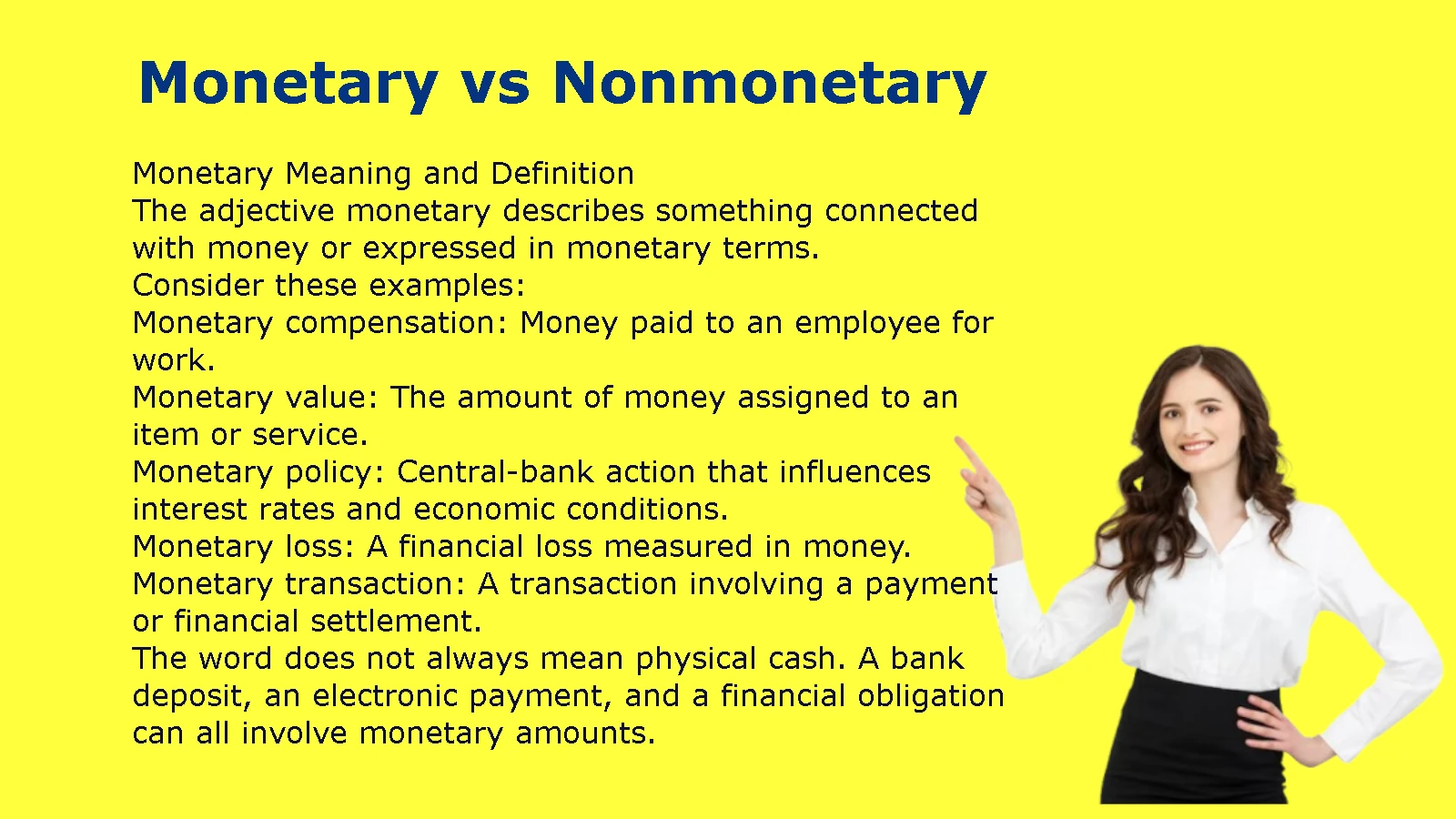
Monetary Meaning and Definition
The adjective monetary describes something connected with money or expressed in monetary terms.
Consider these examples:
- Monetary compensation: Money paid to an employee for work.
- Monetary value: The amount of money assigned to an item or service.
- Monetary policy: Central-bank action that influences interest rates and economic conditions.
- Monetary loss: A financial loss measured in money.
- Monetary transaction: A transaction involving a payment or financial settlement.
The word does not always mean physical cash. A bank deposit, an electronic payment, and a financial obligation can all involve monetary amounts.
Monetary Pronunciation
The word monetary is commonly pronounced MON-uh-ter-ee in American English.
Its IPA pronunciation is /ˈmɑːnəˌteri/ in a common American pronunciation. The first syllable carries the primary stress.
Example: “The company offered monetary compensation for the damaged equipment.”
What Does Monetary Value Mean?
Monetary value means the amount of money assigned to, paid for, or exchanged for something. It may refer to a market price, a transaction amount, an appraised value, or a value recorded in financial statements.
For example, suppose a business purchases a laptop for $1,200. The purchase price establishes its initial cost, but the laptop’s current market value may later fall to $700. Its monetary value depends on which measurement you mean.
Keep these distinctions in mind:
- Market value: The amount an asset could generally sell for in the market.
- Purchase price: The amount a buyer pays to acquire an item.
- Book value: The amount recorded for an asset in the accounting records after applicable adjustments.
- Sentimental value: Personal importance that may not correspond to a market price.
An item can have a monetary value without being a monetary item for accounting purposes. A building may be worth $500,000, for example, but it remains a nonmonetary asset because owning it does not generally give the owner a right to receive a fixed amount of currency.
Monetary vs Nonmonetary: Key Differences
The main difference between monetary and nonmonetary items is what the item represents. In accounting, monetary items involve a right to receive or an obligation to pay a fixed or determinable number of currency units. Nonmonetary items include assets and obligations that do not meet this definition, even when accountants can measure them in dollars.
Monetary vs Nonmonetary Comparison Table
| Feature | Monetary | Nonmonetary |
| Basic meaning | Relates to money or financial amounts | Does not represent a fixed or determinable currency claim in the accounting sense |
| Accounting examples | Cash, receivables, loans payable | Inventory, land, equipment |
| Employee rewards | Cash bonuses, salary | Recognition, career development |
| Can it have a monetary value? | Yes | Yes |
| Is its value necessarily fixed? | The contractual currency amount is fixed or determinable, although collectability and other factors can affect its value | Its value may change with market prices, usage, condition, or other factors |
| Foreign-currency treatment | Often remeasured at the closing exchange rate under applicable rules | Treatment depends on measurement basis and relevant accounting standards |
| Common purpose | Payments, collections, and settlement of financial claims | Holding resources, using assets, or providing noncash benefits |
One important distinction separates everyday usage from technical accounting. In ordinary conversation, people often use monetary to mean cash and nonmonetary to mean noncash. In accounting, that shortcut can produce incorrect classifications.
For example, a $10,000 loan receivable is monetary because it represents a financial claim. A machine purchased for $10,000 is nonmonetary because the business owns equipment, not a right to collect $10,000 from another party.
Monetary vs Nonmonetary Examples in Everyday Life
Everyday examples make the distinction easier to understand.
| Situation | Monetary example | Nonmonetary example |
| Employee reward | $500 cash bonus | An additional day of paid leave |
| Customer compensation | $100 cash refund | Replacement product |
| Gift | $50 cash gift | A book or watch |
| Business resources | Money in a bank account | Office furniture |
| Customer transaction | A receivable for $2,000 | Inventory held for sale |
| Recognition | Cash prize | Employee award or public recognition |
These examples illustrate ordinary usage, but the accounting classification of a specific item still depends on its substance and the relevant accounting rules. A replacement product, for instance, is a noncash form of compensation in everyday language, but its accounting treatment depends on the transaction.
Monetary vs Nonmonetary: Common Mistakes
Several misunderstandings can lead to incorrect classifications.
Mistake: Assuming every asset with a price is monetary.
A vehicle worth $20,000 is not automatically a monetary asset. The vehicle represents a physical resource, not a claim to receive a fixed amount of money.
Mistake: Treating all noncash items as nonmonetary accounting items.
A bank transfer does not involve physical cash, but the bank balance is still a monetary asset. Similarly, a business may settle a financial obligation electronically without changing its classification as a monetary liability.
Mistake: Assuming monetary value means monetary item.
Inventory, trademarks, and buildings all have monetary values. Their classification depends on what rights or resources they represent, not whether an accountant can put a dollar amount beside them.
Mistake: Confusing monetary policy with monetary items.
Monetary items belong to an accounting classification. Monetary policy belongs to economics and central banking. Both terms involve money, but they answer different questions.
Monetary and Nonmonetary Items in Accounting
In accounting, monetary and nonmonetary items require different treatment in some circumstances, particularly when financial statements involve foreign currencies or changing price levels. The classification also helps accountants understand the nature of an asset or liability.
What Are Monetary Items in Accounting?
Monetary items are units of currency held and assets or liabilities that will be received or paid in a fixed or determinable number of currency units.
For example, if a business expects a customer to pay an invoice of $5,000, the business has a monetary receivable. The amount owed is expressed in currency, even if the customer pays several weeks later.
Common monetary items include:
- Cash on hand.
- Bank account balances.
- Trade accounts receivable.
- Loans receivable with fixed or determinable cash repayments.
- Trade accounts payable.
- Loans payable.
- Accrued expenses payable in specified amounts of money.
- Certain bonds and other debt instruments.
The key test is whether the asset or liability represents a contractual or other qualifying right to receive, or obligation to deliver, a fixed or determinable number of currency units.
Some items require closer analysis. A variable payment, an advance, a refundable deposit, or a contract settled in goods may not fit a simple rule of thumb. Accountants must examine the underlying terms.
What Are Nonmonetary Items in Accounting?
Nonmonetary items are assets and liabilities that do not represent a right to receive or an obligation to pay a fixed or determinable number of currency units.
These items often represent physical resources, services, or other economic rights rather than cash claims.
Common examples include:
- Inventory held for sale.
- Land and buildings.
- Machinery and equipment.
- Vehicles used in operations.
- Prepaid rent for future use of premises.
- Prepaid insurance coverage.
- Goodwill.
- Many patents, trademarks, and other intangible assets.
- Certain advances settled through delivery of goods or services.
Consider a company that pays $12,000 upfront for a year of office rent. The prepayment represents a right to use the office over time. It does not generally represent a right to recover $12,000 in cash, so it is usually classified as a nonmonetary asset.
The classification can change when the contract creates a right to receive cash instead of goods, services, or another benefit. Always check the settlement terms.
List of Monetary and Nonmonetary Items
Use this table as a practical starting point when reviewing a balance sheet. The exact classification may depend on the contractual terms and applicable accounting standards.
| Item | Typical classification | Reason |
| Cash in hand | Monetary | It consists of currency units. |
| Bank deposit | Monetary | The holder has a claim to a currency balance. |
| Trade receivables | Monetary | The customer owes a specified or determinable amount. |
| Trade payables | Monetary | The business must pay a currency amount. |
| Loan receivable | Monetary | The lender generally has a claim to cash repayments. |
| Loan payable | Monetary | The borrower generally owes cash repayments. |
| Inventory | Nonmonetary | It represents goods rather than a fixed cash claim. |
| Land | Nonmonetary | It represents a physical asset. |
| Machinery | Nonmonetary | It represents equipment used in operations. |
| Prepaid insurance | Usually nonmonetary | It represents future insurance coverage. |
| Goodwill | Nonmonetary | It represents an intangible business asset. |
| Patent | Usually nonmonetary | It represents an intellectual property right. |
| Customer advance | Depends on terms | It may require delivery of goods or repayment of cash. |
| Refundable cash deposit | Often monetary | The holder may have a right to receive a fixed cash refund. |
| Contract liability | Depends on settlement terms | The obligation may require cash repayment or delivery of goods or services. |
This table is particularly useful for accounting students, bookkeepers, finance teams, and business owners who need to understand the difference between monetary and nonmonetary items.
How to Identify Monetary and Nonmonetary Items
You can use a straightforward decision process to make an initial classification.
A practical classification checklist
Identify the underlying right or obligation.
Determine what the business will receive or deliver under the contract.
Check whether settlement involves currency.
Ask whether the item represents a right to receive or an obligation to pay a fixed or determinable number of currency units.
Review the contract terms.
Check for cash refunds, delivery obligations, variable payments, and other settlement conditions.
Apply the relevant accounting standard.
Confirm the treatment under the applicable framework, especially for foreign-currency transactions and unusual contracts.
For example, a business pays a supplier $8,000 in advance for inventory. If the supplier must deliver goods, the advance generally represents a right to receive inventory rather than a fixed cash claim. If the supplier instead owes an unconditional $8,000 cash refund, the classification may be monetary.
The lesson is simple: classify the underlying right or obligation, not just the number shown in the accounting records.
Monetary vs Nonmonetary Assets and Liabilities
Monetary assets and liabilities represent financial claims or obligations. Nonmonetary assets and liabilities represent other resources or obligations whose settlement does not meet the monetary-item definition.
| Category | Monetary example | Nonmonetary example |
| Assets | Cash, accounts receivable | Inventory, equipment |
| Liabilities | Accounts payable, cash loan payable | Certain obligations to deliver goods or provide services |
| Measurement concern | Settlement amount and, where relevant, currency changes | Asset cost, impairment, fair value, or fulfillment of an obligation |
An important qualification: not every liability settled without cash is automatically nonmonetary, and not every asset that can be sold for cash is monetary. The contractual substance determines the classification.
Monetary and Nonmonetary Items in Foreign Exchange
Foreign-exchange accounting becomes especially important when a company buys, sells, borrows, or lends in a currency different from its functional currency. The distinction between monetary and nonmonetary items helps determine which exchange rate applies when amounts are translated into the reporting currency.
How Are Monetary Items Treated in Foreign Currency?
Under IAS 21, The Effects of Changes in Foreign Exchange Rates, foreign-currency monetary items are generally translated using the closing exchange rate at the end of the reporting period. Exchange differences commonly arise when the rate changes between initial recognition, settlement, and the reporting date.
Typical examples include:
- Foreign-currency bank balances.
- Accounts receivable denominated in another currency.
- Accounts payable to overseas suppliers.
- Foreign-currency loans.
- Other qualifying cash-settled monetary claims and obligations.
Example: A US company records a €10,000 receivable when the exchange rate is $1.08 per euro.
At initial recognition, the receivable equals $10,800. If the closing rate rises to $1.10 per euro before the customer pays, the receivable translates to $11,000.
The difference is a $200 exchange gain, assuming the transaction and circumstances described do not trigger a special accounting treatment.
| Measurement point | Exchange rate | Dollar value |
| Initial recognition | $1.08 per euro | $10,800 |
| Reporting date | $1.10 per euro | $11,000 |
| Exchange gain | — | $200 |
The example shows how the recorded value of a monetary item can change even when the foreign-currency amount remains €10,000.
How Are Nonmonetary Items Treated in Foreign Currency?
Nonmonetary items generally follow different translation rules, depending on their measurement basis.
Under IAS 21:
- Items measured at historical cost: The foreign-currency amount is generally translated using the exchange rate at the transaction date.
- Items measured at fair value: The amount is generally translated using the exchange rate at the date when fair value was measured.
This distinction matters because a historical-cost asset does not automatically get retranslated at every reporting date simply because exchange rates have changed.
For example, a company purchases inventory for €10,000 when the exchange rate is $1.08 per euro. Its initial recorded cost is $10,800. If the inventory remains measured at historical cost, the original transaction-date rate generally continues to apply to that cost.
If the inventory is later written down to net realizable value, the applicable accounting requirements must also be considered. A fair-value measurement, where relevant, may use a different translation date.
Monetary vs Nonmonetary Items in Foreign Exchange: Practical Example
Imagine a US company has three foreign-currency balances:
- A €10,000 customer receivable.
- Inventory originally purchased for €10,000.
- Equipment measured at fair value in euros.
The receivable is monetary, so the company generally uses the closing exchange rate at the reporting date. The inventory is nonmonetary and, if carried at historical cost, generally retains the transaction-date exchange rate. The equipment is also nonmonetary, but if measured at fair value, the exchange rate at the fair-value measurement date generally applies.
This illustrates why accountants cannot use a single exchange rate for every foreign-currency balance.
Monetary vs Nonmonetary Exchange Differences
Exchange differences occur when currency conversion rates change. Their accounting treatment depends on the nature of the item, the applicable standard, and the circumstances.
For monetary items, exchange differences generally arise when the company settles a foreign-currency balance at a different rate or translates it at the reporting date. IAS 21 generally requires these differences to be recognized in profit or loss, subject to specific exceptions.
For nonmonetary items measured at historical cost, the original transaction-date exchange rate generally remains relevant. For nonmonetary items measured at fair value, translation uses the rate at the date of the fair-value measurement. The accounting treatment of the exchange component generally follows the treatment of the gain or loss on the underlying item.
Companies should document the functional currency, measurement basis, transaction date, reporting-date exchange rate, and any applicable exceptions. This creates a consistent audit trail and reduces classification errors.
Monetary vs Nonmonetary Incentives
In human resources, monetary incentives reward employees with money, while nonmonetary incentives offer benefits, recognition, opportunities, or other rewards that do not take the form of direct cash payments. Employers use both approaches to encourage performance, improve retention, and build employee engagement.
The best choice depends on the job, the employee’s needs, the cost of the reward, and the behavior the company wants to encourage.
What Are Monetary Incentives?
Monetary incentives are financial rewards that employees receive in addition to, or as part of, their regular compensation.
Common examples include:
- Performance bonuses.
- Sales commissions.
- Cash awards.
- Profit-sharing payments.
- Piece-rate payments.
- Financial rewards for meeting production targets.
- Referral bonuses paid in cash.
For example, a sales representative might receive a $1,000 bonus for exceeding a quarterly sales target. The reward has a direct financial value, and the employee can use it for any personal expense.
Monetary incentives work particularly well when the company can measure performance clearly. Sales volume, completed projects, production output, and other defined results can provide a basis for incentive payments.
However, poorly designed incentives can encourage employees to focus on rewarded targets while neglecting other responsibilities. A sales bonus based only on revenue, for instance, might encourage excessive discounting or low-quality sales. Employers should consider quality, customer satisfaction, and long-term outcomes when designing reward systems.
What Are Nonmonetary Incentives?
Nonmonetary incentives reward employees through benefits, recognition, flexibility, or opportunities rather than direct cash payments.
Examples include:
- Public recognition for strong performance.
- Additional vacation days.
- Flexible working hours.
- Remote-work opportunities.
- Training and professional development.
- Career advancement opportunities.
- Greater responsibility or autonomy.
- Meaningful assignments.
- Awards and certificates.
A company might allow a high-performing employee to choose a preferred project or attend a professional conference. These rewards can support motivation and career growth without giving the employee a cash bonus.
Nonmonetary incentives are not necessarily free. Training programs, extra leave, conference attendance, and flexible-work arrangements can create costs for the employer. Their value also varies between employees. One person may value career development, while another may prioritize schedule flexibility.
Monetary vs Nonmonetary Incentives: Comparison Table
| Feature | Monetary incentives | Nonmonetary incentives |
| Reward type | Money or financial compensation | Recognition, benefits, opportunities |
| Examples | Bonuses, commissions, cash awards | Flexible schedules, training, recognition |
| Immediate financial benefit | Direct | Usually indirect |
| Employee preferences | Useful for employees who prioritize financial rewards | Useful for employees who value flexibility, growth, or recognition |
| Cost to employer | Direct payment and related employment costs | Program costs, time, resources, and operational effects |
| Measurement | Often linked to measurable performance | May depend on participation, engagement, or other outcomes |
| Potential drawback | May encourage short-term behavior if poorly designed | May feel inadequate if employees expect fair financial compensation |
Which Incentives Work Best?
Neither approach is universally superior. Employers should match incentives to the problem they want to solve.
Use monetary incentives when:
- Employees can influence a measurable outcome.
- The company wants to reward specific achievements.
- A clear link between performance and payment is practical.
- The reward fits within the compensation budget.
Use nonmonetary incentives when:
- Employees want greater flexibility or autonomy.
- The company wants to recognize contributions beyond numerical targets.
- Professional growth and retention are priorities.
- Managers want to strengthen recognition and workplace relationships.
A balanced approach often works best. A company could offer a performance bonus alongside training opportunities, flexible schedules, and meaningful recognition.
Practical Case Study: A Sales Team
Imagine a sales team misses its quarterly target. Management introduces a cash bonus for hitting the next target, but sales quality begins to decline because some employees focus only on closing deals.
The company revises the incentive plan. Employees can now earn a financial bonus based on sales results and customer satisfaction. Managers also recognize employees who support teammates and improve customer relationships.
This combined approach rewards measurable results without ignoring the quality of the work. The lesson is that monetary and nonmonetary incentives should support the same business goals, rather than compete with one another.
Monetary vs Fiscal Policy
Monetary and fiscal policy are two major ways policymakers influence economic activity. Both can affect inflation, employment, consumer spending, business investment, and economic growth, but they use different tools and usually involve different institutions.
What Is Monetary Policy?
Monetary policy refers to central-bank decisions and actions that influence interest rates, credit conditions, and broader financial conditions to support economic objectives.
A central bank may adjust its policy interest rate, conduct open-market operations, or use other tools available within its monetary framework. The precise tools and objectives differ between countries.
For example, when inflation remains above a central bank’s target, the bank may raise interest rates. Higher borrowing costs can reduce demand for loans and slow spending, which may ease inflationary pressure over time.
Monetary policy affects households and businesses through several channels:
- Mortgage and loan interest rates.
- Savings returns.
- Business borrowing costs.
- Consumer spending.
- Investment decisions.
- Exchange rates and financial conditions.
The effects usually take time. A policy change does not immediately alter every price or loan payment, and the final outcome depends on how households, firms, and financial markets respond.
What Is Fiscal Policy?
Fiscal policy refers to government decisions about taxation, public spending, and borrowing that influence the economy.
Governments can increase public spending, change tax rates, adjust transfers, or modify other budgetary measures to influence aggregate demand and the distribution of resources.
For example, a government might increase infrastructure spending to support economic activity during a downturn. It could also change taxes or provide targeted financial assistance to eligible households.
Fiscal policy can affect the economy through:
- Public infrastructure projects.
- Government purchases of goods and services.
- Income taxes and business taxes.
- Transfers and benefits.
- Public borrowing and budget deficits.
The effects depend on the policy design, timing, funding, and broader economic conditions.
Monetary vs Fiscal Policy: Key Differences
| Feature | Monetary policy | Fiscal policy |
| Main institution | Central bank | Government and legislative authorities, depending on the country |
| Main tools | Policy interest rates, liquidity operations, other monetary instruments | Taxes, public spending, transfers, borrowing |
| Main transmission channels | Credit, interest rates, financial conditions, exchange rates | Household disposable income, public demand, business incentives |
| Common objective | Price stability and other central-bank objectives | Economic stabilization and public policy goals |
| Example during inflation | Raising policy interest rates | Adjusting taxes or spending to influence demand |
| Example during recession | Lowering rates when appropriate | Increasing spending or providing targeted fiscal support |
| Implementation | Often through central-bank decisions | Frequently involves budgetary and legislative processes |
Monetary Policy vs Fiscal Policy: Real-World Examples
Suppose an economy experiences high inflation and weak household purchasing power.
The central bank might raise interest rates to slow borrowing and demand. At the same time, the government might reduce certain spending programs or adjust taxes to influence overall demand. Both actions could help reduce inflationary pressure, although their effects and trade-offs would differ.
Now imagine the economy enters a severe recession. The central bank might lower rates if conditions permit, making borrowing less expensive. The government could also fund infrastructure projects or provide temporary assistance to households.
These policies can complement each other, but they can also work at cross-purposes. Expansionary fiscal policy may boost demand while restrictive monetary policy tries to cool it. Policymakers must weigh inflation, employment, debt, and other economic risks.
The central distinction remains straightforward: monetary policy influences financial and monetary conditions, while fiscal policy operates through government revenue and spending decisions.
Monetary Policy Meaning and Real-World Examples
Monetary policy deserves a closer look because it affects everyday financial decisions, from taking out a loan to choosing between spending and saving.
What Does Monetary Policy Mean in Simple Terms?
Monetary policy is how a central bank influences financial conditions to support its economic objectives, which commonly include price stability and, in some countries, employment or broader economic stability.
In simple terms, the central bank can make borrowing more expensive or less expensive by changing its policy settings. These changes influence spending, investment, saving, and inflation, although the results depend on the wider economy.
For example, a business planning to borrow $100,000 to purchase equipment may delay the investment if interest rates rise substantially. A household may also reconsider buying a home when mortgage rates increase.
These individual decisions can affect demand across the economy.
Types of Monetary Policy
Monetary policy is often described as expansionary or contractionary.
Expansionary monetary policy aims to support economic activity by easing monetary or financial conditions. Depending on the circumstances, a central bank may lower policy rates or use other measures to support credit and demand.
Contractionary monetary policy aims to restrain demand and reduce inflationary pressure. A central bank may raise policy rates or tighten financial conditions.
| Policy type | General approach | Possible effect |
| Expansionary | Ease monetary conditions | Encourages borrowing, spending, and investment |
| Contractionary | Tighten monetary conditions | Can slow borrowing, spending, and inflationary pressure |
These effects are not guaranteed. The economy’s response depends on consumer confidence, bank lending, labor-market conditions, global events, and expectations about future inflation.
How Monetary Policy Affects Individuals and Businesses
Monetary policy influences financial decisions through several channels.
Borrowing: Higher interest rates can increase the cost of new loans and some variable-rate debt. Lower rates can make qualifying loans less expensive.
Saving: Higher interest rates may improve returns on some savings products, although banks do not always pass policy changes through immediately or equally.
Business investment: Firms may postpone expansion when financing costs rise. Lower borrowing costs can support investment when businesses expect sufficient demand.
Consumer prices: Tighter financial conditions can reduce demand and help slow inflation over time. However, supply shocks and other factors can keep some prices high.
Exchange rates: Interest-rate differences can influence currency demand and exchange rates, although markets respond to many factors beyond current policy rates.
Understanding these effects helps households and businesses make better decisions. However, no single interest-rate change guarantees a particular outcome for an individual’s loan, savings account, business revenue, or living costs.
Frequently Asked Questions About Monetary vs Nonmonetary
Is monetary the opposite of nonmonetary?
Yes, the terms often serve as contrasts. Monetary relates to money or financial amounts, while nonmonetary describes something that does not take the form of money or, in accounting, does not represent a fixed or determinable currency claim. The precise distinction depends on the context.
What is the difference between monetary and nonmonetary items in accounting?
Monetary items represent a right to receive or an obligation to pay a fixed or determinable number of currency units. Examples include cash, accounts receivable, and loans payable. Nonmonetary items include inventory, equipment, and land because they represent resources rather than fixed cash claims.
What is the difference between monetary and nonmonetary assets?
Monetary assets include cash, bank balances, and qualifying receivables. Nonmonetary assets include inventory, property, machinery, and many intangible assets. Both categories can have a monetary value, but their accounting classification depends on the nature of the asset.
What is the difference between monetary and fiscal policy?
Monetary policy involves central-bank measures that influence interest rates, credit, and financial conditions. Fiscal policy involves government decisions about taxation, public spending, and borrowing. Both can influence inflation, economic growth, and employment.
What is the difference between monetary and nonmonetary incentives?
Monetary incentives provide financial rewards, such as cash bonuses, commissions, and profit-sharing payments. Nonmonetary incentives provide noncash rewards, such as recognition, flexible schedules, career development, and additional leave. Employers can combine both approaches to support employee motivation.
How do you pronounce monetary?
In American English, monetary is commonly pronounced MON-uh-ter-ee, with the primary stress on the first syllable. The word describes something related to money, as in “monetary policy” or “monetary compensation.”
Conclusion: Understand Monetary vs Nonmonetary Before Classifying Items
The difference between monetary vs nonmonetary depends on the context. In everyday language, monetary usually refers to money or financial rewards, while nonmonetary describes noncash alternatives. In accounting, the distinction is more precise: monetary items represent rights to receive or obligations to pay fixed or determinable currency amounts, while nonmonetary items represent other resources or obligations.
Remember these key points:
- Monetary items: Cash, receivables, and qualifying financial liabilities.
- Nonmonetary items: Inventory, property, equipment, and many intangible assets.
- Foreign exchange: Monetary items generally use the closing exchange rate, while nonmonetary items follow rules based on their measurement basis.
- Employee incentives: Cash bonuses are monetary; recognition and development opportunities are nonmonetary.
- Economic policy: Monetary policy involves central banks, while fiscal policy involves government taxation and spending.
When classifying an accounting item, start by identifying the underlying right or obligation. Then review the settlement terms and applicable accounting rules instead of relying only on whether the item has a price.