Luster and lustre have the same meaning, but they follow different spelling conventions. Luster is the standard American English spelling, while lustre is more common in British English and other varieties of English. Both words can describe a soft shine or glow, and they can also refer to attractiveness, appeal, or a quality that makes something impressive.
The confusion is understandable because people often search for luster vs lustre, luster meaning, lustre meaning, or wonder which spelling they should use. In simple terms, use luster when writing in American English and lustre when following British English spelling. The meaning stays the same, so the choice mainly depends on your preferred form of English.
| Question | Answer |
|---|---|
| What is the difference between luster and lustre? | Luster is the American English spelling, while lustre is the British English spelling. Both have the same meaning. |
| What does luster mean? | Luster means a soft shine or glow. It can also describe attractiveness, appeal, or distinction. |
| What does lustre mean? | Lustre has the same meaning as luster. It can refer to shine, brightness, attractiveness, or appeal. |
| Is luster or lustre correct? | Both are correct. Use luster in American English and lustre in British English. |
| Can luster and lustre be used interchangeably? | Yes. They have the same meaning, but you should keep the spelling consistent with the variety of English you are using. |
Luster vs Lustre at a Glance
The easiest way to understand luster vs lustre is to put the two forms side by side.
| Word | English variety | Meaning | Example |
| luster | American English | Shine, brightness, or attractive quality | The polished table had a beautiful luster. |
| lustre | British English | Shine, brightness, or attractive quality | The polished table had a beautiful lustre. |
Quick rule: Use luster in American English and lustre in British English.
Cambridge identifies luster as the US spelling of lustre and lustre as the UK spelling of luster. The dictionaries also give the same core meanings for both forms.
That means you don’t need to memorize two different definitions. You only need to remember which spelling fits your audience.
What Does Luster Mean?
Luster is a noun with several related meanings. At its most basic level, it describes the brightness or shine that comes from a surface.
Think about a freshly polished silver spoon. It reflects light and looks bright and smooth. That visual quality is its luster.
You can use the word for many things, including:
- Polished metal
- Jewelry
- Pearls
- Hair
- Furniture
- Paint
- Minerals
- Fabric
- Other smooth or reflective surfaces
For example:
The jeweler polished the ring until it regained its luster.
Here, luster refers to the ring’s visible shine.
Cambridge defines this sense as the brightness of a shiny surface. Merriam-Webster similarly defines it as a glow or sheen produced by reflected light.
Luster as Shine or Brightness
The physical meaning of luster often overlaps with words such as shine, sheen, glow, and gloss. However, these words aren’t always interchangeable.
For instance, gloss can refer specifically to a smooth, shiny finish. Glow often suggests light that appears to come from within or radiates softly. Luster focuses on the attractive visual quality or sheen of a surface.
Consider these examples:
- The pearls had a soft luster.
- The antique silver had lost some of its luster.
- Her hair had a natural luster.
- The polished wood developed a warm luster.
- The mineral showed a metallic luster under the light.
In each case, the word points to an appealing quality created by light and the surface.
Luster as an Attractive or Special Quality
There’s another important meaning that has nothing to do with physical shine.
Luster can also mean an attractive, impressive, or special quality.
This is the figurative sense of the word. Instead of describing a shiny object, it describes something that has prestige, appeal, distinction, or excellence.
For example:
The award added luster to her already successful career.
The career isn’t literally glowing. The word means that the award made the career seem even more impressive.
This figurative use appears frequently in writing about:
- Careers
- Reputations
- Awards
- Events
- Institutions
- Brands
- Public figures
- Achievements
- Cultural events
Cambridge defines this sense as a special quality that people admire. Merriam-Webster also includes the idea of attractiveness or an appearance of excellence.
What Does Lustre Mean?
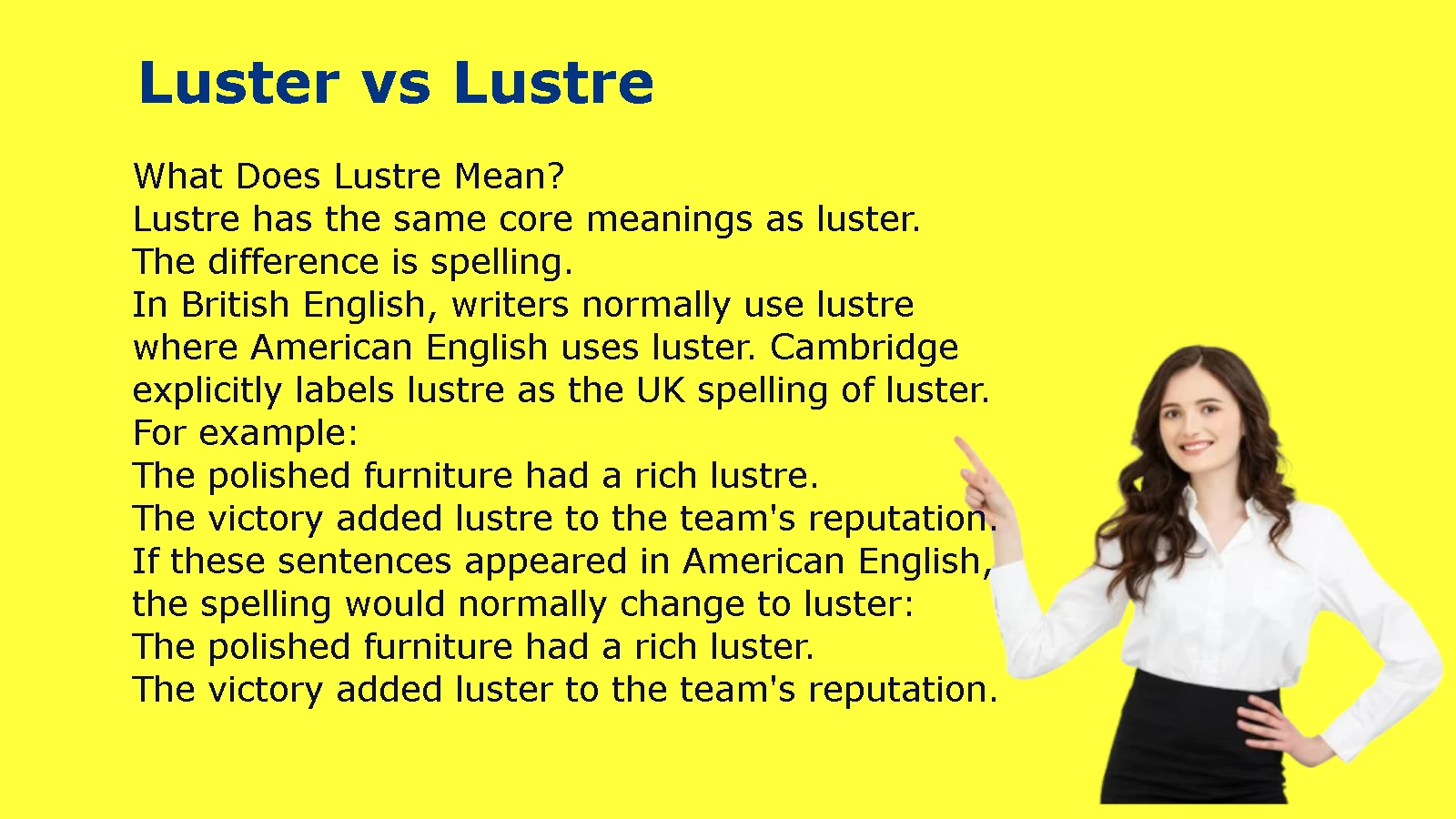
Lustre has the same core meanings as luster.
The difference is spelling.
In British English, writers normally use lustre where American English uses luster. Cambridge explicitly labels lustre as the UK spelling of luster.
For example:
The polished furniture had a rich lustre.
The victory added lustre to the team’s reputation.
If these sentences appeared in American English, the spelling would normally change to luster:
The polished furniture had a rich luster.
The victory added luster to the team’s reputation.
The meaning doesn’t change.
Luster vs Lustre: The Core Difference
The most important fact is simple:
Luster and lustre are spelling variants, not two different meanings of the same word.
| Feature | Luster | Lustre |
| Standard variety | American English | British English |
| Physical shine | Yes | Yes |
| Figurative attractiveness | Yes | Yes |
| Pronunciation | Essentially the same | Essentially the same |
| Meaning | Same | Same |
| Main difference | Spelling | Spelling |
This makes luster vs lustre similar to other American and British spelling differences, such as color/colour and center/centre.
Is Luster or Lustre Correct?
Both are correct.
The better question is which variety of English are you using?
Luster Is Correct in American English
Use luster when you’re writing in standard American English.
For example:
- The diamond has remarkable luster.
- Her hair has regained its luster.
- The company’s reputation has lost some of its luster.
- The award added luster to the ceremony.
If your article, essay, website, or business document otherwise follows American spelling, luster is the natural choice.
Using lustre in an otherwise American English document isn’t usually a serious error. Still, it creates an unnecessary spelling inconsistency.
Lustre Is Correct in British English
Use lustre when you’re following British English conventions.
For example:
- The diamond has remarkable lustre.
- Her hair has regained its lustre.
- The company’s reputation has lost some of its lustre.
- The award added lustre to the ceremony.
British English commonly retains the -re spelling in words such as centre, theatre, and lustre, while American English often uses -er forms such as center, theater, and luster.
The spelling choice should therefore fit the rest of your writing.
Luster vs Lustre in American and British English
The difference becomes easier to remember when you compare it with other regional spelling patterns.
| American English | British English |
| luster | lustre |
| color | colour |
| center | centre |
| theater | theatre |
| honor | honour |
| favor | favour |
These pairs don’t mean that American or British English is “more correct.” They reflect different spelling conventions.
For example, an American newspaper would normally write:
The building has lost its luster.
A British publication would normally write:
The building has lost its lustre.
Both sentences communicate the same idea.
Why Does British English Use “Lustre”?
The spelling has a long history.
Merriam-Webster traces the word to Middle French lustre, from Old Italian lustro, with a connection to Latin. Its entry records the noun’s first known use in the sense of shine at around 1522.
The modern American spelling developed as part of the broader history of American English spelling. Today, dictionaries recognize luster and lustre as established variants rather than treating one as a misspelling.
That historical background explains why the extra e isn’t random. It’s part of an older spelling tradition that remains standard in British English.
Luster vs Lustre Pronunciation
Despite the different spellings, luster and lustre are generally pronounced the same way apart from normal accent differences.
Cambridge gives these pronunciations:
- American English: /ˈlʌs.tɚ/
- British English: /ˈlʌs.tə(r)/
The exact vowel and final sound can vary naturally between accents.
The important point is that the e in lustre doesn’t create a completely different pronunciation.
You shouldn’t think of these as two separate vocabulary words. They’re regional spellings of the same word.
Luster vs Lustre Examples
Examples make the difference especially clear because the sentence stays almost exactly the same. Only the spelling changes.
Examples With Luster
Here are natural examples in American English:
- The jeweler polished the necklace until it regained its luster.
- The pearls had a soft, natural luster.
- The old wooden table still had a warm luster.
- The silver lost its luster after years of exposure.
- Her hair had a healthy luster after the treatment.
- The award added luster to his growing reputation.
- The once popular resort has lost some of its luster.
- The diamond’s brilliant luster caught everyone’s attention.
Notice that the word works in both literal and figurative contexts.
Examples With Lustre
The British equivalents are straightforward:
- The jeweller polished the necklace until it regained its lustre.
- The pearls had a soft, natural lustre.
- The old wooden table still had a warm lustre.
- The silver lost its lustre after years of exposure.
- Her hair had a healthy lustre after the treatment.
- The award added lustre to his growing reputation.
- The once popular resort has lost some of its lustre.
- The diamond’s brilliant lustre caught everyone’s attention.
The meaning remains unchanged. The spelling simply follows British convention.
Luster vs Lustre in Physical Descriptions
One of the oldest and most concrete uses of the word concerns surface appearance.
Imagine holding a polished piece of copper under a bright lamp. Light reflects from the metal, creating a distinctive appearance. You can describe that appearance as its luster.
The same idea applies to minerals. In mineralogy, luster describes the way a mineral’s surface reflects light. Merriam-Webster specifically includes the appearance of a mineral’s surface based on its reflecting qualities in its definition of the word.
Common descriptions include:
- Metallic luster
- Glassy luster
- Pearly luster
- Silky luster
- Waxy luster
This technical use gives the word more precision than simply saying something is “shiny.”
For example:
The mineral has a metallic luster.
That sentence describes a particular visual characteristic rather than merely saying the mineral looks bright.
Luster vs Lustre in Figurative Writing
The figurative sense is just as useful.
When writers say something has luster, they often mean that it has prestige, excitement, appeal, or distinction.
For example:
The championship added luster to the team’s history.
No one expects the history to literally shine. Instead, the championship makes the team’s record seem more impressive.
Likewise:
The scandal caused the institution to lose some of its luster.
The institution hasn’t physically become dull. Its reputation has weakened.
This figurative use works particularly well when discussing things that once seemed glamorous or prestigious.
Common Figurative Uses
You may see luster/lustre used with:
- Reputation
- Fame
- Success
- Careers
- Awards
- Institutions
- Events
- Titles
- Achievements
- Luxury brands
- Historic places
This gives the word a useful metaphorical quality: physical shine becomes a metaphor for social or cultural prestige.
Common Expressions With Luster and Lustre
Some expressions appear often enough to deserve special attention.
Lose Its Luster / Lose Its Lustre
Lose its luster means to become less attractive, impressive, exciting, or prestigious.
British English uses:
lose its lustre
For example:
The historic neighborhood has lost some of its luster.
This could mean that the neighborhood isn’t as fashionable or desirable as it once was.
Another example:
The award lost some of its luster after the controversy.
Here, luster refers to prestige rather than physical shine.
The phrase is common because it creates a clear metaphor: something that once seemed brilliant has become dull.
Add Luster to / Add Lustre to
Add luster to something means to give it an additional attractive or impressive quality.
Cambridge specifically lists add luster to something as a US expression and add lustre to something as the UK spelling.
For example:
The discovery added luster to the museum’s reputation.
In British English:
The discovery added lustre to the museum’s reputation.
This expression is especially useful when an achievement, person, event, or discovery makes something else seem more prestigious.
Regain Its Luster / Regain Its Lustre
This phrase means to become attractive, impressive, or respected again after losing some of that quality.
For example:
The company launched a successful product that helped it regain its luster.
The word suggests that the company once had a strong reputation, lost some of it, and then recovered.
Luster, Lustrous, and Lackluster
Don’t confuse luster with related words such as lustrous and lackluster.
They belong to the same word family, but they don’t function in the same way.
| Word | Part of speech | Meaning |
| luster | Noun | Shine or attractive quality |
| lustre | Noun | British spelling of luster |
| lustrous | Adjective | Very shiny |
| lackluster | Adjective | Dull or unimpressive |
| lacklustre | Adjective | British spelling of lackluster |
| lusterless | Adjective | Lacking luster |
What Does Lustrous Mean?
Lustrous is an adjective meaning very shiny.
For example:
The model had long, lustrous hair.
Cambridge defines lustrous as meaning very shiny.
You can think of the relationship this way:
luster = the shine
lustrous = having that shine
Compare:
The fabric has a beautiful luster.
The fabric is lustrous.
The first sentence uses a noun. The second uses an adjective.
What Does Lackluster Mean?
Lackluster means dull, unimpressive, or lacking energy or appeal.
British English usually spells it lacklustre.
For example:
The team gave a lackluster performance.
In British English:
The team gave a lacklustre performance.
The word can describe both literal appearance and figurative quality, although its figurative use is especially common.
A performance can be lackluster because it lacks excitement. A product can be lackluster because it fails to impress. A surface can be lackluster because it lacks shine.
Merriam-Webster recognizes lusterless as another related adjective meaning lacking luster.
Luster vs Lustre: What About Canadian English?
Canadian English deserves a brief mention because it doesn’t always line up perfectly with either American or British usage.
Lustre is commonly used in Canadian English, although English usage in Canada includes influences from both British and American conventions.
If you’re writing specifically for Canadian readers, lustre is a natural choice.
The bigger lesson is consistency. Don’t mix spelling systems without a reason.
For example, if a Canadian article uses:
- colour
- centre
- favour
- lustre
the spelling system looks consistent.
Likewise, an American article might use:
- color
- center
- favor
- luster
Choosing one system and sticking with it makes the writing look polished.
Luster vs Lustre: Common Mistakes
Although the distinction is simple, a few mistakes appear regularly.
Treating Them as Different Words
The most common misunderstanding is assuming that luster and lustre have different meanings.
They don’t.
The two forms can refer to the same physical shine and the same figurative quality.
Using British Spelling in American Writing
Writing lustre in an American English article isn’t necessarily incomprehensible. Most American readers will understand it immediately.
However, if the entire article uses American spelling, luster is the more consistent choice.
Using American Spelling in British Writing
The reverse is also true.
If you’re writing for a British audience and your document consistently follows British spelling, lustre is the expected form.
Assuming the Extra “E” Changes Pronunciation
It generally doesn’t.
The pronunciation remains closely aligned between the two forms, with normal differences between American and British accents.
Confusing Luster With Lustrous
These words are related but grammatically different.
Luster is generally a noun.
Lustrous is an adjective.
So you can say:
The pearl has a beautiful luster.
Or:
The pearl has a lustrous surface.
But you wouldn’t normally use luster where an adjective is required.
Luster vs Lustre vs Shine, Sheen, and Gloss
Several words can describe brightness or surface appearance, but each carries a slightly different feel.
| Word | General meaning | Example |
| Luster | Attractive shine or reflective quality | The pearl has a soft luster. |
| Shine | Brightness produced by light | The shoes have a nice shine. |
| Sheen | Soft or smooth surface shine | The fabric has a subtle sheen. |
| Gloss | Smooth, often polished or reflective finish | The paint has a glossy finish. |
| Glow | Soft or radiant light | The lamp gave the room a warm glow. |
| Gleam | Small or bright flash of reflected light | A gleam appeared on the blade. |
These distinctions aren’t absolute. In everyday writing, some of the words overlap.
Still, luster often sounds slightly more descriptive or refined than simply shine. That’s one reason it appears in writing about jewelry, minerals, hair, luxury goods, reputation, and prestige.
A Simple Case Study: Choosing the Right Spelling
Imagine two editors are preparing articles about an antique jewelry collection.
The first article targets readers in the United States. The writer uses American spelling throughout:
The collection features pearls with a remarkable luster.
That spelling fits the article.
The second article appears in a British publication:
The collection features pearls with a remarkable lustre.
That spelling fits the publication’s style.
Now imagine the editor mixes the two:
The collection features pearls with a remarkable lustre, but the necklace’s color is unusual and its center stone is rare.
Nothing becomes impossible to understand. Yet the spelling feels inconsistent because lustre belongs to one spelling convention while color and center belong to another.
The lesson is simple: regional consistency matters more than choosing one form as universally “correct.”
How to Remember Luster vs Lustre
There’s an easy memory trick.
American English: Luster
Think:
Luster → American English
It uses -er, just like:
- center
- theater
- fiber
- meter
British English: Lustre
Think:
Lustre → British English
It follows the familiar -re pattern found in words such as:
- centre
- theatre
- fibre
- metre
This isn’t a perfect rule for every English word. However, it’s a useful memory aid for this particular spelling difference.
Which Spelling Should You Use?
Your audience should decide.
Use “Luster” When:
- You’re writing in American English.
- Your readers are primarily in the United States.
- Your publication uses US spelling.
- Your style guide specifies American English.
- You’re writing US focused educational or busines content.
- You’re writing in British English.
- Your audience is primarily in the United Kingdom.
- Your publication follows British spelling.
- Your style guide requires British English.
- You’re writing for a context that consistently uses British spelling.
If you’re reproducing an exact quotation from a source, preserve the original spelling when accuracy requires it.
For example, if a British source says lustre, don’t silently change it to luster simply because the surrounding article uses American English.
That distinction matters when you’re quoting rather than paraphrasing.
Luster vs Lustre in Different Contexts
The spelling choice remains the same regardless of the meaning.
| Context | American English | British English |
| Jewelry | luster | lustre |
| Hair | luster | lustre |
| Furniture | luster | lustre |
| Minerals | luster | lustre |
| Reputation | luster | lustre |
| Achievement | luster | lustre |
| Event | luster | lustre |
| Prestige | luster | lustre |
Whether you’re talking about a diamond’s surface or a university’s reputation, the regional spelling doesn’t change.
That’s worth remembering because the figurative meaning can sometimes make the word look like a completely different vocabulary item. It isn’t.
Is Luster or Lustre More Common?
There isn’t one spelling that is universally “more correct.”
Instead, frequency depends heavily on where the English is being used.
American English favors luster. British English favors lustre. Cambridge explicitly presents these as US and UK spelling variants.
Therefore, a search for luster may produce American sources, while a search for lustre may lead to British sources. Seeing both forms online doesn’t mean that one of them is wrong.
It usually means you’re looking at English from different regional traditions.
Frequently Asked Questions About Luster vs Lustre
Is luster or lustre correct?
Both are correct. Luster is the standard American English spelling, while lustre is the standard British English spelling.
Is lustre British or American?
Lustre is the British spelling. American English normally uses luster.
Is luster the American spelling?
Yes. Luster is the standard American spelling of the word that British English spells lustre.
Do luster and lustre mean the same thing?
Yes. Both can describe the brightness or sheen of a surface and an attractive or impressive quality.
How do you pronounce luster and lustre?
They are generally pronounced the same apart from normal American and British accent differences. Cambridge gives /ˈlʌs.tɚ/ for the US pronunciation and /ˈlʌs.tə(r)/ for the UK pronunciation.
Is lustre used in Canada?
Yes. Lustre is commonly used in Canadian English. Canadian spelling reflects influences from both British and American English, so usage can vary by word and context.
What does luster mean?
Luster can mean the shine or brightness of a surface. It can also mean an attractive, impressive, or special quality.
What is the difference between luster and lustrous?
Luster is a noun describing shine or an attractive quality. Lustrous is an adjective meaning very shiny.
What does “lose its luster” mean?
Lose its luster means to become less attractive, impressive, exciting, or prestigious.
For example:
The brand has lost its luster after several disappointing releases.
What does “add luster to” mean?
Add luster to means to make something more attractive, impressive, or prestigious. Cambridge lists add luster to as the US form and add lustre to as the UK form.
Is “lackluster” related to “luster”?
Yes. Lackluster literally suggests a lack of luster and commonly means dull, unimpressive, or lacking energy. British English generally uses lacklustre.
Final Verdict: Luster or Lustre?
The answer to luster vs lustre is refreshingly simple.
Luster and lustre are the same word with the same core meanings. Both can describe physical shine, such as the surface quality of a pearl or polished metal. Both can also describe figurative attractiveness, prestige, or distinction.
The difference is primarily regional:
- Luster = American English
- Lustre = British English
So, if you’re writing for a US audience, use luster. If you’re writing in British English, use lustre.
Neither spelling is inherently better. The best choice is the one that matches the variety of English you’re using.
When in doubt, look at the spelling of nearby words. If your writing uses color, center, theater, and honor, then luster will fit naturally. If it uses colour, centre, theatre, and honour, then lustre is the better match.
In short, choose the spelling that keeps your writing consistent. That’s the whole distinction in a nutshell.