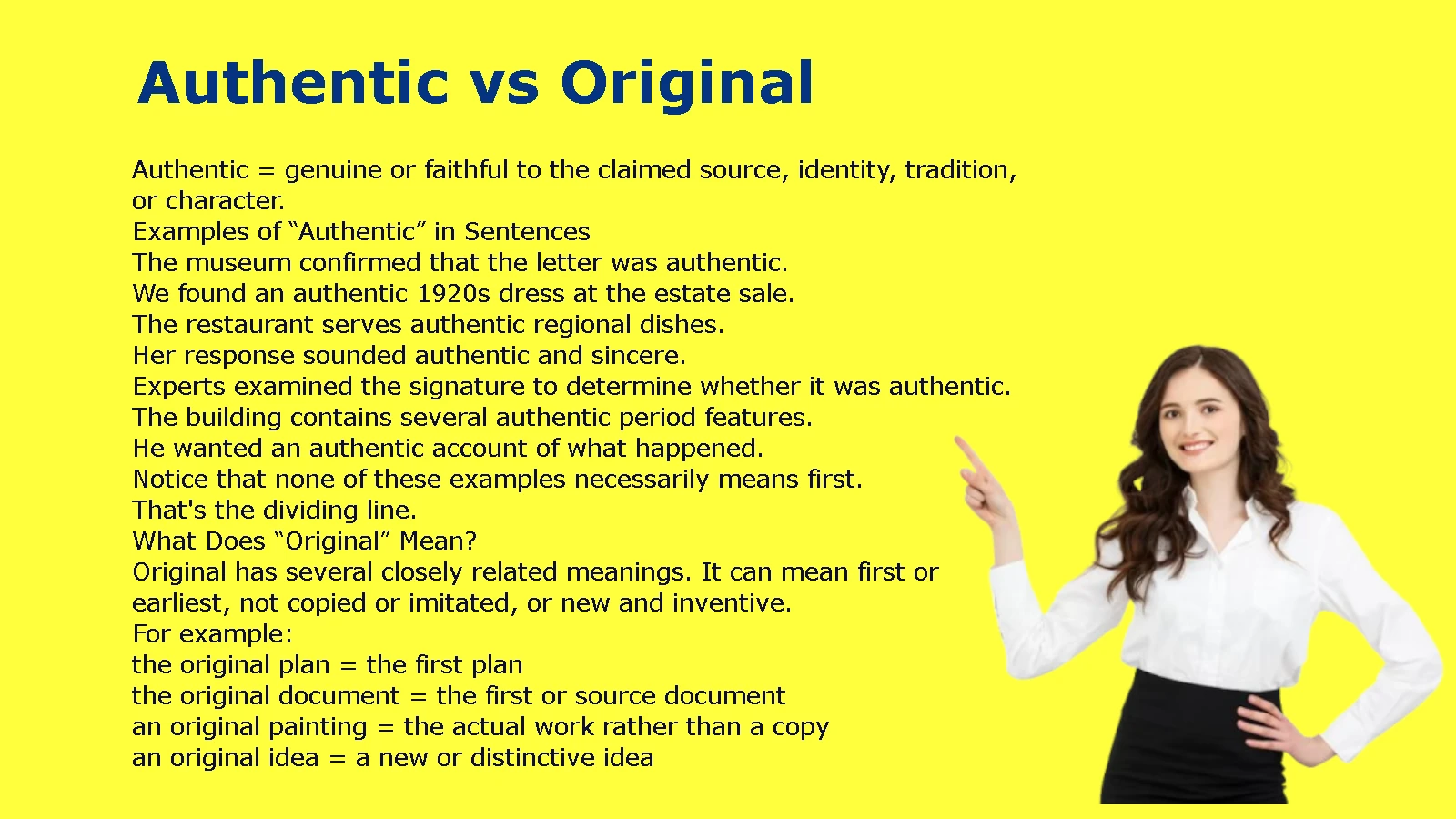
Authentic and original can both describe something genuine, but they focus on different ideas. Authentic means real, genuine, or true to its claimed identity or nature, while original means the first, earliest, or not copied from something else. For example, an authentic painting is genuinely made by the claimed artist, while an original painting can mean the actual first artwork rather than a reproduction.
If you’re searching for “authentic vs original,” “difference between authentic and original,” or “authentic or original,” the main distinction is whether you’re emphasizing genuineness or being the first/not copied.
| Question | Answer |
|---|---|
| What does authentic mean? | Real, genuine, or true to its claimed identity. |
| What does original mean? | First, earliest, or created without copying another source. |
| Are authentic and original the same? | No. They can overlap, but they emphasize different qualities. |
| What is the main difference? | Authentic focuses on being genuine; original focuses on being first or not copied. |
Authentic vs Original: Quick Difference
The easiest way to understand Authentic vs Original is to separate genuineness from origin.
Authentic describes something that is genuine, real, trustworthy, or true to what it claims to be. For example, an authentic historical document is genuinely what it claims to be. An authentic account is considered reliable as a true account of events. Cambridge defines authentic in terms of being real, true, or what people say it is.
Original, on the other hand, can describe the first form of something, something that isn’t copied, or something that is fresh and distinctive. An original document is the first document rather than a copy. An original idea is new or notably different.
Consider these two sentences:
The signature is authentic.
This means the signature is genuine.
She kept the original document.
This means she kept the first or source document rather than a copy.
The two words can describe the same object, but they emphasize different qualities.
Authentic vs Original at a Glance
| Feature | Authentic | Original |
| Means genuine | Yes | Sometimes |
| Means the first version | Not necessarily | Yes |
| Means not a copy | Sometimes | Yes |
| Means creative or inventive | Not usually | Yes |
| Can describe sincere behavior | Yes | Sometimes, but with a different meaning |
| Can describe traditional food | Yes | Usually not in the same sense |
| Can describe a reproduction | Yes | Usually no |
| Common opposite | Fake, false, inauthentic | Copy, duplicate, imitation, unoriginal |
The important point is that authentic and original overlap without being exact synonyms.
What Does “Authentic” Mean?
Authentic means genuine, real, or true to what something claims to be. It can also describe something that faithfully represents a particular tradition, style, source, or character.
For example:
- an authentic painting means the painting is genuinely attributed to the claimed artist.
- an authentic document means the document is genuine rather than fabricated.
- authentic Italian food means the food follows a recognized Italian culinary tradition or style.
- an authentic account means an account that is regarded as genuine and based on what actually happened.
- an authentic person means someone who behaves in a sincere way rather than putting on a false personality.
Merriam Webster also gives authentic a particularly useful meaning: something can be authentic when it is made or done in the same way as an original. That’s why phrases such as “authentic reproduction” and “authentic cuisine” make sense.
Authentic Means Genuine, Not Necessarily First
Here’s where many people get tripped up.
Something can be authentic without being original.
Imagine a museum displays a historically accurate reproduction of a colonial farmhouse. The reproduction isn’t the original building. However, it can still be described as authentic if it faithfully reproduces the original’s important features and construction methods. Merriam Webster specifically recognizes this use of authentic for faithful reproductions.
The same distinction appears in food.
A restaurant can prepare authentic Mexican food without claiming that its dishes are the first versions ever created. Here, authentic means the food genuinely reflects the relevant culinary tradition.
So remember:
Authentic = genuine or faithful to the claimed source, identity, tradition, or character.
Examples of “Authentic” in Sentences
- The museum confirmed that the letter was authentic.
- We found an authentic 1920s dress at the estate sale.
- The restaurant serves authentic regional dishes.
- Her response sounded authentic and sincere.
- Experts examined the signature to determine whether it was authentic.
- The building contains several authentic period features.
- He wanted an authentic account of what happened.
Notice that none of these examples necessarily means first.
That’s the dividing line.
What Does “Original” Mean?
Original has several closely related meanings. It can mean first or earliest, not copied or imitated, or new and inventive.
For example:
- the original plan = the first plan
- the original document = the first or source document
- an original painting = the actual work rather than a copy
- an original idea = a new or distinctive idea
- an original artist = an inventive or distinctive artist
Merriam Webster defines original as something relating to an origin or beginning. It also uses the word for something that isn’t secondary, derivative, or imitative and for something that is independent and creative in thought or action.
Original Can Mean “First”
This is one of the most common meanings.
Consider:
The original design included three windows.
Here, original refers to the design that existed at the beginning. The design may have changed later.
Likewise:
Please send the original document, not a photocopy.
The original is the source document from which the copy was made.
Cambridge gives the same distinction: an original can be the first one made rather than a copy.
Original Can Mean “Not Copied”
Now consider:
She submitted an original painting.
This means the work was produced by the artist rather than being a copy of another painting.
That doesn’t necessarily mean it was the artist’s first painting. Original here means not copied or reproduced.
This is a crucial distinction because the word original changes slightly with context.
Original Can Mean “New or Creative”
There is another important meaning:
She developed an original solution to the problem.
Here, original doesn’t mean “the first document.” It means new, distinctive, or inventive.
Cambridge describes this sense as something different from anything else in a way that makes it special or interesting.
So original can describe both an old object and a new idea.
That’s not a contradiction.
The context tells you which meaning applies.
Authentic vs Original: Key Differences
The biggest difference between Authentic vs Original becomes clearer when you look at what each word asks you to verify.
Authentic Focuses on Genuineness
When you use authentic, you’re primarily concerned with whether something is genuine.
Suppose someone sells you a painting and says it was painted by a famous artist. You might ask:
Is this painting authentic?
You’re questioning whether the painting genuinely comes from the claimed artist.
Authentication involves establishing that something is real or genuine. Merriam Webster defines authenticate as proving or helping prove that something is real, true, or genuine.
So authenticity often involves:
- provenance
- evidence
- expert examination
- documentation
- historical consistency
- signatures or markings
- physical characteristics
- reliable records
The exact evidence depends on the subject.
Original Focuses on Source or First Form
Original often asks a different question:
Is this the original?
Now you’re asking whether you’re looking at the first item or source rather than a reproduction, duplicate, translation, or later version.
For example:
I have a copy of the contract, but the lawyer has the original.
The original is the source document.
This meaning has nothing to do with whether the document feels sincere or whether it represents a cultural tradition. It’s about its position in the chain of copies.
Original Can Also Mean Creative
The word takes another turn when you talk about ideas.
Her proposal was original.
This doesn’t mean it was the first physical document in a filing cabinet. It means the proposal was new, distinctive, or independently conceived.
That is why “original idea” and “original design” are so common.
Authentic Does Not Always Mean Original
This is probably the most useful point in the entire Authentic vs Original comparison.
Something can be authentic even though it isn’t the original.
Imagine a craftsperson creates a historically faithful reproduction of an old chair using traditional materials and techniques. The chair isn’t the original chair. Yet someone could reasonably describe the reproduction as authentic if it faithfully follows the historical form and method.
Merriam Webster explicitly recognizes authentic for reproductions that faithfully reproduce essential features of an original.
Therefore:
Authentic does not automatically mean original.
That’s a distinction worth remembering.
Can Something Be Both Authentic and Original?
Yes. In fact, many objects can be both.
Imagine an artist creates a painting and sells it directly to a collector.
If experts establish that the painting genuinely came from that artist, it can be authentic.
If it is the actual first work rather than a reproduction or copy, it can also be original.
The two words simply emphasize different properties.
| Statement | What it tells you |
| The painting is authentic. | The painting is genuine. |
| The painting is original. | The painting is not a copy or reproduction. |
| The painting is both authentic and original. | It is genuine and is the actual original work. |
The same logic works with documents.
A signed contract might be:
- authentic because the signatures are genuine.
- original because it is the first signed document.
- both because it is a genuine first document.
- neither if it is a fraudulent reproduction.
The words work together rather than competing with each other.
Authentic vs Original in Different Contexts
Context can change which word sounds natural. Here’s where the distinction becomes especially practical.
Authentic vs Original in Art
Art provides one of the clearest examples.
Suppose a museum owns a painting attributed to a famous artist.
Calling it authentic means experts believe it genuinely belongs to that artist or source.
Calling it original can mean it is the artist’s actual work rather than a reproduction or copy. Cambridge specifically uses original artwork to mean work produced by the artist rather than a copy.
For example:
The museum confirmed that the painting is authentic.
The focus is genuineness.
The museum displayed the original painting.
The focus is the actual work rather than a reproduction.
An art reproduction could potentially be authentic in another sense if it faithfully reproduces the original’s essential characteristics. That doesn’t turn it into the original artwork itself.
Authentic vs Original in Food
Food creates another useful distinction.
Authentic food generally refers to food that genuinely reflects a particular culinary tradition, region, or style.
For example:
The restaurant serves authentic Italian food.
The sentence says something about the food’s relationship to Italian culinary tradition.
But:
The chef created an original recipe.
Now the emphasis is on newness and creativity.
An original recipe may be completely new. It doesn’t have to represent an established tradition.
That means you can have:
- authentic Italian cuisine
- an original pasta recipe
- an authentic regional recipe
- an original fusion dish
The words aren’t interchangeable.
Authentic vs Original in Documents
Documents make the difference almost mechanical.
Suppose a company keeps a signed agreement and several photocopies.
The signed agreement is the original document.
If the signatures and document are genuine, the document is also authentic.
A photocopy could be an accurate copy of an authentic original. However, the photocopy isn’t the original document.
| Document | Authentic? | Original? |
| Genuine signed contract | Yes | Yes |
| Photocopy of genuine contract | Potentially | No |
| Forged contract | No | No |
| Accurate reproduction made for display | Potentially | No |
This example shows why authentic and original shouldn’t be treated as perfect synonyms.
Authentic vs Original in Ideas and Designs
When you’re talking about creativity, original usually does more work.
She presented an original idea.
This means the idea is new, distinctive, or independently conceived.
By contrast:
She gave an authentic response.
This suggests sincerity or genuineness.
You could say:
The designer created an original product that reflects an authentic local tradition.
That sentence uses both words correctly because they describe two different qualities.
The product can be original because the design is new while also being authentic because it genuinely reflects the tradition it claims to represent.
Authentic vs Original for People
The difference becomes even sharper when the subject is a person.
If someone is authentic, they tend to act in a way that feels genuine and consistent with their real personality or values.
For example:
She is authentic and doesn’t pretend to be someone she’s not.
Merriam Webster recognizes this meaning of authentic: being true to one’s own personality, spirit, or character.
Original, however, can describe someone who is unusual, inventive, or distinctly different.
For example:
He’s an original.
That can mean he’s an unusual or distinctive person.
So:
- authentic person = genuine and sincere
- original person = distinctive, unusual, or inventive
Those descriptions may overlap, but they aren’t saying the same thing.
Authentic vs Original Examples
The fastest way to master the difference is to see the words side by side.
| Context | Authentic | Original |
| Painting | The painting is authentic. | The painting is the original. |
| Document | The signature is authentic. | Please send the original document. |
| Food | The restaurant serves authentic Mexican food. | The chef created an original recipe. |
| Idea | Her reaction felt authentic. | She proposed an original idea. |
| Person | He has an authentic personality. | She’s a true original. |
| Design | The materials give the building an authentic look. | The architect created an original design. |
| Historical object | Experts confirmed that the artifact is authentic. | The museum owns the original artifact. |
| Experience | We wanted an authentic cultural experience. | The company developed an original experience concept. |
Case Study: A Historical Manuscript
Imagine a library owns a manuscript attributed to a famous writer.
Researchers first ask whether the manuscript is authentic.
Did the claimed writer actually create it? Is the handwriting consistent? Does the paper fit the period? Does its history make sense?
If the evidence supports the attribution, researchers can describe it as authentic.
They might then ask whether it is the original manuscript or a later copy.
Those are separate questions.
A genuine manuscript copied by another person might be authentic as a historical artifact while not being the author’s original manuscript.
That’s the distinction in action:
Authenticity concerns genuineness. Originality concerns source, first form, or lack of copying.
When to Use “Authentic”
Choose authentic when you want to emphasize that something is genuine, sincere, real, or faithful to what it claims to represent.
Use it for:
- genuine objects: authentic jewelry
- historical evidence: authentic records
- food: authentic regional cuisine
- experiences: authentic cultural experiences
- behavior: authentic reactions
- people: authentic personalities
- accounts: authentic accounts of events
- reproductions: authentic reproductions that faithfully follow an original
A useful test is:
Could “genuine” work here without changing the main meaning?
If yes, authentic may be the better choice.
For example:
Is this an authentic signature?
You could say:
Is this a genuine signature?
The meaning remains close.
When to Use “Original”
Choose original when you mean something is the first version, the source, not copied, or newly inventive.
Use it for:
- first versions: original plan
- source documents: original contract
- art: original painting
- creative work: original composition
- ideas: original idea
- designs: original design
- creative people: original thinker
- distinctive things: an original approach
A useful test is:
Are you talking about the first version, a source, a noncopy, or something new and distinctive?
If so, original is probably the right word.
Authentic vs Original: Common Mistakes
Mistake: Treating Authentic and Original as Exact Synonyms
They overlap, but replacing one with the other can alter the meaning.
Compare:
The food is authentic.
with:
The food is original.
The first sentence suggests that the food genuinely reflects a particular culinary tradition.
The second could suggest that the dish is new or invented.
That’s a major difference.
Mistake: Assuming Authentic Means First
Authentic does not inherently mean first.
A reproduction can be authentic in the sense that it faithfully reproduces the original. Merriam Webster explicitly includes this sense.
Therefore:
authentic ≠ necessarily original
Mistake: Assuming Original Always Means New
Original can mean new and inventive, but it can also mean the first or earliest version of something.
For example:
Please return the original document.
Nobody is saying the document was recently invented. They’re identifying it as the source document rather than the copy.
Mistake: Calling Every Genuine Object Original
Something can be genuine without being the first item.
Imagine an authentic historical reproduction. It may accurately represent an earlier object while remaining a reproduction.
So if you’re emphasizing genuineness, use authentic.
If you’re emphasizing the actual first item or source, use original.
Authentic vs Original: Synonyms
The words have different groups of close synonyms.
Synonyms for Authentic
Depending on context, you might use:
- genuine
- real
- true
- legitimate
- sincere
- bona fide
- actual
Merriam Webster lists genuine, real, and true among the close synonyms of authentic.
However, don’t swap synonyms mechanically.
For example:
authentic Italian cuisine
sounds natural.
Replacing it with:
legitimate Italian cuisine
changes the tone and can sound odd.
Likewise:
authentic personality
and
genuine personality
are close, but they don’t always carry exactly the same nuance.
Synonyms for Original
Depending on the intended meaning, close alternatives include:
- first
- initial
- earliest
- source
- new
- innovative
- inventive
- distinctive
Merriam Webster lists initial, first, earliest, and inaugural as synonyms for some uses of original.
But again, context matters.
original document
can mean the first document.
original idea
can mean a new or inventive idea.
The best synonym changes with the sense.
Authentic and Original as Opposites
The opposite of authentic is usually connected to falseness or imitation.
Common opposites include:
- fake
- false
- counterfeit
- inauthentic
For example:
The watch is authentic.
Opposite:
The watch is counterfeit.
Original has different opposites depending on its meaning.
If original means the first document, the opposite may be:
- copy
- duplicate
- reproduction
If original means creative, the opposite may be:
- unoriginal
- derivative
- imitative
Consider these examples:
Keep the original and send me a copy.
Here, copy is the natural contrast.
The proposal was original, not derivative.
Here, derivative contrasts with the creative sense of original.
This is another reason context matters.
Is “Authentic” the Same as “Original”?
No, authentic and original aren’t exact synonyms.
They can overlap when something is both genuine and not copied. However, authentic primarily emphasizes genuineness or faithfulness, while original can emphasize firstness, source, noncopying, or creative novelty.
For example:
This is an authentic painting.
The focus is whether the painting is genuine.
This is the original painting.
The focus is whether you’re looking at the actual source work rather than a copy or reproduction.
In some situations, both statements can be true.
Can Something Be Authentic but Not Original?
Yes.
A reproduction can be authentic in the sense that it faithfully represents the original or follows the original method or tradition. Merriam Webster explicitly recognizes this use of authentic.
Food provides another example.
A traditional dish can be prepared authentically by thousands of cooks. No individual serving is the first dish ever prepared.
The food can still be called authentic because it faithfully reflects the culinary tradition.
So:
Authentic describes a relationship to genuineness or faithful representation.
It doesn’t automatically establish that something was first.
Can Something Be Original but Not Authentic?
Yes, depending on what “original” means.
Suppose someone creates a completely new painting and falsely claims that it was painted by a famous artist.
The painting may be original in the sense that the artist created it independently rather than copying another painting. Yet it isn’t authentic to the claimed famous artist because the attribution is false.
Likewise, a person might create an original design and falsely market it as an authentic historical design.
Here, original describes the newness or independent creation of the work.
Authentic would concern whether the historical claim is genuine.
This example shows why the two concepts can move in different directions.
Is an Authentic Copy an Original?
Usually, no.
A copy can be authentic in certain contexts if it genuinely represents the original or was produced according to an authentic method. However, calling something an original usually means it is the first item, source work, or a work that isn’t copied or imitated, depending on context.
For example:
This is an authentic reproduction of the historic building.
That makes sense.
But:
This is the original reproduction.
That would require a special context and could sound confusing because original and reproduction pull in opposite directions.
What Is the Difference Between an Authentic Product and an Original Product?
An authentic product is genuine and comes from the claimed source or meets the relevant standards of genuineness.
An original product can mean the first version, the source model, or a product that isn’t a copy. The exact meaning depends on context.
For example:
The seller proved that the watch is authentic.
The concern is whether the watch is genuine.
He still owns the original model.
The concern is which model came first or which item represents the source version.
This distinction becomes particularly important when discussing branded products, collectibles, artwork, antiques, and historical objects.
What Is the Difference Between Authentic and Original Food?
Authentic food usually refers to food that genuinely reflects a particular culinary tradition, region, or style.
Original food is less commonly used with this meaning. When it is used, it can suggest a new recipe, a first version, or a distinctive creation.
Compare:
The restaurant serves authentic Thai food.
This describes the relationship between the food and Thai culinary tradition.
The chef created an original Thai inspired recipe.
This emphasizes the chef’s new creation.
The two concepts can exist together. A chef can create an original recipe while using techniques and ingredients that produce an authentic style.
Easy Way to Remember the Difference
Here’s the simplest rule:
Authentic asks, “Is it genuine?”
Original asks, “Is it the first, the source, a noncopy, or something new?”
Use authentic when the central issue is genuineness.
Use original when the central issue is origin, firstness, independent creation, or novelty.
A Quick Memory Table
| If you mean… | Use |
| Genuine | Authentic |
| Real | Authentic |
| Sincere | Authentic |
| True to a tradition | Authentic |
| First version | Original |
| Source document | Original |
| Not a copy | Original |
| New and inventive | Original |
| Distinctive | Original |
There’s a useful mental picture here: authenticity looks backward toward truth and genuineness, while originality often looks toward source or new creation.
That isn’t a strict rule for every sentence, but it makes the distinction much easier to remember.
Authentic vs Original: Which Word Should You Use?
When you’re deciding between Authentic vs Original, ask what information you want the reader to understand.
Choose authentic if you’re saying:
- “This is genuine.”
- “This is real.”
- “This isn’t fake.”
- “This faithfully represents the tradition.”
- “This person is sincere.”
- “This account is trustworthy or genuine.”
Choose original if you’re saying:
Once you identify the intended meaning, the choice becomes much easier.
Frequently Asked Questions About Authentic vs Original
Is authentic the same as original?
No. Authentic generally means genuine or true to what something claims to be. Original can mean first, not copied, or new and inventive.
Can something be authentic but not original?
Yes. An authentic reproduction can faithfully represent an original without actually being the first object. Authentic can also describe traditional food or behavior without implying that something is the first example of its kind.
Can something be original but not authentic?
Yes. Something can be newly created or independently produced while failing to be genuine according to the identity or source it claims to represent.
Does authentic mean real?
Usually, yes. One of the core meanings of authentic is genuine, real, or what something claims to be.
Does original mean real?
Not always. Original can mean first, noncopied, or inventive. It doesn’t always make a claim about truth or genuineness.
Does authentic mean first?
No. Authentic doesn’t inherently mean first or earliest. That is one of the key differences between authentic and original.
What is the difference between an authentic copy and an original?
An authentic copy can be a genuine or faithful reproduction. An original is generally the source item, first version, or noncopied work depending on context.
Which is better, authentic or original?
Neither word is inherently better. The right word depends on what you want to communicate. Use authentic for genuineness and original for firstness, source, noncopying, or creative novelty.
Final Thoughts on Authentic vs Original
The difference between Authentic vs Original becomes simple once you separate genuineness from origin.
Authentic means genuine, real, sincere, or faithful to what something claims to represent. Original can mean first, earliest, the source from which a copy comes, not copied, or creatively new.
The two words can describe the same thing, but they don’t necessarily tell the reader the same thing.
An authentic painting is genuine. An original painting is the actual work rather than a copy. An authentic recipe reflects a culinary tradition. An original recipe may be a new creation. An authentic person behaves sincerely. An original person may simply be unusual or inventive.
So when you’re stuck, ask one quick question:
Are you talking about whether something is genuine, or are you talking about its source, first form, lack of copying, or newness?
If the answer is genuine, choose authentic. If the answer is first, source, noncopied, or newly inventive, choose original. That small distinction will keep your writing precise and natural.