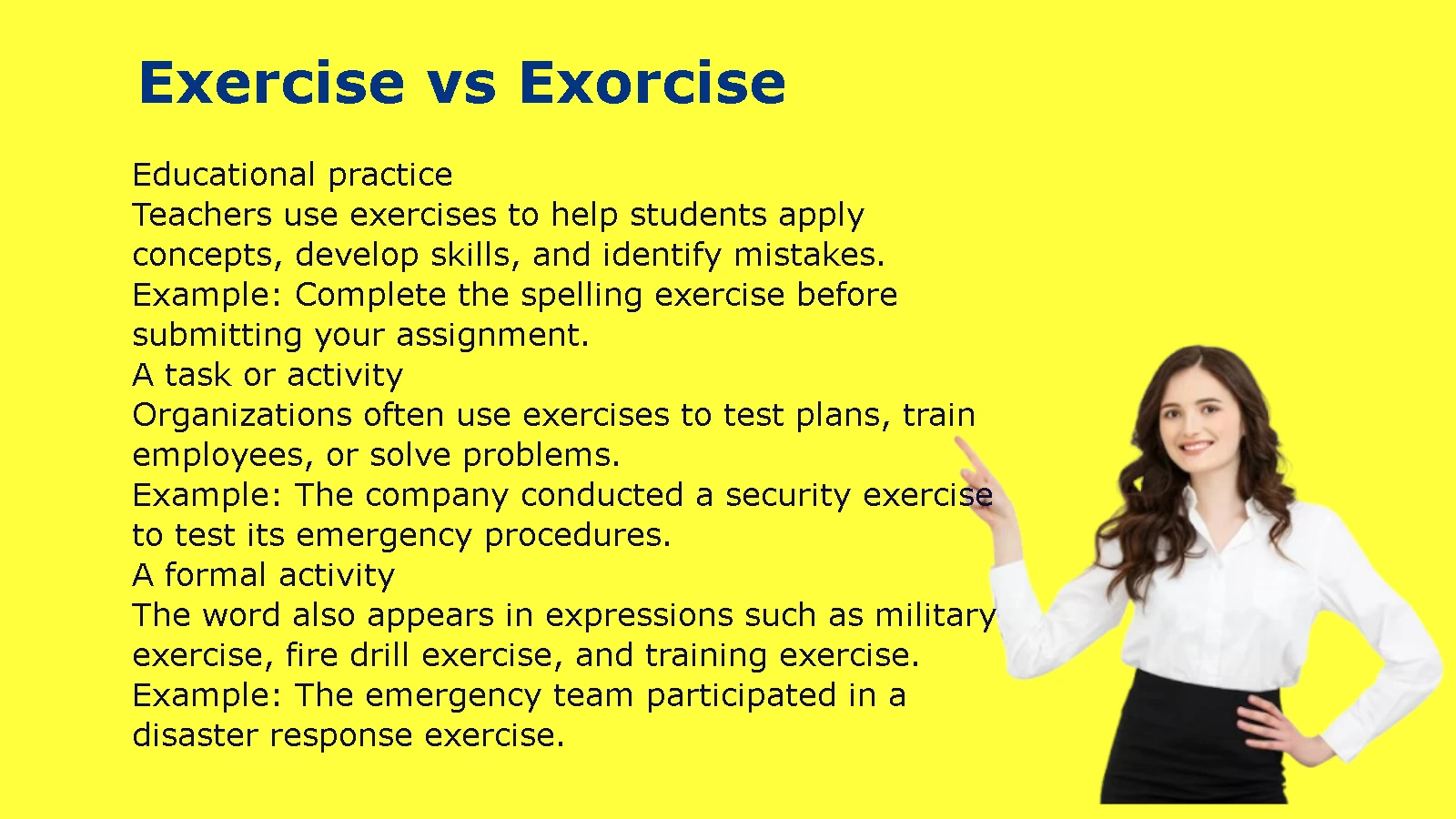
Exercise vs Exorcise is a common spelling and word-choice confusion because the two words look and sound similar but have different meanings. Exercise refers to physical activity, practice, or the use of a right or skill, while exorcise means to drive out an evil spirit or, figuratively, remove something unwanted. Both words are correct, but you cannot use them interchangeably.
The confusion becomes easier to solve when you understand exercise spelling, exercise vs. exersize, excercise or exercise, and exorcise vs. exorcize. You’ll also learn how to pronounce both words, whether British English spells exercise differently, and how exercise vs. workout differs in everyday conversation.
Exercise vs Exorcise: Which Spelling Is Correct?
Both exercise and exorcise are correct English words. However, they describe different actions. Use exercise when you mean physical activity, practice, or performing a right. Use exorcise when you mean driving out an evil spirit or removing something unwanted, such as fear or guilt.
Exercise vs Exorcise at a Glance
| Word | Meaning | Part of Speech | Example |
| Exercise | Physical activity, practice, or use of a right | Noun and verb | I exercise every morning. |
| Exorcise | To drive out an evil spirit or remove something unwanted | Verb | The priest tried to exorcise the demon. |
| Exorcize | An accepted spelling variant of exorcise | Verb | The story describes an attempt to exorcize an evil spirit. |
The most important difference lies in the meaning, not simply the spelling.
For example:
- Correct: I need more exercise to improve my fitness.
- Correct: The priest attempted to exorcise the spirit.
- Incorrect for the intended meaning: I need more exorcise to improve my fitness.
- Incorrect for the intended meaning: The priest attempted to exercise the spirit.
The last sentence might work in an unusual context involving training or exercising something, but it doesn’t express the conventional meaning of removing an evil spirit.
Is Exercise or Exorcise Correct?
Both spellings are correct, but the right choice depends on your sentence.
Use exercise for:
- Physical activity, such as running, walking, or swimming.
- Educational activities, such as grammar exercises.
- Using a right, authority, or skill.
- Practicing or developing a particular ability.
Use exorcise for:
- Driving out an evil spirit or demon.
- Figuratively removing fear, guilt, or painful memories.
- Describing an attempt to free someone or something from an unwanted influence.
Quick memory tip: If you’re talking about fitness, practice, or rights, choose exercise. If you’re talking about casting out a spirit, choose exorcise.
Exercise Meaning and Definition
Exercise means physical activity that helps maintain or improve fitness, but it also refers to practice, a task, or the use of a right, power, or skill. As a noun, it names an activity or task. As a verb, it describes performing physical activity or putting something into use.
What Does Exercise Mean?
The word exercise has several meanings depending on the context.
Its most familiar meaning relates to physical movement. People exercise to build strength, improve endurance, support mobility, or maintain general health.
However, the word also appears in education, business, law, and everyday communication.
Consider these examples:
- Fitness: Walking is a simple form of exercise.
- Education: The teacher assigned an exercise on punctuation.
- Business: The manager used a budgeting exercise to evaluate expenses.
- Law: Citizens can exercise their legal rights.
- Skills: The musician exercises discipline during daily practice.
These examples show why exercise is a versatile word. You shouldn’t assume it always refers to a gym or physical training.
Exercise as a Noun
As a noun, exercise can describe physical activity, a practice task, or an organized activity designed to achieve a goal.
Common uses include:
Physical activity
Exercise can include walking, cycling, swimming, dancing, strength training, and other forms of movement.
Example: Regular exercise helps me maintain an active lifestyle.
Educational practice
Teachers use exercises to help students apply concepts, develop skills, and identify mistakes.
Example: Complete the spelling exercise before submitting your assignment.
A task or activity
Organizations often use exercises to test plans, train employees, or solve problems.
Example: The company conducted a security exercise to test its emergency procedures.
A formal activity
The word also appears in expressions such as military exercise, fire drill exercise, and training exercise.
Example: The emergency team participated in a disaster response exercise.
Exercise as a Verb
As a verb, exercise means to engage in physical activity, practice a skill, or put a right, authority, or ability into use.
Examples:
- I exercise before breakfast.
- She exercises regularly to improve her stamina.
- The employee exercised her right to appeal.
- Leaders must exercise good judgment when making difficult decisions.
- Students exercise critical thinking while solving problems.
Notice that the object of the verb often helps clarify its meaning.
When you exercise your body, you perform physical activity. When you exercise your rights, you use or apply those rights.
The verb also has standard grammatical forms:
| Form | Example |
| Base form | Exercise |
| Third-person singular | Exercises |
| Past tense | Exercised |
| Present participle | Exercising |
| Past participle | Exercised |
Examples:
- He exercises after work.
- They exercised their right to vote.
- She is exercising more consistently.
- The team has exercised caution throughout the process.
Exercise Examples in Everyday English
Here are original examples that show how the word works in different settings.
Fitness and health
- My morning exercise routine includes walking and stretching.
- The trainer recommended gentle exercise after long periods of sitting.
- Swimming provides exercise without the same impact as running.
School and learning
- This grammar exercise focuses on verb tenses.
- The students finished their reading exercises early.
- Practicing with examples is a useful learning exercise.
Work and decision-making
- The manager organized a planning exercise for the new team.
- Employees must exercise care when handling confidential information.
- The negotiation gave both sides an exercise in patience.
Rights and authority
- Voters exercise their rights through participation in elections.
- The director exercised authority within the limits of company policy.
- People should understand how to exercise their contractual rights.
Exorcise Meaning and Definition
Exorcise is a verb that means to drive out or attempt to drive out an evil spirit from a person or place. It can also mean removing something unwanted in a figurative sense, such as guilt, fear, or painful memories. The word commonly appears in religious, supernatural, literary, and figurative contexts.
What Does Exorcise Mean?
The word exorcise traditionally describes an attempt to expel an evil spirit or demonic presence through religious or ritual practices.
For example:
The story follows a priest who attempts to exorcise a demon from an abandoned house.
The word also has figurative meanings. Writers sometimes use it to describe confronting or releasing unwanted emotions, memories, or influences.
For example:
She wrote about her childhood to exorcise some of her lingering fears.
In this sentence, exorcise doesn’t refer to a literal spirit. It expresses the idea of trying to free oneself from an emotional burden.
Keep in mind that figurative exorcism is a metaphor. It doesn’t necessarily mean a person has eliminated a psychological problem or resolved every painful memory.
Exorcise Examples in Sentences
These examples show the literal and figurative meanings of exorcise.
Literal or supernatural context
- The priest performed a ritual intended to exorcise the spirit.
- The villagers believed they needed to exorcise the demon.
- The film depicts an attempt to exorcise an evil presence from a family home.
- The character asked for help to exorcise the spirit haunting the old building.
These sentences describe beliefs or fictional events. They don’t establish that supernatural claims are scientifically verified.
Figurative context
- She tried to exorcise her guilt by apologizing to the people she hurt.
- The author used the novel to exorcise memories of a difficult period.
- He hoped to exorcise his fear of public speaking through practice.
- The team wanted to exorcise the disappointment of its previous defeat.
The figurative use often communicates emotional release, confrontation, or an attempt to move beyond the past.
Exorcise as a Verb: Forms and Grammar
Exorcise is a regular verb, so its common forms follow standard English patterns.
| Verb Form | Example |
| Exorcise | They hope to exorcise the spirit. |
| Exorcises | The character exorcises the demon in the final scene. |
| Exorcised | The story describes how the priest exorcised the spirit. |
| Exorcising | The group is attempting to exorcise the unwanted presence. |
| Exorcised | The ritual was intended to have exorcised the spirit. |
Common expressions include:
- Exorcise a demon
- Exorcise an evil spirit
- Exorcise fear
- Exorcise guilt
- Exorcise painful memories
- Exorcise the past
The object of exorcise usually identifies what someone wants to drive out or remove.
For example, exorcise a demon uses the word in its traditional sense, while exorcise regret uses it figuratively.
Exercise vs Exorcise Pronunciation
Exercise and exorcise have similar pronunciations, but they don’t sound exactly the same in standard American English. Their endings also differ slightly in common pronunciation.
How to Pronounce Exercise
In American English, exercise is commonly pronounced:
EK-ser-size
IPA: /ˈɛk.sɚ.saɪz/
The word has three syllables in this pronunciation.
- The first syllable receives the main stress.
- The middle syllable contains an unstressed vowel.
- The final syllable sounds like size.
Example:
I exercise before work.
In everyday American speech, the verb and noun usually share the same pronunciation.
Some accents may pronounce the middle syllable differently, but the overall word remains recognizable.
How to Pronounce Exorcise
In American English, exorcise is commonly pronounced:
EK-sor-size
IPA: /ˈɛk.sɔːr.saɪz/ or /ˈɛk.sɔɹ.saɪz/, depending on the transcription convention and accent.
The pronunciation contains three syllables.
- Stress falls on the first syllable.
- The middle syllable includes the vowel sound associated with sore in many American pronunciations.
- The final syllable sounds like size.
Example:
The character tries to exorcise the demon.
The middle vowel helps distinguish exorcise from exercise, although connected speech and regional accents can make the contrast less obvious.
Are Exercise and Exorcise Pronounced the Same?
No. Exercise and exorcise have different standard pronunciations, even though they sound similar.
| Feature | Exercise | Exorcise |
| First syllable | EK | EK |
| Middle syllable | Often sounds like ser | Often sounds like sor |
| Final syllable | Size | Size |
| Meaning | Activity, practice, or use | Drive out or remove |
| Stress | First syllable | First syllable |
For pronunciation practice, say these sentences aloud:
- I need more exercise.
- They tried to exorcise the spirit.
Focus on the middle vowel rather than the shared ending.
Practical tip: If you struggle to hear the difference, learn each word inside a sentence. Context helps listeners recognize the intended word, especially when people speak quickly.
Exercise, Exersize, or Excercise: Which Spelling Is Correct?
Exercise is the correct spelling. Exersize and excercise are common misspellings, not accepted standard alternatives. These errors often occur because English spelling doesn’t always match pronunciation, and writers may confuse the ending of exercise with the spelling patterns found in other words.
Exercise vs. Exersize
Exercise is correct. Exersize is incorrect in standard English.
The mistake often comes from replacing the c in exercise with s or trying to spell the word according to its sound.
Compare:
- Correct: I get enough exercise every week.
- Incorrect: I get enough exersize every week.
- Correct: Daily exercise supports an active lifestyle.
- Incorrect: Daily exersize supports an active lifestyle.
The spelling exersize may appear in casual messages, search queries, or online discussions, but that doesn’t make it a recognized standard spelling.
When editing a professional email, academic assignment, article, or business document, use exercise.
Excercise or Exercise?
Exercise is correct, while excercise is a misspelling.
The incorrect version contains an extra c.
Compare:
- Correct: Please complete the exercise.
- Incorrect: Please complete the excercise.
- Correct: The teacher prepared five exercises.
- Incorrect: The teacher prepared five excercises.
A useful correction trick is to remember the opening sequence:
E-X-E-R-C-I-S-E
Write the word slowly once, then check the letter sequence before submitting your work.
This technique works well when you repeatedly make the same spelling mistake.
Common Exercise Spelling Mistakes
| Spelling | Correct or Incorrect? | Explanation |
| Exercise | Correct | Standard spelling |
| Exercises | Correct | Standard plural or verb form |
| Exercised | Correct | Past tense and past participle |
| Exercising | Correct | Present participle |
| Exersize | Incorrect | Misspelling |
| Excercise | Incorrect | Extra c |
| Exorcise | Correct | Different word and meaning |
| Exorcize | Correct | Accepted spelling variant of exorcise |
One important distinction: exorcise isn’t a misspelling of exercise. It’s a separate word.
Likewise, exorcize is a legitimate spelling variant, not an error.
Easy Ways to Remember How to Spell Exercise
Use these practical techniques to avoid spelling mistakes.
Remember the word’s structure
Break it into smaller parts when writing:
EXER + CISE
This is a visual memory aid rather than a claim about the word’s historical formation.
Connect the word with familiar phrases
Memorize common combinations such as:
- Physical exercise
- Exercise routine
- Exercise equipment
- Grammar exercise
- Breathing exercises
Repeated exposure helps reinforce the correct spelling.
Use a proofreading check
When editing, search your document for:
- Exersize
- Excercise
Replace those misspellings with exercise when that’s the intended word.
However, don’t automatically replace every instance of exorcise or exorcize. Those words may be correct in context.
Exercise Spelling in the UK vs. the US
Exercise has the same standard spelling in British and American English. Unlike words such as organise and organize, this word doesn’t change its spelling based on the region. Both British and American writers use exercise for physical activity, practice, and the use of rights or authority.
Is Exercise Spelled Differently in British and American English?
No. The correct spelling is exercise in both British and American English.
Examples:
- British English: She does exercise before breakfast.
- American English: She does exercise before breakfast.
The wording and grammar can vary by context, but the spelling remains the same.
These forms are incorrect in both standard varieties:
- Exersize
- Excercise
The spelling exercise also remains unchanged in common expressions such as:
- Exercise bike
- Exercise class
- Exercise routine
- Exercise book
- Exercise program
Some related words may have regional spelling differences, but those patterns don’t apply to exercise.
Exercise or Exorcise in British English
British writers use exercise for physical activity and exorcise for driving out an evil spirit.
Examples:
- The school introduced daily exercise sessions.
- The priest attempted to exorcise the spirit.
American writers make the same distinction.
Don’t choose exorcise simply because a sentence follows British English conventions. The meaning determines the word.
Related UK and US Spelling Patterns
English contains many spelling differences between the United States and the United Kingdom.
| American English | British English |
| Organize | Organise |
| Analyze | Analyse |
| Prioritize | Prioritise |
| Color | Colour |
| Center | Centre |
| Exercise | Exercise |
| Exorcise | Exorcise |
Some British dictionaries accept -ize spellings, particularly in words such as organize. The -ise form is also widely used in British English.
However, exercise doesn’t follow this pattern.
If you’re writing for a UK audience, keep exercise as it is. There’s no need to change it to exersize or excercise.
Exercise or Exorcise Demons: Which Word Should You Use?
Exorcise demons is the correct expression when you mean attempting to drive out evil spirits. Exercise demons doesn’t carry that meaning in standard English. Although exercise can mean putting something into action or practice, it doesn’t replace exorcise in the traditional expression.
Is It Correct to Say Exorcise Demons?
Yes. Exorcise demons is the conventional expression.
The verb exorcise traditionally describes an attempt to expel a spirit through a religious or ritual practice.
Examples:
- The priest was asked to exorcise the demon.
- The film depicts a family trying to exorcise an evil spirit.
- The villagers believed a ritual could exorcise the presence in the house.
The expression can also appear in discussions of religion, folklore, literature, films, and supernatural fiction.
When writing about a real religious practice, distinguish between describing a belief and claiming that supernatural events have been independently verified.
For example:
Members of the community believed that the ceremony would exorcise the spirit.
This sentence accurately attributes the belief without presenting it as an established scientific fact.
Exorcise Evil Spirits vs. Exercise Your Body
The difference becomes clear when you compare the words with their objects.
| Expression | Meaning | Example |
| Exercise your body | Engage in physical activity | I exercise my body through swimming and walking. |
| Exercise your rights | Use your legal or personal rights | Citizens exercise their rights by voting. |
| Exorcise a demon | Attempt to drive out a demon | The priest attempted to exorcise the demon. |
| Exorcise fear | Figuratively confront or remove fear | She hoped to exorcise her fear through practice. |
The words don’t become interchangeable just because both can describe an action.
The surrounding nouns and verbs establish the intended meaning.
Can You Use Exorcise Figuratively?
Yes. Writers frequently use exorcise as a metaphor for confronting or trying to remove something troubling.
Common figurative expressions include:
- Exorcise guilt
- Exorcise fear
- Exorcise regret
- Exorcise painful memories
- Exorcise the past
For example:
The athlete hoped to exorcise the disappointment of losing the championship.
Here, the writer uses exorcise to suggest overcoming an emotional burden.
However, figurative usage can sound dramatic. In neutral or professional writing, simpler alternatives may work better.
| Dramatic Expression | Simpler Alternative |
| Exorcise your fears | Overcome your fears |
| Exorcise guilt | Address your guilt |
| Exorcise painful memories | Process painful memories |
| Exorcise the past | Move beyond the past |
Choose the expression that matches your tone and audience.
Exorcise or Exorcize: Which Spelling Is Correct?
Exorcise and exorcize are both accepted spellings of the same verb. They share the meaning of driving out an evil spirit or figuratively removing something unwanted. Exorcise is common in British English and widely used in American English, while exorcize is also established, particularly in American usage.
Is Exorcize a Correct Word?
Yes. Exorcize is a correct spelling variant of exorcise.
Both words can appear in sentences such as:
- The priest attempted to exorcise the spirit.
- The priest attempted to exorcize the spirit.
The meaning remains the same.
The difference is orthographic, not semantic.
For most everyday writing, either spelling can communicate the intended meaning. Still, consistency matters when you’re writing an article, book, or professional document.
If your publication follows a particular dictionary or style guide, use its preferred spelling throughout.
Exorcise vs. Exorcize in American and British English
The spelling exorcise is widely used in both British and American English.
The spelling exorcize is also used, especially in American English, but individual dictionaries and publishers may express different preferences.
A practical guide:
- British English: Exorcise is a familiar standard choice.
- American English: Exorcise and exorcize are both recognized.
- Formal writing: Follow your selected dictionary or house style.
- SEO content: Use the main spelling naturally and mention the alternative where relevant.
Don’t assume that every word ending in -ise must change to -ize in American English. English spelling conventions depend on the specific word.
Exercise vs Exorcise vs. Exorcize
| Word | Correct? | Meaning |
| Exercise | Yes | Physical activity, practice, or use of a right |
| Exorcise | Yes | Drive out a spirit or figuratively remove something unwanted |
| Exorcize | Yes | Same meaning as exorcise |
| Exersize | No | Misspelling of exercise |
| Excercise | No | Misspelling of exercise |
The easiest way to remember the distinction is to associate exercise with activity and exorcise with expulsion.
Exercise vs. Workout: What’s the Difference?
Exercise is the broader term for physical activity, while a workout usually refers to a planned or structured session of exercise. Every workout involves exercise, but not every form of exercise counts as a workout. Walking for transportation, taking the stairs, and doing a short stretch can all involve exercise.
What Is the Difference Between Exercise and a Workout?
Exercise describes physical activity that supports fitness, movement, or physical conditioning.
A workout generally refers to a session in which someone intentionally performs physical activities, often according to a routine or goal.
For example:
- Walking to the grocery store can provide exercise.
- Completing a planned 40-minute strength session is a workout.
- Cycling casually with friends can count as exercise.
- Following a structured cycling training session is a workout.
The boundary isn’t strict. People often use the terms interchangeably in casual conversation.
Still, exercise is more general, while workout often suggests a dedicated session.
Exercise vs. Workout Comparison Table
| Feature | Exercise | Workout |
| Meaning | Physical activity or movement | Usually a dedicated exercise session |
| Scope | Broad | More specific in common usage |
| Structure | May be planned or spontaneous | Often planned |
| Example | Walking during lunch | A scheduled gym session |
| Main focus | Activity or movement | A session with a fitness goal |
This distinction helps when discussing fitness routines, health habits, or training plans.
Exercise vs. Workout Examples in Sentences
Exercise
- I get exercise by walking to work.
- Stretching is part of my daily exercise routine.
- The doctor encouraged me to remain physically active.
- Gardening gives me some exercise on weekends.
Workout
- My workout starts with a five-minute warm-up.
- She completed a strength workout at the gym.
- The coach designed a workout for beginners.
- Today’s workout focuses on upper-body strength.
Both terms can describe the same activity in certain contexts.
For instance, a 30-minute treadmill session is exercise and can also be described as a workout.
Is a Workout a Type of Exercise?
Yes. A workout is generally a type of exercise session.
Think of exercise as the larger category and workout as a particular session within that category.
For example:
- Walking around your neighborhood is exercise.
- Completing a scheduled walking session with a specific pace and duration can be a workout.
- A planned weightlifting session is a workout that includes several exercises.
One workout may contain multiple exercises.
A strength workout, for example, could include squats, lunges, rows, and presses.
This is another useful distinction: the word exercise can refer to an individual movement, while workout often refers to the complete session.
Exercise vs Exorcise Examples: How to Use Each Word
The easiest way to choose between exercise and exorcise is to identify what the sentence describes. If the action involves physical activity, practice, or applying a right, use exercise. If it involves driving out a spirit or metaphorically removing an unwanted influence, use exorcise.
Exercise Examples in Sentences
Here are additional examples of exercise in different contexts.
As a noun
- Walking after dinner is my favorite form of exercise.
- The students completed a challenging mathematics exercise.
- The team performed a communication exercise during training.
- Breathing exercises helped the group settle before the presentation.
- The instructor demonstrated a balance exercise.
As a verb
- I exercise three mornings a week.
- She exercised caution before signing the contract.
- The citizens exercised their right to vote.
- He exercises his creativity through photography.
- The organization exercised its authority under the agreement.
These sentences show how the word can describe both physical and nonphysical activities.
Exorcise Examples in Sentences
The verb exorcise works differently.
- The priest attempted to exorcise the demon.
- The villagers believed the ceremony would exorcise the evil spirit.
- The horror novel describes a family’s attempt to exorcise a haunting presence.
- She tried to exorcise her guilt by admitting the truth.
- The writer used the memoir to exorcise painful memories.
- The team hoped to exorcise the disappointment of its previous loss.
In literal contexts, the word often appears in religious or supernatural narratives.
In figurative contexts, it communicates an effort to confront or leave behind something troubling.
Incorrect vs. Correct Sentence Examples
| Incorrect Sentence | Correct Sentence | Why? |
| I need to exorcise before work. | I need to exercise before work. | Physical activity requires exercise. |
| She does exersize daily. | She does exercise daily. | Exersize is misspelled. |
| Complete the excercise. | Complete the exercise. | Excercise is misspelled. |
| They tried to exercise the demon. | They tried to exorcise the demon. | Exorcise expresses the intended meaning. |
| He wants to exorcize at the gym. | He wants to exercise at the gym. | Exercise refers to physical activity. |
The best correction method is to examine the meaning first, then check the spelling.
Quick Practice: Exercise or Exorcise?
Choose the correct word for each sentence.
Fill in the blanks
- She enjoys daily ______ to stay active.
- The character tried to ______ the spirit.
- Students completed a grammar ______.
- He wanted to ______ his guilt through an apology.
- Regular ______ can support physical fitness.
Answer key
- Exercise
- Exorcise
- Exercise
- Exorcise
- Exercise
Why these answers work
The first, third, and fifth sentences refer to physical activity or practice.
The second describes driving out a spirit. The fourth uses exorcise figuratively to express an attempt to remove guilt.
A Practical Editing Example
Imagine you’re proofreading a short fitness article:
Our trainer recommends 20 minutes of exersize each day. Beginners should complete each excercise slowly and carefully.
The corrected version reads:
Our trainer recommends 20 minutes of exercise each day. Beginners should complete each exercise slowly and carefully.
Now consider a supernatural story:
The villagers asked the priest to exercise the demon.
If the writer means driving out the demon, the correct sentence is:
The villagers asked the priest to exorcise the demon.
This small editing example demonstrates why spell-checking alone may not solve every word-choice problem. A spell-checker might recognize both exercise and exorcise as valid words without knowing which one the sentence needs.
Quick Guide to Choosing the Right Word
Use the meaning of the sentence as your first clue. Exercise describes activity, practice, or putting something into use. Exorcise describes driving out a spirit or figuratively removing something unwanted. Exorcize has the same meaning as exorcise.
Use Exercise When You Mean
Choose exercise when your sentence involves:
- Physical activity: I exercise before work.
- Fitness routines: She follows an exercise plan.
- Educational tasks: Complete the spelling exercise.
- Rights: People exercise their right to vote.
- Authority: The director exercised authority.
- Judgment: You should exercise caution.
Remember that exercise can function as both a noun and a verb.
Use Exorcise When You Mean
Choose exorcise when your sentence involves:
- Driving out an evil spirit.
- Attempting to remove a demonic presence.
- Figuratively confronting guilt or fear.
- Trying to release painful memories or unwanted influences.
Examples:
- They tried to exorcise the spirit.
- She wanted to exorcise her regret.
- The character hopes to exorcise the past.
The figurative meaning works best when the context supports its dramatic tone.
Use Exorcize When You Mean
Choose exorcize when you want the accepted spelling variant of exorcise.
For example:
- The ritual was intended to exorcize the spirit.
- He hoped to exorcize his fears.
The meaning doesn’t change.
When you edit a document, choose one spelling and maintain consistency.
Frequently Asked Questions
Is It Exercise or Exersize?
Exercise is the correct spelling. Exersize is a misspelling and isn’t a standard British or American English variant. Use exercise when referring to physical activity, practice tasks, or the use of rights and authority.
Is It Excercise or Exercise?
Exercise is correct. Excercise contains an extra c and is a common spelling mistake. Remember the correct sequence: E-X-E-R-C-I-S-E.
What Is the Difference Between Exercise and Exorcise?
Exercise refers to physical activity, practice, or putting something into use. Exorcise means attempting to drive out an evil spirit or figuratively remove something unwanted, such as guilt or fear.
Is Exercise Spelled Differently in the UK?
No. Both British and American English use exercise. Neither exersize nor excercise is a standard regional alternative.
Do You Exercise or Exorcise a Demon?
You exorcise a demon. The verb exorcise traditionally means attempting to drive out an evil spirit. Exercise refers to activity or putting something into use, so it doesn’t express the intended meaning in this phrase.
What Is the Difference Between Exorcise and Exorcize?
Exorcise and exorcize are accepted spelling variants of the same verb. Both mean to drive out an evil spirit or figuratively remove something unwanted. Use the spelling preferred by your dictionary or publication’s style guide.
Conclusion: Choose Exercise or Exorcise by Meaning
The difference between Exercise vs Exorcise comes down to meaning.
Use exercise when you talk about physical activity, learning tasks, practice, or exercising your rights. Choose exorcise when you mean driving out an evil spirit or figuratively confronting something unwanted. Exorcize is also a correct spelling variant of exorcise.
Remember these key points:
- Exercise is the correct spelling for physical activity and practice.
- Exersize and excercise are misspellings.
- Exorcise and exorcize share the same meaning.
- British and American English both spell the word exercise.
- A workout is usually a structured exercise session, while exercise is the broader term.













