Have you ever heard someone describe a situation as a kerfuffle and wondered what they meant? Kerfuffle is a playful word used to describe a commotion, fuss, or minor disturbance, especially when people become upset or confused over something that may not be very serious.
The word kerfuffle usually refers to a small argument, disagreement, or messy situation that creates more excitement or confusion than the situation seems to deserve. It often has a lighthearted tone, so calling something a kerfuffle can make a tense situation sound less serious.
Examples:
- There was a kerfuffle at the meeting over the new schedule.
- A small kerfuffle broke out when two customers reached for the last seat.
The confusion is understandable. People often search for kerfuffle meaning, what does kerfuffle mean, kerfuffle definition, or kerfuffle in a sentence because the word sounds unusual and doesn’t immediately reveal its meaning. It can describe anything from a minor disagreement to a brief burst of confusion or disorder.
In this guide, you’ll learn the complete kerfuffle meaning, including its definition, pronunciation, origin, synonyms, and usage. You’ll also see clear examples of kerfuffle in a sentence and learn how to use this quirky word naturally in everyday English.
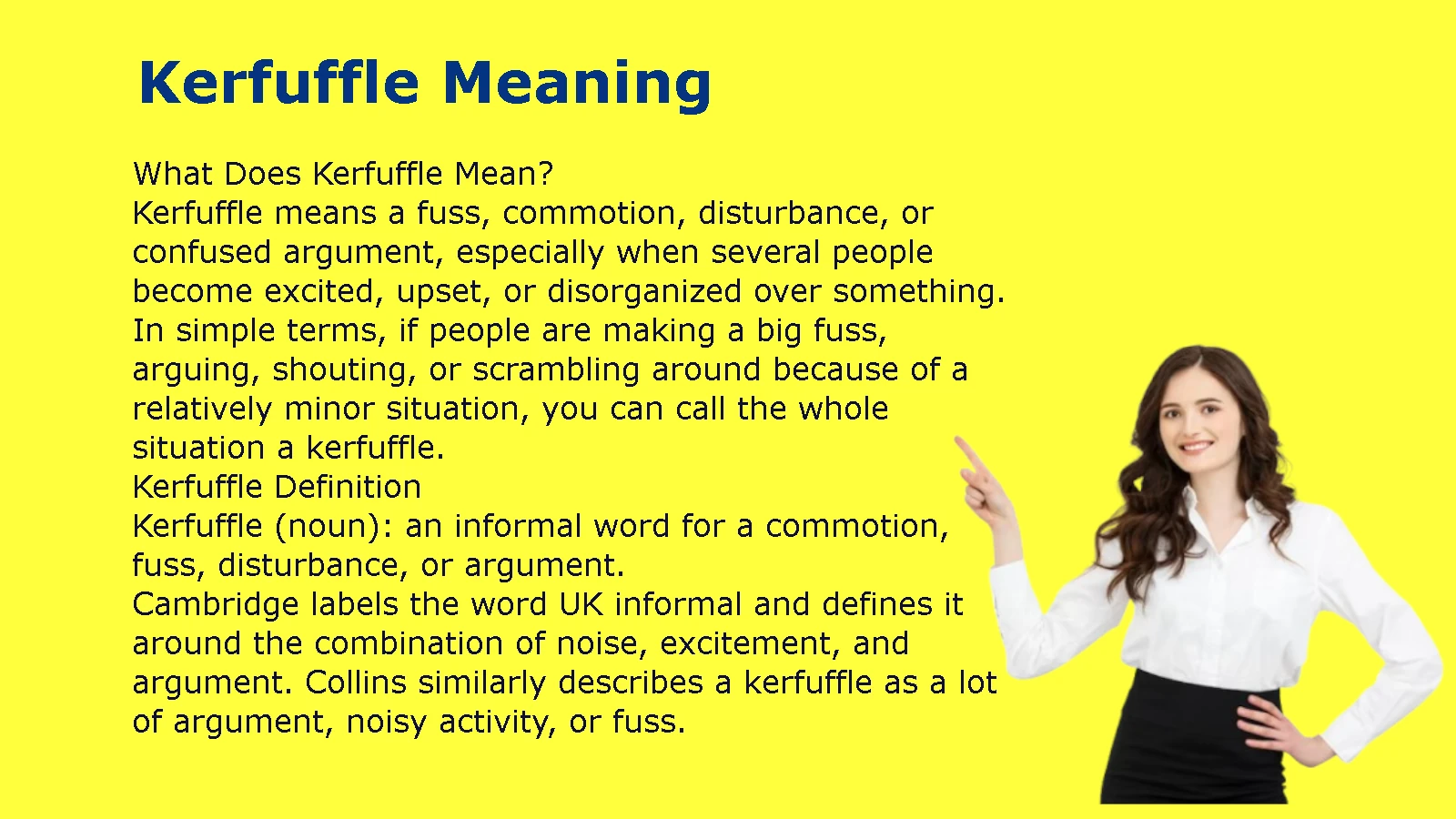
What Does Kerfuffle Mean?
Kerfuffle means a fuss, commotion, disturbance, or confused argument, especially when several people become excited, upset, or disorganized over something.
In simple terms, if people are making a big fuss, arguing, shouting, or scrambling around because of a relatively minor situation, you can call the whole situation a kerfuffle.
Kerfuffle Definition
Kerfuffle (noun): an informal word for a commotion, fuss, disturbance, or argument.
Cambridge labels the word UK informal and defines it around the combination of noise, excitement, and argument. Collins similarly describes a kerfuffle as a lot of argument, noisy activity, or fuss.
| Word | Meaning |
| Kerfuffle | A fuss, commotion, or confused disturbance |
| Part of speech | Noun |
| Register | Informal |
| Tone | Often humorous, lighthearted, or mildly dismissive |
| Common idea | People becoming excited, confused, or argumentative over something |
For example:
There was a kerfuffle at the restaurant when everyone realized they had been given the wrong table.
Here, kerfuffle doesn’t necessarily mean a serious fight. It suggests that the situation became unnecessarily complicated, noisy, or chaotic.
Kerfuffle Meaning in Simple Words
The easiest way to understand kerfuffle is to think of it as “a bit of a fuss.”
Imagine a group of coworkers preparing for a meeting. Someone changes the room at the last minute. One person goes to the old room. Another sends an incorrect message. Someone else starts calling everyone to find out what’s happening.
Nobody is seriously hurt. Nothing disastrous has happened. Yet suddenly, everyone is talking at once.
That’s a kerfuffle.
The word can cover several closely related situations:
- A minor argument
- A noisy disagreement
- A confusing situation
- A sudden commotion
- A fuss over something
- A period of disorder or agitation
- An incident that attracts more attention than expected
Oxford specifically connects kerfuffle with unnecessary excitement or activity, which helps explain why the word often has a slightly humorous flavor.
What Is an Example of a Kerfuffle?
Consider this simple example:
There was a kerfuffle over the seating arrangements at the wedding.
Perhaps two families thought they had reserved the same table. People started moving chairs around. Someone checked the seating chart. Another person called the event coordinator.
The situation became messy, but it wasn’t necessarily a serious conflict.
That’s exactly the kind of situation where kerfuffle works naturally.
Here are more examples:
- A small kerfuffle broke out when the store opened its doors.
- There was a kerfuffle over who had booked the conference room.
- The missing keys caused quite a kerfuffle before the meeting.
- A kerfuffle erupted when the flight gates suddenly changed.
- The children had a little kerfuffle over the last piece of cake.
- There was a brief kerfuffle backstage before the show began.
- The scheduling mistake created an unnecessary kerfuffle.
- Nobody expected such a kerfuffle over a simple parking space.
Notice the pattern. In each sentence, something creates confusion, excitement, disagreement, or disorder.
Kerfuffle Examples in Different Contexts
One useful way to understand this word is to see how it behaves in different situations.
Kerfuffle at Work
Workplaces can produce plenty of kerfuffles.
A meeting gets moved without telling everyone. Two employees receive different instructions. A presentation file disappears five minutes before a presentation. Suddenly, several people are searching emails and asking questions.
You could say:
The last-minute schedule change caused a bit of a kerfuffle at the office.
The word works because the problem created temporary confusion and activity without necessarily becoming a major workplace dispute.
Kerfuffle Between Friends or Family
A small disagreement between people who know each other can also become a kerfuffle.
There was a family kerfuffle over where to spend the holidays.
The phrase doesn’t automatically mean that the family had a serious falling-out. It can suggest that everyone had different opinions and the discussion became more heated or complicated than expected.
Kerfuffle Over Plans
This is one of the most natural uses.
There was a kerfuffle over the dinner reservation because two people had different times written down.
The problem itself might be tiny. The resulting confusion creates the kerfuffle.
Public Kerfuffle
The word can also describe a larger public dispute or controversy.
The announcement caused a media kerfuffle.
In this context, kerfuffle can refer to public argument, criticism, discussion, or excitement surrounding an issue.
Cambridge’s examples include phrases such as “literary kerfuffle” and “kerfuffle over” a particular subject, showing that the word can describe disputes well beyond everyday household situations.
How to Use Kerfuffle in a Sentence
The most common structure is simple:
a kerfuffle + about/over + subject
For example:
- There was a kerfuffle over the new policy.
- The two teams got into a kerfuffle about the schedule.
- The announcement created a kerfuffle among fans.
You can also use the word with verbs such as cause, create, start, and have.
| Pattern | Example |
| a kerfuffle over something | There was a kerfuffle over the new seating plan. |
| cause a kerfuffle | The announcement caused a kerfuffle. |
| create a kerfuffle | The mistake created a major kerfuffle. |
| start a kerfuffle | Nobody meant to start a kerfuffle. |
| have a kerfuffle | The neighbors had a kerfuffle over the fence. |
| in the kerfuffle | The phone disappeared in the kerfuffle. |
| a bit of a kerfuffle | We had a bit of a kerfuffle at the airport. |
The expression “a bit of a kerfuffle” is especially useful because it reinforces the word’s informal, understated tone.
Kerfuffle vs. Fuss
Fuss is probably one of the closest everyday alternatives to kerfuffle.
A fuss can mean unnecessary excitement, concern, or attention. A kerfuffle tends to focus more on the actual disturbance, commotion, or messy situation.
Compare these:
Don’t make such a fuss about the mistake.
This suggests that someone is making too much of something.
Now consider:
There was a kerfuffle after the mistake was discovered.
This suggests that the discovery led to confusion, activity, or disagreement.
The two words overlap, but they don’t always emphasize exactly the same thing.
Kerfuffle vs. Commotion
Commotion is another close synonym.
Cambridge lists commotion and disturbance among the synonyms associated with kerfuffle.
The difference mainly comes down to tone.
| Word | Main emphasis | Tone |
| Kerfuffle | Fuss, confusion, argument, disturbance | Informal and often playful |
| Commotion | Noise, movement, and disorder | More neutral |
| Fuss | Excessive concern or attention | Casual |
| Uproar | Strong public reaction or noisy disturbance | Stronger |
| Fracas | Noisy quarrel or physical confrontation | More serious |
| Ruckus | Loud, disorderly disturbance | Informal |
For example:
There was a commotion outside the theater.
This sounds fairly neutral. You don’t know exactly why people were making noise.
There was a kerfuffle outside the theater.
This sounds more conversational and may suggest a relatively minor disagreement or messy incident.
Kerfuffle vs. Uproar
Uproar usually carries more intensity.
If hundreds of people loudly protest a decision, uproar may fit naturally. If several people get tangled up over a minor misunderstanding, kerfuffle sounds more appropriate.
For example:
The controversial announcement caused an uproar.
That sounds substantial.
Compare:
The announcement caused a bit of a kerfuffle.
The second sentence softens the situation. It suggests noise and disagreement without necessarily presenting the event as a major crisis.
Kerfuffle vs. Fracas
A fracas generally involves a more serious or physical confrontation.
A kerfuffle, by contrast, doesn’t require fighting.
Consider these examples:
The two fans got into a fracas outside the stadium.
This suggests a physical or heated confrontation.
The fans got into a kerfuffle over the last available seats.
This could mean arguing, confusion, shouting, or general disorder. Physical violence isn’t part of the word’s basic meaning.
So if you’re describing a genuine fight, fracas or scuffle may be more precise. Cambridge defines scuffle specifically as a short, sudden fight.
Kerfuffle Synonyms
Several words can replace kerfuffle, but each brings a slightly different shade of meaning.
Closest Synonyms
- Fuss
- Commotion
- Disturbance
- To-do
- Hoo-ha
- Uproar
- Ruckus
- Hubbub
- Rumpus
- Fracas
Cambridge lists commotion, disturbance, hoo-ha, and to-do among related synonyms.
Synonym Comparison
| Synonym | How it differs from kerfuffle |
| Fuss | Emphasizes unnecessary concern or attention |
| Commotion | Focuses on noise, movement, or disorder |
| Disturbance | More neutral and potentially more serious |
| To-do | Informal term for a fuss or disturbance |
| Hoo-ha | Informal and often suggests exaggerated excitement |
| Uproar | Usually suggests a stronger public reaction |
| Ruckus | Emphasizes loud or disorderly activity |
| Hubbub | Focuses on noisy confusion or activity |
| Rumpus | Informal word for noisy disturbance |
| Fracas | Usually suggests a quarrel or physical confrontation |
Choosing the right synonym depends on what actually happened.
If people simply argued over a reservation, kerfuffle works well. If a crowd becomes extremely angry and vocal, uproar may communicate the intensity more clearly.
Is Kerfuffle a Negative Word?
Not necessarily.
Kerfuffle can describe an inconvenient, confusing, or argumentative situation, but the word itself isn’t strongly negative. Its playful sound often takes some of the sting out of what happened.
That’s one reason writers and speakers use it when they want to describe a disturbance without making it sound catastrophic.
Compare:
The scheduling error caused a serious dispute.
with:
The scheduling error caused a bit of a kerfuffle.
The first sounds formal and potentially serious. The second sounds lighter.
However, context matters. A person could use kerfuffle to describe a genuinely important disagreement in a deliberately understated way.
Why Does Kerfuffle Sound Humorous?
Part of the effect comes from the word’s sound.
The repeated “fuff” sequence gives kerfuffle an unusual, almost bouncy rhythm. That doesn’t determine its dictionary meaning, but it contributes to the word’s informal character.
As a result, saying kerfuffle can make a situation feel less stiff than saying disturbance or dispute.
It’s a little like putting a colorful label on a messy box. The mess is still there, but the description feels friendlier.
Is Kerfuffle a Bad Word?
No. Kerfuffle is not a swear word or an offensive term.
It’s an ordinary informal noun that describes a fuss, disturbance, or commotion.
You can use it in casual conversation, articles, commentary, and other forms of general writing. The main consideration is formality, not offensiveness.
For example:
The last-minute change caused a kerfuffle among passengers.
There’s nothing vulgar or insulting about the sentence.
Is Kerfuffle Slang?
Kerfuffle is better described as an informal word than as slang.
Cambridge labels it UK informal, while Oxford identifies it as a British English informal noun.
That’s an important distinction.
Slang often belongs to a particular social group, age group, subculture, or casual speech community. Kerfuffle doesn’t require membership in a particular group. It’s simply an informal and somewhat whimsical word for a disturbance or fuss.
So these descriptions are more accurate:
- Informal: Yes
- Colloquial: Yes
- Slang: Not the best primary label
- Offensive: No
- Formal: No
Is Kerfuffle a British Word?
Kerfuffle has strong Scottish and British associations, but American English speakers also recognize and use it.
Oxford labels the noun British English and informal. Collins describes the American form as informal and chiefly British.
The word’s history helps explain that connection. It developed from Scottish forms such as curfuffle and carfuffle, then spread more widely into English.
Today, you may encounter kerfuffle in American journalism, books, online writing, and everyday speech. It isn’t restricted to the United Kingdom.
Kerfuffle Pronunciation
The standard pronunciation has stress on the middle syllable:
ker-FUFF-ul
Cambridge gives both UK and US pronunciations, with the stress falling on FUFF.
The US pronunciation is represented as:
/kɚˈfʌf.əl/
The UK pronunciation is:
/kəˈfʌf.əl/
The difference mainly concerns the unstressed first syllable and the way the r is realized in American English.
The important point for learners is simple: stress the middle syllable.
Where Does the Word Kerfuffle Come From?
The history of kerfuffle is particularly interesting because the modern spelling developed from older Scottish forms.
Oxford traces the word to the early 19th century and suggests a connection with Scots curfuffle. It also notes a possible connection between Scottish Gaelic car, meaning “twist” or “bend,” and Scottish fuffle, meaning “to disorder.” Oxford also mentions another possible Irish Gaelic connection, which shows that the exact etymology isn’t completely settled.
Etymonline traces curfuffle to Scottish usage and notes that fuffle was associated with throwing something into disorder or disarray.
The Earlier Word Fuffle
The story goes further back.
The Scottish verb fuffle was used with the sense of disordering, disheveling, or throwing something into confusion. Merriam-Webster’s historical discussion describes fuffle as an old Scottish verb meaning to muss or throw into disarray.
That earlier sense fits the modern meaning surprisingly well.
A physical object can become disheveled. A situation can become disordered. Over time, the word developed a figurative sense connected with confusion and disturbance.
From Curfuffle to Kerfuffle
Older spellings included forms such as:
- curfuffle
- carfuffle
- kafuffle
- cafuffle
- cufuffle
The modern spelling kerfuffle eventually became the standard form.
Historical sources don’t present one completely certain explanation for every change in spelling. Etymonline describes kerfuffle as a later form of kafuffle and ultimately connects it with Scottish curfuffle.
Merriam-Webster also notes that the development of the modern spelling has attracted some disagreement among language historians. One theory connects the ker- spelling with sound-symbolic forms such as kerplunk.
So the safest explanation is that kerfuffle evolved through several Scottish forms rather than appearing suddenly in its modern spelling.
Kerfuffle Word History at a Glance
| Period | Development |
| 16th century | Scottish fuffle appears as a verb associated with disheveling or disorder |
| Early 19th century | Forms such as curfuffle and carfuffle appear as nouns |
| Mid-20th century | Forms such as kafuffle and kerfuffle become more widely recorded |
| Modern English | Kerfuffle becomes the standard spelling and gains broader use |
The exact timeline depends on which spelling and form a source tracks. Etymonline, for example, records curfuffle in Scottish writing from the early 19th century and kerfuffle as a later form.
Does Kerfuffle Have a Verb Form?
The noun kerfuffle is by far the form most English speakers encounter.
Some dictionaries also record kerfuffle as a verb, particularly in Scottish usage, with the sense of putting something into disorder or disarray. Collins records the transitive verb with this meaning.
However, this verb use is much less familiar in modern everyday American English.
For most readers, the useful form to remember is the noun:
There was a kerfuffle over the schedule.
You generally don’t need the verb form to understand or use the word naturally.
Common Ways to Use Kerfuffle
Certain patterns occur naturally with this word.
A Bit of a Kerfuffle
We had a bit of a kerfuffle at the airport.
This is especially common in informal speech. The phrase makes the situation sound relatively minor.
A Kerfuffle Over Something
There was a kerfuffle over the new seating arrangement.
This construction identifies the subject that caused the disagreement or confusion.
Cause a Kerfuffle
The unexpected announcement caused a kerfuffle.
Use this when an event triggers a disturbance.
Create a Kerfuffle
The error created a kerfuffle among the guests.
This works much like cause a kerfuffle.
In the Kerfuffle
My phone disappeared somewhere in the kerfuffle.
Here, kerfuffle refers to the surrounding confusion or activity.
Get Into a Kerfuffle
The two neighbors got into a kerfuffle over the parking space.
This suggests that people became involved in a disagreement or messy situation.
Kerfuffle in Real-World Usage
The word isn’t limited to dictionary examples. It appears naturally in journalism and public commentary when writers want to describe a controversy without using a heavier term.
Cambridge’s corpus examples include references to a literary kerfuffle, a kerfuffle over voting rights, and other disputes.
A useful feature of these examples is the word’s flexibility. It can describe something personal, cultural, organizational, or public.
A Literary Kerfuffle
A disagreement among authors, critics, publishers, or readers could be called a literary kerfuffle.
A Political Kerfuffle
A public disagreement surrounding politicians or government affairs can also be called a political kerfuffle. In this context, the word describes the controversy or commotion itself. It doesn’t tell you whether the underlying issue is important or trivial.
A Social Media Kerfuffle
Online disagreements often produce exactly the sort of noise associated with the word:
The celebrity’s post sparked a social media kerfuffle.
The phrase suggests a wave of arguments, reactions, criticism, or confusion.
What Is the Difference Between a Kerfuffle and a Serious Conflict?
The key difference is intensity and implication.
A kerfuffle usually suggests a disturbance that is limited, messy, or somewhat ridiculous. It doesn’t inherently involve violence, lasting hostility, or major consequences.
A conflict, by contrast, can describe a serious and sustained disagreement.
| Situation | More natural word |
| Two coworkers argue about a meeting room | Kerfuffle |
| A crowd becomes noisy over a small mistake | Kerfuffle |
| Two people have a brief physical fight | Scuffle |
| A large public reaction follows a major controversy | Uproar |
| Two groups have a prolonged disagreement | Conflict |
| People engage in a noisy confrontation | Fracas |
This distinction keeps your word choice accurate.
Calling a major violent confrontation a kerfuffle could sound deliberately understated. Calling a minor seating mix-up a conflict could make it sound much more serious than it really was.
Can Kerfuffle Describe an Argument?
Yes.
Kerfuffle can describe a disagreement or argument, especially when the argument creates confusion, excitement, or general commotion.
For example:
The siblings had a kerfuffle over who should get the front seat.
The word doesn’t mean simply argument. Instead, it describes the whole messy episode surrounding the disagreement.
That’s an important distinction.
If two people quietly disagree about a business decision, dispute may be more precise. If they argue loudly while everyone else gets involved and the situation becomes chaotic, kerfuffle becomes a better fit.
Is Kerfuffle Formal or Informal?
Kerfuffle is informal.
Oxford, Cambridge, and Collins all mark the word as informal or chiefly British in their dictionary entries.
It works particularly well in:
- Casual conversation
- Personal writing
- Blogs
- News commentary
- Feature writing
- Humorous descriptions
- Informal workplace communication
It may sound too playful for some highly formal documents.
For example, a legal filing would normally use a more precise term such as dispute, controversy, disturbance, or conflict, depending on the facts.
A newspaper headline or conversational article, however, can use kerfuffle effectively because the word immediately gives the sentence a lighter tone.
Common Mistakes With Kerfuffle
Mistake: Assuming It Means a Fight
A kerfuffle doesn’t necessarily involve physical violence.
People can have a kerfuffle simply because they are confused, arguing, or making a fuss.
Mistake: Treating It as Strongly Negative
The word doesn’t automatically imply wrongdoing or serious consequences.
Its tone often softens the situation.
Mistake: Calling It Pure Slang
It’s more accurate to call kerfuffle an informal or colloquial word.
Mistake: Using It for Every Kind of Noise
Noise alone doesn’t always make something a kerfuffle. The word typically involves some combination of commotion, excitement, confusion, fuss, or argument.
Mistake: Assuming Its Origin Is Completely Certain
The word’s Scottish history is well established, but the precise development of every element and spelling isn’t settled. Oxford and other etymological sources present some parts of the history as possibilities rather than absolute facts.
Frequently Asked Questions About Kerfuffle
What does kerfuffle mean?
Kerfuffle means a fuss, commotion, disturbance, or confused argument. It’s an informal word that often describes a relatively minor situation involving noise, excitement, disagreement, or disorder.
What is a simple example of kerfuffle?
There was a kerfuffle over who had reserved the table.
The sentence describes a messy disagreement or fuss rather than a serious conflict.
Is kerfuffle a bad word?
No. Kerfuffle is not offensive or profane. It’s simply an informal word for a fuss or commotion.
Is kerfuffle British slang?
It’s strongly associated with British English and is commonly labeled informal or chiefly British. However, American English also uses and recognizes the word.
What is another word for kerfuffle?
The closest alternatives include fuss, commotion, disturbance, to-do, uproar, ruckus, and hubbub. The best choice depends on how loud, serious, or argumentative the situation is.
Can kerfuffle mean an argument?
Yes. It can describe an argument, especially when the disagreement creates a broader scene of confusion, noise, or excitement.
What is the opposite of kerfuffle?
There isn’t one perfect dictionary antonym. Depending on context, words such as calm, order, peace, quiet, agreement, or tranquility can express the opposite idea.
Is kerfuffle a noun?
Yes. Kerfuffle is primarily used as a noun in modern English.
For example:
The argument caused a kerfuffle.
Some dictionaries also record a less common verb use, particularly in Scottish English, meaning to put something into disorder or disarray.
Final Takeaway: Kerfuffle Meaning
Kerfuffle means a fuss, commotion, disturbance, or confused argument. It’s an informal word with strong Scottish and British associations, although modern American English also uses it.
The word works especially well when a situation becomes more complicated, noisy, or dramatic than expected. A disagreement over seats, a mix-up at an event, a workplace misunderstanding, or a public controversy can all become a kerfuffle.
The easiest way to remember it is:
Kerfuffle = a messy fuss or commotion, often over something relatively minor.
Its closest everyday alternatives include fuss, commotion, disturbance, uproar, ruckus, and to-do. However, those words aren’t interchangeable in every situation. Uproar can suggest greater intensity, while fracas can imply a physical confrontation. Kerfuffle sits in a lighter, more conversational space.
And that’s part of the charm of the word. When a simple misunderstanding turns into ten people talking at once, three conflicting explanations, and someone dramatically asking, “What is going on here?”, kerfuffle may be exactly the word you need.