Have you ever written “ensure” or “insure” and stopped to wonder which word is correct? While Ensure or Insure sound similar and are often confused, they have different meanings and uses. Choosing the right word depends on what you’re trying to say.
Ensure means to make certain that something happens or is true. Insure, on the other hand, usually means to protect against financial loss by purchasing or providing insurance. Both words are correct, but they belong in different contexts.
Examples:
- Please ensure that all doors are locked before you leave.
- She decided to insure her car against accidents.
The confusion is understandable. People often search for ensure vs insure, ensure or insure difference, when to use ensure or insure, or is it insure or ensure because the two words sound almost identical. And here’s the kicker: using one instead of the other can completely change the meaning of your sentence.
In this guide, you’ll learn the complete Ensure or Insure difference, including their meanings, definitions, pronunciation, correct usage, and examples in sentences. You’ll also discover an easy way to remember the difference between ensure, insure, and assure, so you can choose the right word with confidence.
Ensure vs Insure: The Quick Difference
The simplest way to understand Ensure vs Insure is to look at what each word does.
| Word | Main meaning | Typical use | Example |
| Ensure | Make certain | Outcomes, actions, conditions, results | Please ensure that the form is complete. |
| Insure | Protect against financial loss through insurance | Cars, homes, people, property, risks | We insured the car against theft. |
| Assure | Give someone confidence or remove doubt | People and their concerns | I assured her that everything was fine. |
Ensure is about certainty.
Insure is about financial protection.
Assure is usually about a person.
That three word distinction will solve most usage questions in seconds.
Cambridge defines ensure as making something certain to happen. It defines the main sense of insure as protecting yourself or property against risk through insurance. Microsoft’s style guidance makes the same practical distinction for clear worldwide communication.
The easiest memory trick
Think of:
Ensure → make sure
Insure → insurance
Assure → a person
For example:
- Ensure the package arrives safely.
- Insure the package against loss.
- Assure the customer that the package is on its way.
Once you separate certainty, insurance, and reassurance, the confusion becomes much smaller.
What Does Ensure Mean?
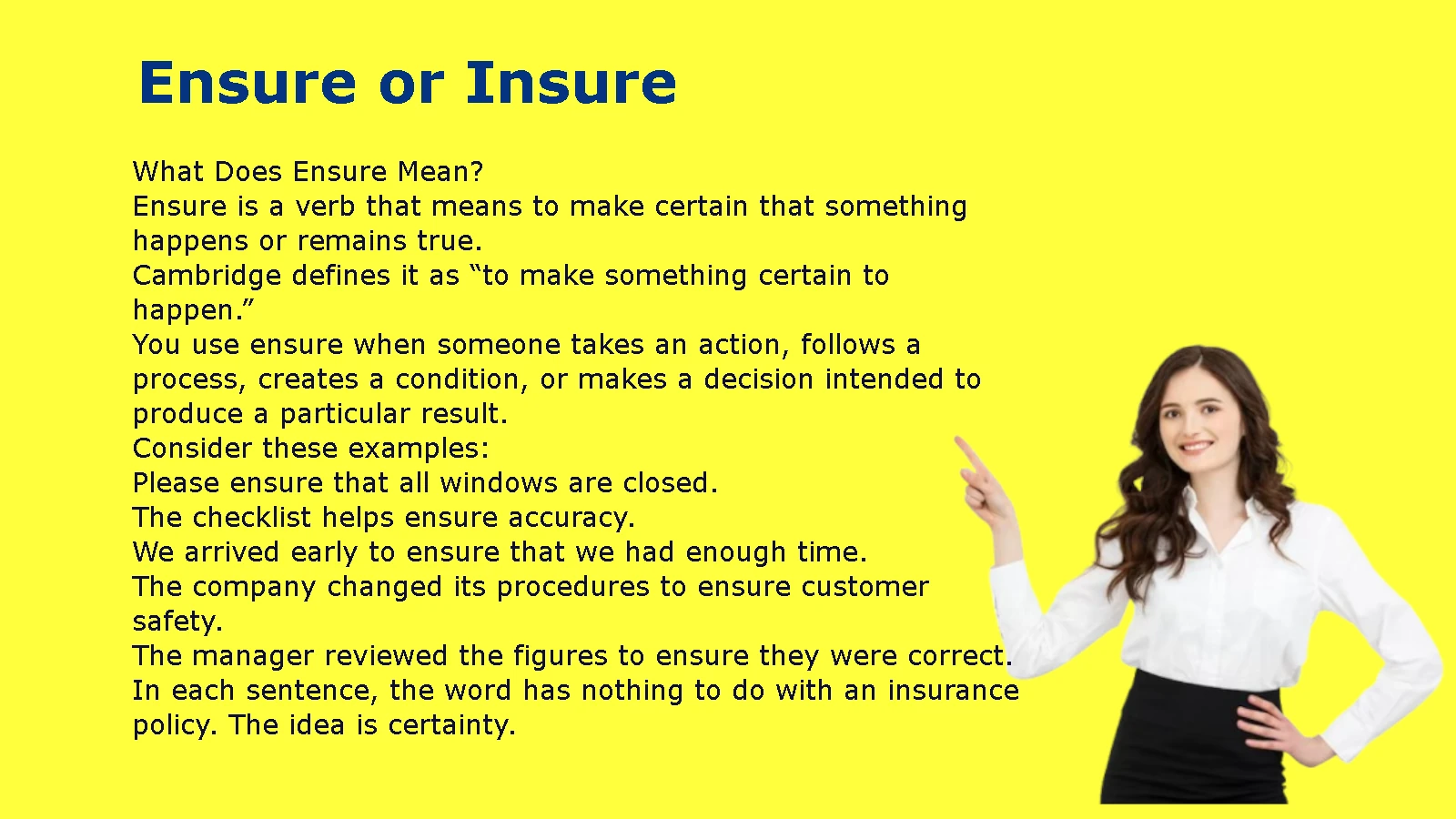
Ensure is a verb that means to make certain that something happens or remains true.
Cambridge defines it as “to make something certain to happen.”
You use ensure when someone takes an action, follows a process, creates a condition, or makes a decision intended to produce a particular result.
Consider these examples:
- Please ensure that all windows are closed.
- The checklist helps ensure accuracy.
- We arrived early to ensure that we had enough time.
- The company changed its procedures to ensure customer safety.
- The manager reviewed the figures to ensure they were correct.
In each sentence, the word has nothing to do with an insurance policy. The idea is certainty.
Ensure means “make sure”
In everyday language, you can often replace ensure with make sure.
Please ensure that everyone receives a copy.
means essentially:
Please make sure that everyone receives a copy.
The first version sounds more formal. The second sounds more conversational.
That difference matters in workplace, academic, technical, and official writing. Ensure is especially common when the writer wants to describe a deliberate step taken to guarantee an outcome.
Common sentence patterns with ensure
Ensure commonly appears in several grammatical structures.
Ensure + noun
You can use ensure directly before a noun when the noun represents the condition or result being secured.
- The new system ensures accuracy.
- Regular maintenance ensures reliability.
- The policy ensures compliance.
- Better lighting ensures visibility.
Here, ensure means that something helps make the stated condition certain or more likely.
Ensure + that clause
This is one of the most common structures.
- Please ensure that the door is locked.
- The teacher checked the answers to ensure that everyone understood the lesson.
- The company introduced safeguards to ensure that customer data remained secure.
The that can sometimes be omitted, especially in less formal writing:
- Please ensure everyone has signed the form.
Both structures are common.
Ensure + object + noun
Another possible construction uses an object followed by a noun phrase.
- The victory ensured the team a place in the final.
- The agreement ensured the company a steady supply of materials.
This structure is less common in everyday speech, but it is grammatically useful and appears in formal writing.
Ensure Examples in Everyday and Professional Writing
The meaning of ensure becomes clearer when you see it in different situations.
At work
- Please ensure that the report is submitted by Friday.
- The review process helps ensure accuracy.
- We added a second approval step to ensure compliance.
- Please ensure all attachments are included before sending the email.
At home
- Check the windows to ensure they’re locked.
- Leave early to ensure you don’t miss the flight.
- Keep the medicine out of reach to ensure children’s safety.
In education
- Teachers use quizzes to ensure students understand the material.
- Read the instructions carefully to ensure that you answer every question.
- The school changed the schedule to ensure enough classroom time.
In technology
- Two factor authentication helps ensure account security.
- The backup system helps ensure that important files aren’t lost.
- Developers test the software to ensure it works as expected.
Notice the pattern: none of these examples involves paying an insurer or protecting property through an insurance policy.
What Does Insure Mean?
Insure primarily means to protect someone, something, or yourself against financial loss or damage by obtaining or providing insurance.
Cambridge gives examples involving homes, possessions, drivers, and other risks. It also lists common structures such as insure something against something and insure something for an amount.
For example:
- We insured the house against fire.
- She insured her car against theft.
- The company insures valuable equipment.
- The painting is insured for $2 million.
- The homeowner insured the property against flood damage.
Here, insure clearly belongs to the world of insurance.
Insure and insurance
The connection between insure and insurance provides the easiest memory aid.
If you’re talking about a policy, coverage, a premium, an insurer, or protection against financial loss, insure is usually the word you want.
For example:
- We need to insure the vehicle.
- The vehicle has insurance.
- The company is the insurer.
- The driver is insured.
- The policy provides coverage against theft.
The words belong to the same semantic family.
Common sentence patterns with insure
Insure something against something
This construction identifies the risk being covered.
- We insured the house against fire.
- They insured the equipment against accidental damage.
- The traveler insured the trip against cancellation.
Insure something for an amount
This construction identifies the insured value.
- The artwork was insured for $500,000.
- They insured the building for $3 million.
- The collector insured the watch for $25,000.
Insure someone or something
You can also use insure without stating the specific risk.
- The company insured its employees.
- We insured the vehicle.
- The homeowner insured the property.
The surrounding context usually makes the insurance meaning clear.
Ensure or Insure Examples Compared Side by Side
The difference becomes much easier when similar sentences sit next to each other.
| Ensure | Insure |
| Please ensure the door is locked. | Insure the property against theft. |
| We took steps to ensure safety. | We insured the building against fire. |
| The checklist helps ensure accuracy. | The company insures the equipment. |
| Please ensure the data is correct. | The artwork is insured for $1 million. |
| The process helps ensure compliance. | They insured the vehicle against damage. |
Consider these two sentences:
We need to ensure the building is safe.
We need to insure the building against damage.
The first sentence concerns certainty and safety. Someone needs to take steps to make sure the building is safe.
The second concerns financial protection. The building needs insurance in case a specified type of damage occurs.
The difference isn’t merely spelling. The underlying idea changes.
Can Insure Mean Ensure?
Yes. This is where many explanations become too rigid.
In American English, insure can mean make certain, and Cambridge explicitly labels this as an American English meaning. It gives examples in which insure means making something certain rather than buying insurance.
For example:
The reporters checked the figures to insure the accuracy of the story.
In this sense, insure is functioning like ensure.
So saying “insure is always wrong when you mean ensure” isn’t completely accurate.
Why use ensure instead?
Even though the alternative meaning exists, ensure is generally the clearer choice when your intended meaning is simply “make certain.”
Microsoft’s style guidance recommends using ensure for “make sure” or “guarantee” and reserving insure for insurance. The goal is straightforward communication, particularly for readers from different English speaking backgrounds.
This distinction is especially useful in:
- Business writing
- Technical documentation
- Academic writing
- Website copy
- Professional emails
- International communication
- Instructions and policies
If you write:
Please ensure that the report is accurate.
Nobody has to wonder whether you mean insurance.
If you write:
Please insure that the report is accurate.
An American reader may understand what you mean, but the spelling can create unnecessary friction.
When two words can communicate the same idea, the clearer and more widely recognized option is usually better.
Ensure or Insure in American English
American English deserves special attention because the distinction isn’t identical to a strict dictionary rule.
Cambridge’s US dictionary entry identifies insure as both an insurance term and a synonym of ensure in the “make certain” sense.
That means American English allows both of these:
- Please ensure that the documents are complete.
- Please insure that the documents are complete.
However, they aren’t equally useful in every context.
For clarity, ensure is the better default when you mean “make certain.”
Use insure when the subject is actually insurance.
A practical American English rule
Ask yourself:
Am I talking about making something certain?
→ Use ensure.
Am I talking about insurance or protection against financial loss?
→ Use insure.
That rule won’t capture every historical or dictionary nuance, but it works extremely well for modern writing.
Ensure or Insure in British English
British English generally maintains a stronger distinction between the two words.
In ordinary British usage:
- Ensure = make certain
- Insure = provide or obtain insurance
Cambridge’s British entries reflect this distinction, defining ensure around certainty and insure around insurance.
That makes ensure the safest choice for the “make certain” meaning in British English.
For example:
Preferred:
Please ensure that the information is correct.
Insurance meaning:
Please insure the vehicle before driving it.
This distinction also explains why using ensure for general certainty works well across English varieties. It creates little ambiguity.
Ensure vs Insure vs. Assure
There’s a third word that often gets pulled into this discussion: assure.
The three words overlap in meaning, but they serve different purposes in careful modern writing.
| Word | Core idea | Typical object | Example |
| Ensure | Make certain | An outcome or condition | Ensure the report is accurate. |
| Insure | Provide financial protection | A person, property, or risk | Insure the car against theft. |
| Assure | Give confidence | A person | I assure you that it’s safe. |
A useful shortcut is:
Ensure an outcome. Insure against a risk. Assure a person.
What does assure mean?
Assure usually means to tell someone confidently that something is true or to remove that person’s doubts or worries.
Cambridge gives examples such as telling someone confidently that something is true or promising that something will happen.
For example:
- I assure you that everything is fine.
- She assured me that the package had been shipped.
- The manager assured the customer that the issue would be resolved.
- He assured us that there was nothing to worry about.
The word normally involves a person who receives reassurance.
Compare all three
Look at this sentence:
I assured the customer that we would ensure the equipment was safe and insure it against accidental damage.
Each word has a distinct role:
- Assured → gave the customer confidence.
- Ensure → made the equipment’s safety certain.
- Insure → provided financial protection against damage.
That’s the distinction in action.
How to Remember Ensure vs Insure
You don’t need a complicated mnemonic. One simple association does most of the work.
Remember insurance when you see insure
Insure → insurance
If money, coverage, a policy, property damage, theft, liability, or another insurable risk appears in the sentence, insure is likely correct.
Examples:
- Insure the house.
- Insure the car.
- Insure the equipment against theft.
- Insure the shipment for $50,000.
Remember “make sure” when you see ensure
Ensure → make sure
If you could replace the word with make sure, choose ensure in most formal writing.
- Ensure the door is locked.
- Ensure the figures are accurate.
- Ensure everyone receives the notice.
- Ensure the process runs smoothly.
The three word memory sentence
A useful sentence brings all three together:
I assure you that I’ll ensure the car is insured.
It sounds slightly playful, but it captures the distinction perfectly:
- Assure → give someone confidence.
- Ensure → make something certain.
- Insured → covered by insurance.
Once you understand that pattern, the spelling stops feeling random.
Common Mistakes With Ensure and Insure
Most mistakes come from treating the words as interchangeable in every situation.
Mistake: Using insure for ordinary certainty
Consider:
Please insure that the form is complete.
American English dictionaries recognize this use of insure, so calling it universally ungrammatical would be inaccurate. However, ensure is clearer and more widely useful for the “make certain” meaning.
Better:
Please ensure that the form is complete.
Mistake: Using ensure for insurance
Consider:
You should ensure your car against theft.
If the intended meaning is to obtain insurance coverage, this is the wrong choice.
Correct:
You should insure your car against theft.
The word against is a strong clue because insure something against a risk is a standard insurance construction.
Mistake: Confusing assure with ensure
This sentence is common:
I ensure you that everything is fine.
The intended meaning is probably that you’re reassuring someone.
Better:
I assure you that everything is fine.
Here, you is the person receiving reassurance.
Mistake: Assuming the words are completely interchangeable
They’re not.
Although American English recognizes an overlap between ensure and insure, the words still have clearly distinct primary uses.
Compare:
The procedure will ensure accuracy.
with:
The company will insure the equipment.
Replacing one with the other changes the meaning or creates unnecessary ambiguity.
Ensure or Insure: Which One Should You Use?
When you’re unsure, don’t stare at the spelling. Look at the meaning.
Use this decision guide:
| Ask yourself | Choose |
| Do I mean “make certain”? | Ensure |
| Do I mean “make sure”? | Ensure |
| Am I talking about an insurance policy? | Insure |
| Am I protecting property against financial loss? | Insure |
| Am I giving someone confidence? | Assure |
| Am I telling someone not to worry? | Assure |
Quick examples
Make certain:
Please ensure all information is correct.
Insurance:
Please insure all company vehicles.
Reassurance:
I assure you that the problem has been fixed.
This method works better than memorizing a long list of exceptions.
Ensure or Insure in Professional Writing
Word choice matters more in professional writing because a small ambiguity can distract readers from the actual message.
Ensure or insure in emails
Use ensure when you’re asking someone to verify or complete something:
- Please ensure that the invoice is attached.
- Please ensure all team members receive the update.
- We need to ensure that the figures are accurate.
- Please ensure the final version is approved before publication.
Use insure when you’re discussing insurance:
- The equipment must be insured before shipment.
- The company insures its vehicles against theft.
- Please confirm that the shipment is insured for its full value.
Ensure or insure in reports
Professional reports often use ensure when describing procedures and controls.
For example:
The company introduced a second review stage to ensure compliance with its internal standards.
An insurance statement would look different:
The company insures its facilities against specified property risks.
The first sentence describes a process for achieving certainty or compliance. The second describes financial protection.
Ensure or insure in technical writing
Technical documentation benefits from precise word choice.
For example:
Ensure that the device is disconnected from power before opening the case.
This is an instruction. The writer wants the reader to make certain that a condition is met.
By contrast:
The device is insured against accidental damage.
This is a statement about financial protection.
The distinction is small on the page but significant in meaning.
Is Ensure a Verb?
Yes. Ensure is a verb.
It means to make something certain or to make sure something happens.
Common forms include:
- ensure
- ensures
- ensured
- ensuring
Examples:
- The system ensures accurate results.
- The manager ensured everyone had the information.
- The team is ensuring compliance with the policy.
- Please ensure the door is closed.
Cambridge classifies ensure as a transitive verb, meaning it normally takes an object or an equivalent clause.
For example:
The policy ensures safety.
or:
The policy ensures that employees are protected.
Is Insure a Verb?
Yes. Insure is also a verb.
Its main meaning is connected with insurance.
Common forms include:
- insure
- insures
- insured
- insuring
Examples:
- We insured the house.
- The company insures commercial vehicles.
- They are insuring the shipment.
- The artwork is insured for $2 million.
Cambridge also recognizes the American English “make certain” meaning of insure, which overlaps with ensure.
Still, when the sentence concerns insurance, insure is the unmistakable choice.
Is “Ensurance” a Word?
Ensurance exists in some historical or specialized usage, but it isn’t the normal noun you should use when you mean the act of ensuring something.
In ordinary modern English, use forms such as:
- ensure
- ensuring
- certainty
- guarantee
- assurance, depending on the intended meaning
For example, instead of writing:
The process provides ensurance of quality.
A more natural version would be:
The process ensures quality.
Or:
The process provides assurance of quality.
This distinction matters because assurance is an established noun, while ensurance isn’t the normal everyday counterpart of ensure.
Ensure vs Insure: A Practical Case Study
Imagine a business ships a $100,000 piece of equipment to a customer.
The company needs to do two different things.
First, it needs to verify that the equipment has been packed correctly and that the required paperwork is complete.
The shipping team checks the documentation to ensure the equipment is ready for delivery.
Second, the company wants financial protection if the shipment is lost or damaged.
The company insures the equipment against damage during transit.
Now add a customer service representative:
The representative assures the customer that the shipment has been properly prepared.
All three words work because all three describe different actions.
| Action | Correct word | Why |
| Check paperwork | Ensure | The company wants to make something certain. |
| Buy coverage | Insure | The company wants financial protection. |
| Reassure customer | Assure | The representative gives confidence to a person. |
This is why memorizing the words individually isn’t enough. Understanding the underlying relationship is more useful.
Ensure or Insure: Practice Questions
Choose ensure, insure, or assure for each sentence.
- Please ___ that all files are backed up.
- We need to ___ the vehicle against theft.
- I can ___ you that the issue has been resolved.
- The checklist helps ___ safety.
- The company decided to ___ its new equipment.
- The manager wanted to ___ everyone that the deadline would not change.
- Please ___ that your application is complete.
- The owner decided to ___ the building against fire.
- She ___ me that the documents had been received.
- The new process should ___ consistent results.
Answers
- ensure — The sentence means “make sure.”
- insure — The vehicle is being protected against a financial risk.
- assure — A person is being given confidence.
- ensure — The checklist is intended to make safety more certain.
- insure — The equipment is receiving insurance coverage.
- assure — The manager is reassuring people.
- ensure — The applicant needs to make certain the application is complete.
- insure — The building is being protected against an insurable risk.
- assured — She gave someone confidence about the documents.
- ensure — The process is intended to make consistent results more certain.
Frequently Asked Questions About Ensure and Insure
Is it ensure or insure?
It depends on the meaning.
Use ensure when you mean make certain or make sure.
Use insure when you mean provide or obtain insurance.
Please ensure that the door is locked.
We insured the house against fire.
What is the easiest way to remember Ensure vs Insure?
Think:
Ensure = make sure.
Insure = insurance.
If the sentence involves a policy or protection against financial loss, insure is usually the right choice. If it involves making an outcome certain, choose ensure.
Can insure mean ensure?
Yes, in American English.
Major dictionaries recognize insure as a US synonym for ensure in the “make certain” sense.
However, ensure is usually the clearer choice when you mean “make certain,” especially in professional and international writing.
Is ensure used in American English?
Yes. Ensure is standard American English.
Cambridge’s US dictionary lists ensure and gives its pronunciation and meaning as “to make something certain to happen.”
Is insure only used for insurance?
Not entirely.
Its primary meaning concerns insurance, but American English also recognizes insure in the sense of “make certain.”
For clear writing, though, using ensure for “make certain” avoids confusion.
What is the difference between ensure and assure?
Ensure means to make something certain.
Assure usually means to give a person confidence or remove their doubts.
Compare:
The safety checks ensure that the equipment is ready.
The engineer assured me that the equipment was ready.
The first sentence concerns an outcome. The second concerns a person.
What is the difference between ensure and insurance?
Ensure is a verb meaning to make something certain.
Insurance is financial protection against specified risks.
For example:
Safety checks ensure the equipment is ready.
The equipment has insurance against accidental damage.
The words may look related, but they operate in different semantic fields.
Should you use insure or ensure in formal writing?
For the “make certain” meaning, ensure is usually the better choice.
Although American English recognizes insure with this meaning, ensure creates less ambiguity. Microsoft specifically recommends ensure for “make sure” or “guarantee” and insure for providing insurance.
Is “ensure” the same as “make sure”?
In most contexts, yes.
For example:
Please ensure that the report is complete.
and:
Please make sure that the report is complete.
Both communicate essentially the same idea. Ensure simply has a more formal tone.
Final Takeaway: Ensure or Insure?
The difference between ensure and insure is easier once you focus on meaning instead of spelling.
Ensure means make certain.
Please ensure that all information is correct.
Insure primarily means protect against financial loss through insurance.
We insured the property against theft.
Assure usually means give someone confidence or remove doubt.
I assure you that everything is under control.
There is an important American English nuance: insure can also mean “make certain.” Major dictionaries recognize that usage.
Even so, ensure remains the clearest default when you mean “make sure,” particularly in professional, academic, technical, and international writing.
Remember the three word rule:
Ensure an outcome. Insure against a risk. Assure a person.
Once that distinction clicks, choosing between ensure or insure becomes much easier.