Have you ever wondered whether you should write “chord” or “cord”? These two words sound exactly alike, but their meanings are completely different. Knowing the difference between Chord or Cord can help you avoid common spelling mistakes and use each word correctly in your writing.
Chord refers to a group of musical notes played together. It can also describe a straight line connecting two points on a circle. Cord, on the other hand, usually refers to a thick string or rope made of several strands. It can also mean a group of wires or a bundle of nerves in the body.
Examples:
- She played a beautiful chord on the piano.
- He tied the package with a strong cord.
The confusion is understandable. People often search for chord vs cord, chord or cord difference, cord vs chord, or how to remember chord and cord because these words are pronounced the same but have different meanings. And here’s the kicker: one small letter can completely change what you’re talking about.
In this guide, you’ll learn the complete difference between Chord or Cord, including their meanings, definitions, pronunciations, parts of speech, and correct usage. You’ll also discover easy examples, helpful memory tricks, and when to use chord or cord in a sentence.
Chord vs Cord: What’s the Difference?
The simplest distinction is this:
Chord usually relates to music, geometry, or an emotional connection. Cord usually refers to a string, rope, cable, body structure, fabric, or firewood.
Both words are nouns in their most common uses. However, chord can also function as a verb, meaning to play or make chords or to harmonize. Cord can also function as a verb, meaning to furnish, bind, or connect something with a cord.
Here’s a useful side by side comparison:
| Feature | Chord | Cord |
| Pronunciation | /kɔrd/ | /kɔrd/ |
| Music | Yes | No |
| Geometry | Yes | No |
| Emotional expression | Yes | Sometimes in specialized senses |
| Rope or string | No | Yes |
| Electrical cable | No | Yes |
| Anatomy | Rare/specialized | Yes |
| Firewood measurement | No | Yes |
| Fabric | No | Yes |
| Common phrase | strike a chord | power cord |
The spelling becomes much easier once you stop trying to hear the difference. You can’t hear one.
You have to identify what the word means.
What Does Chord Mean?
Chord has several established meanings, but three are especially useful for everyday English: music, geometry, and figurative language.
Chord in Music
In music, a chord is a group of musical notes sounded together to create harmony. Cambridge defines it as three or more musical notes played at the same time, while learner dictionaries may use the broader description of two or more notes.
You’ll encounter chord constantly when talking about:
- Guitar playing
- Piano playing
- Music theory
- Harmony
- Songwriting
- Chord progressions
- Major and minor harmony
- Jazz
- Pop music
- Rock music
For example:
- She learned her first guitar chord.
- The song begins with a simple piano chord.
- The musician changed chords during the chorus.
- The final chord lasted several seconds.
A chord isn’t the same thing as a single musical note. A note is an individual pitch. A chord combines multiple notes into a harmonic structure.
For example, a basic C major chord contains the notes C, E, and G.
That’s why you write:
C major chord
not:
C major cord
The second spelling refers to something physical, such as a rope or cable.
Common Musical Types of Chords
You may see chord paired with many different musical terms.
Some common examples include:
- Major chord
- Minor chord
- Seventh chord
- Power chord
- Diminished chord
- Augmented chord
- Suspended chord
- Guitar chord
- Piano chord
- Chord progression
- Chord change
The context makes the spelling clear.
“The guitarist played a power chord.”
Here, chord refers to music.
But consider:
“The guitarist plugged the amplifier into the power cord.”
Now cord refers to an electrical cable.
The words sound exactly alike, yet their meanings couldn’t be more different.
Chord in Geometry
Music isn’t the only place where chord belongs.
In geometry, a chord is a straight line segment whose endpoints lie on a circle. Cambridge gives essentially the same definition, describing it as a line segment joining the ends of an arc.
Imagine drawing a circle and placing two dots anywhere along its edge. Connect those dots with a straight line.
That line segment is a chord.
A useful distinction is:
- Radius: center to the edge
- Diameter: edge to edge through the center
- Chord: any straight segment connecting two points on the circle
- Arc: the curved portion of the circle between two points.
Every diameter is a chord, but not every chord is a diameter.
A diameter passes through the center of the circle. Because of that, it is the longest possible chord in that circle.
For example:
The diameter is the longest chord in a circle.
Here, chord has nothing to do with music. It still uses the spelling chord, however.
Chord in Figurative English
One of the most common nonmusical uses appears in the phrase “strike a chord.”
If something strikes a chord with you, it creates a strong emotional reaction or feels personally meaningful.
For example:
The speaker’s story struck a chord with the audience.
This doesn’t mean anyone literally played music.
The expression comes from the idea of striking a musical chord that produces a recognizable sound. Over time, the musical image became a metaphor for creating an emotional response. Merriam Webster lists the figurative sense of chord as an individual emotion or disposition and gives examples involving a responsive chord.
You may also encounter:
- strike a chord
- touch a chord
- strike a responsive chord
- strike an emotional chord
Examples:
- Her story struck a chord with young parents.
- The documentary touched a chord with viewers.
- The song struck an emotional chord with listeners.
In these expressions, chord is always the standard spelling.
So write:
The story struck a chord with me.
Not:
The story struck a cord with me.
What Does Cord Mean?
While chord has strong connections to music and geometry, cord has a much more physical range of meanings.
A cord can be a length of twisted or woven string, a cable used to carry electricity, a rope like structure in the body, a unit of firewood, or a type of ribbed fabric.
Cord as String or Rope
The most basic meaning of cord is a length of strong, flexible material.
For example:
- Tie the package with a cord.
- The curtain cord broke.
- She pulled the cord to raise the blinds.
- The bag closes with an elastic cord.
A cord can be made from different materials and can serve many practical purposes.
You might find cords made from:
- Cotton
- Nylon
- Polyester
- Leather
- Synthetic fibers
- Twisted threads
Cambridge describes this sense as a length of rope or string made from twisted threads.
The key idea is simple:
If you’re talking about a physical string, rope, or similar material, use cord.
Cord as an Electrical Cable
Another extremely common meaning appears in technology and household objects.
A cord can be a covered electrical wire used to connect equipment to a power source or another device.
Common examples include:
- Power cord
- Extension cord
- Electrical cord
- Telephone cord
- Lamp cord
- Appliance cord
For example:
The power cord is too short to reach the outlet.
Here, cord is correct.
This is a common spelling trap because people sometimes write power chord after hearing the phrase aloud. That spelling changes the meaning completely.
Power Cord vs. Power Chord
These two expressions are an excellent example of why context matters.
Power cord = an electrical cable.
Power chord = a type of musical chord commonly associated with guitar driven rock music.
Compare:
Plug the amplifier into the power cord.
and:
The guitarist played a powerful power chord.
One connects equipment.
The other belongs to music.
The pronunciation won’t rescue you. The meaning will.
Cord in Anatomy
Cord also describes several long structures in the human body that resemble cords or ropes.
Common examples include:
- Spinal cord
- Umbilical cord
- Vocal cords
- Spermatic cord
- Nerve cord
Cambridge specifically lists anatomical uses such as the umbilical cord, nerve cord, spermatic cord, spinal cord, and vocal cords.
Spinal Cord
The spinal cord is a long bundle of nervous tissue that runs within the vertebral column. It forms a major part of the central nervous system and carries signals between the brain and the rest of the body.
So the correct spelling is:
spinal cord
Not:
spinal chord
Example:
The spinal cord carries signals between the brain and the body.
Umbilical Cord
The umbilical cord connects a developing fetus to the placenta during pregnancy.
Again, the correct spelling is cord.
The umbilical cord supplies the developing fetus with oxygen and nutrients through the placenta.
Vocal Cords
Here’s another especially common spelling question.
The correct term is:
vocal cords
not:
vocal chords
Vocal cords are structures in the larynx that vibrate as air passes through them and contribute to voice production.
The spelling may seem confusing because the vocal cords create sound. However, they’re anatomical structures, so cord is the correct word.
The singer rested her voice to protect her vocal cords.
The musical term chord describes notes played together. The anatomical term cord describes the structures involved in producing the voice.
That’s a useful distinction to remember.
Cord as a Unit of Firewood
Cord has another established meaning that surprises many readers.
A cord is a traditional unit for measuring firewood. One full cord contains 128 cubic feet of stacked wood. Merriam Webster describes it as a stack measuring 4 × 4 × 8 feet.
The calculation is straightforward:
4 × 4 × 8 = 128 cubic feet
So:
One cord of wood = 128 cubic feet
You might see the term in contexts involving:
- Firewood sales
- Heating homes
- Wood storage
- Forestry
- Rural property
- Fireplace fuel
Example:
They ordered a cord of firewood before winter.
This meaning has no connection to music.
It’s another reason a simple rule like “chord means sound and cord means string” isn’t enough to explain every use. English words often develop several meanings over centuries.
Cord in Fabric and Clothing
Cord can also refer to corduroy fabric, especially in British usage. Cambridge lists cord as a term for corduroy and notes the related use of cords for trousers made from the material.
For example:
He wore a pair of brown cords.
In this context, cords means corduroy pants.
The fabric has raised ribs running along its surface. That physical texture explains the connection with the broader word cord.
Are Chord and Cord Pronounced the Same?
Yes.
In standard US English, chord and cord are homophones. Both are pronounced /kɔrd/. Cambridge lists the same US pronunciation for both words.
A homophone is a word that sounds the same as another word but has a different meaning or spelling.
Other familiar examples include:
- to / too / two
- there / their / they’re
- right / write
- flower / flour
- sea / see
Chord and cord belong to the same category.
The spelling is different.
The pronunciation is not.
That’s why proofreading software and spell checkers can’t always solve the problem. Both chord and cord are legitimate English words. If you write the wrong one, the sentence may still be grammatically correct.
The problem is semantic, not grammatical.
Why Do People Confuse Chord and Cord?
The main reason is straightforward: they sound exactly the same.
But their history makes the situation even more interesting.
Merriam Webster explains that the cord referring to string traces back through Anglo French to Latin chorda, ultimately connected with Greek khordē. The musical chord, meanwhile, developed from Middle English cord, a shortened form related to accord.
So the spelling difference isn’t based on a neat modern logic.
English inherited and reshaped these words over time.
That history explains why a learner can’t simply look at the letters and infer the pronunciation or meaning.
“The English language?” Merriam Webster jokingly describes homophone confusion as evidence of the language’s antagonism toward its speakers.
The joke works because this is exactly what happens with chord and cord: the pronunciation gives you no clue about which spelling belongs in a sentence.
Chord or Cord Examples
The fastest way to master the difference is to see the words in context.
Examples With Chord
- The guitarist played a difficult chord.
- She learned three new chords on the piano.
- The song ends with a minor chord.
- The diameter is the longest chord of a circle.
- His speech struck a chord with the audience.
- The final chord faded into silence.
- The chord progression gives the song its distinctive mood.
- That story touched a chord with many readers.
Examples With Cord
- The package was tied with a strong cord.
- The lamp cord is damaged.
- Don’t use the appliance if its power cord is frayed.
- She pulled the curtain cord.
- The spinal cord is part of the central nervous system.
- The umbilical cord connects the fetus to the placenta.
- The singer injured her vocal cords.
- They bought a cord of firewood.
- He wore brown cords to the event.
The pattern becomes obvious once the examples are grouped by meaning.
Common Chord vs Cord Mistakes
Certain errors appear again and again because the wrong word still sounds perfectly natural.
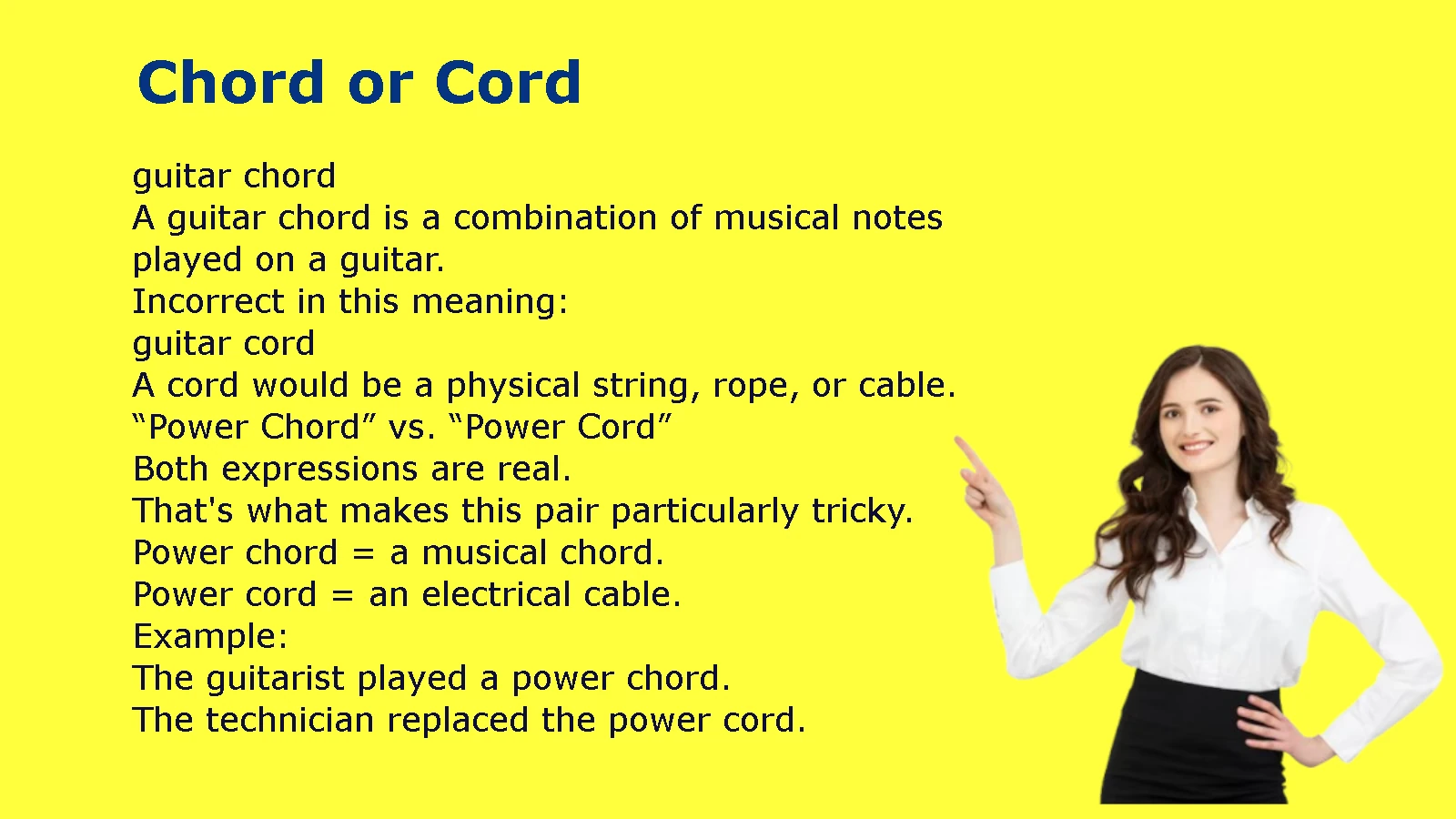
“Guitar Cord” vs. “Guitar Chord”
Correct:
guitar chord
A guitar chord is a combination of musical notes played on a guitar.
Incorrect in this meaning:
guitar cord
A cord would be a physical string, rope, or cable.
“Power Chord” vs. “Power Cord”
Both expressions are real.
That’s what makes this pair particularly tricky.
Power chord = a musical chord.
Power cord = an electrical cable.
Example:
The guitarist played a power chord.
The technician replaced the power cord.
Neither spelling is universally “correct.” The correct choice depends on what you’re talking about.
“Spinal Chord” vs. “Spinal Cord”
Correct:
spinal cord
The word describes an anatomical structure.
“Vocal Chords” vs. “Vocal Cords”
Correct:
vocal cords
The structures belong to the body, so use cord.
“Strike a Cord” vs. “Strike a Chord”
Correct:
strike a chord
The expression refers to producing an emotional response. The spelling comes from the musical metaphor.
“Chord of Wood” vs. “Cord of Wood”
Correct:
cord of wood
A cord is a unit of firewood measurement.
Chord or Cord in Common Phrases
Learning common collocations can make the spelling almost automatic.
Common phrases with chord
- guitar chord
- piano chord
- major chord
- minor chord
- power chord
- seventh chord
- chord progression
- chord change
- strike a chord
- touch a chord
- emotional chord
- chord of a circle
Common phrases with cord
- power cord
- extension cord
- electrical cord
- lamp cord
- telephone cord
- charging cord
- spinal cord
- umbilical cord
- vocal cords
- spermatic cord
- cord of wood
- elastic cord
- curtain cord
A good strategy is to learn these as phrases rather than isolated words.
For example, don’t memorize only cord.
Memorize:
power cord
Don’t memorize only chord.
Memorize:
guitar chord
That approach reduces hesitation because the surrounding word helps trigger the correct spelling.
A Simple Way to Remember Chord vs Cord
One popular memory trick is:
Chord has an H, and H can remind you of harmony.
So:
chord → H → harmony → music
Meanwhile:
cord → physical thing
This works particularly well for the musical meaning.
Another useful trick comes from the spelling itself:
Cord is shorter. Think of a single piece of string. Chord is longer. Think of a group of notes.
Merriam Webster offers a similar mnemonic based on the fact that cord is a single piece of string while chord represents a collection of notes.
However, don’t treat either mnemonic as an absolute rule.
Remember:
- A chord can be a geometric line.
- A cord can be an anatomical structure.
- A cord can measure firewood.
- A chord can describe an emotional response.
The mnemonic gets you started.
Context finishes the job.
Chord vs Cord in Technology
Technology creates some of the clearest examples.
When you’re discussing electricity, cables, or physical connections, cord is usually the word you need.
For example:
- power cord
- extension cord
- electrical cord
- USB cable
- charging cable
- lamp cord
Technically, cord and cable aren’t always interchangeable in every specialized context. Their construction and intended uses can differ. In everyday language, however, power cord and extension cord are standard terms.
The important spelling distinction is this:
Electrical connection → cord
Musical harmony → chord
Consider this sentence:
The guitarist plugged the amplifier into the power cord before playing a power chord.
That’s one sentence with both words.
The power cord supplies electricity.
The power chord belongs to the music.
Chord vs Cord in Anatomy
The same context rule works in medicine and biology.
Use cord when you’re referring to a cordlike anatomical structure.
| Term | Meaning |
| Spinal cord | Nervous tissue connecting the brain with much of the body |
| Umbilical cord | Structure connecting a fetus to the placenta |
| Vocal cords | Laryngeal structures involved in voice production |
| Spermatic cord | Structure associated with the male reproductive system |
| Nerve cord | A cordlike nerve structure in certain animals |
The spelling chord would generally be incorrect in these everyday anatomical terms.
That’s true even when the body structure has a role in producing sound, as with the vocal cords.
Chord vs Cord in Geometry
Geometry provides one of the clearest examples of chord outside music.
Suppose a circle has radius 5 inches.
Its diameter is:
2 × 5 = 10 inches
That diameter is also a chord because its endpoints lie on the circle.
But a shorter line connecting two points on the circumference is also a chord.
So you can think of the relationship this way:
Circle
•─────────•
/ \
/ CHORD \
| ───── |
\ /
\ • /
\_______________/
The exact drawing isn’t important. The concept is.
A chord connects two points on a curve.
For a circle, the chord’s endpoints lie on the circumference.
A diameter is simply the special case where the chord passes through the center.
Chord or Cord? A Quick Decision Guide
When you’re unsure, ask yourself one question:
What does the word describe?
Is it music?
Use chord.
She played a beautiful chord.
Is it a line segment connecting two points on a circle?
Use chord.
The diameter is a chord.
Does it describe an emotional reaction?
Use chord.
The story struck a chord.
Is it rope or string?
Use cord.
Tie it with a cord.
Is it an electrical cable?
Use cord.
Unplug the power cord.
Is it an anatomical structure?
Use cord.
The spinal cord is protected by the vertebral column.
Is it firewood measured in a traditional unit?
Use cord.
They bought a cord of wood.
Is it corduroy fabric or clothing?
Use cord in contexts where that usage applies.
He wore brown cords.
This decision tree covers most everyday situations where the two words cause confusion.
A Practical Case Study: One Pronunciation, Six Spellings Decisions
Imagine someone says:
“I need to replace the cord before I play the song.”
What does cord mean?
You can’t know from the pronunciation alone.
If the person means the electrical cable connecting an amplifier, cord is correct.
If they mean a musical group of notes, they actually mean chord.
Now consider six sentences:
| Sentence | Correct word | Why |
| She played a ___ on the piano. | chord | Music |
| The lamp needs a new ___. | cord | Electrical cable |
| The line is a ___ of the circle. | chord | Geometry |
| His story struck a ___. | chord | Emotional response |
| The doctor examined the spinal ___. | cord | Anatomy |
| They bought a ___ of firewood. | cord | Unit of wood |
This is the central lesson:
Sound doesn’t determine the spelling. Meaning does.
Chord vs Cord: Important Facts
Here are the key facts worth remembering:
- Chord and cord are homophones in standard US English.
- Both are pronounced /kɔrd/.
- Chord commonly refers to multiple musical notes sounded together.
- Chord also has a geometric meaning.
- A diameter is a special type of chord.
- Chord appears in the figurative expression “strike a chord.”
- Cord can mean string, rope, or a similar flexible material.
- Cord can mean an electrical cable.
- Cord appears in anatomical terms such as spinal cord and vocal cords.
- A cord of wood equals 128 cubic feet.
- Chord has an established meaning in geometry as a line segment joining two points on a circle or curve.
- The words have related and intertwined histories, which helps explain why their spellings can be confusing.
Chord or Cord: Frequently Asked Questions
Is it chord or cord in music?
It’s chord.
A musical chord consists of multiple notes sounded together.
Example:
The guitarist played a minor chord.
Is it power cord or power chord?
Both are correct, but they mean different things.
- Power cord = electrical cable
- Power chord = musical chord
Is it guitar chord or guitar cord?
It’s guitar chord when you’re talking about music.
Example:
She learned a new guitar chord.
Is it spinal cord or spinal chord?
It’s spinal cord.
The spinal cord is an anatomical structure in the central nervous system.
Is it vocal cords or vocal chords?
It’s vocal cords.
The term refers to structures in the larynx involved in producing the voice.
Is it strike a chord or strike a cord?
It’s strike a chord.
The phrase means to create a strong emotional reaction or sense of recognition.
Do chord and cord sound the same?
Yes. In standard US English, both are pronounced /kɔrd/.
Is a diameter a chord?
Yes.
A diameter is a special type of chord because it connects two points on a circle and passes through the center. It is also the longest chord in that circle.
What is a cord of wood?
A cord is a traditional unit for measuring firewood. One cord equals 128 cubic feet, traditionally represented by a stack measuring 4 feet high, 4 feet deep, and 8 feet long.
What’s the easiest way to remember Chord vs Cord?
For the musical meaning, remember:
Chord → H → harmony
For physical objects, think:
Cord → string, rope, cable, or cordlike structure
Just remember that chord has other meanings too, especially in geometry and the phrase “strike a chord.”
Final Takeaway: Chord or Cord?
The difference between chord and cord comes down to meaning.
Use chord when you’re talking about:
- Music
- Musical harmony
- A line segment joining two points on a circle
- An emotional response, as in “strike a chord”
Use cord when you’re talking about:
- String or rope
- Electrical cables
- Anatomical structures
- Firewood
- Corduroy fabric or clothing
Instead, look at the sentence.
If a guitarist plays it, it’s probably a chord.
If you plug it in, tie it up, measure firewood with it, or find it in the body, it’s probably a cord.
And when the meaning is emotional, remember the musical metaphor:
A story can strike a chord. It can’t strike a cord.