Have you ever wondered what introverts really means? The word introverts is commonly used to describe people who tend to feel more comfortable with solitude, quiet environments, and smaller social settings. However, being an introvert doesn’t simply mean that someone is shy or dislikes people.
Introverts is the plural form of introvert, a noun that refers to a person who tends to focus more on their inner thoughts and feelings and may prefer less stimulating social situations. Introverts can enjoy spending time with others, but they often need some quiet time alone to recharge after social interaction.
Examples:
- Introverts often enjoy reading, writing, or spending time on their own.
- Some introverts prefer small gatherings instead of large parties.
The confusion is understandable. People often search for introverts meaning, introvert meaning, what does introverts mean, or introverts definition because the word is sometimes mistakenly associated only with shyness or social anxiety. In reality, introversion describes a personality preference, not a person’s ability to socialize or make friends.
In this guide, you’ll learn the complete meaning of Introverts, including its definition, pronunciation, origin, synonyms, and usage. You’ll also discover how to use introverts correctly in sentences, along with clear examples to help you understand the word in everyday English.
What Does Introverts Mean?
Introverts is the plural form of introvert. An introvert is a person who tends toward introversion, a personality trait associated with greater orientation toward one’s inner thoughts and feelings and, compared with highly extroverted people, a greater preference for less stimulating or more solitary experiences.
In everyday language, people often describe introverts as people who:
- Enjoy spending time alone
- Prefer small groups to large crowds
- Like deeper conversations
- Need quiet time after extended social activity
- Often think before speaking
- Enjoy independent hobbies
- Prefer calm environments
- Maintain a smaller circle of close relationships
- May feel overwhelmed by prolonged social stimulation
These tendencies don’t apply equally to every introvert. Personality doesn’t work like a checklist where someone must meet every condition.
The American Psychological Association describes introversion as a broad personality trait that exists on a continuum. That point matters because someone can be somewhat introverted without being extremely withdrawn or quiet.
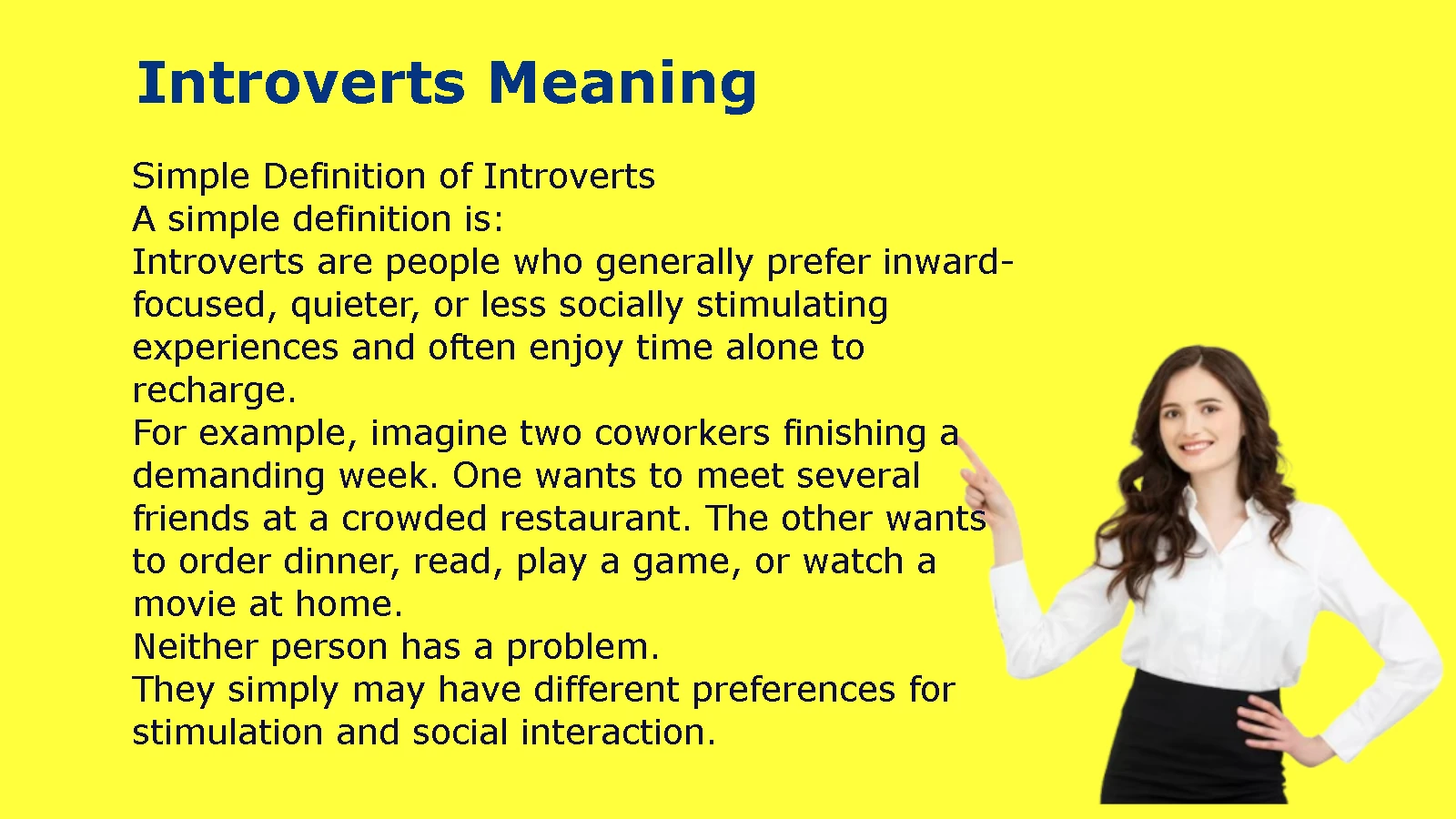
Simple Definition of Introverts
A simple definition is:
Introverts are people who generally prefer inward-focused, quieter, or less socially stimulating experiences and often enjoy time alone to recharge.
For example, imagine two coworkers finishing a demanding week. One wants to meet several friends at a crowded restaurant. The other wants to order dinner, read, play a game, or watch a movie at home.
Neither person has a problem.
They simply may have different preferences for stimulation and social interaction.
Introverts Meaning in Everyday Language
In everyday conversation, introvert usually describes someone who prefers solitude or smaller social settings.
For example:
- “My brother is an introvert, so he enjoys quiet weekends.”
- “Some introverts prefer texting to large group conversations.”
- “She’s an introvert, but she’s very comfortable speaking at work.”
That last example highlights an important point: introversion doesn’t automatically mean poor social skills.
A person can be introverted and still communicate clearly, make friends, lead a team, teach a class, or speak to hundreds of people.
Introvert vs. Introverts
The difference between introvert and introverts is grammatical rather than conceptual.
| Word | Form | Meaning | Example |
| Introvert | Singular noun | One person who tends toward introversion | “He is an introvert.” |
| Introverts | Plural noun | Two or more people who tend toward introversion | “Introverts may enjoy quiet spaces.” |
| Introverted | Adjective | Describes someone or something associated with introversion | “She has an introverted personality.” |
| Introversion | Noun | The personality trait or tendency | “Introversion can affect social preferences.” |
So if you’re talking about one person, use introvert. If you’re talking about several people, use introverts.
What Are the Common Traits of Introverts?
Introverts can have very different personalities, yet certain tendencies appear more often among people who score lower on the extraversion dimension.
The most recognizable trait is a preference for lower levels of social stimulation. An introvert may enjoy social interaction but prefer to experience it in smaller doses or in calmer settings.
The APA describes introversion using characteristics such as being relatively reserved, deliberate, quiet, and more inclined toward independent work.
Enjoying Time Alone
Many introverts genuinely enjoy solitude.
That doesn’t necessarily mean they feel lonely. Alone time can provide space to read, think, create, work on a hobby, or simply relax without responding to other people’s demands.
For some people, an evening alone feels less like isolation and more like plugging a phone into a charger.
Preferring Smaller Groups
An introvert may prefer dinner with two close friends over a party with fifty people.
Smaller groups often make it easier to have focused conversations and avoid the constant noise and social switching that can come with large gatherings.
However, this isn’t a universal rule. Some introverts enjoy parties and large events. They may simply prefer them less frequently.
Enjoying Deeper Conversations
Many introverts prefer conversations with substance.
Small talk isn’t necessarily unbearable, but conversations about ideas, experiences, hobbies, goals, books, relationships, or other meaningful subjects may feel more rewarding.
That preference doesn’t mean extroverts only enjoy superficial conversation. It simply describes one tendency that can occur with introversion.
Thinking Before Speaking
An introverted person may pause before answering a question because they prefer to organize their thoughts first.
This can look like hesitation to someone who processes ideas by speaking. In reality, the person may simply use a different communication style.
Needing Quiet Time After Socializing
One of the most common experiences associated with introversion is wanting some downtime after sustained social activity.
Consider someone who spends eight hours in meetings, attends dinner with coworkers, and then returns home. An introvert might enjoy the entire day and still want several hours of silence afterward.
Enjoying the social experience and needing recovery time aren’t contradictory.
Signs You Might Be an Introvert
No single behavior proves that someone is an introvert. Still, several patterns can offer clues.
You may lean toward introversion if you regularly:
- Prefer one-on-one conversations to large group discussions
- Look forward to quiet time after social events
- Enjoy independent hobbies
- Think carefully before answering
- Prefer a few close friends to a very large social circle
- Feel comfortable entertaining yourself
- Like calm environments
- Find prolonged social interaction tiring
- Prefer meaningful conversations to constant social activity
- Need uninterrupted time to concentrate
The important word is prefer.
An introvert may attend a wedding, enjoy it, dance, talk with relatives, and laugh with friends. If that person later wants to spend Sunday alone, the two behaviors can coexist perfectly well.
Introversion describes a tendency, not a permanent behavior in every situation.
Introverts vs. Extroverts
The simplest way to understand introversion is to compare it with extraversion, the opposite end of the same broad personality dimension.
Highly extraverted people tend to be more socially assertive, sociable, enthusiastic, and oriented toward external interaction. People who are more introverted tend to be quieter and less socially driven on average.
| Introverts | Extroverts |
| Often prefer quieter environments | Often enjoy stimulating environments |
| May prefer smaller groups | May enjoy larger groups |
| Often value time alone | Often seek frequent social interaction |
| May think before speaking | May process ideas through conversation |
| Can prefer independent activities | May enjoy highly interactive activities |
| May need downtime after social events | May gain energy from continued social interaction |
This comparison describes broad tendencies rather than strict rules.
A person can also show different behavior in different situations. Someone may be quiet at a family gathering but highly energetic with close friends. Another person may enjoy socializing at work but prefer solitude at home.
Why the Introvert-Extrovert Comparison Isn’t Black and White
Personality traits generally exist along dimensions. The APA specifically describes introversion and extraversion as a continuum.
That means most people don’t fit neatly into two boxes.
Think of it like a dimmer switch rather than an on/off button.
Someone can lean strongly toward introversion. Another person may sit near the middle. Someone else may lean strongly toward extraversion.
This middle territory is often associated with the informal term ambivert.
Introverts vs. Shy People
Introversion and shyness are not the same thing.
Shyness generally involves discomfort, self-consciousness, or inhibition in social situations. Introversion, by contrast, describes a personality orientation or preference.
An introvert may confidently walk into a room, introduce themselves to everyone, and lead a conversation. They might simply prefer to go home afterward.
A shy person may desperately want to join a conversation but feel nervous about doing so.
That difference is crucial.
| Introversion | Shyness |
| Personality tendency | Social-emotional response |
| Can exist with confidence | Often involves social discomfort |
| Doesn’t necessarily involve fear | Can involve nervousness or fear |
| Doesn’t prevent social interaction | May make interaction difficult |
A person can also be both introverted and shy. However, one does not automatically cause the other.
Introverts vs. Social Anxiety
Social anxiety is different from introversion as well.
Someone with social anxiety may experience substantial fear or distress around social situations. They may worry intensely about embarrassment, judgment, rejection, or making mistakes.
An introvert doesn’t necessarily experience any of those concerns.
For example, an introverted employee might be perfectly comfortable presenting a project to colleagues. They simply don’t want to spend another three hours at a crowded networking event afterward.
The distinction can be summarized simply:
Introversion is a personality tendency. Social anxiety involves significant anxiety or fear associated with social situations.
Because social anxiety can affect daily functioning and mental health, it shouldn’t be casually equated with simply enjoying solitude.
Are Introverts Antisocial?
No. Being introverted doesn’t mean being antisocial.
This confusion partly comes from everyday use of the word antisocial. People sometimes use it to mean someone who doesn’t enjoy socializing. In psychology, however, antisocial has a much more specific meaning and should not be used as a casual synonym for introverted.
An introvert can:
- Have a strong group of friends
- Maintain a healthy relationship
- Enjoy family gatherings
- Work successfully with colleagues
- Participate in community activities
- Lead organizations
- Speak publicly
- Enjoy travel
- Attend parties
The difference often lies in how much social stimulation the person prefers and how they manage their energy, not in whether they care about other people.
Examples of Introverts in Everyday Life
The easiest way to understand the introverts meaning is to look at realistic situations.
Example: The Quiet Weekend
Maya spends Monday through Friday working with customers. She enjoys her coworkers and talks with people throughout the day.
On Saturday, she stays home, reads a novel, cooks lunch, and takes a long walk.
That doesn’t mean Maya dislikes people. She may simply prefer a quieter weekend after a socially demanding week.
Example: The Social Introvert
Daniel enjoys parties. He talks with people, tells jokes, and meets new friends.
After several hours, though, he leaves before everyone else and spends the next morning alone.
Daniel can still be an introvert.
His comfort with people doesn’t automatically make him an extrovert.
Example: The Introverted Professional
A project manager may prefer written preparation and small meetings over spontaneous brainstorming sessions.
That same manager can still lead a team effectively.
In fact, careful preparation can become a practical strength in situations where listening, planning, and thoughtful responses matter.
How Introverts Behave in Social Situations
Introverts don’t follow one universal social script.
Some are quiet observers. Others are highly expressive around people they trust. Some enjoy public speaking but dislike networking. Others love dinner parties but avoid crowded clubs.
The setting matters.
| Situation | Possible introvert preference |
| Large party | Attend briefly or stay with a small group |
| Dinner | Prefer a few close friends |
| Workplace | Prepare before meetings |
| Conversation | Favor meaningful discussion |
| Weekend | Schedule quiet or independent activities |
| Networking | Focus on a few useful conversations |
| Group project | Prefer defined responsibilities and preparation |
These are possibilities rather than rules.
An introverted personality doesn’t predict exactly how someone will behave in every circumstance.
Common Misconceptions About Introverts
Introversion has collected plenty of stereotypes over the years. Most are too simplistic.
“Introverts Hate People”
False.
Introverts can care deeply about other people and maintain close, lasting relationships.
They may simply prefer fewer relationships or more intimate interactions.
“Introverts Are Always Quiet”
Not necessarily.
An introvert can be extremely talkative when discussing a favorite subject or spending time with trusted friends.
Quietness alone doesn’t define introversion.
“Introverts Are Shy”
Not automatically.
Confidence and introversion can coexist.
A confident introvert may have no problem speaking in front of an audience. They may just prefer quiet time afterward.
“Introverts Don’t Like Parties”
Too broad.
Some introverts dislike large parties. Others enjoy them.
The more useful question is how a person responds to the level and duration of stimulation.
“Introverts Can’t Be Good Leaders”
Incorrect.
Leadership doesn’t belong exclusively to extroverts.
A leader needs many abilities, including decision-making, communication, listening, planning, judgment, and relationship building. Introversion doesn’t automatically prevent someone from developing any of these skills.
Strengths Commonly Associated With Introverts
Introversion shouldn’t be treated as a list of superpowers. Still, several tendencies associated with introversion can become useful strengths depending on the person and situation.
Focus and Independent Work
People who enjoy working independently may find it easier to spend extended periods concentrating on a task without needing constant interaction.
Thoughtful Communication
Some introverts prefer to consider their words before speaking.
That can be useful when a conversation requires careful reasoning rather than an immediate response.
Listening
A person who isn’t trying to dominate a conversation may have more room to listen closely.
Strong listening can improve friendships, teamwork, management, teaching, and customer relationships.
One-on-One Relationships
An introvert who prefers smaller social circles may invest substantial attention in individual relationships.
That can create close and meaningful connections.
Reflection
Introversion is often associated with greater attention to internal thoughts and feelings. The APA’s definition specifically describes introversion in terms of orientation toward the internal private world.
Reflection can help people evaluate decisions, examine experiences, and develop ideas.
Possible Challenges Introverts May Experience
Introversion isn’t inherently positive or negative. Context matters.
An environment that rewards nonstop interaction can feel exhausting for someone who prefers quiet concentration.
Common challenges may include:
- Too many back-to-back meetings
- Constant workplace interruptions
- Pressure to socialize
- Large networking events
- Misinterpretation of quiet behavior
- Limited opportunities for uninterrupted work
- Difficulty finding enough personal downtime
For example, an employee may have excellent ideas but prefer to formulate them before a meeting. If a workplace rewards only people who speak first, that employee’s communication style could be overlooked.
The problem isn’t necessarily the person’s personality. Sometimes the environment simply favors one communication style.
Where Does the Word Introvert Come From?
The history of introvert is older than its modern psychological meaning.
The word comes from Latin roots associated with turning inward. The English verb introvert appeared in the 17th century, while the noun developed through other technical uses before gaining its modern personality-related sense.
The psychological concept became strongly associated with Swiss psychiatrist Carl Jung, who developed the introversion-extraversion distinction as part of his theory of psychological types. Jung’s Psychological Types was published in German in 1921 and later translated into English.
The original psychological concept was broader than today’s casual definition.
Jung wasn’t simply saying that introverts are people who don’t like parties. He was describing different orientations toward the inner and outer worlds.
Modern personality psychology has developed considerably since Jung. Today, introversion is commonly understood as part of the broader extraversion-introversion personality dimension, including within the Five-Factor Model of personality.
Introversion and the Big Five Personality Model
Modern personality research often discusses extraversion as one of the Big Five major personality dimensions.
The Big Five model doesn’t classify people into simple personality boxes. Instead, it measures traits along dimensions.
Extraversion is one such dimension. People can score relatively high, low, or somewhere in the middle.
Someone who scores lower on extraversion may show more introverted tendencies, such as being less socially assertive or enthusiastic and more comfortable with quieter settings.
This approach helps explain why two introverts can look completely different.
One may be quiet and reserved.
Another may be confident, funny, highly successful, and socially capable while still preferring limited social stimulation.
Personality is more nuanced than a label.
Introverts and Ambiverts
The term ambivert is commonly used for someone who displays characteristics associated with both introversion and extraversion.
For example, an ambivert might enjoy a busy social event one weekend and spend the next weekend happily reading alone.
However, everyday personality labels don’t always capture the full complexity of human behavior.
A person doesn’t need to decide, “I’m 100% introvert” or “I’m 100% extrovert.”
The continuum model makes more sense for many real-life situations.
Introverts in the Workplace
The workplace provides a useful example of why the introverts meaning should go beyond “quiet person.”
An introverted employee may prefer:
- Written instructions
- Focused individual work
- Smaller meetings
- Preparation before presentations
- Fewer interruptions
- One-on-one feedback
- Time to think through complex decisions
That doesn’t mean the employee can’t collaborate.
In fact, an effective workplace doesn’t require everyone to communicate in exactly the same way. Some people think best while talking. Others think best before talking.
Both approaches can produce useful ideas.
Introverts in Friendships and Relationships
Introverts can form deep and lasting relationships.
They may prefer quality over quantity, but even that isn’t universal. Some introverts have large friend groups. Others have only a few close relationships.
A common pattern is a preference for meaningful interaction rather than constant interaction.
For example, an introvert may happily spend three hours talking with a close friend but feel exhausted after thirty minutes of forced small talk with strangers.
The duration isn’t necessarily the deciding factor.
The type of interaction matters, too.
Is Being an Introvert a Bad Thing?
No.
Introversion is a normal personality tendency.
It doesn’t make someone less capable, less friendly, less intelligent, or less successful.
The real issue comes when people treat one personality style as the universal standard.
A classroom may reward students who speak quickly. A workplace may reward employees who constantly network. A social culture may celebrate highly outgoing behavior.
None of that proves introversion is inferior.
Personality differences exist because people differ.
Introverts Meaning: Quick Reference Table
| Question | Answer |
| What does introverts mean? | People who tend toward introversion. |
| What is an introvert? | A person with an introverted personality tendency. |
| Are introverts shy? | Not necessarily. |
| Do introverts hate people? | No. |
| Do introverts dislike socializing? | Not necessarily. |
| Can introverts be confident? | Yes. |
| Can introverts be leaders? | Yes. |
| What is the opposite of introversion? | Extraversion. |
| Can someone be both introverted and extroverted? | People can show characteristics of both and may fall somewhere along the continuum. |
| Is introversion a mental disorder? | No. It is a personality trait, not a disorder. |
Introverts in a Sentence
Here are several natural examples of introverts used correctly:
- Introverts often appreciate having some quiet time after a busy day.
- Some introverts prefer meaningful conversations with a few close friends.
- Introverts can be excellent speakers when they have time to prepare.
- Many introverts enjoy social events but don’t want to attend every event.
- The group included several introverts who preferred working independently.
- Introverts aren’t necessarily shy or socially anxious.
- Some introverts enjoy traveling alone because they can control their environment and schedule.
- Introverts may prefer written communication when they need time to organize complex ideas.
Related Words to Introverts
Understanding related vocabulary can make the definition even clearer.
Introversion
Introversion is the personality trait or tendency associated with an inward orientation and lower levels of extraversion.
Introverted
Introverted is the adjective used to describe a person or behavior associated with introversion.
Example: “She has an introverted personality.”
Extrovert
An extrovert is a person who tends toward extraversion and generally shows greater preference for social interaction and external stimulation.
Extraversion
Extraversion is the personality dimension at the opposite end of the introversion-extraversion continuum.
Ambivert
Ambivert is an informal term for someone who shows characteristics associated with both introversion and extraversion.
Reserved
Reserved means restrained or less openly expressive. A reserved person may be introverted, but the two words aren’t exact synonyms.
Shy
Shy usually describes discomfort, nervousness, or inhibition in social situations. It isn’t a direct synonym for introverted.
Antisocial
Antisocial has a different meaning from introverted and shouldn’t be casually substituted for it.
Frequently Asked Questions About Introverts
What does introverts mean?
Introverts is the plural form of introvert. It refers to people who tend toward introversion, a personality trait commonly associated with greater preference for inward-focused attention, quieter environments, independent activities, or lower levels of social stimulation.
What is an introvert person?
An introvert is a person who tends toward the introversion side of the introversion-extraversion personality dimension. Introverts may prefer solitude, smaller groups, quiet environments, or time to reflect. However, they can still be confident, social, talkative, and successful in group settings.
Are introverts shy?
Not necessarily. Introversion and shyness are different concepts. An introvert may feel completely comfortable meeting people and speaking publicly while still preferring quiet time afterward.
Do introverts dislike people?
No. Introverts can enjoy people and maintain strong relationships. They may simply prefer smaller groups, deeper conversations, or less frequent social interaction.
Can introverts be social?
Yes. An introvert can be highly social. Introversion doesn’t prevent someone from attending parties, making friends, joining groups, or enjoying conversations.
Can introverts be confident?
Absolutely. Confidence and introversion describe different things. A person can be confident and introverted, just as someone can be insecure and extroverted.
What is the opposite of an introvert?
The broad opposite is extrovert, although psychologists generally discuss introversion and extraversion as ends of a personality dimension rather than two completely separate categories.
Can someone be both an introvert and an extrovert?
People can display both introverted and extroverted characteristics. Many individuals fall somewhere between the two extremes rather than fitting perfectly into one category.
Are introverts good at relationships?
They can be. Introversion doesn’t determine relationship quality. An introvert may prefer a small number of close relationships, while another introvert may have a much wider social network.
Is being an introvert a bad thing?
No. Introversion is a normal personality trait. It isn’t a weakness, illness, or character flaw.
Final Takeaway on Introverts Meaning
The simplest introverts meaning is people who tend toward introversion, a personality style often associated with greater comfort with inward reflection, quieter settings, independent activities, and lower levels of social stimulation.
However, the label means much more than “quiet person.”
Introverts aren’t automatically shy. They don’t necessarily dislike people. They aren’t inherently antisocial, lonely, or socially incapable. An introvert can be confident, funny, ambitious, successful, deeply social, and an excellent communicator.
The most useful way to understand introversion is as a continuum of personality traits, not a rigid category. People can enjoy both solitude and social interaction in different amounts and different situations.
Once that distinction becomes clear, the word stops being a stereotype and becomes what it really is: a useful way to describe one dimension of human personality.