Have you ever come across the words “prognosis” and “prognoses” and wondered which one is correct? Although they look almost identical, Prognosis vs Prognoses can be confusing because they have different grammatical uses and pronunciations.
Prognosis is a singular noun that refers to a prediction or expected outcome, especially regarding the likely course of a disease or medical condition. Prognoses is the plural form of prognosis, meaning two or more predictions or expected outcomes.
Examples:
- The doctor gave him a positive prognosis.
- The doctors compared the prognoses of several patients.
The confusion is understandable. People often search for prognosis vs prognoses, prognosis plural, what is the plural of prognosis, or how to use prognosis and prognoses in a sentence because the two words differ by only one letter. The tricky part is knowing when you need the singular form and when you need the plural.
In this guide, you’ll learn the complete difference between prognosis and prognoses, including their meanings, definitions, pronunciations, plural forms, and correct usage. You’ll also see clear examples, common mistakes, and simple tips to help you remember when to use prognosis and when to use prognoses.
Prognosis vs. Prognoses at a Glance
The easiest way to understand prognosis vs. prognoses is to treat the words as a singular and plural pair.
| Word | Number | Meaning | Example |
| prognosis | Singular | One expected outcome or forecast | The patient’s prognosis is favorable. |
| prognoses | Plural | Two or more expected outcomes or forecasts | The doctors discussed several prognoses. |
Prognosis refers to one prediction or expected outcome.
Prognoses refers to more than one.
Cambridge Dictionary explicitly identifies prognoses as the plural of prognosis, while Oxford lists prognoses as the plural form as well.
So, if you’re writing about a single patient, a single disease outcome, or one forecast, prognosis will usually be the correct choice.
If you’re comparing the expected outcomes of several patients, diseases, treatments, or situations, prognoses is the form you need.
The simplest way to remember it
Think of the pair like this:
- One → prognosis
- More than one → prognoses
For example:
- The patient’s prognosis is encouraging.
- The patients’ prognoses are encouraging.
Notice another small but important change. The singular noun takes is, while the plural noun takes are.
What Does Prognosis Mean?
Prognosis is a noun that describes an expected outcome or a judgment about what is likely to happen.
In medical contexts, it commonly refers to a healthcare professional’s assessment of how a disease or illness is likely to develop or the chances of recovery. Oxford defines it as an opinion based on medical experience about the likely development of a disease or illness.
For example:
The patient’s prognosis is good after the successful operation.
Here, prognosis refers to the expected outcome of the patient’s condition.
The word doesn’t necessarily mean that a doctor knows exactly what will happen. A prognosis is an informed expectation, not a guarantee.
Prognosis in medical contexts
Healthcare professionals may consider many factors when assessing a prognosis. Depending on the condition, these can include:
- The type and severity of the disease
- The stage of a disease
- The patient’s overall condition
- How the disease has responded to treatment
- Available treatment options
- Relevant test results
- Known risk factors
- The expected course of the condition
The exact factors vary widely from one medical condition to another. That’s why a prognosis should not be understood as a simple prediction based on one piece of information.
For example, two people can have the same broad diagnosis but different prognoses because their circumstances and clinical features differ.
Prognosis outside medicine
Although prognosis appears frequently in healthcare writing, the word isn’t limited to medicine.
It can also mean a forecast or judgment about how something is likely to develop. Both Oxford and Cambridge recognize this broader use.
For example:
- The economic prognosis looks uncertain.
- The company’s financial prognosis has improved.
- Analysts offered a positive prognosis for the industry.
- The long-term prognosis for the project remains unclear.
In these sentences, prognosis means something close to forecast, outlook, or expected development.
What Does Prognoses Mean?
Prognoses is simply the plural of prognosis.
It refers to two or more expected outcomes, forecasts, or judgments.
Cambridge Dictionary lists prognoses directly as the plural of prognosis.
For example:
- The doctors discussed several prognoses.
- The patients had different prognoses.
- Researchers compared the prognoses of several groups.
- Economists presented competing prognoses for future growth.
The word doesn’t have a completely different meaning from prognosis. The difference is grammatical.
Think of it in the same way you might think about other singular and plural nouns:
- diagnosis → diagnoses
- analysis → analyses
- crisis → crises
- prognosis → prognoses
That pattern helps explain why prognoses can look unfamiliar even though it follows a recognizable family of Greek-derived plural forms.
Prognosis vs. Prognoses: Singular and Plural
The central grammar rule behind prognosis vs. prognoses is simple.
Use prognosis for one
Use prognosis when the sentence refers to a single expected outcome.
Examples:
- The patient’s prognosis is favorable.
- Her prognosis improved after treatment.
- The doctor explained his prognosis.
- The economic prognosis remains uncertain.
- The team’s prognosis for the season looks promising.
Each sentence treats prognosis as one assessment or forecast.
Use prognoses for multiple outcomes
Use prognoses when the sentence refers to two or more assessments or forecasts.
Examples:
- The doctors compared the patients’ prognoses.
- The study examined different prognoses.
- Several experts offered competing prognoses.
- The patients had similar prognoses.
- The researchers analyzed the prognoses of several groups.
The surrounding words often make the number obvious.
Words such as several, different, multiple, various, and competing naturally signal that you need the plural.
Watch the verb, too
A common mistake involves choosing the right noun but pairing it with the wrong verb.
Correct:
The prognosis is uncertain.
Correct:
The prognoses are uncertain.
Incorrect:
The prognoses is uncertain.
The noun changes from singular to plural, so the verb changes with it.
| Singular | Plural |
| The prognosis is good. | The prognoses are good. |
| Her prognosis was encouraging. | Their prognoses were encouraging. |
| The prognosis remains uncertain. | The prognoses remain uncertain. |
| This prognosis seems favorable. | These prognoses seem favorable. |
That small agreement rule can make a noticeable difference in formal and academic writing.
How Do You Pronounce Prognosis?
In American English, prognosis is pronounced approximately:
prog-NOH-sis
Its American English pronunciation is represented by dictionaries as /ˈprɑːɡnoʊsɪs/.
The stress falls on the middle part:
PROG-NOH-sis
The final -sis sounds roughly like “sis.”
Try saying it slowly:
prog + NO + sis
Then blend the parts together:
prognosis
The word can feel intimidating when you first see it in writing. Once you hear the pronunciation, however, it becomes much easier.
How Do You Pronounce Prognoses?
The plural prognoses has a different ending sound.
In American English, dictionaries give the pronunciation approximately as:
prog-NOH-seez
Cambridge represents the US pronunciation as /ˈprɑːɡnoʊˌsiz/, while Oxford gives the American form as /prɑːɡˈnoʊsiz/.
Compare the two:
| Word | Approximate US pronunciation | Ending |
| prognosis | prog-NOH-sis | sis |
| prognoses | prog-NOH-seez | seez |
This pronunciation change is important because the words can look almost identical on the page.
When spoken aloud, though, the difference becomes much clearer.
Why Is the Plural of Prognosis Prognoses?
The spelling prognoses comes from the word’s historical origin.
Oxford traces prognosis to Greek prognōsis, through Late Latin. The Greek elements relate to knowing something beforehand: pro- means “before,” while gignōskein means “to know.”
English contains many nouns that entered the language from Greek and retain plural patterns that don’t behave like ordinary English nouns.
For example:
- analysis → analyses
- diagnosis → diagnoses
- hypothesis → hypotheses
- crisis → crises
- prognosis → prognoses
This explains why prognosises isn’t the standard plural.
English has plenty of regular plurals, such as:
- book → books
- car → cars
- idea → ideas
But not every noun follows that simple -s pattern. Words borrowed from other languages sometimes retain older plural forms.
Is “prognosises” correct?
No. Prognoses is the standard plural form.
Use:
The doctors discussed several prognoses.
Not:
The doctors discussed several prognosises.
The latter may seem logical if you’re applying the usual English plural rule, but standard dictionaries list prognoses as the plural.
Prognosis Examples in a Sentence
Seeing the word in context makes its meaning much easier to grasp.
Medical examples
- The patient’s prognosis is favorable after treatment.
- The doctor explained the prognosis to the patient’s family.
- Her prognosis improved after she responded well to treatment.
- The prognosis remains uncertain at this stage.
- Early treatment may affect the patient’s prognosis.
- The physician gave a cautiously optimistic prognosis.
- The prognosis depends on several clinical factors.
- The family asked the doctor about the long-term prognosis.
In each example, prognosis refers to one expected course or outcome.
General examples
The word also works outside healthcare.
- The economic prognosis remains uncertain.
- The industry’s prognosis looks stronger than it did last year.
- The company’s financial prognosis has improved.
- Analysts offered a positive prognosis for the market.
- The project’s prognosis changed after funding was approved.
- The long-term prognosis for the industry remains difficult to predict.
These examples show why prognosis isn’t simply another word for a medical diagnosis.
Prognoses Examples in a Sentence
Because prognoses is plural, the sentence should refer to multiple forecasts or expected outcomes.
Medical examples
- The doctors compared the prognoses of several patients.
- The patients had different prognoses despite receiving similar treatment.
- The study examined the prognoses of people with different stages of the disease.
- Researchers compared the long-term prognoses of several patient groups.
- The doctors discussed the different prognoses with the families.
General examples
- Economists offered several competing prognoses for the country’s growth.
- The analysts presented different prognoses for the industry.
- The researchers considered multiple prognoses for the project.
- Several experts published their prognoses for future demand.
Notice how the plural often appears alongside words such as different, several, or multiple.
That combination gives readers an immediate clue that you’re discussing more than one forecast.
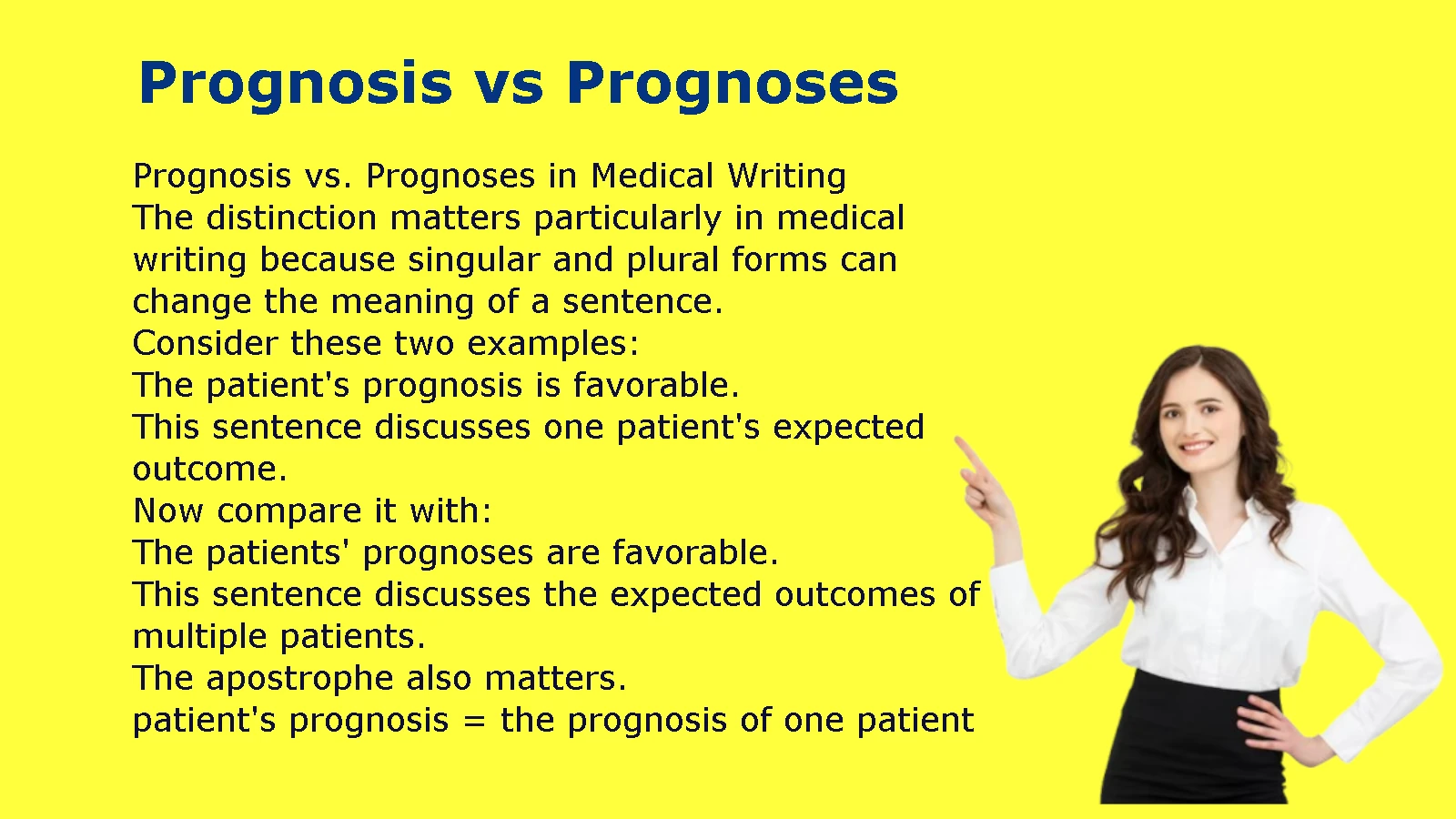
Prognosis vs. Prognoses in Medical Writing
The distinction matters particularly in medical writing because singular and plural forms can change the meaning of a sentence.
Consider these two examples:
The patient’s prognosis is favorable.
This sentence discusses one patient’s expected outcome.
Now compare it with:
The patients’ prognoses are favorable.
This sentence discusses the expected outcomes of multiple patients.
The apostrophe also matters.
- patient’s prognosis = the prognosis of one patient
- patients’ prognoses = the prognoses of multiple patients
Here’s a closer look:
| Phrase | Meaning |
| the patient’s prognosis | One patient’s expected outcome |
| the patients’ prognoses | Multiple patients’ expected outcomes |
| the patient’s prognoses | One patient has multiple forecasts or assessments |
| the patients’ prognosis | Usually awkward if referring to multiple patients because each person typically has an individual prognosis |
The last two forms aren’t automatically impossible. Context can determine their meaning. However, most everyday medical writing will use one prognosis per patient when describing an individual expected outcome.
A useful medical example
Imagine a clinical study involving three patients.
Patient A has one expected outcome.
Patient A’s prognosis is favorable.
Now consider all three patients:
The three patients have different prognoses.
The grammar follows the number of outcomes being discussed.
This distinction becomes especially useful in research papers, medical reports, case discussions, and educational material where writers frequently compare outcomes across groups.
Prognosis vs. Diagnosis
Prognosis and diagnosis often appear together in medical conversations, but they mean different things.
A diagnosis identifies or describes a disease, condition, or health problem.
A prognosis concerns the expected development or outcome of that condition.
A simple way to remember the difference is:
Diagnosis asks, “What is happening?” Prognosis asks, “What is likely to happen next?”
For example:
- Diagnosis: The patient has pneumonia.
- Prognosis: The patient is expected to recover with appropriate treatment.
The two concepts connect, but they aren’t interchangeable.
Diagnosis vs. prognosis vs. prognoses
| Term | Meaning | Example |
| Diagnosis | Identification of a disease or condition | The diagnosis was pneumonia. |
| Prognosis | One expected outcome or course | The prognosis is good. |
| Prognoses | Multiple expected outcomes or courses | The patients have different prognoses. |
This distinction helps explain why prognosis vs. prognoses is a grammar question while diagnosis vs. prognosis is primarily a meaning question.
Can Prognosis Be Used Outside Medicine?
Absolutely.
Although medical usage is common, dictionaries also recognize a broader meaning: a judgment about how something is likely to develop in the future. Oxford gives forecast as a synonym for this formal sense.
For example:
The prognosis for economic growth is positive.
Here, nobody is discussing a patient’s health. The sentence refers to the expected future of economic growth.
Other examples include:
- The prognosis for the industry remains uncertain.
- The company’s prognosis improved after the merger.
- The project’s prognosis looks promising.
- The financial prognosis remains cautious.
- The long-term prognosis for the sector is difficult to assess.
Prognosis and forecast
In many general contexts, forecast will sound more natural and less formal.
Compare:
The economic forecast is positive.
with:
The economic prognosis is positive.
Both can work, but prognosis has a more formal or specialized feel.
Cambridge also gives prognosis a general sense involving a statement about what is judged likely to happen in the future.
So, don’t assume the word belongs exclusively to hospitals and medical reports.
Prognosis vs. Prognoses vs. Prognostic
Another word that sometimes causes confusion is prognostic.
It isn’t the plural of prognosis. Instead, prognostic is a related word that functions primarily as an adjective and can describe something connected with predicting an outcome.
| Word | Function | Basic meaning |
| prognosis | Noun | An expected outcome or forecast |
| prognoses | Plural noun | Multiple expected outcomes or forecasts |
| prognostic | Usually adjective | Related to predicting an outcome |
For example:
- The prognosis is favorable.
- The patients have different prognoses.
- The researchers identified several prognostic factors.
In medical writing, you may encounter phrases such as prognostic factor, prognostic indicator, or prognostic value.
These terms relate to factors or information that can help assess an expected outcome.
Oxford lists prognostic as a related word alongside prognosis and prognostication.
Common Mistakes With Prognosis and Prognoses
The unusual spelling creates several predictable errors.
Mistake: Using “prognoses” for one outcome
Incorrect:
The patient’s prognoses is good.
Correct:
The patient’s prognosis is good.
Why? You’re talking about one expected outcome.
Mistake: Using “prognosis” after a plural determiner
Incorrect:
The doctors discussed several prognosis.
Correct:
The doctors discussed several prognoses.
Words such as several, many, and multiple require a plural noun when they’re modifying a countable noun.
Mistake: Writing “prognosises”
Incorrect:
The researchers compared several prognosises.
Correct:
The researchers compared several prognoses.
The standard plural doesn’t add -es to the entire word. It changes the ending according to the noun’s established plural form.
Mistake: Using the wrong verb
Incorrect:
The prognoses is uncertain.
Correct:
The prognoses are uncertain.
Because prognoses is plural, it takes a plural verb.
Mistake: Treating prognosis as a synonym for diagnosis
Incorrect in meaning:
The doctor gave a prognosis to identify the disease.
Better:
The doctor gave a diagnosis to identify the disease and discussed the prognosis afterward.
A diagnosis and a prognosis answer different questions.
A Practical Case Study: Choosing Prognosis or Prognoses
Consider a fictional medical research report involving five patients.
Each patient receives an individual assessment of the likely course of their condition.
For one patient, the report might say:
Patient A’s prognosis is favorable.
That’s singular because the sentence discusses one patient’s expected outcome.
Now imagine the researcher compares all five patients:
The patients had different prognoses.
That’s plural because the researcher discusses five expected outcomes.
Finally, suppose the researcher compares two possible treatment pathways rather than individual patients:
The study considered two possible prognoses under different treatment conditions.
The important point is that prognosis and prognoses don’t tell you whether an outcome is good or bad. They tell you whether you’re discussing one or multiple outcomes.
That distinction is easy to miss because people sometimes associate prognosis with a serious medical prediction. Grammatically, however, the singular/plural rule remains the same regardless of whether the outlook is positive, negative, or uncertain.
How to Choose Between Prognosis and Prognoses
When you’re unsure which word belongs in your sentence, don’t overthink it.
Ask one question:
Am I talking about one expected outcome or more than one?
If the answer is one, use prognosis.
If the answer is more than one, use prognoses.
Quick decision guide
| If you’re talking about… | Use |
| One patient’s expected outcome | prognosis |
| One disease’s expected course | prognosis |
| One economic forecast | prognosis |
| Several patients’ expected outcomes | prognoses |
| Several possible outcomes | prognoses |
| Several economic forecasts | prognoses |
| One assessment | prognosis |
| Multiple assessments | prognoses |
The substitution trick
Here’s another useful test.
Replace the word with prediction.
If the sentence means one prediction, use prognosis.
If it means several predictions, use prognoses.
For example:
The patient’s prognosis is encouraging.
Think:
The patient’s prediction is encouraging.
The wording isn’t perfectly interchangeable in every context, but the number is singular.
Now:
The patients have different prognoses.
Think:
The patients have different predictions.
Again, the number is plural.
The substitution isn’t a definition. It’s simply a quick grammar check.
Prognosis vs. Prognoses in Academic Writing
Academic and scientific writing often uses both forms because researchers compare outcomes across groups.
For example:
The study evaluated the long-term prognosis of patients receiving the intervention.
This sentence focuses on the expected outcome as a general concept or one defined assessment.
Compare:
The study compared the prognoses of patients receiving two different interventions.
Now the writer discusses multiple expected outcomes.
In research contexts, prognosis can also appear in phrases such as:
- long-term prognosis
- short-term prognosis
- overall prognosis
- poor prognosis
- favorable prognosis
- unfavorable prognosis
- prognostic factors
- prognostic indicators
- prognostic value
Plural forms can appear when comparing groups:
- different prognoses
- similar prognoses
- long-term prognoses
- individual prognoses
- competing prognoses
The distinction remains grammatical rather than conceptual.
Facts About Prognosis and Prognoses
A few facts make the difference easier to remember.
- Prognosis is a noun.
- Prognoses is the plural form of prognosis.
- The word commonly appears in medical contexts.
- Prognosis can also mean a forecast about future development.
- Prognosises is not the standard plural.
- American English pronunciation is approximately prog-NOH-sis for prognosis.
- American English pronunciation is approximately prog-NOH-seez for prognoses.
- The singular takes singular verbs: the prognosis is.
- The plural takes plural verbs: the prognoses are.
- The words have Greek roots and belong to a group of nouns with unusual plural patterns.
Prognosis vs. Prognoses: Quick Comparison
| Feature | Prognosis | Prognoses |
| Number | Singular | Plural |
| Part of speech | Noun | Noun |
| Refers to | One expected outcome or forecast | Two or more expected outcomes or forecasts |
| Common medical use | One patient’s expected course | Multiple patients’ expected courses |
| Common general use | One forecast | Multiple forecasts |
| US pronunciation | prog-NOH-sis | prog-NOH-seez |
| Example | The prognosis is good. | The prognoses are good. |
| Incorrect common plural | — | prognosises |
Frequently Asked Questions About Prognosis vs. Prognoses
Is prognoses the plural of prognosis?
Yes. Prognoses is the standard plural form of prognosis. Both Cambridge and Oxford list it as the plural.
Is prognosis singular or plural?
Prognosis is singular.
You can say:
The prognosis is favorable.
For multiple outcomes, use:
The prognoses are favorable.
What is the plural of prognosis?
The plural of prognosis is prognoses.
The spelling may look unusual, but it follows a pattern found in several Greek-derived English nouns.
Is prognosises a word?
Prognosises is not the standard plural form of prognosis.
Use prognoses instead.
One prognosis
Two prognoses
What is the difference between prognosis and prognoses?
The difference is number.
Prognosis refers to one expected outcome or forecast.
Prognoses refers to multiple expected outcomes or forecasts.
The basic meaning stays the same.
How do you pronounce prognosis?
In American English, prognosis is pronounced approximately prog-NOH-sis, with the main stress on the middle syllable. Cambridge gives the US pronunciation as /ˈprɑːɡnoʊ.sɪs/.
How do you pronounce prognoses?
In American English, prognoses is pronounced approximately prog-NOH-seez. Cambridge gives the US pronunciation as /ˈprɑːɡnoʊˌsiz/.
Can prognosis be used outside medicine?
Yes. In formal English, prognosis can describe a forecast or judgment about how something is likely to develop. For example, you can discuss the economic prognosis for a country or the financial prognosis of a company.
Is prognosis the same as diagnosis?
No.
A diagnosis identifies a disease or condition.
A prognosis describes the expected course or outcome of that condition.
What is the difference between prognosis and prediction?
A prediction is a broad statement about what someone expects to happen. A prognosis is a more specialized term for an expected outcome or course, especially in medicine. Oxford also recognizes its broader formal sense as a judgment about future development.
Can you say “good prognoses”?
Yes.
Prognoses is plural, so you can use adjectives such as good, poor, favorable, unfavorable, or uncertain with it.
For example:
The patients had good prognoses after treatment.
Can one person have multiple prognoses?
Context can make this possible, especially when discussing different scenarios, assessments, or potential outcomes. However, ordinary medical writing usually refers to a patient’s expected course as a prognosis.
For example:
The doctor discussed the patient’s prognosis.
If several possible outcomes are being evaluated, a writer might discuss multiple prognoses.
The Bottom Line: Prognosis vs. Prognoses
The difference between prognosis and prognoses comes down to one simple grammatical idea: singular versus plural.
Prognosis means one expected outcome, course, or forecast. The word appears especially often in medical contexts, where it describes the likely development of an illness or a patient’s chances of recovery. It can also refer to a formal forecast outside medicine.
Prognoses means more than one prognosis.
So when you need to choose between the two, remember:
One prognosis. Several prognoses.
The pronunciation changes, too. Prognosis ends with a “sis” sound, while prognoses ends with a “seez” sound.
Once you recognize that prognoses is simply the plural form of prognosis, the spelling becomes much less mysterious.
One final example
The patient’s prognosis is encouraging, but the doctors are comparing the prognoses of several patients in the study.
That sentence captures the entire distinction:
- patient’s prognosis → one expected outcome
- patients’ prognoses → multiple expected outcomes
That’s the whole puzzle. Prognosis is singular. Prognoses is plural.