Cost is the usual past tense and past participle of cost when talking about price or value. Costed is used in business, accounting, and project management to mean calculated or estimated the cost of something.
Examples:
- The laptop cost $900 last year.
- The team costed the new construction project before submitting the proposal.
Understanding the difference between costed and cost helps you choose the correct word
The confusion often comes from costed meaning, cost meaning, and knowing when to use the past tense of cost. Many people also search for Costed vs Cost, is costed a word, cost or costed, and how to use cost in a sentence because the answer depends on the context. And here’s the kicker: using the wrong form can make your writing sound unnatural or grammatically incorrect.
In this guide, you’ll learn the difference between Costed vs Cost, discover the correct usage of cost, understand when to use costed, and see plenty of cost examples in real sentences. You’ll also find the correct past tense of cost, learn how to use cost and costed correctly, and pick up an easy trick to remember which word fits your sentence.
The Short Answer: Costed vs Cost
If you only remember one rule, make it this one:
Use cost when you’re talking about the price of something. Use costed when you’re talking about calculating or estimating costs in a business or financial setting.
Here’s a quick comparison.
| Feature | Cost | Costed |
| Is it a real word? | ✅ Yes | ✅ Yes |
| Common in everyday English? | ✅ Very common | ❌ No |
| Used in accounting and finance? | ✅ Yes | ✅ Frequently |
| Past tense of cost (price)? | ✅ Yes | ❌ No |
| Means “estimated expenses”? | ❌ No | ✅ Yes |
| Used in business planning? | Sometimes | ✅ Yes |
Quick Examples
| Sentence | Correct? | Why |
| The repairs cost $800. | ✅ | Past tense of the verb cost. |
| The vacation cost more than expected. | ✅ | Talking about the price. |
| The accountant costed the new product. | ✅ | Calculated production costs. |
| They costed the bridge before requesting funding. | ✅ | Estimated project expenses. |
| The repairs costed $800. | ❌ | Should be cost because you’re referring to the price. |
The key difference is that cost tells you how much something was worth, while costed describes the process of working out or assigning costs.
Is It “Cost” or “Costed”?
At first glance, it seems logical to think that the past tense of cost should be costed. After all, many English verbs simply add -ed in the past tense.
For example:
- Walk → Walked
- Open → Opened
- Paint → Painted
However, English contains many irregular verbs, and cost is one of them. That means its past tense doesn’t change.
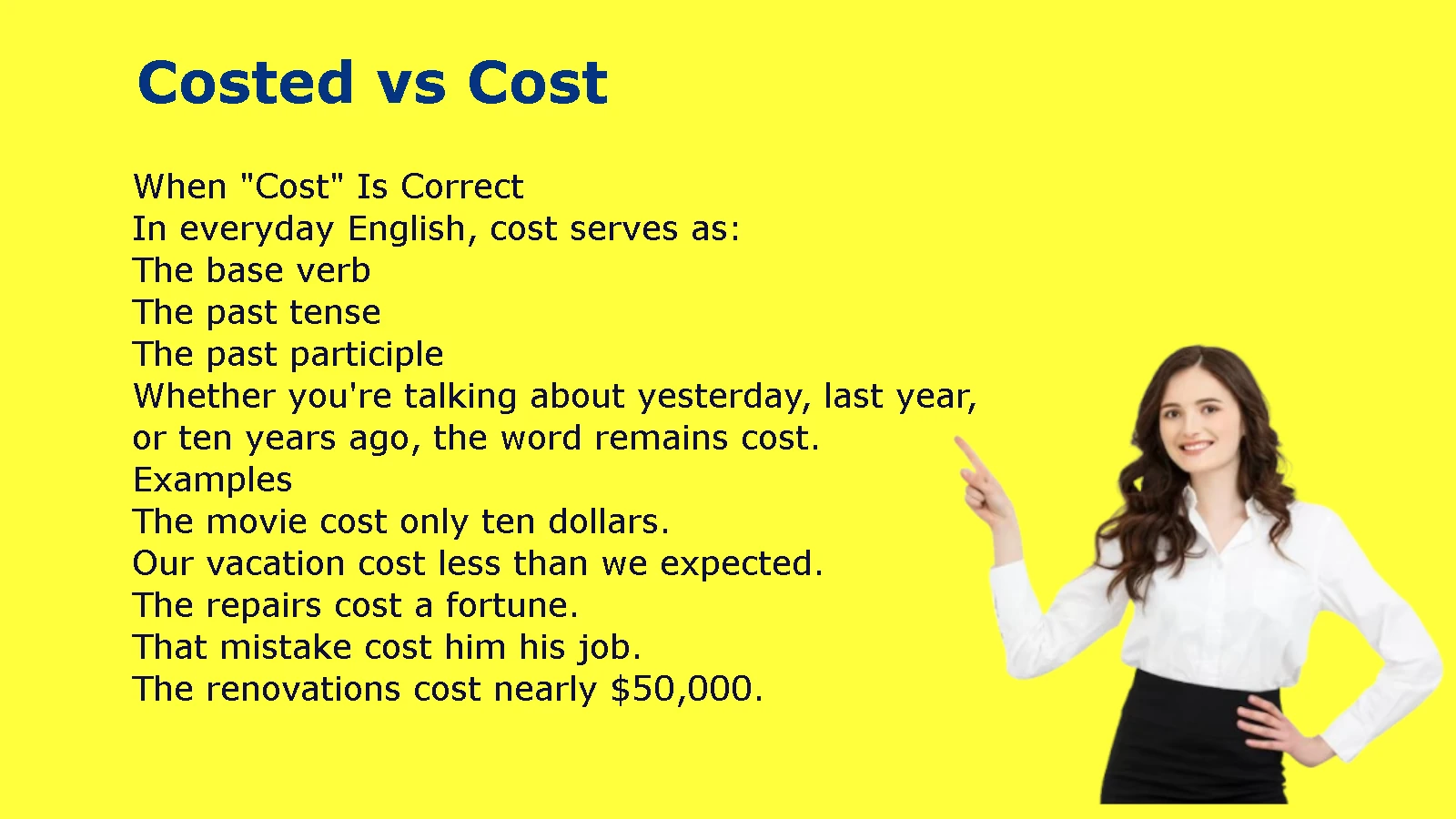
When “Cost” Is Correct
In everyday English, cost serves as:
- The base verb
- The past tense
- The past participle
Whether you’re talking about yesterday, last year, or ten years ago, the word remains cost.
Examples
- The movie cost only ten dollars.
- Our vacation cost less than we expected.
- The repairs cost a fortune.
- That mistake cost him his job.
- The renovations cost nearly $50,000.
Notice that the verb never changes, even though every sentence refers to the past.
When “Costed” Is Correct
Unlike cost, costed isn’t simply another past tense form. Instead, it has a specialized meaning.
Professionals use costed when they’ve worked out the expected expense of something.
This often involves:
- Preparing budgets
- Estimating project expenses
- Calculating manufacturing costs
- Assigning labor costs
- Pricing products
- Creating financial forecasts
Instead of describing what something cost, costed describes the act of calculating costs.
Examples
- The engineering team costed every phase of the construction project.
- We costed several production methods before making a decision.
- The consultant costed the proposal using current market rates.
- Every department costed its annual budget.
- The manufacturer costed each component individually.
Each sentence focuses on planning or estimating, not on stating a final price.
What Does “Cost” Mean?
The word cost is one of the most commonly used words in English because it functions as both a noun and a verb.
Cost as a Noun
As a noun, cost refers to the amount of money needed to buy, produce, or maintain something.
Examples include:
- The cost of living continues to rise.
- Healthcare costs vary across states.
- Fuel costs affect shipping prices.
- The total cost includes taxes.
In this form, cost simply means price or expense.
Cost as a Verb
As a verb, cost means to have a particular price or to require a sacrifice.
Examples:
- The meal cost $40.
- This software costs less than the premium version.
- Poor planning cost the company millions.
- His decision cost him valuable time.
The verb isn’t limited to money.
Sometimes it describes losing something valuable.
For example:
- That mistake cost her the championship.
- The delay cost us an important client.
- The accident cost him several weeks of recovery.
Here, cost refers to consequences rather than dollars.
Common Meanings of “Cost”
Depending on context, cost can mean:
- Purchase price
- Expense
- Financial burden
- Loss
- Sacrifice
- Consequence
- Investment
This flexibility explains why the word appears in business, education, sports, healthcare, economics, law, and everyday conversation.
Verb Forms of “Cost”
Because cost is irregular, its forms don’t follow the usual pattern.
| Verb Form | Word |
| Base Form | cost |
| Third Person Singular | costs |
| Present Participle | costing |
| Past Tense | cost |
| Past Participle | cost |
This table is worth remembering because it’s where many learners make mistakes.
Everyday Examples of “Cost”
Here are examples you’ll hear in normal conversation.
- My phone cost nearly a thousand dollars.
- The concert tickets cost less than expected.
- Dinner cost us about sixty dollars.
- Their new home cost much more than they planned.
- The repairs cost almost nothing because the warranty covered them.
- Missing the deadline cost the company an important contract.
- His honesty cost him a promotion.
- Medical treatment cost thousands of dollars.
In every example above, cost is the correct choice.
What Does “Costed” Mean?
Although many people assume costed is simply an incorrect version of cost, that’s not true.
Costed is a legitimate English word with a very specific meaning.
It usually means:
- Calculated costs
- Estimated expenses
- Assigned monetary values
- Determined production costs
- Prepared a financial estimate
Rather than describing the price something had, costed describes the work of figuring out the costs.
Why Businesses Use “Costed”
Imagine you’re building a new office.
Before construction begins, someone must calculate:
- Labor
- Materials
- Equipment
- Transportation
- Insurance
- Taxes
- Permits
- Unexpected expenses
That entire process is known as costing.
Once completed, professionals often say:
“The project has been costed.”
In other words, every expected expense has been calculated.
Industries That Commonly Use “Costed”
You’ll frequently see costed in:
- Accounting
- Manufacturing
- Construction
- Engineering
- Government
- Procurement
- Supply chain management
- Healthcare administration
- Architecture
- Event planning
- Product development
- Finance
Outside these industries, however, most people rarely use the word.
Examples of “Costed”
Here are some natural examples.
- The architect costed the renovation before meeting the client.
- Every product was carefully costed before entering production.
- The purchasing department costed several suppliers.
- We costed multiple delivery options.
- The proposal was fully costed before submission.
- The finance team costed every department’s annual spending.
- Engineers costed each design separately.
- The nonprofit costed the community program before applying for grants.
Notice that every sentence involves planning, estimating, or financial analysis.
A Simple Way to Remember the Meaning
Think of costed as a behind-the-scenes word.
Before a product reaches the store, before a bridge gets built, or before a company approves a new project, someone must calculate every expected expense.
That’s when professionals say the work has been costed.
By contrast, once the item is available and you’re simply talking about its price, you use cost.
For example:
- The smartphone cost $900.
- The company costed the smartphone before manufacturing began.
The first sentence tells you the price.
The second explains that someone calculated production expenses before the product entered the market.
Cost vs Costed: Side-by-Side Comparison
Understanding the distinction becomes much easier when you compare the two words directly.
| Feature | Cost | Costed |
| Meaning | Had a price or required a sacrifice | Calculated or estimated costs |
| Everyday English | Very common | Rare |
| Business English | Common | Common |
| Accounting | Used to discuss expenses | Used to estimate or assign expenses |
| Grammar | Base verb, past tense, past participle | Past participle/adjective of the specialized verb to cost meaning “to estimate costs” |
| Typical Audience | Everyone | Finance, accounting, engineering, project management |
| Example | The repairs cost $600. | The repairs were fully costed before approval. |
This comparison highlights why both words are correct—but only in the right context.
Why Do People Say “Costed”?
One reason people become confused is that costed looks exactly like a regular past-tense verb. That leads many learners to assume it’s simply another way of saying cost.
In reality, people use costed for two very different reasons.
They’re Thinking of Regular Grammar Rules
English contains thousands of regular verbs that form the past tense by adding -ed.
Because of that pattern, learners often write:
- The car costed $20,000.
- My shoes costed $80.
These sentences sound logical, but they’re grammatically incorrect because cost is an irregular verb.
They Work in Finance or Project Management
For accountants, engineers, procurement specialists, and project managers, costed carries a specialized meaning that has nothing to do with the ordinary past tense.
For example:
- The proposal was fully costed before approval.
- Every construction phase was carefully costed.
- We costed the expansion using current material prices.
In these contexts, costed doesn’t describe the final price. Instead, it refers to the process of calculating expected expenses.
Examples of Cost in Sentences
The easiest way to understand costed vs cost is to see both words in context. Since cost is the standard past tense of the verb when referring to price or value, you’ll hear it every day in conversations, news reports, and written English.
Here are practical examples from different situations.
Everyday Life
- The groceries cost more than they did last month.
- My new glasses cost $250.
- The concert tickets cost less than we expected.
- Their family vacation cost nearly $5,000.
- Lunch cost only fifteen dollars.
Shopping
- The laptop cost $1,300 after taxes.
- Those shoes cost twice as much as mine.
- The jacket cost less during the holiday sale.
- The designer handbag cost thousands of dollars.
- This watch cost more than my first car.
Business
- The software upgrade cost the company $50,000.
- Delays cost the project valuable time.
- The mistake cost us an important client.
- Poor planning cost millions in additional expenses.
- The legal dispute cost the business both money and reputation.
Travel
- Our flights cost less because we booked early.
- The hotel stay cost far more than expected.
- Renting a car cost another $600.
- Fuel cost almost as much as the airfare.
- The guided tour cost $120 per person.
Education
- Tuition cost more this year.
- The textbooks cost nearly $700.
- Online courses cost much less than traditional programs.
- His degree cost years of hard work and dedication.
- That certification cost both time and money.
Figurative Uses
Remember that cost doesn’t always involve money.
Examples include:
- His careless comment cost him his promotion.
- The delay cost us the championship.
- That decision cost the company its reputation.
- Ignoring the warning cost them valuable time.
- The injury cost her an entire season.
In these examples, cost refers to a loss rather than a financial expense.
Examples of Costed in Sentences
Unlike cost, costed appears mainly in professional environments where people calculate, estimate, or assign expenses before making decisions.
Here are examples from industries that commonly use the term.
Accounting
- The accountant costed every department’s annual budget.
- We costed the proposal before presenting it to management.
- The audit confirmed that every item had been properly costed.
- The finance department costed each production stage separately.
- Every service package was accurately costed.
Manufacturing
- Engineers costed every component before production began.
- The factory costed each product line individually.
- They costed alternative materials to reduce expenses.
- Every unit was carefully costed before pricing.
- The prototype was fully costed before approval.
Construction
- The contractor costed the renovation project.
- Architects costed multiple building designs.
- The bridge project was fully costed before funding was approved.
- Every construction phase was professionally costed.
- The consulting firm costed the infrastructure upgrade.
Project Management
- The team costed every milestone.
- Project managers costed labor and equipment separately.
- We costed several timelines before selecting one.
- The expansion plan was completely costed.
- Every risk scenario was costed during planning.
Procurement
- Purchasing specialists costed products from five suppliers.
- The department costed transportation separately.
- Every quotation was costed before negotiations began.
- They costed shipping and customs fees.
- Imported materials were fully costed before ordering.
These examples illustrate an important point: costed almost always appears when someone performs a financial analysis rather than simply describing a price.
Common Mistakes People Make
Many grammar mistakes happen because people assume every verb forms its past tense by adding -ed. That isn’t true for cost, which is an irregular verb.
Let’s look at some of the most common errors.
| Incorrect | Correct | Why |
| The repairs costed $800. | The repairs cost $800. | Talking about the price. |
| My vacation costed too much. | My vacation cost too much. | Use cost for the past tense. |
| The phone costed $900. | The phone cost $900. | Refers to purchase price. |
| Dinner costed fifty dollars. | Dinner cost fifty dollars. | Past tense remains cost. |
| The proposal was cost before submission. | The proposal was costed before submission. | Refers to calculating costs. |
Mistake 1: Adding “-ed” Automatically
Many learners write:
❌ The computer costed $1,200.
The correct sentence is:
✅ The computer cost $1,200.
Mistake 2: Avoiding “Costed” Completely
Some writers believe costed is always wrong.
That’s also incorrect.
For example:
✅ The engineering team costed the entire project before requesting funding.
Here, costed is the correct business term because the team estimated expenses.
Mistake 3: Confusing Price With Estimation
Compare these two sentences carefully.
- The kitchen remodel cost $30,000.
- The contractor costed the remodel before construction began.
The first sentence gives the final price.
The second describes the planning process.
Mistake 4: Misusing “Costed” in Everyday Conversation
You’ll rarely hear native speakers say:
❌ My coffee costed five dollars.
Instead, they’ll naturally say:
✅ My coffee cost five dollars.
The specialized meaning of costed makes it sound awkward in casual conversation.
Why Costed Sounds Wrong in Everyday English
If costed is a real word, why does it sound strange outside the workplace?
The answer lies in how English developed over time.
Many common verbs are irregular. Instead of following the usual -ed pattern, they keep the same spelling in different tenses.
Examples include:
| Base Verb | Past Tense | Past Participle |
| Cut | Cut | Cut |
| Hit | Hit | Hit |
| Put | Put | Put |
| Let | Let | Let |
| Cost | Cost | Cost |
Native speakers learn these patterns from an early age, so phrases like:
- It cost too much.
- The repairs cost thousands.
sound perfectly natural.
By contrast, adding -ed to these verbs feels unnatural unless the word has developed a separate meaning, as costed has in business English.
Everyday English Favors Simplicity
General English prefers short, familiar verb forms.
That’s why you’ll hear:
- The repairs cost a fortune.
- The trip cost less than expected.
- That mistake cost him everything.
You’ll almost never hear:
- The repairs costed a fortune.
because it doesn’t match standard grammar.
Business English Uses More Specialized Vocabulary
Professional industries often create technical meanings for existing words.
Consider these examples:
- Budgeted
- Forecasted
- Allocated
- Estimated
- Costed
Each describes a planning activity rather than an outcome.
That’s why costed feels perfectly normal in finance, accounting, procurement, engineering, and project management.
The Grammar Rule Behind Cost
Understanding one simple grammar rule will eliminate most confusion.
Cost Is an Irregular Verb
Unlike regular verbs, irregular verbs don’t simply add -ed in the past tense.
Instead, they keep the same form or change in unique ways.
Examples include:
| Base | Past | Past Participle |
| Cut | Cut | Cut |
| Read | Read | Read |
| Put | Put | Put |
| Hit | Hit | Hit |
| Cost | Cost | Cost |
Because cost belongs to this group, you should write:
- It cost $500.
- The repairs cost thousands.
- The damage cost us valuable time.
Verb Forms of Cost
Here’s the complete conjugation.
| Verb Form | Example |
| Base Form | cost |
| Third-Person Singular | costs |
| Present Participle | costing |
| Past Tense | cost |
| Past Participle | cost |
Examples:
- It costs too much.
- They are costing the new project.
- The repairs cost $900.
- It has cost us a great deal.
Notice that costed doesn’t appear as the standard past tense.
Where Does “Costed” Fit?
The confusion comes from the fact that English also recognizes another verb:
to cost = to calculate or estimate costs
When used in that specialized sense, the past form becomes costed.
Examples:
- We costed the proposal yesterday.
- Every department costed its operating budget.
- The consultant costed several alternatives.
This meaning is separate from the irregular verb meaning “to have a price.”
Costed in Accounting and Project Management
This is where costed truly belongs.
Professionals use the word every day because organizations can’t approve projects without understanding their financial impact.
Before construction begins, before products reach store shelves, and before companies hire new employees, someone usually prepares a detailed cost analysis.
That process often leads to statements such as:
The project has been fully costed.
In other words, every expected expense has been identified and calculated.
What Does Costing Include?
Depending on the industry, costing may involve calculating:
- Labor
- Raw materials
- Equipment
- Utilities
- Transportation
- Taxes
- Insurance
- Packaging
- Marketing
- Maintenance
- Overhead
- Contingency funds
Without accurate costing, businesses struggle to estimate profits, control spending, or make informed decisions.
Case Study: Launching a New Coffee Shop
Imagine a company wants to open a neighborhood coffee shop.
Before signing a lease, the finance team creates a detailed cost estimate.
| Expense Category | Estimated Cost |
| Lease deposit | $12,000 |
| Renovations | $45,000 |
| Coffee equipment | $38,000 |
| Furniture | $20,000 |
| Initial inventory | $10,000 |
| Marketing | $8,000 |
| Licenses and permits | $4,000 |
| Working capital | $30,000 |
After reviewing every expense, the project manager reports:
“The coffee shop has been fully costed, and the projected startup investment is $167,000.”
Notice the wording. The manager doesn’t say the coffee shop cost $167,000 because the business hasn’t opened yet. Instead, the team has costed the project by estimating and assigning expected expenses.
Why Accurate Costing Matters
Organizations rely on accurate costing to:
- Set competitive prices.
- Estimate profits before launching a product.
- Control operating expenses.
- Compare different project options.
- Prepare realistic budgets.
- Secure investor or lender approval.
- Reduce financial risk.
- Improve long-term planning.
As management expert Peter Drucker famously said:
“What gets measured gets managed.”
That idea applies directly to costing. When businesses measure expenses carefully, they make better financial decisions and avoid costly surprises.
Cost vs Costed in British and American English
Both American English and British English recognize cost and costed, but they don’t use them with the same frequency.
Everyday Usage
In both varieties of English, cost is the standard choice when referring to price.
Examples:
- The tickets cost $120.
- The repairs cost more than expected.
- The new software cost thousands to develop.
You’ll find this usage in newspapers, books, academic writing, and everyday conversations on both sides of the Atlantic.
Professional Usage
The term costed appears more often in professional writing than in casual speech. It’s especially common in:
- Accounting
- Government reports
- Construction
- Manufacturing
- Procurement
- Project management
- Public-sector budgeting
British English tends to use expressions such as fully costed proposal, costed plan, or costed strategy slightly more often, particularly in government and organizational documents. American English also uses these terms, though writers may alternatively choose phrases like estimated, budgeted, or priced, depending on the context.
The important point remains the same in both dialects:
- Cost describes what something was worth.
- Costed describes the process of calculating or assigning costs.
Neither variety of English uses costed as the ordinary past tense of the verb meaning “to have a price.”
Synonyms and Related Terms
While cost and costed have distinct meanings, several related words may fit better depending on the context. Choosing the right synonym helps you write more naturally and avoid repetition.
Alternatives to Cost
When you’re referring to the price, value, or expense of something, consider these alternatives.
| Word | Best Used For | Example |
| Price | Selling or purchase amount | The price of the laptop dropped by $200. |
| Expense | Business or personal spending | Travel expenses increased this quarter. |
| Charge | Fees for a service | The repair shop added a labor charge. |
| Fee | Payments for professional services | The attorney charged a consultation fee. |
| Rate | Standard pricing | The hourly rate is $75. |
| Value | Worth of an item | The property’s value has increased. |
| Outlay | Formal financial spending | The initial outlay was substantial. |
| Expenditure | Business or government spending | Capital expenditure rose this year. |
Alternatives to Costed
In business writing, costed isn’t always the best choice. Depending on your meaning, you might use one of these words instead.
| Word | Meaning | Example |
| Estimated | Calculated an approximate amount | The consultant estimated the project at $250,000. |
| Budgeted | Planned future spending | The company budgeted $1 million for expansion. |
| Calculated | Worked out a precise amount | The engineer calculated the material costs. |
| Priced | Assigned a selling price | The retailer priced the new collection competitively. |
| Evaluated | Assessed financially | Management evaluated every proposal carefully. |
| Assessed | Determined value or expense | The insurance company assessed the damages. |
| Itemized | Listed individual costs | The invoice itemized every expense. |
Which Word Should You Choose?
Use this quick guide:
- Choose cost when discussing the actual price.
- Choose costed when discussing calculating projected expenses.
- Choose estimated when the figures are approximate.
- Choose budgeted when planning future spending.
- Choose priced when setting a selling price.
The subtle differences matter, especially in professional writing.
Quick Memory Trick for Costed vs Cost
If you struggle to remember which word to use, this simple trick can help.
Think of it this way:
- Cost = The answer.
- Costed = The calculation.
Here’s another way to remember it:
Imagine you’re building a house.
Before construction starts, an estimator prepares a budget. The house has been costed.
Once the house is complete and sold, you can say:
The house cost $450,000.
The first sentence describes the planning process.
The second describes the final price.
That simple distinction solves nearly every costed vs cost question.
Real-World Case Study: Why Both Words Matter
Consider a software company developing a new mobile app.
Before writing a single line of code, the project manager estimates every expense.
Planning Stage
The finance team calculates:
- Developer salaries
- Software licenses
- Cloud hosting
- Testing costs
- Marketing budget
- Customer support
- Legal fees
After completing the financial analysis, the report states:
“The project has been fully costed at an estimated budget of $850,000.”
Notice that costed doesn’t describe the final expense. It describes the budgeting process.
After the Project Ends
Eighteen months later, the company reviews its financial records.
Now they write:
“The app cost $910,000 to develop.”
This sentence reports the actual amount spent.
The two words work together, but they describe different stages of the same project.
Costed vs Cost: Common Scenarios
The following examples show which word fits different situations.
| Situation | Correct Word | Example |
| Buying groceries | Cost | The groceries cost $95. |
| Buying a car | Cost | The SUV cost $42,000. |
| Estimating a construction project | Costed | Engineers costed the entire project. |
| Creating a company budget | Costed | Finance staff costed next year’s operations. |
| Discussing a vacation expense | Cost | The trip cost more than expected. |
| Preparing a manufacturing proposal | Costed | The proposal was fully costed before approval. |
| Talking about restaurant prices | Cost | Dinner cost $85. |
| Preparing a government funding request | Costed | Officials submitted a fully costed plan. |
Costed vs Cost at a Glance
Here’s a quick summary of everything covered in this guide.
| Question | Answer |
| Is cost a real word? | Yes. |
| Is costed a real word? | Yes. |
| Is costed the normal past tense of cost? | No. |
| When should I use cost? | When talking about the actual price or value of something. |
| When should I use costed? | When calculating, estimating, or assigning costs in business or finance. |
| Is costed common in everyday conversation? | No. |
| Is costed common in accounting? | Yes. |
Frequently Asked Questions
Is costed a real word?
Yes. Costed is a legitimate English word. However, it has a specialized meaning. It refers to calculating, estimating, or assigning costs, especially in accounting, manufacturing, engineering, procurement, and project management.
Why isn’t the past tense of cost “costed”?
The verb cost is irregular. Like cut, put, and hit, it keeps the same form in the past tense.
Correct:
- The repairs cost $900.
Incorrect:
- The repairs costed $900.
Can you say, “The project costed $10,000”?
Not if you’re referring to the final price.
Correct:
- The project cost $10,000.
However, if you mean someone estimated the expenses before work began, you could say:
- The project was costed before construction started.
The meaning changes depending on the context.
What does costed mean in accounting?
In accounting, costed means that someone has calculated or assigned the expected or actual costs of a product, service, project, or department.
Examples include:
- Costed production plans
- Costed budgets
- Costed proposals
- Costed projects
Is costed correct in business English?
Yes.
Many professionals regularly use costed in industries such as:
- Finance
- Accounting
- Manufacturing
- Construction
- Engineering
- Government
- Supply chain management
It is standard terminology in these fields.
Is costed used in American English?
Yes.
Although it appears less often in everyday conversation, American businesses, consultants, accountants, and project managers frequently use costed in reports, budgets, and proposals.
Is costed used in British English?
Yes.
British English also recognizes costed, and you’ll often find phrases such as:
- Fully costed proposal
- Costed business plan
- Costed government initiative
These expressions are especially common in public-sector and corporate documents.
What is the difference between costing and costed?
Costing usually refers to the ongoing process of calculating costs.
Example:
- The team is costing the new product.
Costed refers to a completed action.
Example:
- The product has been costed.
Is “fully costed” a correct expression?
Yes.
A fully costed proposal means every expected expense has been identified and calculated before approval.
You’ll commonly see this phrase in:
- Government reports
- Business proposals
- Grant applications
- Construction projects
- Financial planning documents
Final Verdict: Costed vs Cost
Understanding costed vs cost is much easier once you recognize that the two words serve different purposes.
Use cost when discussing the actual price, expense, or loss associated with something. Since cost is an irregular verb, its past tense and past participle remain cost, not costed.
Examples:
- The renovation cost $75,000.
- The delay cost us valuable time.
- Their vacation cost less than expected.
Use costed when referring to the process of calculating, estimating, or assigning costs. This specialized term belongs mainly to accounting, finance, engineering, manufacturing, procurement, and project management.
Examples:
- The finance department costed the expansion project.
- Every proposal was fully costed before approval.
- Engineers costed several design options.
In short:
- Cost tells you what something actually cost.
- Costed tells you that someone calculated the expected or assigned costs.
Once you understand that distinction, choosing the correct word becomes straightforward.
“Cost” reports the price. “Costed” reports the calculation.
Keep that rule in mind, and you’ll avoid one of the most common grammar mistakes surrounding these two words.
Conclusion
The confusion over costed vs cost comes from the fact that both words are correct—but they belong in different contexts. In everyday English, cost is the standard choice because it functions as the base form, past tense, and past participle of the irregular verb cost. Whether you’re talking about the price of a meal, a new car, or the consequences of a decision, cost is almost always the right word.
Costed, on the other hand, has a specialized role. It appears in business, accounting, engineering, and project management to describe the act of calculating or assigning costs before work begins or during financial planning. That’s why phrases like fully costed proposal or costed project plan are perfectly correct in professional settings, even though they would sound unusual in everyday conversation.
Whenever you’re unsure, ask yourself one simple question:
- Am I stating the actual price? Use cost.
- Am I describing the process of estimating or assigning expenses? Use costed.
By applying this rule consistently, you’ll write with greater accuracy and confidence in both casual and professional contexts. Whether you’re preparing a report, writing an email, or improving your grammar, knowing the difference between cost and costed will help you communicate more clearly and avoid a common English mistake.