Aging and ageing are both correct spellings of the same word, but their usage depends on regional English. Aging is the preferred spelling in American English, while ageing is commonly used in British, Australian, and other forms of English. When comparing Aging vs. Ageing, the correct choice depends on the style of English you are using.
The confusion comes from regional spelling differences and English language conventions, making it difficult to know which form to use in blogs, academic writing, business documents, or everyday communication. But here’s the kicker: using the preferred spelling for your audience can make your writing look more natural and professional.
The good news? The rule is easier than you might think.
In this guide, you’ll learn the difference between Aging vs Ageing, discover the correct spelling for American English and British English, and understand when to use aging or ageing in different types of writing. You’ll also find aging vs ageing examples, how to pronounce aging and ageing, and simple tips to help you choose the right spelling with confidence.
By the end, you’ll know exactly which version fits your audience and how to avoid one of the most common spelling variations in English.
Aging vs Ageing: Quick Comparison
| Feature | Aging | Ageing |
| Meaning | The process of growing older | The process of growing older |
| Pronunciation | Same | Same |
| English variety | American English | British English |
| Correct spelling | Yes | Yes |
| Used in the United States | Yes | Rare |
| Used in the United Kingdom | Occasionally | Yes |
| Used in Australia and New Zealand | Less common | Yes |
| Used in international journals | Sometimes | Sometimes, depending on editorial style |
Quick takeaway: The difference is regional spelling, not meaning or pronunciation.
What Does Aging Mean?
The word aging refers to the natural process of becoming older over time. It can describe changes in people, animals, plants, buildings, products, and even entire populations.
The word comes from the verb age, which means to grow older or mature.
In American English, the final silent e is usually dropped before adding -ing, resulting in aging.
Dictionary Definition
Most American dictionaries define aging as:
The process of growing old or showing the effects of increasing age.
The definition applies to physical, biological, emotional, and social changes that occur over time.
Common Uses of Aging
One reason this word appears so often is that it applies to many fields beyond healthcare.
Aging in Human Health
Doctors and researchers use aging to describe biological changes that happen throughout life.
Examples include:
- Skin aging
- Brain aging
- Healthy aging
- Cognitive aging
- Cellular aging
- Muscle aging
Example:
Regular exercise can slow many effects of healthy aging.
Aging in Population Studies
Governments frequently discuss an aging population when the average age of citizens increases because people live longer and birth rates decline.
Population aging can affect:
- Healthcare systems
- Retirement planning
- Labor markets
- Housing
- Pension programs
For example, countries like Japan, Italy, and Germany have experienced significant population aging over the past few decades.
Aging in Food Production
Some foods improve with time under carefully controlled conditions.
Examples include:
- Cheese
- Beef
- Wine
- Whiskey
- Balsamic vinegar
Example:
Dry aging beef concentrates its flavor by allowing moisture to evaporate naturally.
Here, aging refers to a controlled maturation process rather than simply getting older.
Aging in Infrastructure
Civil engineers often discuss aging infrastructure.
This phrase describes:
- Bridges
- Roads
- Water systems
- Electrical grids
- Railways
As structures become older, maintenance becomes increasingly important to maintain safety and reliability.
Aging in Technology
Technology ages much faster than people.
You might hear phrases such as:
- Aging software
- Aging hardware
- Aging servers
- Aging equipment
These expressions describe products approaching the end of their useful life because newer alternatives have become available.
Example Sentences Using Aging
Here are examples from everyday English.
Daily Conversation
- My grandparents are aging gracefully.
- Regular walking supports healthy aging.
- The city plans to replace its aging bridges.
Professional Writing
- Researchers continue studying the biological mechanisms of aging.
- Healthcare costs often rise in aging populations.
- The company replaced its aging computer systems.
Business Context
- Aging equipment reduced manufacturing efficiency.
- The organization invested in modernizing aging infrastructure.
What Does Ageing Mean?
The word ageing carries exactly the same meaning as aging.
The only difference is that ageing follows British English spelling conventions.
If you’re writing for readers in the United Kingdom, Ireland, Australia, New Zealand, or many Commonwealth countries, ageing is generally the preferred spelling.
Definition of Ageing
British dictionaries define ageing in much the same way:
The process of becoming older or showing the effects of age.
Whether discussing biology, medicine, engineering, or society, the meaning remains unchanged.
Common Uses of Ageing
British publications commonly use ageing in the following contexts.
Healthcare
Examples include:
- Healthy ageing
- Ageing brain
- Ageing skin
- Ageing muscles
Medical organizations across the UK routinely use these expressions.
Government Reports
Government agencies often publish reports discussing:
- Ageing societies
- Ageing workforce
- Ageing infrastructure
- Population ageing
These reports examine how demographic changes influence public services and economic planning.
Scientific Research
Many British universities publish studies using ageing, especially in fields such as:
- Biology
- Medicine
- Neuroscience
- Gerontology
- Public health
The spelling reflects the institution’s editorial style rather than a difference in scientific meaning.
Media
British newspapers frequently use headlines like:
- Ageing population puts pressure on healthcare
- Healthy ageing improves quality of life
- Scientists study healthy ageing
Readers expect this spelling throughout UK publications.
Example Sentences Using Ageing
Here are several natural examples.
Everyday English
- Healthy eating supports graceful ageing.
- The ageing building needs repairs.
- She researches healthy ageing at a university.
Academic Writing
- The report examines population ageing across Europe.
- Scientists continue investigating the biology of ageing.
Professional Communication
- The charity supports people facing challenges associated with ageing.
- The council announced funding for ageing infrastructure improvements.
Aging vs Ageing: What’s the Actual Difference?
This question has one surprisingly simple answer.
There is no difference in meaning.
There is no difference in pronunciation.
The only distinction is which variety of English you’re using.
Side-by-Side Comparison
| Feature | Aging | Ageing |
| Meaning | Same | Same |
| Pronunciation | Same | Same |
| Grammar | Same | Same |
| Verb form | Same | Same |
| Preferred region | United States | United Kingdom and Commonwealth countries |
Why Do the Spellings Differ?
English has evolved differently in various parts of the world.
Over time, American English simplified many spellings, while British English preserved older forms in several cases.
That doesn’t make one version more correct than the other.
Instead, each spelling follows the conventions established within its own variety of English.
This pattern appears in many familiar word pairs.
| American English | British English |
| Color | Colour |
| Favorite | Favourite |
| Honor | Honour |
| Traveling | Travelling |
| Aging | Ageing |
As you can see, aging vs ageing follows the same regional pattern found throughout English spelling.
Why Does American English Use Aging Instead of Ageing?
The answer comes from American spelling conventions rather than pronunciation.
In American English, many verbs ending in a silent e drop that e before adding -ing.
For example:
| Base Verb | American Form |
| Age | Aging |
| Make | Making |
| Bake | Baking |
| Chase | Chasing |
| Smile | Smiling |
Most of the time, the final silent e disappears because it is no longer needed for pronunciation.
However, English isn’t perfectly consistent. Some words keep the e to avoid confusion or maintain pronunciation, which explains why learners sometimes find spelling rules frustrating.
Why Does British English Prefer Ageing?
British English treats age as a traditional exception.
Instead of dropping the final e, British editors generally keep it when adding -ing, producing ageing.
This choice reflects long-standing editorial practice rather than a different grammatical rule.
Many respected British dictionaries, publishers, universities, and newspapers continue using ageing because it aligns with their house style.
Is Ageing Wrong in American English?
No. Ageing isn’t technically wrong in American English. However, it isn’t the spelling most American readers expect to see.
If you’re writing for a US audience, publishers, editors, and style guides almost always prefer aging. Using ageing may make readers assume the content was written for a British audience or that the spelling is inconsistent with American English.
When You Might Still See Ageing in the US
Although uncommon, ageing appears in certain situations:
- Articles written by British authors
- International research collaborations
- Publications that follow British editorial standards
- Quotations from UK sources
- Global organizations that use British English across all communications
For example, a medical journal based in London may publish research that American scientists frequently cite without changing the spelling.
Should You Change It?
That depends on your audience.
Use this simple rule:
| Your Audience | Recommended Spelling |
| United States | Aging |
| United Kingdom | Ageing |
| Australia | Ageing |
| New Zealand | Ageing |
| International audience | Follow your chosen style guide consistently |
If you’re writing for an American company, website, or school, aging is the safer choice.
Is Aging Wrong in British English?
No. British readers understand aging without any difficulty because the meaning is identical.
However, British editors typically replace it with ageing to match local spelling conventions.
Think of it the same way as color and colour. Both communicate the same idea, but one fits American English while the other matches British English.
When You May See Aging in the UK
British readers sometimes encounter aging in:
- American books
- US news websites
- International business reports
- Scientific collaborations
- American software and user interfaces
In those cases, the spelling usually remains unchanged because it reflects the original publication.
Why Consistency Matters
Switching between aging and ageing in the same article can confuse readers and make your work look less professional.
Instead:
- Choose one spelling.
- Follow the same style throughout the document.
- Match the expectations of your target audience.
That simple habit improves readability and builds trust with readers.
Which Spelling Do Major Dictionaries Use?
Leading dictionaries recognize both spellings, but they recommend different versions based on the variety of English.
American Dictionaries
American dictionaries overwhelmingly list aging as the standard spelling.
Examples include:
| Dictionary | Preferred Spelling |
| Merriam-Webster | Aging |
| American Heritage Dictionary | Aging |
| Dictionary.com | Aging |
These references treat aging as the standard form for American English.
British Dictionaries
British dictionaries generally prefer ageing.
Examples include:
| Dictionary | Preferred Spelling |
| Oxford English Dictionary | Ageing |
| Cambridge Dictionary (UK) | Ageing |
| Collins Dictionary | Ageing |
Although these dictionaries recognize the American spelling, they recommend ageing for British usage.
What All Dictionaries Agree On
Despite the spelling difference, dictionaries agree on several important facts:
- Both words are correct.
- Both have the same meaning.
- Both are pronounced the same way.
- Neither spelling is more formal.
- The choice depends entirely on regional English.
That’s why spelling matters more for style than for grammar.
Style Guide Recommendations
Professional writers don’t rely only on dictionaries. They also follow style guides that establish consistent spelling rules.
Here are the recommendations from several widely used guides.
AP Style
The Associated Press (AP) Stylebook is widely used in American journalism.
Recommendation:
- Use aging.
You’ll see this spelling in most US newspapers and news websites.
Examples include:
- Aging population
- Aging infrastructure
- Healthy aging
Chicago Manual of Style
The Chicago Manual of Style, one of the most respected guides for books and academic publishing in the United States, also favors aging when writing in American English.
Publishers using Chicago style rarely use ageing unless quoting a British source.
Oxford Style
Oxford’s editorial guidance reflects British English.
Preferred spelling:
- Ageing
This spelling appears consistently across Oxford publications, educational materials, and many UK organizations.
House Style Matters
Many organizations create their own editorial standards.
For example:
- A US hospital may require aging in every publication.
- A British university may require ageing across all research papers.
Before publishing, always check the organization’s style guide if one exists.
Aging vs Ageing in Google Search and SEO
Many writers wonder whether choosing aging or ageing affects search rankings.
The answer is more nuanced than a simple yes or no.
Which Keyword Gets More Searches?
Search volume varies by country.
Generally:
- Aging receives significantly more searches in the United States.
- Ageing performs better in the United Kingdom and several Commonwealth countries.
Search engines understand that the two spellings represent the same concept. However, they also recognize regional language preferences.
That means users in different countries often receive results matching their local spelling.
Which Version Should You Target?
The answer depends on your audience.
| Target Audience | Best Keyword |
| United States | Aging |
| United Kingdom | Ageing |
| Australia | Ageing |
| Canada | Depends on publication style |
| Global audience | Choose one and remain consistent |
If your website primarily serves American readers, optimize around aging.
If most visitors come from the UK, ageing is usually the better option.
Can You Mention Both Spellings?
Yes.
Many SEO articles naturally mention both spellings early in the article.
For example:
Aging (American English) and ageing (British English) refer to the same process of growing older.
This approach helps readers from different regions understand the topic without stuffing keywords unnaturally.
Best Practices
When writing about aging vs ageing, follow these guidelines:
Examples:
- Healthy aging
- Healthy ageing
- Aging process
- Population aging
- Population ageing
- Aging skin
- Aging population
- Ageing society
Natural language helps both readers and search engines.
Aging vs Ageing in Different Contexts
The meaning stays the same across industries, but the preferred spelling changes based on location and editorial style.
Medical Writing
Medicine is one of the most common fields where you’ll encounter these words.
Common phrases include:
- Healthy aging
- Healthy ageing
- Aging research
- Ageing research
- Biological aging
- Biological ageing
American medical organizations almost always write aging, while British healthcare institutions generally prefer ageing.
Example
American publication:
Healthy aging depends on regular physical activity, balanced nutrition, and preventive healthcare.
British publication:
Healthy ageing involves maintaining physical, mental, and social wellbeing throughout later life.
Both sentences communicate exactly the same idea.
Scientific Research
Scientific journals often establish their own spelling rules.
An American journal usually edits manuscripts to aging.
A British journal often changes the same manuscript to ageing before publication.
The scientific findings remain identical regardless of spelling.
Case Study: International Research Collaboration
Imagine researchers from the United States, Canada, and the United Kingdom co-author a paper on memory decline in older adults.
During editing:
- The US journal publishes the paper using aging throughout.
- A UK journal publishing the same research changes every instance to ageing.
Nothing about the research changes. Only the editorial style differs.
This example shows why spelling reflects audience expectations rather than scientific accuracy.
Healthcare
Healthcare providers frequently discuss aging in relation to prevention, treatment, and quality of life.
Common healthcare topics include:
- Healthy aging programs
- Aging-related diseases
- Aging adults
- Successful aging
- Active aging
Healthcare professionals increasingly emphasize healthy aging, encouraging people to remain physically active, socially connected, and mentally engaged as they grow older.
Government Publications
Governments often analyze demographic trends involving older populations.
Common topics include:
- Aging population
- Population aging
- Retirement planning
- Elder care
- Healthcare spending
- Workforce participation
As life expectancy rises in many countries, governments continue developing policies that address the economic and social effects of an aging population.
Academic Writing
Universities usually expect students to follow one recognized style guide throughout an assignment.
For example:
- A student using APA style in the United States should write aging.
- A student writing for a British university should generally use ageing.
Common Expressions Using Aging or Ageing
Both spellings appear in hundreds of everyday and professional expressions. The only difference is whether the writer uses American or British English.
Here’s how the most common phrases compare.
| American English | British English | Meaning |
| Aging population | Ageing population | A society with an increasing average age |
| Healthy aging | Healthy ageing | Maintaining health while growing older |
| Aging process | Ageing process | Natural biological changes over time |
| Aging skin | Ageing skin | Skin changes associated with age |
| Aging brain | Ageing brain | Brain changes that occur over time |
| Aging workforce | Ageing workforce | An increasing proportion of older workers |
| Aging infrastructure | Ageing infrastructure | Older public facilities requiring maintenance |
| Active aging | Active ageing | Encouraging health and independence later in life |
Notice that only the spelling changes. The meaning stays exactly the same.
Healthy Aging
One of the most widely used expressions is healthy aging.
The phrase describes maintaining physical, mental, and social well-being as people grow older.
Healthy aging often includes:
- Regular physical activity
- Nutritious eating habits
- Preventive healthcare
- Strong social connections
- Lifelong learning
- Adequate sleep
- Stress management
Modern healthcare focuses on helping people remain independent and active rather than simply living longer.
Aging Population
An aging population occurs when the proportion of older adults increases within a country.
This usually happens because:
- People live longer.
- Birth rates decline.
- Healthcare improves.
- Infant mortality decreases.
Population aging creates both opportunities and challenges.
Potential Benefits
- Experienced workforce
- Greater volunteer participation
- Increased demand for innovation in healthcare
- Growth of the senior economy
Challenges
- Higher healthcare costs
- Greater demand for long-term care
- Pension funding pressures
- Labor shortages in some industries
Many governments now include population aging in long-term economic planning.
Aging Gracefully
The expression aging gracefully means accepting the natural process of getting older while maintaining confidence, health, and quality of life.
People often associate graceful aging with:
- Staying physically active
- Keeping a positive mindset
- Building meaningful relationships
- Continuing hobbies and learning
- Prioritizing overall wellness
Today, many experts prefer focusing on healthy aging rather than trying to “fight aging,” emphasizing well-being instead of unrealistic expectations.
Aging Infrastructure
You’ll frequently hear politicians, engineers, and journalists discuss aging infrastructure.
This includes:
- Roads
- Bridges
- Railways
- Airports
- Water systems
- Power grids
- Public buildings
As infrastructure grows older, governments must invest in maintenance, upgrades, and modernization to ensure safety and reliability.
Common Mistakes to Avoid
Even though aging and ageing are straightforward once you understand regional spelling, writers still make several common mistakes.
Avoiding these errors will make your writing more professional and easier to read.
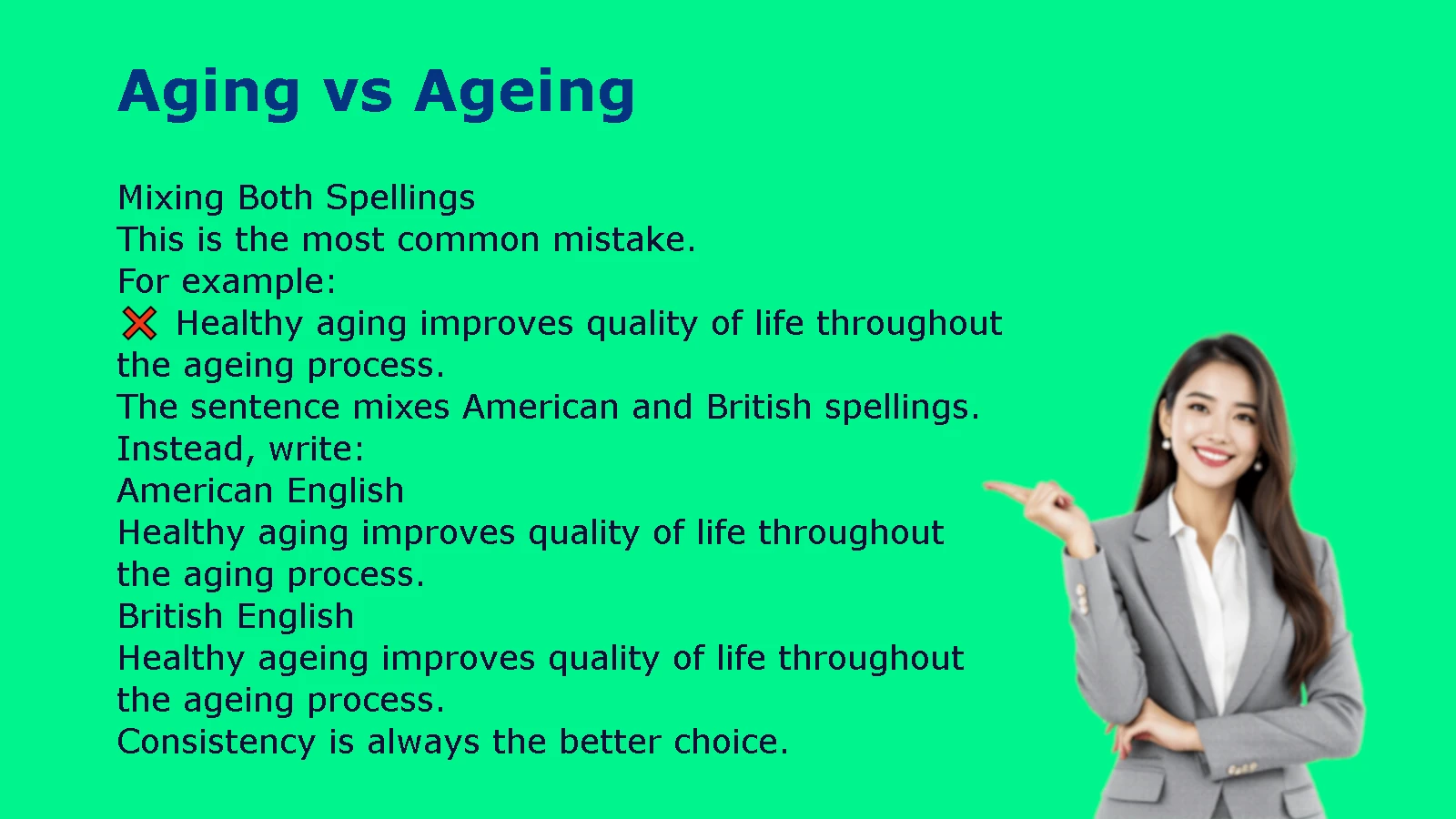
Mixing Both Spellings
This is the most common mistake.
For example:
❌ Healthy aging improves quality of life throughout the ageing process.
The sentence mixes American and British spellings.
Instead, write:
American English
Healthy aging improves quality of life throughout the aging process.
British English
Healthy ageing improves quality of life throughout the ageing process.
Consistency is always the better choice.
Assuming One Spelling Is Incorrect
Some writers believe aging is right and ageing is wrong.
Others believe exactly the opposite.
Neither assumption is correct.
Both spellings are accepted by major dictionaries.
The correct choice depends entirely on the variety of English you’re using.
Ignoring Your Audience
Suppose you’re writing for an American healthcare website.
Using ageing throughout the article may seem unusual to readers.
Likewise, publishing aging in a British newspaper may appear inconsistent with local editorial standards.
Before writing, ask yourself:
- Who will read this article?
- Which variety of English do they expect?
Answering those two questions usually determines the correct spelling.
Forgetting to Follow the Style Guide
Many schools, publishers, businesses, and organizations have established editorial standards.
If their style guide specifies American English, use aging consistently.
If it specifies British English, use ageing throughout.
Following the required style is more important than personal preference.
Similar American vs British Spelling Differences
The difference between aging and ageing is only one example of regional spelling variation.
Here are several other common word pairs.
| American English | British English |
| Aging | Ageing |
| Color | Colour |
| Favorite | Favourite |
| Honor | Honour |
| Labor | Labour |
| Center | Centre |
| Theater | Theatre |
| Organize | Organise |
| Realize | Realise |
| Analyze | Analyse |
| Traveling | Travelling |
| Canceled | Cancelled |
| Labeled | Labelled |
| Jewelry | Jewellery |
| Defense | Defence |
| License (noun) | Licence (noun) |
These differences developed over centuries as American and British English evolved independently. Neither version is inherently better; they simply follow different conventions.
Case Study: Choosing the Right Spelling for Your Website
Imagine two health blogs publishing an article about staying healthy as people grow older.
Website A
- Audience: United States
- Language: American English
- Primary keyword: healthy aging
The article consistently uses:
- Aging
- Aging process
- Aging population
This matches reader expectations and aligns with American editorial standards.
Website B
- Audience: United Kingdom
- Language: British English
- Primary keyword: healthy ageing
The article consistently uses:
- Ageing
- Ageing process
- Ageing population
Again, the content is equally correct because it matches the audience.
Lesson
Neither website has the “correct” spelling for everyone. Each uses the spelling that best serves its readers.
Expert Perspective
“Good writing isn’t about choosing one spelling over another. It’s about choosing the spelling your audience expects and using it consistently.”
This principle applies to many regional spelling differences in English. Consistency builds credibility and improves the reading experience.
Frequently Asked Questions
Is aging or ageing correct?
Both are correct.
Aging is the preferred spelling in American English, while ageing is the standard spelling in British English.
Why does American English use aging?
American English generally drops the final silent e before adding -ing to many verbs. As a result, age becomes aging.
Why does British English use ageing?
British English traditionally retains the e in this word. The preference comes from editorial convention rather than a grammatical difference.
Is aging a typo?
No.
Aging is the standard spelling in the United States and appears in American dictionaries, style guides, universities, and government publications.
Is ageing accepted in the United States?
Yes.
American readers understand ageing, but most editors will change it to aging when following American English conventions.
Which spelling should I use in academic writing?
Use the spelling required by your institution, publisher, or style guide.
- American universities generally expect aging.
- British universities usually expect ageing.
Do search engines recognize both spellings?
Yes.
Modern search engines understand that aging and ageing refer to the same concept.
However, they often display results that match the user’s region and language preferences.
Is there any pronunciation difference?
No.
Both words are pronounced exactly the same way.
The difference exists only in writing.
Which spelling is better for SEO?
Neither spelling is universally better.
Choose the version that matches your target audience.
- US audience → aging
- UK audience → ageing
Consistency throughout the article is more important than trying to use both equally.
Can I use both spellings in one article?
It’s possible, especially when explaining the difference between them, as this guide does.
However, if you’re writing about aging as a topic rather than comparing spellings, it’s best to choose one version and use it consistently.
Final Verdict: Aging vs Ageing
The debate over aging vs ageing has a simple answer: both spellings are correct. They share the same meaning, pronunciation, and grammatical function. The only distinction is the variety of English you choose to follow.
If you’re writing for an American audience, aging is the standard spelling you’ll see in newspapers, universities, medical journals, and government publications. If your audience is in the United Kingdom or another country that follows British English, ageing is the expected form.
The best approach isn’t to search for a universally “correct” spelling. Instead, focus on your readers. Match the language they use, follow the appropriate style guide, and stay consistent from the first sentence to the last.
Whether you’re discussing healthy aging, an aging population, ageing research, or ageing infrastructure, the message remains the same. Choosing the right regional spelling helps your writing feel natural, professional, and trustworthy. That’s what readers notice most.