Focuses and foci are both correct plural forms of focus, but they are used in different contexts. Foci is the traditional Latin plural commonly used in scientific, medical, and mathematical writing, while focuses is the standard English plural preferred in everyday communication. When comparing Focuses vs. Foci, both forms are correct, but focuses is more common in general English.
The confusion is understandable. Many writers aren’t sure about the plural of focus, focuses meaning, or foci meaning, and the distinction isn’t always obvious. But here’s the kicker: using the correct plural depends on the context, audience, and style of writing.
In this guide, you’ll learn the difference between Focuses vs Foci, discover when to use focuses or foci, understand the correct plural of focus, and see real focuses and foci examples in sentences. You’ll also learn how to pronounce foci, why foci is common in scientific and mathematical writing, and when focuses is the better choice for everyday English.
By the end, you’ll know exactly which word fits your sentence and use it with confidence in any situation.
Focuses vs Foci: Quick Difference
The main difference between focuses and foci is how they are used.
| Word | Type | Meaning | Common Usage |
| Focuses | Regular English plural or verb form | Multiple points of attention, goals, or subjects | Everyday writing, business, education, general communication |
| Foci | Traditional Latin plural of focus | Specific points used in technical or scientific contexts | Mathematics, physics, medicine, academic research |
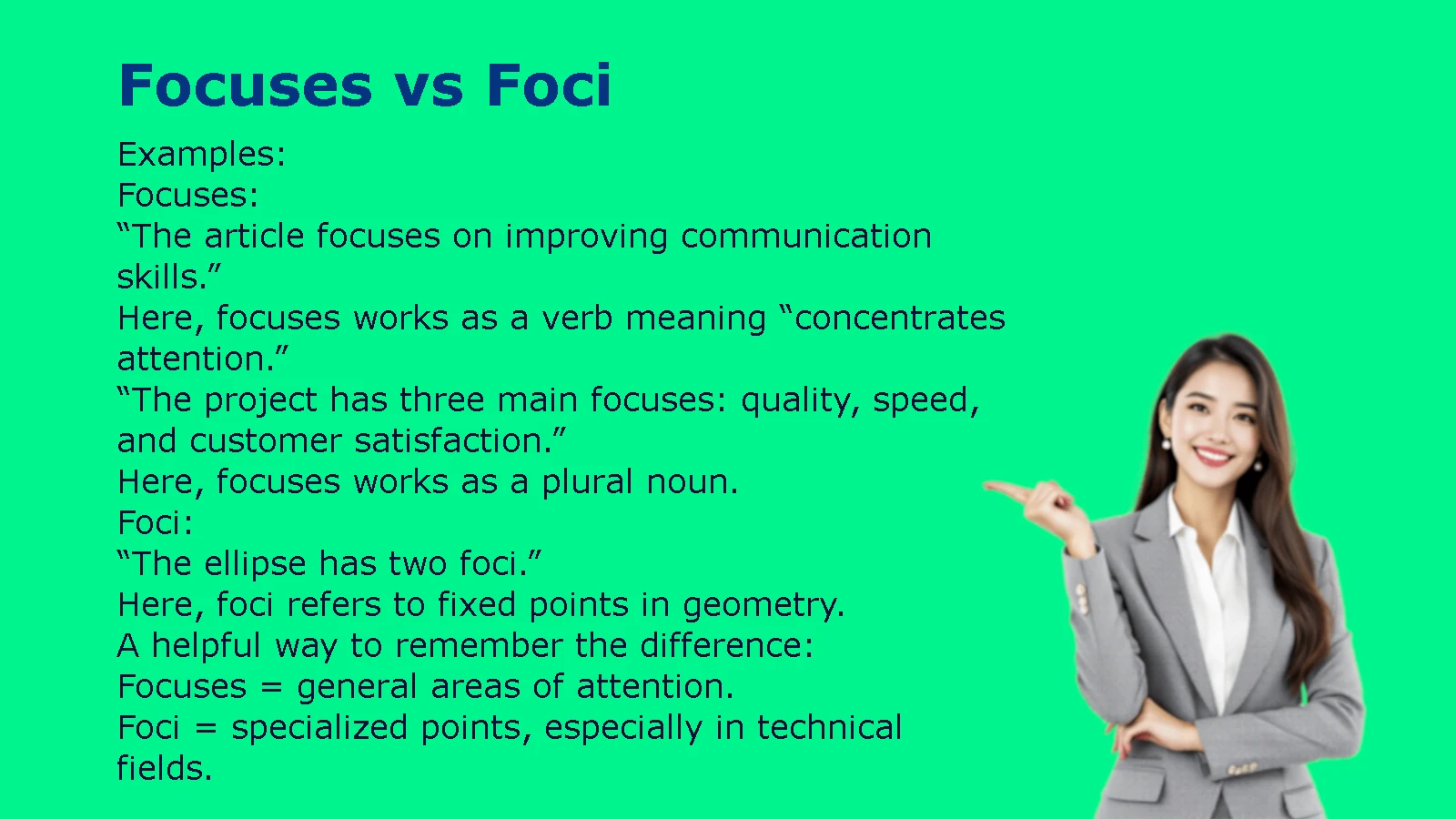
Examples:
Focuses:
“The article focuses on improving communication skills.”
Here, focuses works as a verb meaning “concentrates attention.”
“The project has three main focuses: quality, speed, and customer satisfaction.”
Here, focuses works as a plural noun.
Foci:
“The ellipse has two foci.”
Here, foci refers to fixed points in geometry.
A helpful way to remember the difference:
- Focuses = general areas of attention.
- Foci = specialized points, especially in technical fields.
What Does Focus Mean?
The word focus has several meanings depending on the situation. At its core, focus refers to a central point where attention, energy, activity, or something physical is concentrated.
The word can function as both a noun and a verb.
Focus as a Noun
As a noun, focus describes the main point of interest or attention.
Examples:
- “The main focus of the meeting was improving customer service.”
- “Her focus during the exam helped her achieve a high score.”
- “The camera lens brought the image into focus.”
In everyday situations, focus often relates to concentration or priorities.
For example, if someone says:
“My main focus this month is learning a new language.”
They mean that learning a language is their primary goal or area of attention.
The plural form in this type of situation is usually focuses.
Example:
“The organization has different focuses, including education, healthcare, and environmental protection.”
Focus as a Verb
As a verb, focus means to direct attention toward something.
Examples:
- “She focuses on her career goals.”
- “The photographer focuses the camera before taking the picture.”
- “The students focus better in a quiet environment.”
When used as a third-person singular verb, focus becomes focuses.
Examples:
| Subject | Correct Form |
| I focus | “I focus on my work.” |
| You focus | “You focus on the important details.” |
| He focuses | “He focuses on solving problems.” |
| She focuses | “She focuses on her studies.” |
| The company focuses | “The company focuses on innovation.” |
This is one reason people sometimes misunderstand focuses. It is not only a plural noun. It can also be a verb form.
What Does Focuses Mean?
The word focuses has two main uses:
- The plural form of the noun focus.
- The third-person singular present form of the verb focus.
The meaning depends on how the word appears in a sentence.
Focuses as a Plural Noun
When focuses acts as a noun, it refers to multiple areas of attention, priorities, or central points.
Examples:
- “The company’s main focuses are innovation and customer satisfaction.”
- “The conference had several focuses, including technology and business growth.”
- “The research project has different focuses across various fields.”
In most modern English writing, focuses is the preferred plural form because it follows normal English grammar rules.
English usually forms plurals by adding -s or -es:
| Singular | Plural |
| Book | Books |
| Class | Classes |
| Focus | Focuses |
Since focus ends with the sound that commonly takes -es, the regular plural becomes focuses.
Why Focuses Is More Common in Everyday English
Most English speakers naturally choose focuses because it feels familiar and clear.
For example:
Natural:
“The article has two main focuses: grammar and vocabulary.”
Less common:
“The article has two main foci: grammar and vocabulary.”
The second sentence is not grammatically wrong, but it sounds more formal and academic. Many readers may associate foci with mathematics or science rather than everyday topics.
Common situations where you should use focuses:
- Business goals
- Personal priorities
- School subjects
- Marketing strategies
- Research topics
- General discussions
Examples:
Business:
“The company’s focuses include improving customer experience and expanding globally.”
Education:
“The course focuses on writing skills and critical thinking.”
Personal development:
“Her main focuses are health, learning, and creativity.”
What Does Foci Mean?
Foci is the traditional plural form of focus that comes from Latin.
The original Latin word focus meant “hearth” or “fireplace.” Over time, the meaning expanded to describe a central point where something gathers or happens.
In modern English, foci appears mainly in technical and academic contexts.
Common fields that use foci include:
- Mathematics
- Geometry
- Physics
- Optics
- Medicine
- Scientific research
Foci in Mathematics and Geometry
The most well-known use of foci appears in geometry.
In mathematics, a focus is a fixed point used to define certain shapes. The plural form is foci.
For example, an ellipse has two foci.
An ellipse is a curved shape similar to a stretched circle. The two fixed points inside the ellipse are called the foci.
A key property of an ellipse is:
The total distance from any point on the ellipse to both foci remains constant.
Example:
“The location of the foci determines the shape and size of an ellipse.”
Other shapes involving foci include:
- Ellipses
- Hyperbolas
- Parabolas
Foci in Science and Medicine
Scientists also use foci to describe specific points or locations where something occurs.
Medicine Example
Doctors may use foci when describing multiple areas of abnormal activity.
Example:
“The scan revealed several infection foci.”
This means the scan showed several specific locations where infection was present.
Physics Example
In optics, a focus describes the point where light rays meet.
Example:
“The lens creates multiple optical foci under different conditions.”
Geology Example
Scientists studying earthquakes may refer to the focus of an earthquake as the underground point where energy is released.
The plural form may appear as:
“Researchers studied earthquake foci across the region.”
Why Are Both Focuses and Foci Correct?
The existence of both focuses and foci comes from the way English develops over time.
English has borrowed thousands of words from Latin, Greek, French, and other languages. Some borrowed words kept their original plural forms while others adapted to normal English rules.
For example:
| Singular | Traditional Plural | Common English Plural |
| Focus | Foci | Focuses |
| Formula | Formulae | Formulas |
| Index | Indices | Indexes |
| Appendix | Appendices | Appendixes |
Focuses vs Foci: Grammar Rules and Usage Guide
Understanding the grammar behind focuses vs foci makes it easier to choose the right word without second-guessing yourself. While both forms are correct, they do not always fit the same situations.
The best choice depends on what you mean, who will read your writing, and what field you are discussing.
A business report, for example, will usually sound more natural with focuses. A geometry textbook will almost always use foci.
The difference is similar to many other English words that have both traditional and modern plural forms. One version often survives in specialized fields while another becomes common in everyday communication.
When to Use Focuses
Use focuses when you are writing or speaking about general areas of attention, goals, interests, or priorities.
In most everyday situations, focuses is the safer and more natural choice.
Use Focuses for General Topics
When you describe multiple things that receive attention, use focuses.
Examples:
- “The company’s main focuses are improving customer service and reducing costs.”
- “The course has three main focuses: writing, reading, and communication.”
- “The research paper explores several focuses related to environmental change.”
These sentences discuss broad ideas rather than technical points.
Use Focuses in Business Writing
Businesses frequently use the word focuses when discussing strategies, priorities, and goals.
Examples:
“The company’s primary focuses include expanding its online services and improving customer support.”
The word works well because business audiences usually expect clear, modern English.
Other examples:
- “The marketing team has two major focuses this quarter.”
- “The organization’s focuses have shifted toward sustainability.”
- “The new strategy focuses on long-term growth.”
Use Focuses in Education and Research
Academic writing can use both words, but focuses is usually better when discussing general subjects.
Examples:
- “The study focuses on the relationship between technology and education.”
- “The research has several focuses, including language development and social behavior.”
However, if the research discusses specific scientific points or mathematical concepts, foci may be more appropriate.
When to Use Foci
Use foci when you are writing in a technical field where the word has a specific meaning.
The word appears most often in:
- Mathematics
- Physics
- Astronomy
- Medicine
- Scientific research
In these areas, foci is not simply a fancy alternative for focuses. It often refers to a specific technical concept.
Use Foci in Mathematics
Mathematics is the clearest example of where foci is preferred.
Examples:
- “An ellipse has two foci.”
- “The distance between the foci determines the shape of the ellipse.”
- “The equation calculates the position of the foci.”
Using focuses in these examples would change the meaning completely.
Incorrect:
“An ellipse has two focuses.”
This sounds like the ellipse has two areas of attention rather than two mathematical points.
Correct:
“An ellipse has two foci.”
Use Foci in Science
Scientific fields often use foci because researchers need precise terminology.
Examples:
Medicine
“The MRI showed multiple abnormal foci.”
Meaning:
- Several specific areas showed unusual activity.
Biology
“Scientists identified several infection foci.”
Meaning:
- Researchers found multiple locations where infection existed.
Optics
“The lens creates two different optical foci.”
Meaning:
- Light concentrates at two specific points.
In scientific writing, precision matters. The word foci communicates a specialized meaning that focuses cannot always provide.
Focuses vs Foci: Pronunciation Differences
The pronunciation of these two words can also create confusion.
How to Pronounce Focuses
Focuses is pronounced:
FOH-kuh-siz
Example:
“The report focuses on economic trends.”
The ending sounds like -siz, similar to words such as “houses” or “passes.”
How to Pronounce Foci
Foci has more than one accepted pronunciation.
Common pronunciations include:
- FOH-sigh
- FOH-kye
The pronunciation depends partly on region and personal preference.
Example:
“The ellipse has two foci.”
In many scientific classrooms, FOH-sigh is common.
Focuses vs Foci in Different Fields
The context often determines which plural form sounds correct.
The table below shows where each word usually appears.
| Field | Preferred Word | Example |
| Everyday conversation | Focuses | “My main focuses are health and education.” |
| Business | Focuses | “The company has several focuses this year.” |
| Marketing | Focuses | “The campaign focuses on customer needs.” |
| Mathematics | Foci | “The ellipse has two foci.” |
| Physics | Foci | “The optical system has multiple foci.” |
| Medicine | Foci | “The scan revealed abnormal foci.” |
| Scientific research | Both, depending on meaning | “The study focuses on disease foci.” |
Case Study: How Context Changes the Correct Word
Imagine a company researching renewable energy.
A business manager might write:
“Our main focuses are reducing costs and increasing efficiency.”
Here, focuses works because the sentence describes company priorities.
Now imagine a scientist studying solar technology.
They might write:
“The researchers analyzed the optical foci created by the solar lens.”
Here, foci is correct because it describes physical points where light gathers.
The topic is similar, but the meaning changes.
| Situation | Correct Word | Reason |
| Company goals | Focuses | Refers to priorities |
| Scientific measurement | Foci | Refers to specific points |
| Research topics | Focuses | Refers to subjects being studied |
| Mathematical points | Foci | Refers to geometric locations |
This is why context matters more than simply memorizing a rule.
Common Mistakes When Using Focuses and Foci
Many people misunderstand these words because they assume one must be incorrect. However, the real issue is choosing the right form for the situation.
Mistake: Thinking Foci Is Always More Correct
Some writers believe that because foci comes from Latin, it must be the “proper” plural.
That is not true.
Example:
Less natural:
“The presentation has three main foci: customer service, pricing, and marketing.”
Better for most audiences:
“The presentation has three main focuses: customer service, pricing, and marketing.”
The word foci is not automatically more sophisticated. It is simply more specialized.
Mistake: Thinking Focuses Is Incorrect
Another common mistake is assuming focuses is wrong because it does not look like the Latin plural.
That is incorrect.
Example:
“The article focuses on improving grammar skills.”
This sentence is completely correct.
Also:
“The article has several focuses.”
This is also acceptable.
Modern English regularly creates standard plurals instead of keeping original foreign forms.
Mistake: Confusing Focuses as a Verb and a Noun
The word focuses can have two different grammatical roles.
Verb Example:
“The teacher focuses on practical examples.”
Meaning:
- The teacher gives attention to practical examples.
Noun Example:
“The lesson has several focuses.”
Meaning:
- The lesson contains several main areas of attention.
A simple way to identify the difference:
- If focuses describes an action, it is a verb.
- If focuses names multiple things, it is a noun.
Focuses vs Foci Examples in Sentences
Seeing the words in real sentences makes the difference easier to understand.
Everyday Examples With Focuses
- “The workshop has two main focuses: communication and leadership.”
- “The company focuses on creating affordable products.”
- “Her focuses have changed as she gained more experience.”
- “The article focuses on common grammar mistakes.”
Academic Examples With Focuses
- “The research focuses on language acquisition.”
- “The study has multiple focuses across different academic fields.”
- “The professor focuses on historical analysis.”
- “The paper’s main focuses include culture and social development.”
Scientific Examples With Foci
- “The microscope revealed several cellular foci.”
- “The researchers examined infection foci in affected areas.”
- “The optical device produces multiple light foci.”
- “Scientists studied seismic foci after the earthquake.”
Mathematical Examples With Foci
- “The ellipse contains two foci.”
- “The distance between the foci affects the ellipse’s shape.”
- “The hyperbola has two separate foci.”
- “The formula calculates the location of the foci.”
A Simple Decision Guide: Focuses or Foci?
If you are unsure which word to use, ask yourself one question:
Am I talking about general areas of attention or specific technical points?
Use this guide:
| Question | Use |
| Am I discussing goals or priorities? | Focuses |
| Am I writing for a general audience? | Focuses |
| Am I talking about business objectives? | Focuses |
| Am I describing mathematical points? | Foci |
| Am I discussing scientific locations? | Foci |
| Am I writing a technical paper? | Usually foci |
Why English Keeps Multiple Plural Forms
The difference between focuses vs foci shows how English continues to evolve.
English contains many words that have multiple plural forms because of historical influences.
For example:
- Cactus → cactuses / cacti
- Formula → formulas / formulae
- Index → indexes / indices
- Appendix → appendixes / appendices
In many cases, the traditional plural remains popular in professional fields while the regular English plural dominates everyday speech.
This pattern helps explain why both focuses and foci exist today.
Focuses vs Foci: Frequently Asked Questions and Final Usage Guide
The difference between focuses vs foci becomes much easier once you understand that both words have a place in English. The key is not deciding which word is “right” and which word is “wrong.” Instead, you need to understand what each word means and where people normally use it.
In most conversations, articles, reports, and general writing, focuses will be the better choice. When you enter a technical field such as geometry, physics, or medicine, foci often becomes the correct term because it refers to a specific concept.
The following questions cover the most common situations where people hesitate between these two forms.
Is Foci the Plural of Focus?
Yes, foci is a plural form of focus.
The word comes from Latin, where focus originally meant a hearth or fireplace. English borrowed the word and kept the traditional Latin plural form in specialized areas.
However, English also created its own regular plural form:
- Singular: focus
- Regular plural: focuses
- Latin plural: foci
Both forms are accepted.
Examples:
General English:
“The company has several focuses for the next year.”
Mathematics:
“The ellipse has two foci.”
The difference is not about correctness. It is about context.
Is Focuses a Correct Plural of Focus?
Yes, focuses is a completely correct plural form of focus.
Many people mistakenly believe that because foci comes from Latin, it must be the only proper plural. Modern English does not work that way.
English frequently adapts borrowed words into normal English patterns.
For example:
- Focus → focuses
- Campus → campuses
- Bonus → bonuses
- Virus → viruses
The plural focuses follows standard English grammar.
Examples:
- “The project has several focuses.”
- “The company’s focuses include innovation and sustainability.”
- “The article discusses different focuses within education.”
For everyday readers, focuses is usually clearer and more natural.
Should You Use Foci or Focuses in an Essay?
The answer depends on the topic of your essay.
For most school essays, opinion pieces, reports, and general academic writing, use focuses.
Example:
“The essay focuses on the effects of social media on communication.”
Here, focuses is a verb and is the correct choice.
If you are discussing a technical subject, foci may be better.
Example:
“The essay explains how the foci of an ellipse affect its structure.”
Here, foci refers to a mathematical concept.
General Essay Rule:
| Essay Type | Better Choice |
| History essay | Focuses |
| Literature essay | Focuses |
| Business report | Focuses |
| Scientific paper | Depends on meaning |
| Mathematics paper | Foci |
When writing for a broad audience, clarity usually matters more than using traditional word forms.
Is Focuses Also a Verb?
Yes, focuses can be a verb.
This is one of the most common uses of the word.
When focuses acts as a verb, it means “concentrates attention” or “directs effort toward something.”
Examples:
- “She focuses on improving her writing.”
- “The company focuses on customer satisfaction.”
- “The camera focuses automatically.”
- “The research focuses on climate change.”
The verb form follows this pattern:
| Subject | Verb Form |
| I focus | First person |
| You focus | Second person |
| He focuses | Third person |
| She focuses | Third person |
| The study focuses | Third person |
A quick trick:
If you can replace focuses with “concentrates,” it is probably the verb form.
Example:
“The research focuses on health.”
Meaning:
“The research concentrates on health.”
Why Does Focus Have Two Plurals?
The reason comes from the history of the English language.
English has borrowed thousands of words from other languages. Some borrowed words keep their original plural forms while others adopt normal English endings.
The word focus entered English from Latin. Because of that history, foci remained in certain academic fields.
However, everyday English speakers naturally created focuses by following common grammar rules.
This process happens constantly.
For example:
Data
Traditional:
- Datum → data
Modern usage:
- Data is often treated as a singular noun.
Formula
Traditional:
- Formula → formulae
Common English:
- Formula → formulas
Focus
Traditional:
- Focus → foci
Common English:
- Focus → focuses
Language changes because people use it. The forms that feel natural often become the most common.
Focuses vs Foci: Which Word Sounds More Natural?
In everyday communication, focuses usually sounds more natural.
Compare these examples:
Natural:
“The presentation has three main focuses.”
More technical:
“The presentation has three main foci.”
The second sentence is grammatically correct, but many readers may expect a scientific meaning.
However, in mathematics:
Natural:
“The ellipse has two foci.”
Unusual:
“The ellipse has two focuses.”
The second example sounds like the ellipse has two areas of attention rather than two mathematical points.
The surrounding topic determines what sounds correct.
Memory Trick to Remember Focuses vs Foci
A simple memory trick:
Focuses = everyday focuses.
Foci = scientific points.
Think of it this way:
- Your career has focuses.
- A scientist studies foci.
- A company creates focuses.
- A mathematician calculates foci.
This quick distinction works in most situations.
Focuses vs Foci: Complete Comparison Table
| Feature | Focuses | Foci |
| Singular form | Focus | Focus |
| Origin | Modern English plural | Latin plural |
| Most common use | Everyday writing | Technical writing |
| Grammar role | Noun and verb | Noun only |
| Common fields | Business, education, general topics | Mathematics, science, medicine |
| Pronunciation | FOH-kuh-siz | FOH-sigh / FOH-kye |
| Meaning | Multiple areas of attention | Multiple technical points |
Examples Showing the Difference Clearly
Example 1: Business
Correct:
“The company’s main focuses are product quality and customer service.”
Why?
The sentence discusses priorities.
Example 2: Geometry
Correct:
“The ellipse has two foci.”
Why?
The sentence describes fixed mathematical points.
Example 3: Research
Correct:
“The study focuses on environmental changes.”
Why?
Here, focuses is a verb.
Example 4: Medicine
Correct:
“Doctors identified several disease foci.”
Why?
The sentence describes specific locations where disease exists.
Common Questions About the Plural of Focus
What is the plural of focus?
The two accepted plural forms are:
- Focuses
- Foci
However, they are used differently.
Is “focuses” always better than “foci”?
No.
Focuses works best in general writing.
Foci works best when referring to technical concepts.
Can I use foci in normal conversation?
You can, but it may sound overly formal.
For example:
“My main foci today are exercise and reading.”
This is understandable, but most people would say:
“My main focuses today are exercise and reading.”
Is foci singular or plural?
Foci is plural.
The singular form is:
“The focus of the experiment was accuracy.”
The plural form is:
“The foci of the experiments were different.”
Do scientists always use foci?
Not always.
Scientists use foci when they are referring to specific points or locations. They may use focuses when discussing general research topics.
Example:
“The research focuses on cancer treatment.”
Here, focuses is correct.
“The scan revealed cancer foci.”
Here, foci is correct.
Final Rule: Focuses vs Foci
The difference between focuses vs foci is simple once you understand the context.
Use focuses when you mean:
- Goals
- Priorities
- Subjects
- Areas of attention
- General topics
Examples:
- “The article focuses on grammar.”
- “The company has several focuses.”
- “The project focuses on improvement.”
Use foci when you mean:
- Mathematical points
- Scientific locations
- Technical concepts
Examples:
- “The ellipse has two foci.”
- “Researchers studied infection foci.”
- “The lens creates optical foci.”
The easiest rule to remember:
Everyday ideas have focuses. Technical points have foci.
Focuses vs Foci: Real-World Usage Examples
The easiest way to understand focuses vs foci is to see how writers use these words in different situations. The surrounding topic usually tells you which form fits best.
A word can have the same root but a completely different purpose depending on the field. That happens often in English, especially with words borrowed from Latin.
Focuses vs Foci in Business Writing
In business, focuses is almost always the preferred choice because companies usually discuss priorities, goals, and strategies rather than technical points.
Examples:
- “The company’s main focuses are customer retention and product development.”
- “The marketing team focuses on increasing brand awareness.”
- “The organization has shifted its focuses toward sustainability.”
Business communication values clarity. A word like focuses feels direct and accessible.
Using foci in a business report may confuse readers because it can sound like the writer is trying to use technical language unnecessarily.
Example:
Less natural:
“The company has three strategic foci.”
Better for most audiences:
“The company has three strategic focuses.”
However, some academic business writing may use foci, especially when discussing research frameworks.
Example:
“The study examines the strategic foci of multinational corporations.”
Here, the word appears in a formal research context.
Focuses vs Foci in Academic Writing
Academic writing can use both forms. The choice depends on what the writer means.
When Academic Writers Use Focuses
Researchers often use focuses when describing topics, themes, or areas of investigation.
Examples:
- “The study focuses on language development.”
- “The research has several focuses, including education and technology.”
- “The paper focuses on the relationship between culture and identity.”
Here, the word refers to subjects being explored.
When Academic Writers Use Foci
Researchers use foci when referring to specific points, locations, or analytical centers.
Examples:
- “The study identified several research foci.”
- “The article examines the political foci of modern movements.”
- “The researchers analyzed multiple cultural foci.”
In academic writing, foci often appears because scholars use more specialized vocabulary.
However, writers should avoid choosing foci simply because it sounds more formal. The word should add accuracy, not just complexity.
Focuses vs Foci in Mathematics
Mathematics is one of the clearest areas where foci is the correct choice.
In geometry, a focus is a fixed point used to define certain shapes.
The plural is always:
focus → foci
Examples:
- “An ellipse has two foci.”
- “The foci determine the shape of the ellipse.”
- “The distance between the foci affects the ellipse’s eccentricity.”
Using focuses in mathematics would create confusion because the reader may interpret it as a general word rather than a mathematical term.
Focuses vs Foci in Medicine
Medical professionals sometimes use foci when referring to specific areas where a condition exists.
Examples:
- “The scan showed multiple infection foci.”
- “Doctors identified abnormal foci in the tissue.”
- “The researchers examined inflammatory foci.”
In medicine, precision matters. The word foci helps describe separate locations rather than general areas of attention.
However, medical researchers may still use focuses when discussing topics.
Example:
“The research focuses on improving cancer treatment methods.”
Here, focuses is correct because it describes the direction of the research.
Focuses vs Foci in Scientific Research
Scientific writing often uses both forms.
The difference depends on whether the writer discusses an idea or a physical point.
| Sentence | Correct Word | Reason |
| “The study focuses on renewable energy.” | Focuses | Describes the research topic |
| “The experiment identified several optical foci.” | Foci | Describes physical points |
| “The researchers focus on improving accuracy.” | Focus | Verb form |
| “The researchers analyzed multiple infection foci.” | Foci | Describes specific locations |
How to Choose Between Focuses and Foci Quickly
When you are unsure, use this three-step method.
Ask What You Mean by Focus
Are you talking about:
A Goal, Topic, or Priority?
Use:
Focuses
Example:
“The article has several focuses.”
A Fixed Point or Technical Location?
Use:
Foci
Example:
“The equation calculates the foci.”
An Action of Concentrating?
Use:
Focuses
Example:
“The report focuses on customer needs.”
Focuses vs Foci: Common Sentence Corrections
Incorrect:
“The company has several foci, including marketing and sales.”
Better:
“The company has several focuses, including marketing and sales.”
Why?
The sentence discusses business priorities rather than technical points.
Incorrect:
“The ellipse has two focuses.”
Correct:
“The ellipse has two foci.”
Why?
The sentence uses the mathematical meaning of focus.
Incorrect:
“The research foci on climate change.”
Correct:
“The research focuses on climate change.”
Why?
The sentence needs a verb, not a plural noun.
The History Behind Focuses and Foci
The story of focuses vs foci shows how languages change over time.
The word focus entered English from Latin. Latin words often had different plural endings than modern English words.
In Latin:
- Singular: focus
- Plural: foci
English borrowed the word but adapted it according to normal English patterns:
- Singular: focus
- Plural: focuses
Over time, both forms survived.
The traditional Latin plural remained common in specialized subjects because scholars often preserved older terminology.
Meanwhile, everyday speakers naturally preferred the simpler English plural.
This pattern appears throughout English.
Examples:
| Word | Traditional Form | Modern Form |
| Focus | Foci | Focuses |
| Cactus | Cacti | Cactuses |
| Formula | Formulae | Formulas |
| Index | Indices | Indexes |
English does not always replace old forms. Instead, it often keeps multiple options that serve different purposes.
Focuses vs Foci: Which One Should You Use?
For most writers, the answer is simple:
Use focuses unless you are writing about a technical concept.
Choose focuses for:
- Articles
- Blog posts
- Business documents
- General essays
- Conversations
- Presentations
Choose foci for:
- Geometry
- Physics
- Optics
- Medical terminology
- Scientific descriptions
A clear word choice helps readers understand your meaning immediately.
Final Takeaway: Focuses vs Foci Explained Simply
The difference between focuses vs foci comes down to usage.
Focuses is the common English form. It describes multiple areas of attention or acts as the third-person singular verb form of focus.
Examples:
- “The company focuses on innovation.”
- “The project has several focuses.”
Foci is the specialized plural form. It describes technical points, especially in mathematics and science.
Examples:
- “The ellipse has two foci.”
- “The researchers studied disease foci.”
Remember this simple rule:
If you are talking about ideas, goals, or priorities, use focuses. If you are talking about scientific or mathematical points, use foci.
Once you understand the context, choosing between focuses and foci becomes straightforward. Both words are correct. The right choice simply depends on what you are trying to say.