Ever wondered why people get confused between Wreck vs Reck even though only one letter changes? This small spelling difference can completely change the meaning of a sentence—and lead to serious writing mistakes in emails, essays, and everyday communication.
The problem is clear. Both words sound somewhat similar in fast speech, but they belong to totally different meanings, which often causes spelling confusion, grammar errors, and misinterpretation in writing. And here’s the kicker: even confident writers sometimes mix them up.
But don’t worry—this confusion is easier to fix than it looks.
In this guide, you will learn the clear difference between Wreck vs Reck, along with their meanings, correct usage, and common examples. You’ll also discover related LSI concepts like spelling confusion words, commonly misused English words, homophone spelling mistakes, and English grammar clarity rules to strengthen your understanding.
So, if you’ve ever paused while writing and thought, “Which one is correct?”, this guide will clear it up once and for all. Let’s break it down.
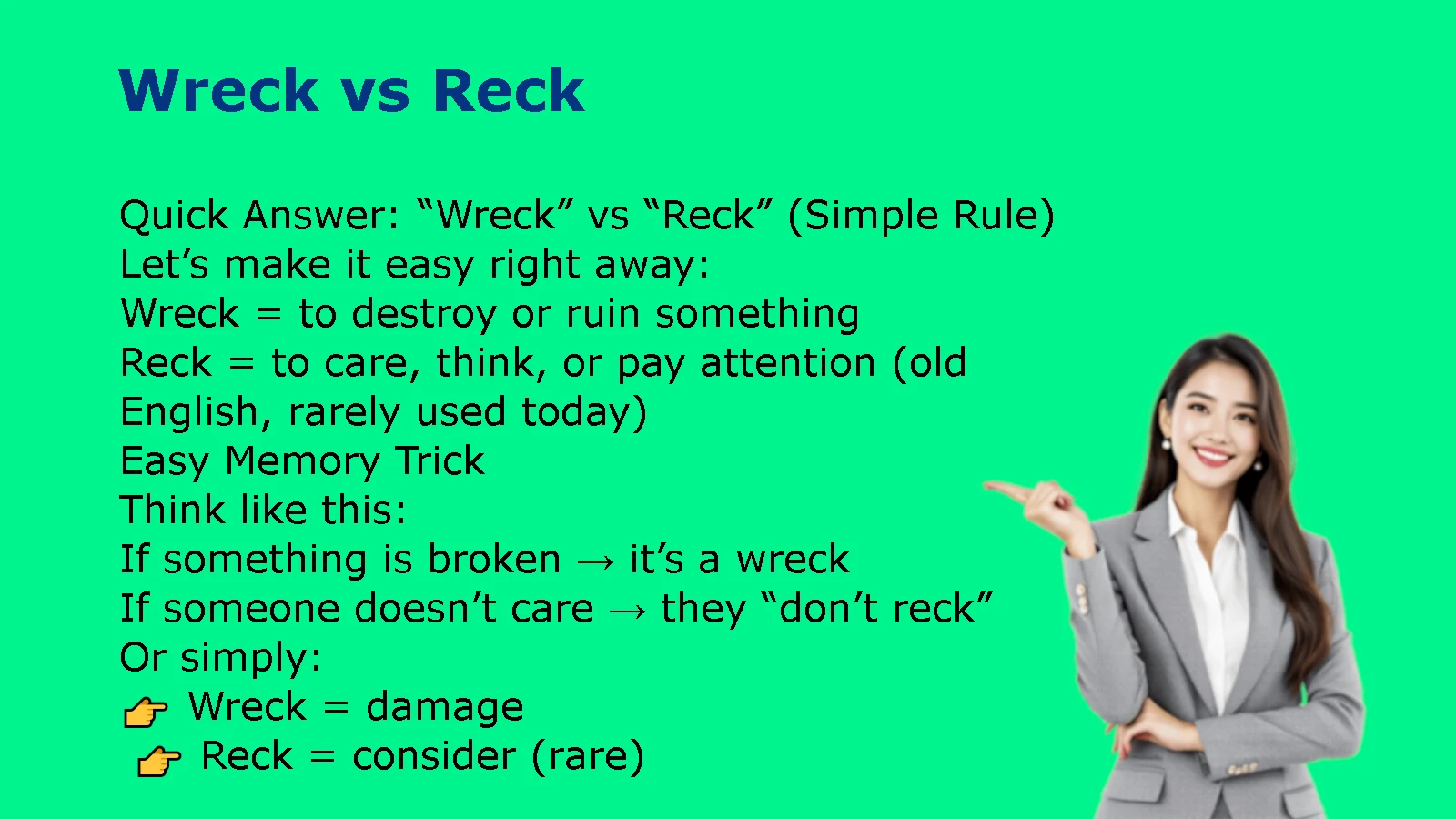
Quick Answer: “Wreck” vs “Reck” (Simple Rule)
Let’s make it easy right away:
- Wreck = to destroy or ruin something
- Reck = to care, think, or pay attention (old English, rarely used today)
Easy Memory Trick
Think like this:
- If something is broken → it’s a wreck
- If someone doesn’t care → they “don’t reck”
Or simply:
👉 Wreck = damage
👉 Reck = consider (rare)
What Does “Wreck” Mean? (Clear Explanation)
The word wreck is common in modern English. It is used as both a noun and a verb.
As a Verb (Action)
To wreck something means to destroy, damage, or ruin it.
Examples:
- The storm wrecked the village.
- He wrecked his car in the accident.
- Don’t wreck your chances by being careless.
As a Noun (Thing)
A wreck is something that has been destroyed.
Examples:
- The car was a complete wreck after the crash.
- The shipwreck left behind a wreck on the shore.
Key Idea
👉 Wreck always involves damage, destruction, or ruin
What Does “Reck” Mean? (Rare But Important)
Now comes the tricky one.
Reck is an old English word that means:
👉 to care, consider, or pay attention
But here’s the important part:
⚠️ It is almost never used in modern English alone
You usually see it in phrases like:
- reckless (without care)
- reckoning (judgment or calculation – related root idea)
Old Usage Examples
- He did not reck the danger. (He did not care about the danger.)
- She would reck nothing of the consequences. (She ignored the consequences.)
Modern Reality
Today, instead of “reck,” we simply say:
- care
- mind
- worry about
- consider
Key Idea
👉 Reck = care or consider (old usage only)
Wreck vs Reck: Side-by-Side Comparison
| Word | Meaning | Usage Today | Example |
| Wreck | Destroy or ruin | Very common | The storm wrecked the house |
| Reck | Care or consider | Rare / archaic | He did not reck the warning |
Why People Confuse “Wreck” and “Reck”
This confusion happens for a few reasons:
1. They look almost identical
Just one letter changes everything.
2. Sound similarity
In fast speech, they can sound nearly the same.
3. Old English influence
“Reck” appears in older literature, so learners still encounter it.
4. Modern slang overlap
Words like “wrecked” (slang for exhausted or drunk) add more confusion.
Real-Life Examples of “Wreck”
Let’s see how it appears in daily English:
- The flood wrecked the bridge.
- The argument wrecked their friendship.
- I was so tired I felt wrecked after work.
Mini Scenario
You come home after a long day and say:
“I’m completely wrecked.”
Meaning: You’re exhausted, not literally destroyed.
Real-Life Examples of “Reck” (Old Style)
Although rare, here’s how it used to appear:
- He did not reck the danger ahead.
- She would not reck the opinions of others.
- They recked nothing of the consequences.
Modern Translation
All of these simply mean:
👉 They did not care.
Quick Decision Guide
When you see the word, ask:
- Is it about damage or destruction? → Wreck
- Is it about caring or considering (old text)? → Reck
- Still unsure? → It’s almost always wreck in modern English
Common Mistakes People Make
❌ Thinking “reck” is a modern word
It’s mostly outdated in everyday English.
❌ Using “reck” instead of “care”
Modern English does not use it like that.
❌ Confusing “wreck” with “weak”
Completely different meanings.
FAQ: Wreck vs Reck
Is “reck” still used in English today?
Rarely. You’ll mostly find it in old literature or fixed expressions.
Is “wreck” always about destruction?
Mostly yes, but it can also mean extreme exhaustion in slang (“I’m wrecked”).
Are wreck and reck related?
Yes, historically they come from similar linguistic roots, but their modern meanings are very different.
Which one should I use in writing today?
Almost always wreck, unless you are analyzing old English texts.
Final Takeaway: The One Rule to Remember
If you only remember one thing, make it this:
👉 Wreck = damage, ruin, destruction (modern and common)
👉 Reck = care or consider (old and rarely used)
So next time you see them, don’t overthink it. One belongs to everyday English. The other belongs mostly to history books.
And that’s the real difference between “wreck vs reck.”