Ever wondered why people confuse Ignorant vs. Stupid in everyday conversations and online arguments? At first glance, both words may sound insulting in the same way—but they actually describe completely different ideas: one is about lack of knowledge, while the other is about judgment or intelligence.
That’s where the confusion starts. You’re not alone if you’ve seen these terms used interchangeably in debates, social media comments, or even academic discussions. And here’s the kicker: using the wrong word can completely change how harsh or accurate your message sounds.
But don’t worry—this is easier to fix than it seems.
In this guide, you will clearly understand the difference between Ignorant vs. Stupid, along with related meanings like lack of knowledge vs intelligence, uninformed behavior, and cognitive misunderstanding. You’ll also learn how these terms are used in real-life conversations, education, and online discourse.
So if you’ve ever hesitated before using either word, this breakdown will give you clarity once and for all. Let’s get into it.
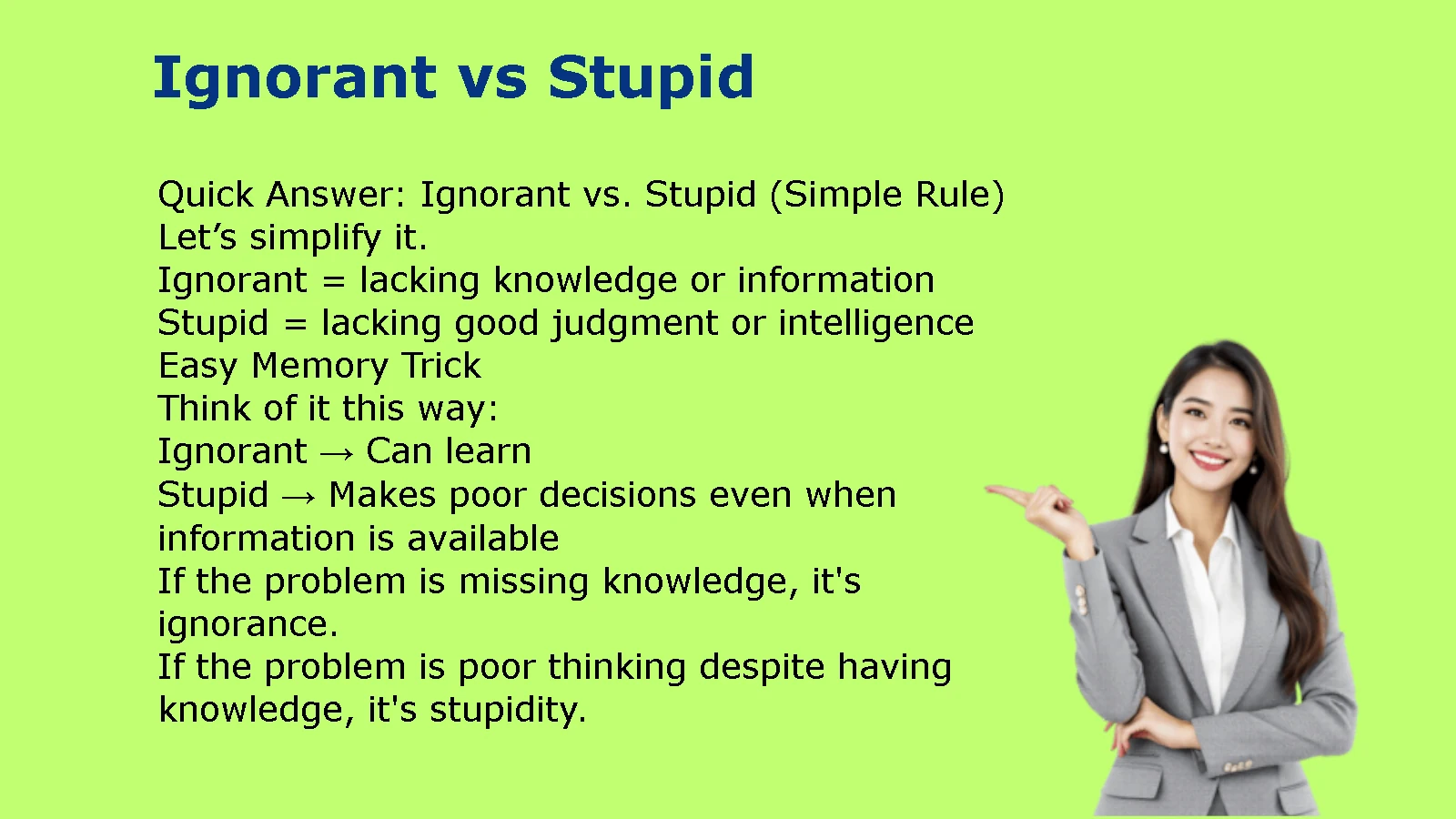
Quick Answer: Ignorant vs. Stupid (Simple Rule)
Let’s simplify it.
Ignorant = lacking knowledge or information
Stupid = lacking good judgment or intelligence
Easy Memory Trick
Think of it this way:
Ignorant → Can learn
Stupid → Makes poor decisions even when information is available
If the problem is missing knowledge, it’s ignorance.
If the problem is poor thinking despite having knowledge, it’s stupidity.
What “Ignorant” Actually Means
The word ignorant comes from the idea of not knowing something.
Being ignorant does not automatically mean someone is unintelligent. It simply means they lack information, education, awareness, or understanding about a particular topic.
Examples
- Someone who has never studied history may be ignorant of historical events.
- A tourist may be ignorant of local customs.
- A new employee may be ignorant of company procedures.
Key Insight
Ignorance can usually be fixed through learning, research, or experience.
That’s why ignorance is often considered temporary.
What “Stupid” Actually Means
The word stupid refers to poor reasoning, bad judgment, or an inability to think effectively.
Unlike ignorance, stupidity is not necessarily about lacking information.
A person may know the facts and still make an obviously poor decision.
Examples
- Driving while texting despite knowing the dangers.
- Ignoring repeated warnings about a serious problem.
- Making reckless decisions without thinking about consequences.
Key Insight
Stupidity is often associated with poor decision-making rather than lack of knowledge.
The Core Difference Between Ignorant and Stupid
The easiest way to understand the distinction is by asking one question:
Does the Person Know the Information?
If the answer is no, they’re probably ignorant.
If the answer is yes but they still make a bad choice, they may be acting stupid.
Example
A person doesn’t know that touching a hot stove causes burns.
Result: Ignorant.
A person knows the stove is hot but touches it anyway.
Result: Stupid.
That simple example captures the entire difference.
The Learning Test
Here’s a useful test.
Ignorant People
When given new information:
- They learn.
- They adapt.
- They improve.
Stupid People
When given new information:
- They ignore it.
- They repeat mistakes.
- They continue making poor choices.
Why This Matters
Knowledge can cure ignorance.
Knowledge alone doesn’t always cure stupidity.
Real-Life Examples of Ignorance
Let’s look at everyday situations.
Example 1: New Driver
A teenager doesn’t know a specific traffic law.
That’s ignorance because they simply haven’t learned it yet.
Example 2: Foreign Culture
Someone visits another country and accidentally breaks a local custom.
Again, ignorance—not stupidity.
Example 3: New Technology
An older adult doesn’t understand a new smartphone feature.
They’re uninformed about that technology, not necessarily unintelligent.
Common Theme
The person lacks information rather than reasoning ability.
Real-Life Examples of Stupidity
Now compare those situations.
Example 1: Ignoring Safety Rules
A worker removes protective equipment despite repeated warnings.
That’s a stupid decision.
Example 2: Spending Without Thinking
Someone spends all their rent money on unnecessary purchases.
That’s poor judgment.
Example 3: Repeating the Same Mistake
A person keeps making the same avoidable error despite knowing the consequences.
That behavior is often described as stupid.
Common Theme
The information exists, but it isn’t being used wisely.
Why People Confuse Ignorant and Stupid
The confusion happens because both can lead to mistakes.
Similar Outcome
Whether someone is ignorant or stupid:
- Errors happen.
- Problems occur.
- Bad results may follow.
Different Cause
The cause is what matters.
| Situation | Ignorant | Stupid |
|---|---|---|
| Doesn’t know the facts | ✔ | ✘ |
| Knows the facts | ✘ | ✔ |
| Can be solved through learning | ✔ | Sometimes |
| Involves poor judgment | ✘ | ✔ |
Key Lesson
The same mistake can come from two very different reasons.
Can Someone Be Both Ignorant and Stupid?
Yes.
A person can lack knowledge and also refuse to learn when information becomes available.
Example
Someone spreads false information online.
At first, they may simply be ignorant.
After being shown reliable evidence, they continue spreading it anyway.
Now the behavior may be considered both ignorant and stupid.
Important Note
The two concepts can overlap, but they are not the same thing.
Which Word Is More Offensive?
Generally, stupid is considered much harsher.
Why?
Calling someone ignorant focuses on what they don’t know.
Calling someone stupid attacks their thinking ability.
Compare
- “You’re ignorant about this topic.”
- “You’re stupid.”
The second statement feels much more personal and insulting.
Professional Communication Tip
When possible, address the lack of information rather than attacking intelligence.
Common Mistakes People Make
Mistake #1: Using the Words Interchangeably
They have different meanings.
Always identify whether the issue is knowledge or judgment.
Mistake #2: Assuming Ignorance Means Low Intelligence
Many intelligent people are ignorant about topics they’ve never studied.
No one can know everything.
Mistake #3: Assuming Stupidity Means Low IQ
A highly intelligent person can still make stupid decisions.
Knowledge and judgment aren’t always the same thing.
Better Alternatives to Use
Sometimes both words sound harsh.
Consider these alternatives.
Instead of “Ignorant”
- Uninformed
- Unaware
- Uneducated
- Unfamiliar
Instead of “Stupid”
- Careless
- Reckless
- Unwise
- Poorly thought out
These alternatives often sound more professional and respectful.
Quick Decision Guide
Use this whenever you’re unsure.
Ask These Questions
Did the person know the information?
No → Ignorant
Yes → Continue
Did they make a poor decision despite knowing better?
Yes → Stupid
No → Neither may apply
Simple Formula
Lack of knowledge = Ignorant
Poor judgment = Stupid
FAQ: Ignorant vs. Stupid
Is being ignorant a bad thing?
Not necessarily.
Everyone is ignorant about some topics. Ignorance simply means lacking knowledge.
Can ignorance be fixed?
Yes.
Learning, reading, and experience can reduce ignorance.
Does stupid mean low intelligence?
Not always.
Many intelligent people occasionally make stupid choices.
Which term is more negative?
Stupid is usually considered more insulting than ignorant.
Can someone be intelligent but ignorant?
Absolutely.
A person can be highly intelligent while lacking knowledge in a specific area.
Case Study: Same Mistake, Different Cause
Imagine two employees make the same error.
Employee A
They were never trained properly.
Result: Ignorance caused the mistake.
Employee B
They received training, understood the rules, and ignored them.
Result: Poor judgment caused the mistake.
Why This Matters
The solution differs.
For Employee A, provide education.
For Employee B, address decision-making and accountability.
Understanding the difference leads to better communication and better solutions.
Key Facts You Should Remember
- Ignorant means lacking knowledge or information.
- Stupid means showing poor judgment or reasoning.
- Ignorance can usually be corrected through learning.
- Stupidity often involves bad decisions despite knowing better.
- The words are related but not interchangeable.
- Stupid is generally more offensive than ignorant.
- Many mistakes come from ignorance, not low intelligence.
Final Takeaway: The One Difference That Matters
Here’s the simplest way to remember ignorant vs. stupid.
Ignorance is not knowing.
Stupidity is not thinking.
Someone who lacks information can learn and improve. Someone who has the information but ignores it may continue making poor choices.
Before labeling someone, ask yourself what caused the mistake. Was it a lack of knowledge or a lack of judgment?
That single question will help you choose the right word every time.
Because when it comes to ignorant vs. stupid, understanding the difference isn’t just about vocabulary—it’s about being fair, accurate, and clear in how we describe people and situations.