Ever wondered why Roil vs. Royal confuses so many writers, even when they know English well? One small spelling difference can completely change meaning—and in some cases, turn a serious sentence into total nonsense.
Here’s the problem: roil and royal may look similar, but they belong to completely different worlds of language. You’re not alone if you’ve mixed them up in writing, captions, or even formal documents. And here’s the kicker: this tiny mistake can make your message look careless or confusing.
But don’t worry—this is easier to fix than it seems.
In this guide, you’ll clearly understand the difference between Roil (to disturb or churn) and Royal (relating to kings, queens, or monarchy). You’ll also learn spelling differences, word meaning confusion, and commonly misused English words that often cause similar mistakes.
And it gets better—you’ll see simple examples and memory tricks that make it almost impossible to confuse them again.
So, if you’re ready to master Roil vs. Royal once and for all, let’s break it down in a simple way.
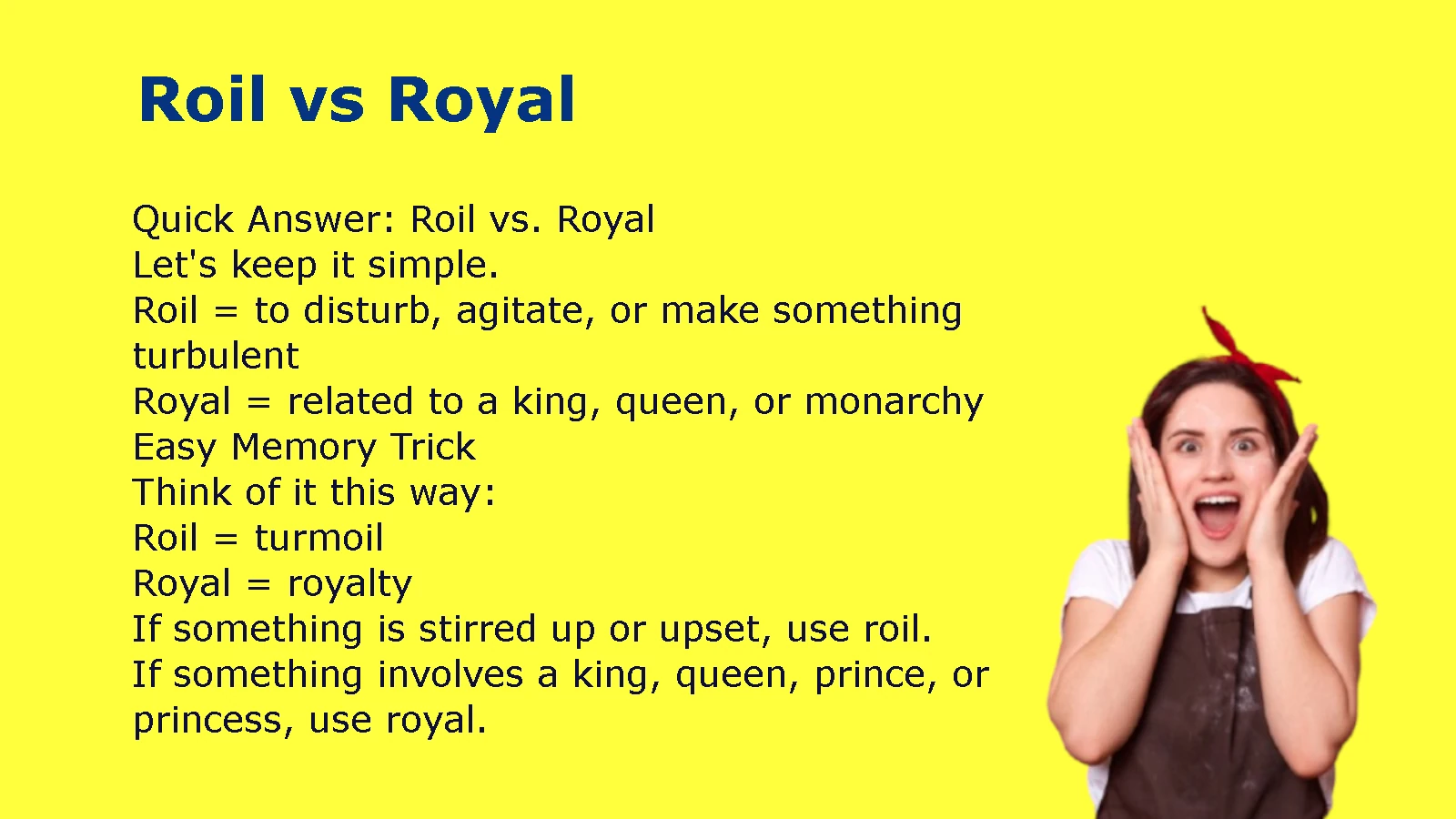
Quick Answer: Roil vs. Royal
Let’s keep it simple.
Roil = to disturb, agitate, or make something turbulent
Royal = related to a king, queen, or monarchy
Easy Memory Trick
Think of it this way:
- Roil = turmoil
- Royal = royalty
If something is stirred up or upset, use roil.
If something involves a king, queen, prince, or princess, use royal.
Side-by-Side Comparison Table
| Word | Meaning | Part of Speech | Example |
| Roil | To disturb or stir up | Verb | The news roiled the community. |
| Royal | Related to a king or queen | Adjective | The royal family attended the event. |
What Does “Roil” Mean?
The word roil means to disturb, upset, or stir something into confusion.
It can describe:
- Emotional turmoil
- Political unrest
- Turbulent water
- Public controversy
Examples of Roil
- The announcement roiled investors.
- Strong winds roiled the ocean.
- The scandal roiled the company for months.
- Her comments roiled social media.
Think of Roil as Chaos
Whenever something is stirred up physically or emotionally, roil is often the right choice.
What Does “Royal” Mean?
The word royal refers to anything connected with a king, queen, prince, princess, or monarchy.
It often describes:
- Royal families
- Royal palaces
- Royal ceremonies
- Royal authority
Examples of Royal
- The royal palace attracts thousands of tourists.
- The royal family attended the ceremony.
- She received a royal welcome.
- The event had a royal theme.
Think of Royal as Kings and Queens
If the sentence involves monarchy or nobility, choose royal.
Why People Confuse Roil and Royal
Several factors cause confusion.
Similar Appearance
Both words start with:
Ro-
When reading quickly, people sometimes overlook the remaining letters.
Similar Pronunciation
In some accents, the words may sound somewhat alike.
Spell-Check Problems
Writers typing quickly may accidentally select the wrong word because both are valid English words.
Roil vs. Royal: The Key Difference
The simplest distinction is this:
Roil = Disturbance
Examples:
- Markets were roiled by uncertainty.
- The storm roiled the sea.
Royal = Monarchy
Examples:
- The royal wedding drew millions of viewers.
- The royal guards protected the palace.
Quick Test
Ask yourself:
Is the sentence about confusion or turbulence?
→ Use roil
Is the sentence about kings, queens, or royalty?
→ Use royal
Real-Life Examples of Roil
Here are some common situations.
News Headlines
- Political tensions roil the nation.
- Rising prices roil financial markets.
Nature
- The storm roiled the river.
- Heavy rain roiled the water.
Emotions
- The accusation roiled public opinion.
- The decision roiled employees.
Real-Life Examples of Royal
Now compare those with examples of royal.
Monarchy
- The royal family appeared on the balcony.
- The royal heir attended the ceremony.
Luxury and Grandeur
- Guests enjoyed a royal banquet.
- The hotel provided royal treatment.
Historical References
- The castle served as a royal residence.
- The museum displays royal artifacts.
Common Mistakes to Avoid
Incorrect
❌ The royal waters were stirred by the storm.
Correct
✅ The roiled waters were stirred by the storm.
Incorrect
❌ The roil family attended the coronation.
Correct
✅ The royal family attended the coronation.
Incorrect
❌ The royal controversy upset investors.
Correct
✅ The controversy roiled investors.
A Simple Memory Trick That Works
Remember this phrase:
Roil = Turmoil
The words rhyme and share a similar meaning.
Example:
- The controversy caused turmoil.
- The controversy roiled the organization.
Royal = Royalty
They share the same root idea.
Example:
- Royalty lives in a palace.
- The royal family lives in a palace.
Mini Quiz: Roil or Royal?
Choose the correct word.
1.
The scandal _____ the company.
A) roiled
B) royal
Answer: A) roiled
2.
The _____ palace opened to visitors.
A) roil
B) royal
Answer: B) royal
3.
Strong winds _____ the sea.
A) roiled
B) royal
Answer: A) roiled
4.
The _____ wedding attracted global attention.
A) roil
B) royal
Answer: B) royal
Quick Decision Guide
Use this shortcut whenever you’re unsure.
Choose “Roil” If:
- Something is disturbed
- Emotions are stirred up
- Water becomes turbulent
- Conflict or controversy exists
Choose “Royal” If:
- A king or queen is involved
- The sentence concerns monarchy
- You’re discussing nobility
- Something is majestic or regal
FAQ: Roil vs. Royal
Is roil a common word?
It’s less common than royal, but it’s frequently used in journalism, politics, finance, and news reporting.
Can roil be used for emotions?
Yes. It often describes emotional or social agitation.
Example:
“The decision roiled the community.”
Does royal always relate to kings and queens?
Usually, yes. It can also describe something grand, regal, or associated with monarchy.
Are roil and royal homophones?
Not exactly. Some accents make them sound similar, but they are generally pronounced differently.
Key Facts to Remember
- Roil means to disturb, agitate, or stir up.
- Royal means connected to kings, queens, or royalty.
- Roil often appears in news and political reporting.
- Royal commonly appears in discussions of monarchy and luxury.
- The two words are unrelated in meaning.
Final Takeaway: Roil vs. Royal
The difference between roil vs. royal is actually simple once you know what each word represents.
- Roil is about disturbance, turbulence, and agitation.
- Royal is about kings, queens, royalty, and regal status.
When you’re unsure, remember:
Roil = Turmoil
Royal = Royalty
That one memory trick will help you choose the correct word every time and avoid embarrassing writing mistakes.