Ever wondered whether Dealed vs. Dealt is the correct form to use in your writing? If you’ve ever hesitated before typing one of these words, you’re not alone. Many English learners and native speakers alike get confused when choosing the proper past tense of deal.
The confusion is understandable. Both words appear online, but only one is widely accepted in standard English grammar. And here’s the kicker: using the wrong form can make your writing look less polished in academic papers, business emails, and professional communication.
But don’t worry—there’s a simple answer.
In this guide, you’ll learn the difference between Dealed vs. Dealt, which form is grammatically correct, and why the confusion exists in the first place. We’ll also cover common usage examples, verb tense rules, and practical tips to help you avoid this common grammar mistake.
And it gets better. By the end of this article, you’ll know exactly which word to use in formal writing, casual conversation, and everyday English.
Let’s clear up the Dealed vs. Dealt debate once and for all.
Quick Answer: “Dealed” vs. “Dealt” (Simple Rule)
Let’s make this crystal clear:
👉 Dealt = Correct form (past tense and past participle of “deal”)
❌ Dealed = Incorrect (not standard English)
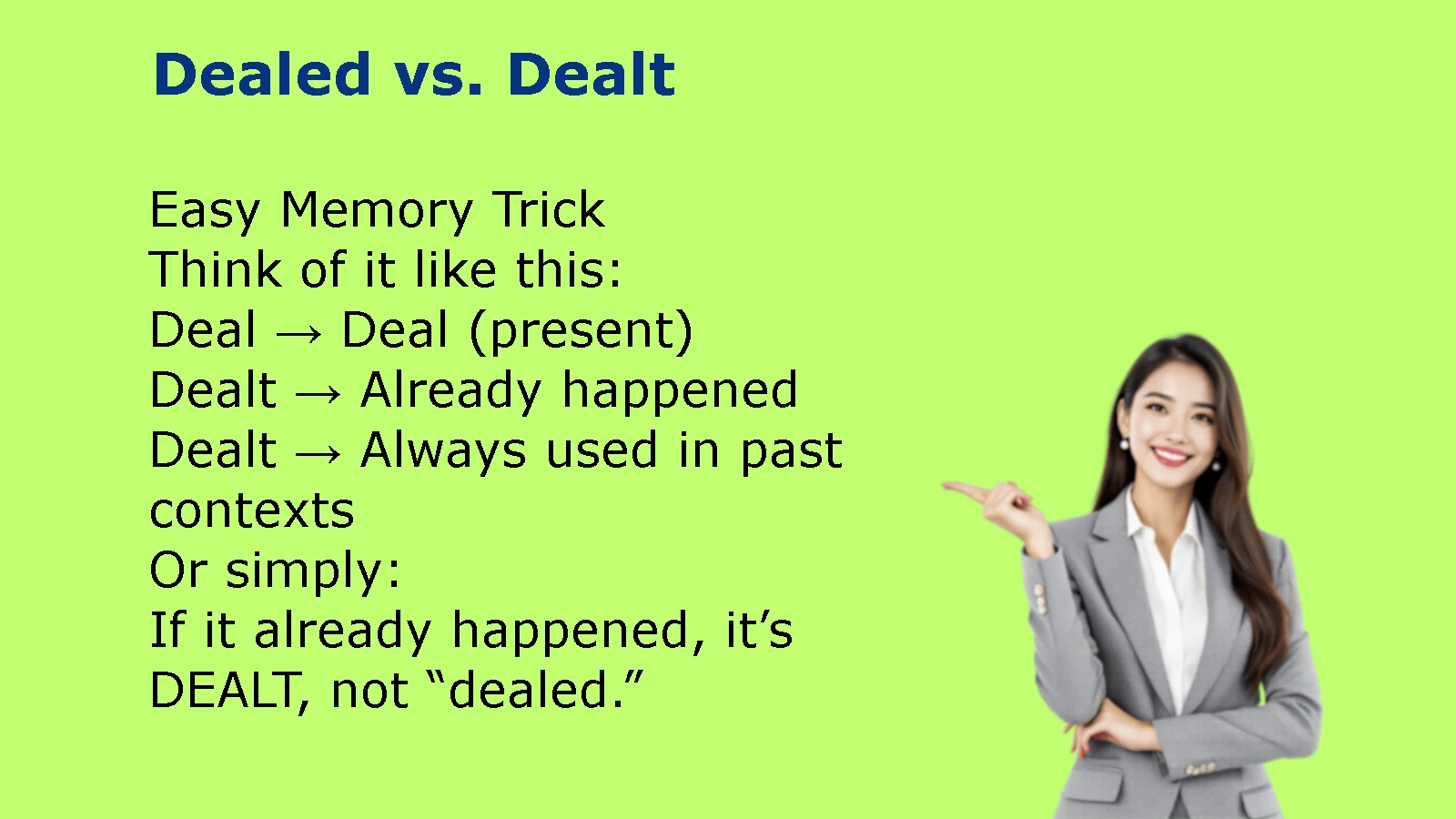
Easy Memory Trick
Think of it like this:
- Deal → Deal (present)
- Dealt → Already happened
- Dealt → Always used in past contexts
Or simply:
If it already happened, it’s DEALT, not “dealed.”
Why “Dealed” Feels Correct (But Isn’t)
Here’s where most confusion starts.
English often follows a pattern:
- play → played
- work → worked
- talk → talked
So people naturally assume:
👉 deal → dealed ❌
But “deal” is an irregular verb, meaning it breaks the normal “-ed” rule.
Instead, it changes completely:
👉 deal → dealt (correct form)
What “Dealt” Actually Means
The word “dealt” is the past form of “deal,” and it is used in multiple meanings:
1. Handled a situation
“I dealt with the problem yesterday.”
2. Distributed something
“She dealt the cards in the game.”
3. Managed or responded to something
“He dealt with pressure very well.”
Key Insight
“Dealt” is flexible—it doesn’t just mean one thing. It covers all past actions of “deal.”
“Dealed” Explained (Why It’s Wrong)
Let’s be clear:
❌ “Dealed” is NOT accepted in standard English grammar
❌ You will not find it in professional writing
❌ It is considered a spelling/grammar mistake
Example of incorrect usage
❌ I have dealed with many problems.
Correct version
✔ I have dealt with many problems.
Why People Still Use It
- Overgeneralizing grammar rules
- Influence from spoken English
- Lack of exposure to irregular verbs
- Autocorrect or typing habits
Side-by-Side Comparison Table
| Form | Correctness | Usage | Example |
| Deal | Correct (present) | Current action | I deal with customers daily. |
| Dealt | Correct (past) | Completed action | I dealt with it yesterday. |
| Dealed | Incorrect | Not standard English | ❌ I dealed with it. |
Real-Life Examples of “Dealt”
Let’s see how native speakers actually use it:
Everyday Use
- “I dealt with the issue quickly.”
- “She dealt with a difficult customer.”
- “They dealt the cards before the game started.”
Work/Professional Use
- “The manager dealt with the complaint.”
- “We dealt with the crisis effectively.”
Emotional Context
- “He dealt with stress in a healthy way.”
Common Mistake People Make
Here’s the real problem:
People think English past tense always ends in “-ed.”
So they apply it everywhere.
What goes wrong:
- deal → dealed ❌
- feel → feeled ❌
- keep → keeped ❌
Reality:
English has many irregular verbs that must be memorized.
Quick Grammar Insight (Simple Logic)
Instead of thinking:
👉 “Add -ed to make past tense”
Think:
👉 “Is this verb irregular?”
If yes → learn its special form
If no → add “-ed”
And “deal” is clearly irregular:
👉 deal → dealt
Real-World Scenario (Case Study)
A student writes:
“I have dealed with all assignments.”
What happens:
- Teacher marks it incorrect
- Sentence loses credibility
- Meaning becomes grammatically weak
Correct version:
“I have dealt with all assignments.”
Lesson:
One small verb mistake can affect clarity and professionalism.
When to Use “Dealt” (Simple Guide)
Use dealt when:
- Talking about past actions
- Using present perfect (have/has + past participle)
- Describing completed situations
Examples:
- I have dealt with it.
- She dealt with the problem.
- They had dealt with it earlier.
Why “Dealt” Is Always the Safe Choice
If you’re unsure, remember:
👉 There is NO correct situation for “dealed”
👉 “Dealt” works in all past forms of “deal”
So you can safely rely on it every time.
Quick Decision Guide
When you’re stuck:
- Present action → deal
- Past action → dealt
- “Dealed” → ❌ never use
Simple. Clean. Reliable.
FAQ: “Dealed” vs. “Dealt”
Is “dealed” ever correct?
No. It is not accepted in standard English.
Why is “deal” irregular?
Because English has historical verb forms that didn’t follow modern rules.
Can I use “dealt” in formal writing?
Yes. It is the only correct past form.
What is the past tense of deal?
“Dealt” is both the past tense and past participle.
Final Takeaway: The One Rule You Must Remember
Let’s simplify everything:
👉 Deal = present
👉 Dealt = past and past participle
👉 Dealed = never correct
English can feel confusing, but irregular verbs follow one rule:
you either know them—or you get used to them.
So next time you’re tempted to write “dealed,” pause and remember:
In English, some verbs don’t follow rules—they make their own.