Have you ever come across the words Immerse vs Emerse and wondered if they mean the same thing? Although they look similar, these terms have completely opposite meanings, which often leads to confusion in writing, science, and everyday communication.
If you’re unsure when to use immerse or emerse, you’re not alone. Many people mix them up because of their similar spelling and pronunciation. But here’s the good news: understanding the difference is much easier than it seems.
In this guide, you’ll learn the key distinctions between Immerse vs Emerse, their definitions, real-world examples, and the situations where each word is used correctly. And there’s more…
By the end of this article, you’ll be able to confidently choose the right term in any context, whether you’re discussing underwater plants, scientific concepts, or everyday actions. Let’s explore the difference and clear up the confusion once and for all.
Quick Answer: “Immerse” vs. “Emerse” (Simple Rule)
Let’s make this simple.
Immerse = to go into something completely (physical or mental)
Emerse = to come out of something (rare, formal, and scientific use)
Easy Memory Trick
Think of it like this:
- Im- = in → Immerse = go in
- E- = exit → Emere (emerge/emerse) = come out
If you’re going in, it’s immerse.
If you’re coming out, it’s emerse.
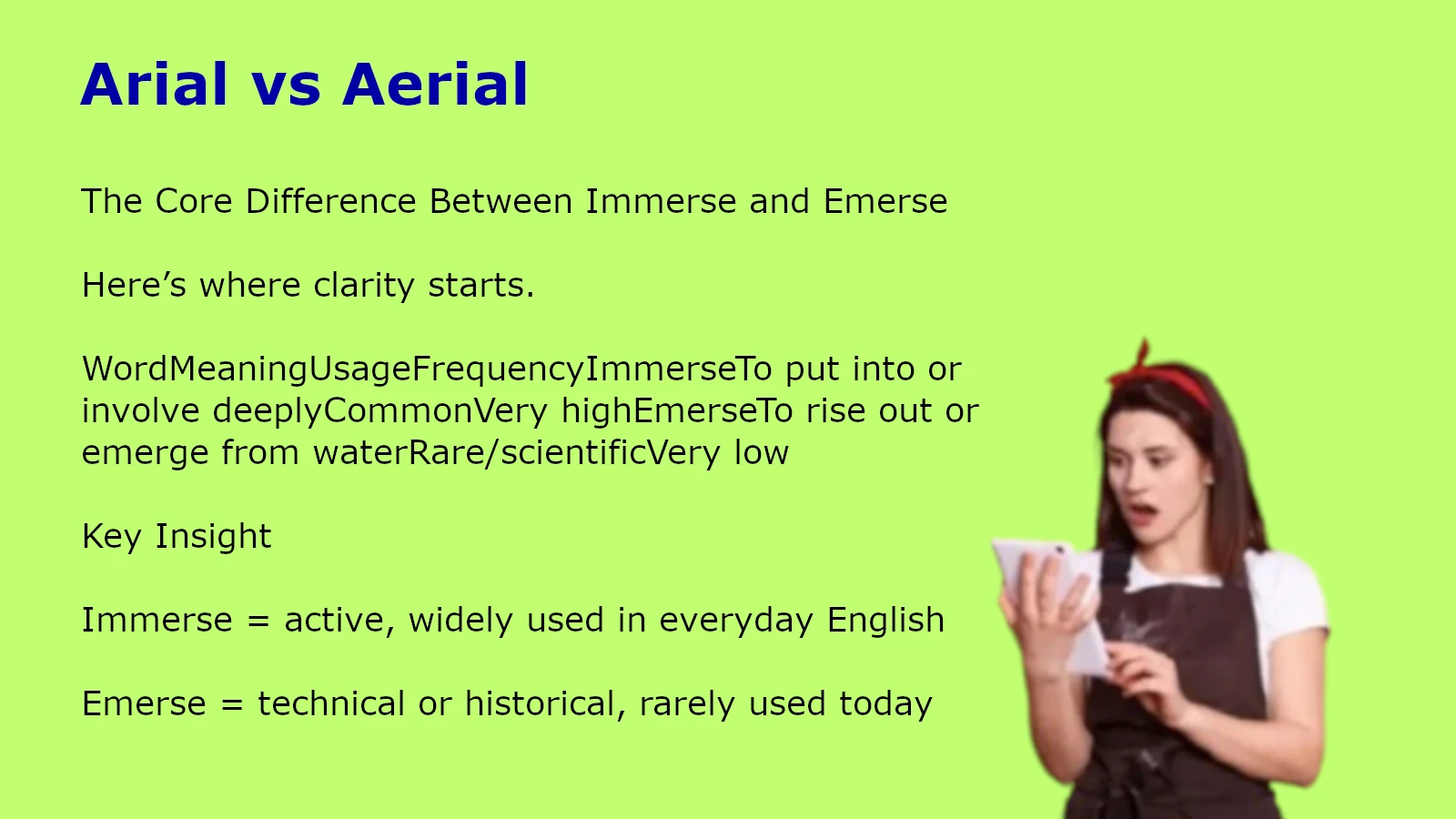
The Core Difference Between Immerse and Emerse
Here’s where clarity starts.
| Word | Meaning | Usage | Frequency |
| Immerse | To put into or involve deeply | Common | Very high |
| Emerse | To rise out or emerge from water | Rare/scientific | Very low |
Key Insight
- Immerse = active, widely used in everyday English
- Emerse = technical or historical, rarely used today
“Immerse” Explained Clearly (With Real Meaning)
Immerse is the word you’ll see everywhere—in writing, speech, education, and daily conversation.
Standard Meaning
To put something completely into a liquid or environment.
But it also has a deeper, modern meaning:
👉 To fully involve yourself in an experience or activity
Real-Life Examples of “Immerse”
Physical Use
- “She immersed the cloth in water.”
- “The chef immersed the vegetables in boiling broth.”
Emotional / Mental Use
- “He immersed himself in learning English.”
- “She immersed in the culture during her travel.”
Key Idea
“Immerse” is about going fully inside something—physically or mentally.
“Emerse” Explained Clearly (Rare but Real)
Now the less familiar twin.
Emerse is not commonly used in everyday English anymore. It comes from Latin roots and appears mostly in scientific or formal contexts.
Standard Meaning
To rise out of a liquid or emerge from something.
Real-Life Examples of “Emerse”
Scientific Use
- “The plant will emerse from the water surface.”
- “The organism emersed after the floodwaters receded.”
Historical/Technical Use
- “The diver emersed from the submerged chamber.”
Key Idea
“Emerse” is about coming out of something after being inside it.
Why “Emerse” Feels Unfamiliar
Here’s the truth:
- “Emerse” is rarely used in modern English
- “Emerge” has largely replaced it
- Most speakers don’t encounter it in daily life
Important Note
In many cases:
- Emersed → replaced by emerged
- That’s why confusion is common
The Biggest Mistake People Make
Here’s the real confusion.
People assume:
Immerse and emerse are equally common opposites
But that’s not true.
What actually happens:
- “Immerse” is active and widely used
- “Emerse” is outdated or scientific
- “Emerge” is the everyday opposite of immerse in modern usage
Real-Life Confusion Scenario
Someone says:
“The diver emersed from the water.”
Others might expect:
“The diver emerged from the water.”
Result:
Confusion in meaning and tone mismatch.
Immerse vs Emerse: Side-by-Side Comparison
Here’s a quick breakdown you can scan anytime:
| Feature | Immerse | Emerse |
| Meaning | Go into fully | Come out of liquid |
| Usage | Everyday English | Rare/scientific |
| Modern relevance | Very high | Very low |
| Common alternative | N/A | “Emerge” |
| Example | Immerse in water | Emersed from water |
Real-Life Examples of “Immerse” (Modern Use)
Let’s ground it in real communication.
Daily Life
- “I want to immerse myself in books this weekend.”
- “She immersed in meditation for peace.”
Work / Study
- “He immersed himself in coding practice.”
- “The team immersed in market research.”
Travel / Culture
- “They immersed in Japanese culture during the trip.”
Real-Life Examples of “Emerse” (Rare Use)
Now the limited usage.
Scientific Context
- “The algae emersed after water evaporation.”
- “The specimen emersed from the solution.”
Technical Writing
- “The device emersed from the testing chamber.”
Why “Immerse” Is the Word You Actually Need
Here’s the practical takeaway.
In 99% of real-life situations:
✔ Use immerse
❌ Avoid emerse
✔ Use emerge instead of emerse in modern speech
Simple Rule
- Into something → immerse
- Out of something → emerge
Forget emerse in everyday writing unless you’re in a scientific context.
How to Never Confuse Them Again
Use this mental shortcut:
Step 1: Think direction
- In = immerse
- Out = emerge (not emerse in modern usage)
Step 2: Remember usage
- Immerse = everyday word
- Emers(e) = technical history
Step 3: When in doubt
- Just use “immerse” or “emerge”
Quick Decision Guide
When you’re unsure:
- Going inside something → immerse
- Coming out of something → emerge
- Rare scientific context → emerse (optional)
Simple. Reliable. Safe.
FAQ: Immerse vs Emerse
Is “emerse” a real word?
Yes, but it’s rarely used in modern English and mostly appears in scientific or historical contexts.
What is the opposite of immerse?
In modern English, the opposite is emerge, not emerse.
Can I use “emerse” in writing?
You can, but it may sound outdated or overly technical.
Why don’t people use “emerse” anymore?
Because “emerge” became the standard and more natural alternative.
Conclusion: Immerse vs. Emerse
While immerse and emerse may look similar, they have very different meanings. Immerse means to dip, submerge, or become deeply involved in something, making it a common word in everyday conversation, education, and literature. Emerse, on the other hand, is a specialized term mainly used in biology and botany to describe plants or organisms that rise above the surface of water.
Understanding the distinction between these two words helps you use them accurately and avoid confusion. If you’re talking about deep involvement or submersion, immerse is almost always the correct choice. If you’re discussing aquatic plants or scientific topics related to water environments, emerse may be the term you need. By recognizing their unique meanings and contexts, you can communicate with greater precision and confidence.