Unsecure vs Insecure is a commonly confused pair of words, but they are not interchangeable—and using the wrong one can change the meaning of your sentence entirely. Have you ever written something like “unsecure connection” or “I feel unsecure” and wondered if it sounded correct? You’re not alone. Many writers, students, and even professionals mix these terms up in everyday communication.
But here’s the kicker: only one of these words is widely accepted in standard English usage. And it gets better… understanding the difference helps you write more accurately, especially in professional, technical, or emotional contexts. In this guide, you’ll learn the correct meaning of unsecure vs insecure, when to use each word, and how to avoid common mistakes so your writing stays clear, correct, and confident.
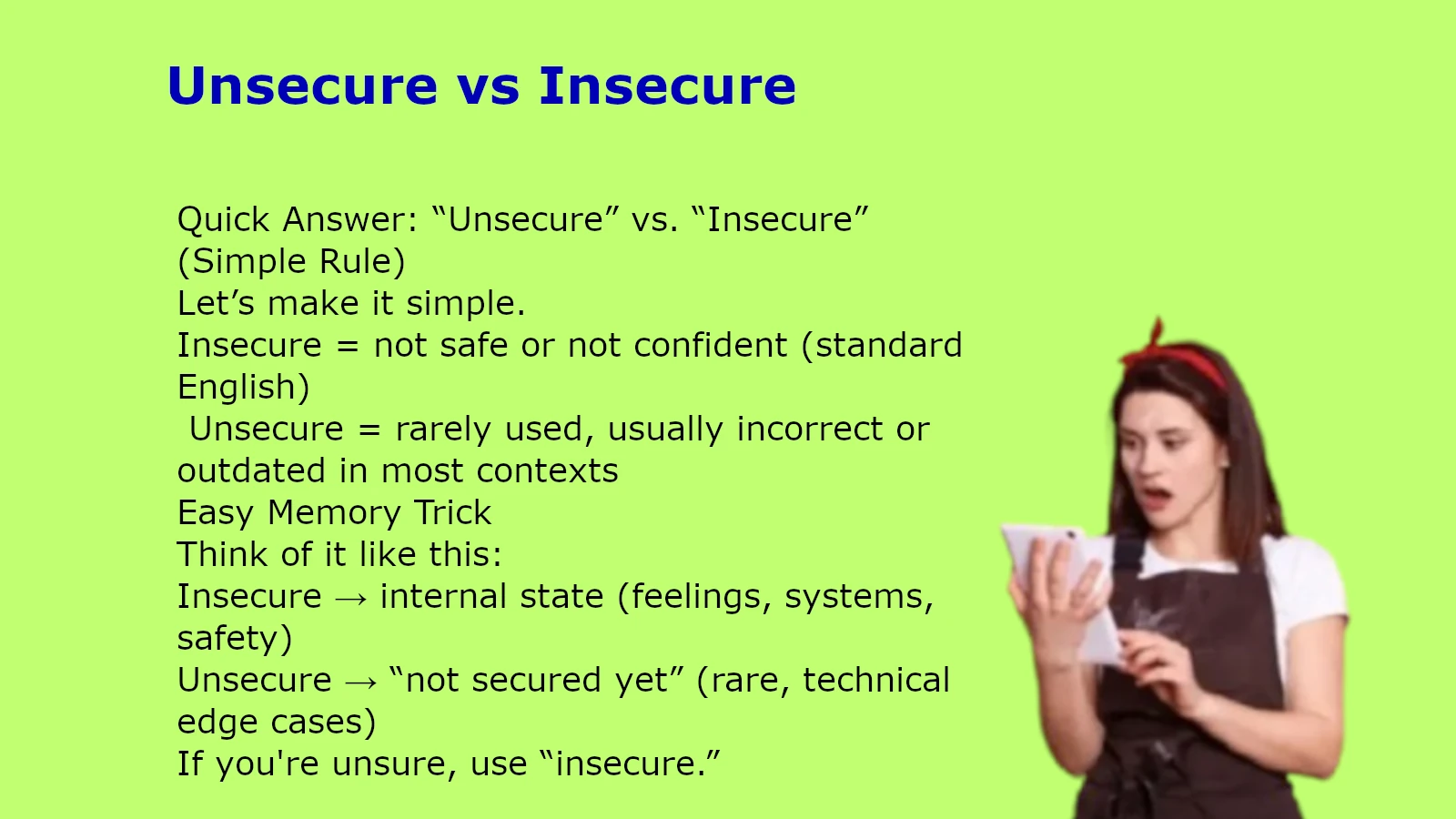
Quick Answer: “Unsecure” vs. “Insecure” (Simple Rule)
Let’s make it simple.
Insecure = not safe or not confident (standard English)
Unsecure = rarely used, usually incorrect or outdated in most contexts
Easy Memory Trick
Think of it like this:
- Insecure → internal state (feelings, systems, safety)
- Unsecure → “not secured yet” (rare, technical edge cases)
If you’re unsure, use “insecure.”
The Real Difference Between “Unsecure” and “Insecure”
This is where things get interesting.
Both words come from the idea of “not secure,” but they evolved differently in English.
Insecure (The Standard Word)
“Insecure” is the correct and widely accepted word in modern English.
It means:
- Not safe or protected
- Lacking confidence or stability
Examples:
- “The system is insecure and needs an update.”
- “He feels insecure about his presentation.”
- “This network is insecure.”
Unsecure (Rare and Limited Use)
“Unsecure” technically exists, but it is not commonly used in standard English.
When it is used, it usually means:
- To remove security from something (verb usage)
- Or something not yet secured (rare technical usage)
Examples (rare/technical):
- “The admin unsecure the file system temporarily.” (very uncommon)
- “Unsecure access points were detected.” (non-standard in most writing)
Key Insight:
In most real-world writing, “unsecure” sounds incorrect or unnatural.
Why “Insecure” Is the Word You See Everywhere
English prefers “insecure” because it developed as the natural opposite of “secure.”
Think of similar patterns:
- active → inactive
- complete → incomplete
- secure → insecure
But NOT:
- secure → unsecure (rare exception, not standard usage)
That’s why:
👉 “insecure” became the dominant form
👉 “unsecure” stayed niche or outdated
“Insecure” in Everyday Life (With Real Meaning)
“Insecure” is used in two major ways.
1. Security Meaning (Technical / Digital)
- “The Wi-Fi connection is insecure.”
- “This website is insecure and unsafe.”
2. Emotional / Psychological Meaning
- “She feels insecure in new environments.”
- “He’s insecure about his skills.”
Key Insight:
“Insecure” can describe both systems and people, which is why it’s so widely used.
Where “Unsecure” Still Appears (Edge Cases)
Even though it’s rare, you might still see “unsecure” in:
1. Informal or incorrect usage
- Often in non-native writing or quick messages
2. Technical commands (rare legacy systems)
- Some older systems or documentation may use it as a verb:
- “unsecure device access” (meaning remove security)
3. Mistakes in cybersecurity writing
- Very common in outdated or unedited content
Key Takeaway:
If you see “unsecure,” always double-check the context—it’s often wrong or non-standard.
Side-by-Side Comparison Table
| Word | Meaning | Usage Level | Correct in Modern English |
| Insecure | Not safe / not confident | Very common | Yes |
| Unsecure | Not secured / remove security (rare) | Rare / technical | Usually no |
Real-Life Examples of “Insecure”
Let’s ground it in real usage.
Security Context
- “The app is insecure and exposes user data.”
- “Avoid insecure connections when banking online.”
Emotional Context
- “He feels insecure in social situations.”
- “She became insecure after criticism.”
What it means:
Always clear, always standard, always correct.
Real-Life Examples of “Unsecure”
Now the rare side.
Technical / Uncommon Use
- “Unsecure the firewall for maintenance.” (rare)
- “Unsecure mode enabled.” (system-specific)
What it usually means:
- Remove security controls (temporary)
- Or poorly written “insecure”
Key Insight:
In most cases, you should rewrite it as “insecure” or “not secure.”
The Biggest Mistake People Make
Here’s the real problem.
People assume:
“unsecure = correct opposite of secure”
But English doesn’t always work like simple opposites.
What goes wrong:
- Writers use “unsecure” in professional documents
- It looks natural but sounds incorrect
- Readers notice inconsistency
Real Scenario
A cybersecurity report says:
“The system is unsecure.”
What experts expect:
“The system is insecure.”
Same meaning—but one sounds correct, the other doesn’t.
How to Choose the Right Word Every Time
Use this simple system:
Use “insecure” when:
- Talking about safety
- Talking about emotions
- Writing professional content
- Describing systems or risks
Avoid “unsecure” unless:
- You are dealing with a specific technical system that uses it
- You are quoting legacy documentation
When in doubt:
👉 Replace both with “not secure”
Better Alternatives (Cleaner English)
Instead of risking confusion, use:
- “not secure”
- “unsafe”
- “vulnerable”
- “exposed”
Example upgrades:
- ❌ “The network is unsecure.”
- ✔ “The network is not secure.”
- ✔ “The network is vulnerable.”
Quick Decision Guide
If you’re unsure:
- Emotional meaning → insecure
- Security risk → insecure
- Technical legacy system → maybe unsecure
- Still unsure → not secure
Simple. Safe. Professional.
FAQ: “Unsecure” vs. “Insecure”
Is “unsecure” a real word?
Yes, but it is rarely used and often considered incorrect in modern English.
Can I use “unsecure” in writing?
It’s best to avoid it unless required by a specific technical context.
Is “insecure” always correct?
Yes, in most contexts—especially security and emotional usage.
Why do people confuse them?
Because “un-” and “in-” both mean “not,” but English doesn’t apply them consistently.
Final Takeaway: The One Rule That Never Fails
Here’s the truth.
English is full of near-duplicates, but only one usually survives in real usage.
So remember this:
👉 “Insecure” is the standard word for almost everything.
👉 “Unsecure” is rare, technical, or incorrect in most cases.
When in doubt, don’t overthink it—just use “insecure.”
Because in real writing, clarity always beats complexity.