In Rime vs. Rhyme, ideas from Edward Finegan, Steven Pinker, Language: Its Structure and Use, and The Language Instinct show how linguists in the field explain syllable structure to everyday literacy instructors in training for kindergarten students. The concepts of onset, rime, and rhyme often create confusion in spelling and sound-spelling correspondence. In phonetics and phonology, the first sound like consonant /b/ in bear is the onset, while pear and care share a word family ending like -ear. This shows sound similarity but different orthography, creating semantic contrast that affects beginning reader reading development.
In language use, words with similar sounds at the end of sentences form rhyme, often used as a literary device in poems, while rime can also refer to snow, ice, covering trees and plants. These are homophones, creating lexical ambiguity in English language learning, where even dictionaries influence instructional clarity in literacy instruction and instructional coaching. Within mental categories of language learning, choices like word choice, usage decision, and spelling variants depend on sound patterns, pronunciation, meaning selection, and context.
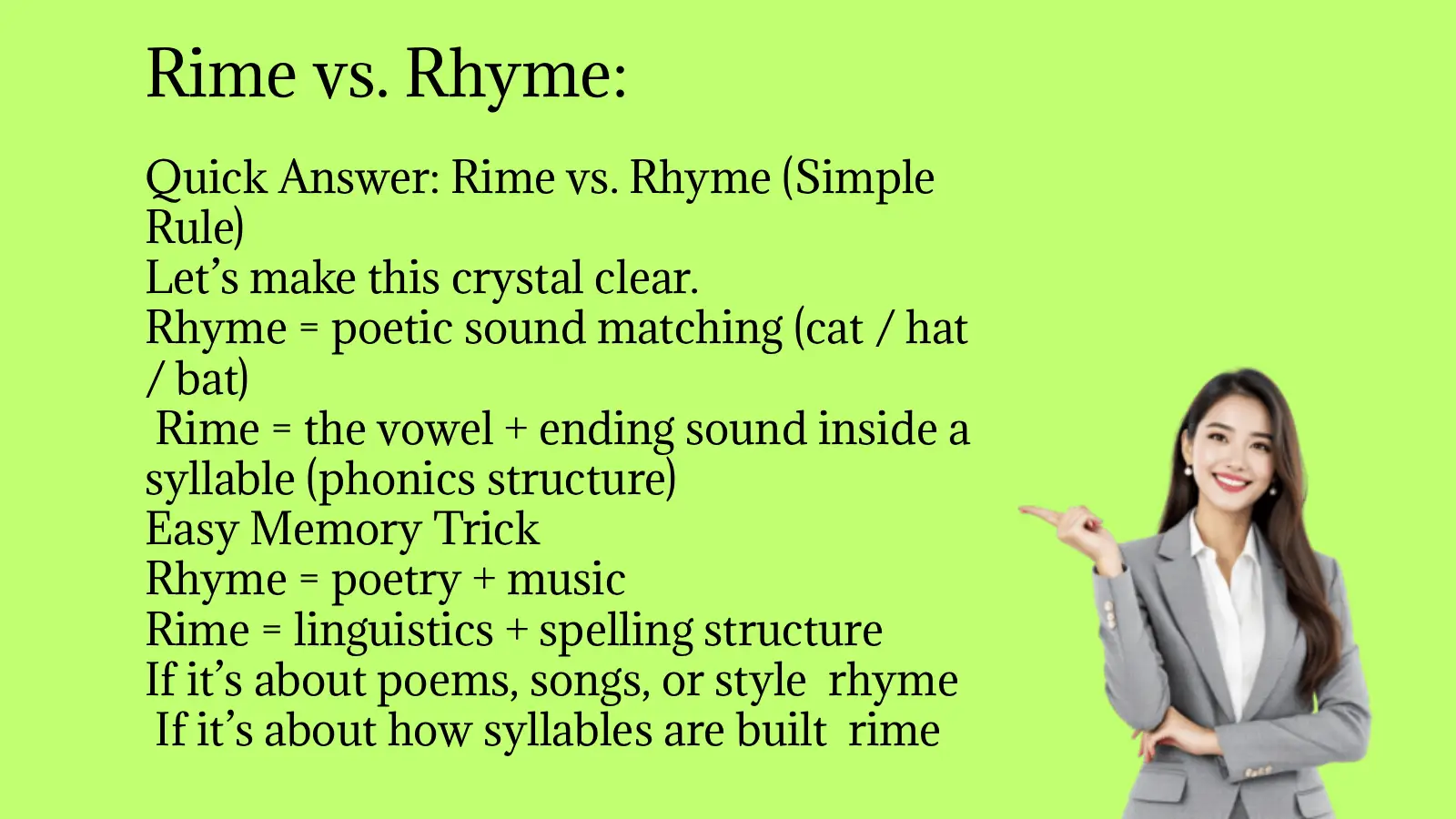
Quick Answer: Rime vs. Rhyme (Simple Rule)
Let’s make this crystal clear.
Rhyme = poetic sound matching (cat / hat / bat)
Rime = the vowel + ending sound inside a syllable (phonics structure)
Easy Memory Trick
- Rhyme = poetry + music
- Rime = linguistics + spelling structure
If it’s about poems, songs, or style → rhyme
If it’s about how syllables are built → rime
Why This Confusion Happens
The confusion is actually very understandable.
Both words sound identical, and historically they come from the same origin. But over time, they split into different meanings in different fields—especially in poetry vs. linguistics.
In modern usage:
- Writers mostly use rhyme
- Linguists and educators often use rime
Rhyme Explained Clearly (With Examples)
A rhyme is when words share similar ending sounds, usually in poetry or songs.
Classic Examples
- cat / hat / bat
- light / night / sight
- flow / go / show
In Poetry
Rhyme is used to create:
- rhythm
- musical effect
- memorability
Example:
“Twinkle, twinkle, little star
How I wonder what you are”
Here, star and are form a rhyme pattern.
Key Idea
Rhyme is about sound matching at the end of words, mainly for artistic effect.
Rime Explained Clearly (With Linguistics Insight)
Now let’s switch to the technical side.
In linguistics, especially in early reading instruction and phonology (part of Linguistics), a rime is the part of a syllable that includes:
- the vowel sound
- any consonants after it
Example Breakdown
Take the word “cat”:
- onset = c
- rime = -at
Now compare:
- cat → -at
- hat → -at
- bat → -at
These words share the same rime structure.
Key Idea
Rime is about how syllables are built inside words, not poetic style.
Rhyme vs Rime: The Core Difference
Here’s the simplest breakdown:
| Feature | Rhyme | Rime |
| Field | Poetry / literature | Linguistics / phonics |
| Focus | End sound similarity | Syllable structure |
| Example | cat / hat | -at in cat |
| Purpose | Artistic effect | Language analysis |
The Biggest Mistake People Make
Here’s the real issue:
People assume rime is just a spelling variant of rhyme. It’s not.
What goes wrong:
- Teachers say “rime units” in phonics
- Students think it’s just “rhyme spelled differently”
- Writers mix the terms incorrectly
Real Confusion Example
A student writes:
“These words have the same rhyme: cat, hat, bat”
A linguist would say:
“These words share the same rime: -at”
Same words. Different perspectives.
Real-Life Usage Examples
Rhyme in Action
- “Can you find a rhyme for ‘time’?”
- “This poem uses a perfect rhyme scheme.”
- “Rhyming words make songs catchy.”
Rime in Action
- “Teach children to recognize rime units.”
- “The rime of ‘spring’ is ‘-ing’.”
- “Phonics instruction focuses on rime patterns.”
Why Linguists Prefer “Rime”
In early reading instruction, breaking words into rime helps children:
- recognize patterns faster
- decode unfamiliar words
- improve reading fluency
That’s why in structured literacy approaches (especially in Phonology), “rime” is preferred over “rhyme.”
Simple Way to Never Confuse Them Again
Use this rule:
- If you can sing it → rhyme
- If you can split it into syllables → rime
Or even simpler:
- Poetry brain → rhyme
- Phonics brain → rime
Quick Comparison Table
| Phrase | Meaning | Best Use |
| Rhyme | Matching end sounds in words | Poems, songs, writing |
| Rime | Vowel + ending in syllables | Reading, phonics, linguistics |
FAQ: Rime vs Rhyme
Are rime and rhyme the same?
No. They are related historically but used in different fields today.
Can I use “rime” in poetry?
Not usually. In poetry, “rhyme” is the correct term.
Why do teachers use “rime”?
Because it helps break words into readable chunks for learning.
Is “rime” outdated?
No—it is still widely used in linguistics and education.
Final Takeaway: The One Rule That Never Fails
Here’s the simplest way to remember it:
Rhyme belongs to poetry.
Rime belongs to language structure.
They may look the same. They may sound the same.
But they live in two different worlds.
So next time you see them, don’t guess—just ask:
Am I talking about sound in poetry or structure in language?
That answer will tell you everything.