In Gaudy vs. Gawdy, the confusion often begins when people encounter two similar-looking words that sound almost identical but carry very different meanings. Gaudy is a legitimate English word used as an adjective to describe something extravagantly bright, showy, or even tasteless, like neon lights in a casino, creating a visible display for miles. However, Gawdy is simply a common misspelling that is not recognized in standard English dictionaries, and therefore, it should be avoided in both writing and speaking to ensure clear and accurate communication.
Moreover, many learners get confused because the spelling appears similar and is sometimes used interchangeably in informal contexts. However, understanding the correct usage of Gaudy is important because it reflects good language control and helps prevent embarrassing mistakes. In addition, the word carries historical depth, tracing back to Middle English “gaud,” which implied a trick or ornament, later evolving into “gaudi,” referring to ornamental beads around the 1520s, which improves clarity in understanding its origin and evolution.
Furthermore, in real-life usage, Gaudy is often applied to describe visually overwhelming scenes, such as decorative rooms with gold mirrors, velvet curtains, and glittering chandeliers that compete for attention. On the other hand, using Gawdy in formal writing can lead to confusion, negative judgment, and reduced credibility. Therefore, mastering this distinction not only improves vocabulary and writing skills but also enhances communication, clarity, and confidence in everyday and professional language use.
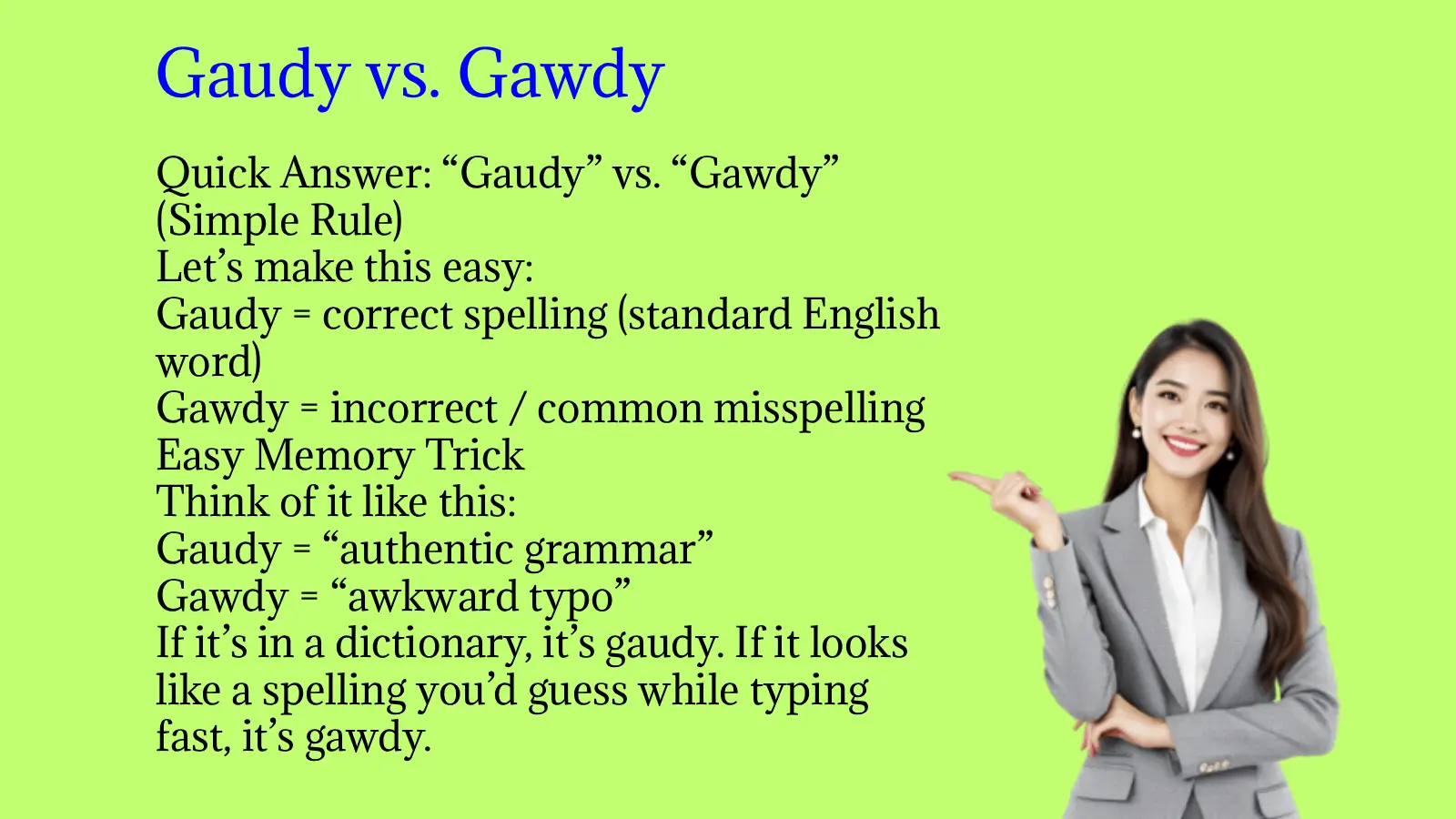
Quick Answer: “Gaudy” vs. “Gawdy” (Simple Rule)
Let’s make this easy:
Gaudy = correct spelling (standard English word)
Gawdy = incorrect / common misspelling
Easy Memory Trick
Think of it like this:
- Gaudy = “authentic grammar”
- Gawdy = “awkward typo”
If it’s in a dictionary, it’s gaudy. If it looks like a spelling you’d guess while typing fast, it’s gawdy.
What “Gaudy” Actually Means
The word gaudy describes something that is too bright, flashy, or over-decorated in a way that lacks taste.
Standard Meaning
- Excessively bright or showy
- Over-the-top decoration
- Loud in appearance rather than elegant
Simple Example
- “The room was decorated in a gaudy mix of neon colors and gold accents.”
It’s usually used in a slightly negative or critical tone.
Where “Gawdy” Comes From
Here’s the key point: “gawdy” is not a real standard word in modern English.
Why People Write It
- It sounds like “gaudy” when spoken aloud
- People assume spelling follows pronunciation
- Fast typing + autocorrect mistakes
- Confusion with similar-sounding words
Reality Check
If you’re writing formally, academically, or professionally, “gawdy” is always considered wrong.
Why “Gaudy” and “Gawdy” Get Confused
This confusion is surprisingly common because English spelling is inconsistent.
Main Reasons
- The pronunciation sounds identical
- “au” and “aw” often represent similar sounds in English
- Social media spreads incorrect spelling quickly
- People copy what they see online
Result
One correct word → gaudy
One frequent typo → gawdy
“Gaudy” in Real-Life Usage (With Examples)
Let’s see how it actually appears in sentences.
Common Situations
- “The jewelry looked gaudy under the bright lights.”
- “He prefers simple designs over gaudy decorations.”
- “The costume was intentionally gaudy for the performance.”
What It Implies
Usually:
- Too flashy
- Not subtle
- Lacks elegance or refinement
“Gawdy” in Real Life (Spoiler: It Shouldn’t Be There)
If you see “gawdy” in real sentences, it’s almost always a mistake.
Incorrect Examples
- ❌ “The dress looked gawdy at the party.”
- ❌ “That building is too gawdy for my taste.”
Correct Versions
- ✔ “The dress looked gaudy at the party.”
- ✔ “That building is too gaudy for my taste.”
Side-by-Side Comparison Table
| Word | Correctness | Meaning | Usage Status |
|---|---|---|---|
| Gaudy | Correct | Flashy, over-decorated | Standard English |
| Gawdy | Incorrect | Misspelling of gaudy | Not accepted usage |
The Biggest Mistake People Make
Here’s the real issue:
People think “gawdy” is an alternative spelling of “gaudy.”
What Actually Happens
- They see “gawdy” online
- Assume it’s a variant (like “colour/color”)
- Start using it in writing
- Pass the mistake forward
Reality
There is no official variation. Only one correct spelling exists: gaudy.
Quick Way to Remember the Correct Spelling
Use this simple trick:
“AU = Authentic”
- Gaudy = Correct
- “au” is your signal for standard spelling
“AW = Awkward”
- Gawdy = Wrong
- “aw” reminds you it’s a typo or mistake
When You’ll Most Often See “Gaudy”
The word appears in:
Fashion
- “gaudy outfits”
- “gaudy jewelry”
Interior Design
- “gaudy decorations”
- “gaudy wallpaper”
Criticism / Reviews
- “The design feels gaudy rather than elegant.”
It’s usually used when something tries too hard to look impressive.
Real-World Scenario (Common Confusion Case)
Imagine someone writes:
“The wedding setup looked gawdy but expensive.”
What happens:
- Some readers understand the meaning
- Grammar-conscious readers immediately spot the error
- The credibility of the writing drops slightly
Fixed Version
“The wedding setup looked gaudy but expensive.”
One letter makes the difference between correct and incorrect English.
FAQ: Gaudy vs. Gawdy
Is “gawdy” ever correct?
No. It is not recognized in standard English dictionaries.
Why do people still use “gawdy”?
Because it sounds like “gaudy” and is often a typing or spelling error.
Does “gaudy” always mean ugly?
Not always. It means overly flashy, which can be intentional or stylistic.
Can “gaudy” ever be positive?
Rarely, but sometimes in fashion or art when exaggeration is intentional.
Final Takeaway: The One Rule That Never Fails
Here’s the simplest way to remember everything:
If you mean flashy or over-decorated → use “gaudy.”
If you wrote “gawdy,” it’s a mistake—fix it immediately.
English often has confusing spellings, but this one is simple once you lock it in.
Because in the end, clarity in writing matters more than guessing spelling—and in the case of gaudy vs. gawdy, only one version actually belongs in correct English.