Compromise is the correct spelling in American and British English, while compromize is a misspelling. A compromise is an agreement in which people accept trade-offs to resolve a disagreement, but the word can also mean putting something at risk, such as security, privacy, or quality.
Understanding compromise vs. compromize helps you spell the word correctly and use it naturally in conversations, academic writing, and professional communication. You can also learn its meaning, pronunciation, synonyms, antonyms, and examples, along with related expressions such as compromise vs. sacrifice, compromise vs. negotiation, and compromise vs. comprise.
Compromise vs. Compromize: Which Spelling Is Correct?
Compromise is the correct spelling. Compromize is incorrect in standard English. Both American and British English use compromise, so you don’t need to change its spelling when switching between these varieties.
| Word | Correctness | Explanation |
| Compromise | Correct | Standard English spelling |
| Compromize | Incorrect | Common spelling mistake |
| Compromises | Correct | Third-person singular verb or plural noun |
| Compromised | Correct | Past tense and past participle |
| Compromising | Correct | Present participle or adjective |
Compromise or Compromize: Correct Spelling
Always write compromise when you mean reaching an agreement or weakening something’s security, integrity, or effectiveness.
Examples:
- We reached a compromise after a long discussion.
- Both departments agreed to compromise on the deadline.
- Sharing your password could compromise your account.
- The two neighbors found a reasonable compromise.
Incorrect: We need to compromize to solve this issue.
Correct: We need to compromise to solve this issue.
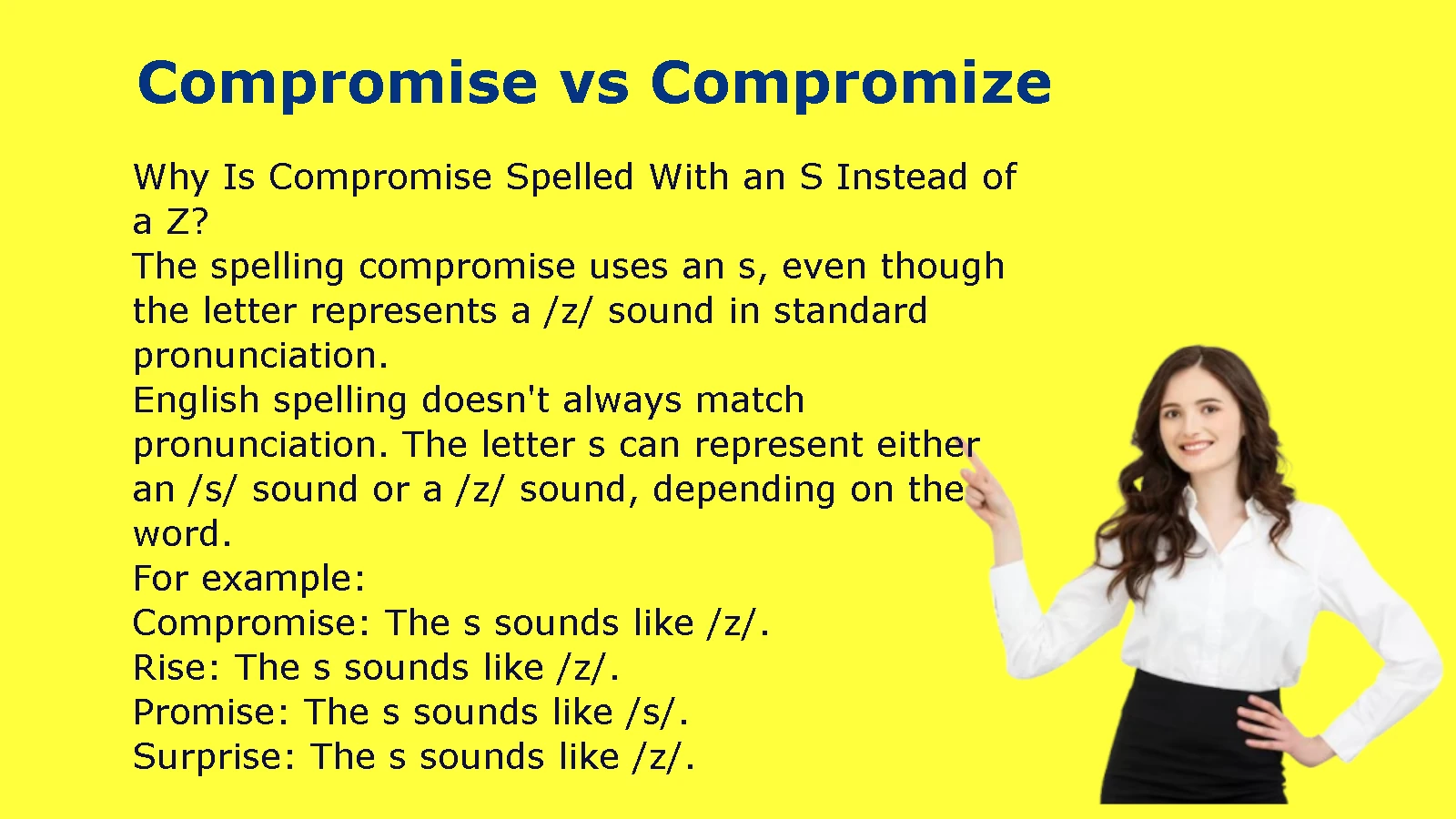
Why Is Compromise Spelled With an S Instead of a Z?
The spelling compromise uses an s, even though the letter represents a /z/ sound in standard pronunciation.
English spelling doesn’t always match pronunciation. The letter s can represent either an /s/ sound or a /z/ sound, depending on the word.
For example:
- Compromise: The s sounds like /z/.
- Rise: The s sounds like /z/.
- Promise: The s sounds like /s/.
- Surprise: The s sounds like /z/.
The pronunciation doesn’t justify changing the spelling to compromize. Memorizing the standard spelling is the safest approach.
Compromise Spelling Examples
Here are a few examples to help you remember the correct form.
- We need a compromise that benefits both teams.
- She refused to compromise her professional standards.
- The agreement represents a fair compromise.
- He compromised his privacy by sharing personal information.
Spelling tip: Remember the phrase compromise, not compromize. The standard word always ends in -mise, not -mize.
Compromise Meaning and Definition
Compromise is a noun and a verb. As a noun, it refers to an agreement reached through mutual concessions or trade-offs. As a verb, it means to reach an agreement by making concessions or to weaken, damage, or expose something to risk.
The meaning depends on how you use the word in a sentence.
Compromise as a Noun
A compromise is an agreement in which people adjust their expectations or demands to settle a disagreement.
It often involves finding a middle ground between different preferences, goals, or positions.
Examples:
- The compromise satisfied both business partners.
- Their compromise helped end the argument.
- We finally reached a compromise on the project budget.
In these examples, compromise refers to a solution rather than the process of discussing it.
A compromise doesn’t always mean both parties give up exactly the same amount. One person might adjust the schedule while another changes the budget. What matters is whether the agreement works for the people involved.
Compromise as a Verb
As a verb, compromise has two important meanings.
Meaning 1: To reach an agreement through concessions
Examples:
- They compromised on the meeting time.
- We compromised to avoid further conflict.
- Both sides agreed to compromise.
Meaning 2: To weaken, damage, expose, or put something at risk
Examples:
- Poor planning could compromise the entire project.
- The data breach compromised customer information.
- He refused to compromise his principles.
These meanings can create confusion. In one sentence, compromise describes cooperation. In another, it describes harm or risk.
Pay attention to the object and surrounding context to understand the intended meaning.
Compromising Situation Meaning
A compromising situation is a circumstance that may expose someone to embarrassment, suspicion, reputational damage, or an uncomfortable position.
It often describes a situation that could make a person’s conduct appear questionable, even when the full context remains unclear.
Examples:
- The manager found himself in a compromising situation after accepting an expensive gift from a supplier.
- She avoided a compromising situation by keeping the discussion transparent.
- The photograph placed the politician in a compromising position.
However, a compromising situation doesn’t always involve wrongdoing. Sometimes, appearances alone create misunderstandings.
Also, don’t confuse a compromising situation with a situation that requires compromise. The first concerns exposure or embarrassment; the second involves resolving differences.
How to Pronounce Compromise
The American English pronunciation of compromise is commonly represented as /ˈkɑːm.pɹə.maɪz/.
A simple pronunciation guide is:
KAHM-pruh-mize
The word has three syllables, with the primary stress on the first syllable.
The final sound resembles ize, but the spelling remains -mise.
Example:
“We reached a compromise after the discussion.”
Practice saying the word in a full sentence rather than focusing only on its individual sounds.
Compromise Examples in Everyday English
Compromise examples help show how people use the word in personal, academic, and professional situations.
The word can describe a mutual agreement, an adjustment in expectations, or a decision that risks something valuable.
Compromise Examples as a Noun
Here are original examples of compromise used as a noun.
- The compromise allowed both friends to enjoy the weekend.
- Their final proposal offered a reasonable compromise.
- The compromise saved the company time and money.
- Finding a compromise took patience and honest communication.
- Neither side received everything it wanted, but both accepted the compromise.
Notice how the noun often appears with words such as reach, find, offer, accept, and reasonable.
Common expressions include:
- Reach a compromise
- Find a compromise
- Accept a compromise
- A fair compromise
- A reasonable compromise
Compromise Examples as a Verb
The verb often appears with on, with, or a direct object.
Examples:
- We compromised on the color of the living room.
- The two companies compromised on the delivery schedule.
- She wouldn’t compromise her values for financial gain.
- They compromised with the landlord to avoid a dispute.
- The outdated software could compromise network security.
These sentences illustrate why context matters.
In “compromised on the schedule,” the verb describes reaching an agreement.
In “compromise network security,” it means weakening or putting security at risk.
Compromise in a Relationship
Compromise in a relationship means making reasonable adjustments to accommodate each other’s preferences, needs, and circumstances.
Healthy compromise requires respect and communication. It shouldn’t force one person to abandon their identity, safety, or essential boundaries.
For example, imagine one partner enjoys quiet weekends at home while the other prefers going out.
They could agree to spend Saturday evening at home and plan an outdoor activity on Sunday.
Both partners adjust their preferences, and neither has to give up everything.
Healthy relationship compromises may involve:
- Deciding how to divide household responsibilities.
- Choosing activities that both partners enjoy.
- Balancing personal time with time together.
- Planning holidays around different budgets.
- Agreeing on routines that accommodate both schedules.
Healthy compromise vs. unhealthy compromise
| Healthy compromise | Unhealthy compromise |
| Both people have a voice | One person controls decisions |
| Boundaries remain respected | Boundaries face constant pressure |
| Adjustments feel reasonable | One person repeatedly sacrifices |
| Both partners can disagree safely | Disagreement leads to intimidation |
| The arrangement can be revisited | One person must accept unfair terms |
Practical example: One partner wants to save money, while the other wants to take a vacation. They agree to choose a less expensive destination and save toward the trip together.
That is a compromise because both people adjust their expectations.
However, nobody should feel pressured to accept abuse, coercion, unsafe behavior, or unwanted intimacy in the name of compromise.
Compromise in Business and Negotiation
In business, compromise can help teams settle differences involving deadlines, budgets, prices, and responsibilities.
Imagine a client wants a website completed in two weeks, but the developer estimates four weeks for the full project.
Instead of promising an unrealistic deadline, they negotiate a compromise:
- The developer delivers the essential pages within two weeks.
- The client receives the remaining features two weeks later.
- Both parties document the revised scope and timeline.
This compromise protects the quality of the work while addressing the client’s immediate needs.
Business compromises work best when people identify their priorities before making concessions.
A useful framework is:
- Identify: What does each party need?
- Separate: Which preferences are flexible, and which requirements are essential?
- Propose: Offer realistic alternatives.
- Evaluate: Compare costs, risks, and benefits.
- Confirm: Record the final agreement clearly.
This approach prevents a quick agreement from creating bigger problems later.
Compromise Synonyms and Alternatives
Common compromise synonyms include agreement, settlement, accommodation, concession, and middle ground.
However, these words have different meanings. Choose an alternative based on whether you mean a mutual resolution, an individual concession, or a negotiated outcome.
Common Synonyms for Compromise
| Synonym | Meaning | Example |
| Agreement | A shared decision or understanding | We reached an agreement. |
| Settlement | A resolution to a dispute | The settlement ended the legal dispute. |
| Accommodation | An adjustment to meet needs | The schedule change was an accommodation. |
| Concession | Something given up | Her concession helped move the discussion forward. |
| Middle ground | A position between opposing views | They found middle ground on the proposal. |
| Trade-off | A balance between competing benefits or costs | The shorter deadline involved a trade-off. |
| Reconciliation | Restoring friendly relations or resolving differences | Their reconciliation followed months of conflict. |
Formal and Professional Synonyms
When writing emails, reports, or business proposals, consider these alternatives:
Settlement: Use this when parties resolve a dispute or claim.
Example: Both companies negotiated a settlement.
Mutual agreement: Use this when everyone involved accepts the terms.
Example: The new schedule was established by mutual agreement.
Resolution: Use this when emphasizing the result of a problem-solving process.
Example: The meeting produced a practical resolution.
Accommodation: Use this when an adjustment helps meet someone’s needs.
Example: The company approved an accommodation for the employee’s schedule.
Negotiated agreement: Use this when highlighting the terms established through negotiation.
Example: The supplier accepted the negotiated agreement.
Informal Alternatives to Compromise
In casual conversations, these expressions often sound more natural:
- Meet halfway: Both people make adjustments.
- Find common ground: Identify shared interests or beliefs.
- Work something out: Resolve a disagreement.
- Give and take: Exchange concessions or adjustments.
- Come to an agreement: Reach a shared decision.
Examples:
“We couldn’t agree at first, but we eventually met halfway.”
“Let’s find common ground before making a decision.”
“We can work something out if we’re both flexible.”
How to Choose the Right Synonym
Don’t replace compromise with a synonym automatically.
Consider what your sentence emphasizes.
- Use agreement when the parties accept shared terms.
- Use concession when someone gives up a demand.
- Use settlement when resolving a dispute.
- Use trade-off when balancing benefits and costs.
- Use accommodation when adjusting to another person’s needs.
For example, “She made a compromise” may work in everyday speech, but “She made a concession” is more precise if she alone gave up one demand.
What Is the Opposite of Compromise?
The opposite of compromise depends on the meaning. Refusal, deadlock, intransigence, and insistence can describe resistance to compromise, while uncompromised can describe something that remains intact.
No single antonym fits every use of the word.
Common Opposites of Compromise
| Opposite | Meaning |
| Refusal | Rejecting a proposal or request |
| Deadlock | A situation where progress stops |
| Intransigence | Refusing to change one’s position |
| Standoff | A conflict with no clear resolution |
| Insistence | Firmly maintaining a demand or position |
For example:
- Their refusal prevented an agreement.
- Intransigence prolonged the negotiations.
- The discussion ended in a deadlock.
Compromise vs. Refusal
A compromise involves accepting an arrangement or making concessions to resolve differences.
A refusal means rejecting a request, proposal, or offer.
Example:
The landlord requested a rent increase. The tenant proposed a smaller increase, and both eventually compromised.
If the landlord rejected every proposal, that response would be a refusal rather than a compromise.
Refusal isn’t always negative. Someone can reasonably refuse an unfair, unsafe, or unacceptable offer.
Compromise vs. Deadlock
A deadlock occurs when parties cannot move forward because their positions conflict.
Compromise may help break a deadlock, but the two terms don’t describe the same thing.
Example:
Two departments disagree over how to allocate their budgets. Neither accepts the other’s proposal, so the decision reaches a deadlock.
They may resolve it by revisiting priorities or considering new options.
Compromise vs. Sacrifice
Compromise vs. sacrifice is an important distinction because people often confuse cooperation with giving something up.
A compromise involves reaching an acceptable arrangement through adjustments or concessions. A sacrifice means giving up something valuable, often for a goal, responsibility, or another person.
A compromise may involve sacrifice, but sacrifice doesn’t always produce an agreement.
Key Differences Between Compromise and Sacrifice
| Compromise | Sacrifice |
| Focuses on resolving differences | Focuses on giving something up |
| Often involves multiple parties | Can involve one person |
| May distribute costs and benefits | May impose a personal cost |
| Usually aims for an acceptable arrangement | May serve a larger goal or personal value |
Example of compromise: Two roommates want different room temperatures. They agree on a setting that feels acceptable to both.
Example of sacrifice: One roommate voluntarily gives up their preferred temperature every day to keep the other comfortable.
The second arrangement may be generous, but it isn’t necessarily a mutual compromise.
When Should You Compromise Instead of Sacrifice?
Choose compromise when:
- Both parties can participate fairly.
- Different preferences can be accommodated.
- The agreement protects essential needs.
- The long-term outcome benefits everyone involved.
A sacrifice may make sense when you freely choose to give something up for a meaningful goal.
For example, a student may sacrifice some leisure time to prepare for an important exam.
However, repeated sacrifice in a relationship or workplace can create resentment if one person always carries the burden.
Compromise vs. Collaboration
Compromise often involves accepting trade-offs. Collaboration focuses on working together to find a solution that addresses the important interests of everyone involved.
Main Differences Between Compromise and Collaboration
| Compromise | Collaboration |
| Often involves trade-offs | Focuses on joint problem-solving |
| May require each side to give something up | May uncover options that avoid major sacrifices |
| Can resolve disagreements quickly | May require more discussion |
| Works well when options are limited | Works well when creative alternatives exist |
Imagine two marketing teams disagree over a campaign budget.
A compromise might divide the available funds between them.
A collaborative approach might examine their shared goals and develop one campaign that serves both audiences.
The collaborative solution may produce better results because it addresses the underlying interests instead of simply splitting resources.
Is Collaboration Better Than Compromise?
Neither approach is always better.
Compromise can work well when:
- Time is limited.
- Both parties have clear, competing preferences.
- The available options are relatively fixed.
- A practical agreement matters more than an ideal solution.
Collaboration can work well when:
- The problem has several possible solutions.
- Parties can share information openly.
- Everyone wants a durable outcome.
- The benefits of joint planning justify the time involved.
Sometimes, collaboration leads to a solution that requires little compromise.
Compromise vs. Negotiation
Compromise vs. negotiation compares a possible resolution with the process used to reach it.
Negotiation involves discussing terms, interests, or proposals to reach an agreement. Compromise is one possible way to resolve differences during that process.
Key Differences Between Compromise and Negotiation
| Compromise | Negotiation |
| An agreement or approach involving trade-offs | A process of discussing terms |
| May be one outcome of negotiation | Can produce several types of outcomes |
| Often involves concessions | May involve compromise, creative solutions, or no agreement |
| Focuses on acceptable adjustments | Focuses on reaching mutually acceptable terms or another negotiated outcome |
Example:
An employee requests a salary increase of 15%, while the employer offers 5%.
They negotiate the terms.
The final agreement includes an 8% increase and an additional performance bonus.
The negotiation is the process. The compromise is the agreed trade-off.
Can You Negotiate Without Compromising?
Yes.
People can negotiate without making major concessions when they discover an option that meets both parties’ interests.
For example, a freelancer wants a higher project fee, while the client has a fixed budget.
They may negotiate a smaller project scope that fits the client’s budget while allowing the freelancer to earn an acceptable rate.
Neither party necessarily has to abandon an essential requirement.
Negotiation can also end without an agreement. Discussing terms doesn’t guarantee compromise.
Compromise vs. Concession
A concession means giving up a demand, position, or advantage. A compromise generally involves resolving differences through adjustments or trade-offs.
A concession may contribute to a compromise, but one concession alone doesn’t guarantee a mutual agreement.
Key Differences Between Compromise and Concession
| Compromise | Concession |
| Often involves an overall agreement | Involves yielding on a particular point |
| May include concessions from multiple parties | Can come from just one party |
| Focuses on a workable resolution | Focuses on what someone gives up |
Example:
A buyer offers $8,000 for a used vehicle, while the seller asks for $9,000.
The seller lowers the asking price to $8,700. This is a concession.
The buyer raises the offer to $8,700, and the seller accepts. They reach an agreement.
Concession vs. Compromise in a Sentence
Concession: The supplier made a concession by extending the payment deadline.
Compromise: The supplier and customer reached a compromise on the payment schedule.
Use concession when describing a specific adjustment. Use compromise when emphasizing the broader resolution.
Compromise vs. Settling
Compromise often suggests a reasonable agreement through adjustments. Settling means accepting an offer or outcome, but the expression settling for less can imply accepting something below your expectations or standards.
Compromise vs. Settling for Less
Imagine you’re looking for a new job.
One position offers a higher salary but requires a longer commute. Another offers a lower salary with better flexibility.
Choosing the second job after weighing the trade-offs may be a reasonable decision.
However, accepting a position with unsafe conditions because you feel pressured may be settling for less than you deserve.
The distinction depends on your priorities, options, and circumstances.
Is Compromise Always a Good Thing?
No.
Compromise can resolve ordinary disagreements, but it isn’t appropriate in every situation.
Avoid compromising on:
- Personal safety.
- Basic human dignity.
- Essential legal obligations.
- Important ethical principles.
- Clearly established personal boundaries.
For example, compromising on a meeting time is reasonable. Compromising on whether a workplace should follow essential safety rules is not.
A good compromise should solve a problem without creating a more serious one.
Accommodation vs. Compromise
Accommodation vs. compromise compares adjustment with mutual trade-offs.
Key Differences Between Accommodation and Compromise
| Accommodation | Compromise |
| Involves adjusting to needs or circumstances | Involves resolving differences |
| May be one-sided or mutual | Often involves trade-offs |
| May not require negotiation | Frequently follows discussion or negotiation |
Example:
A manager changes a meeting time to accommodate an employee’s schedule.
The manager may make the adjustment without expecting anything in return.
By contrast, if the manager and employee exchange scheduling preferences and agree on a time that works for both, the result may represent a compromise.
In accessibility contexts, accommodation can also refer to changes that enable people with disabilities to participate. It shouldn’t automatically be treated as a favor or a negotiable compromise.
Compromise vs. Adjustment
An adjustment is a change made to improve a situation or meet new conditions. A compromise typically involves resolving differences through concessions or trade-offs.
Not every adjustment requires disagreement.
Compromise vs. Adjustment in Everyday Use
Consider these examples:
Schedule: A company moves a meeting from 9 a.m. to 10 a.m. because the conference room isn’t available. That’s an adjustment.
Budget: Two departments disagree about spending and negotiate a revised allocation. That’s a compromise.
Home: You move your desk closer to a window for better lighting. That’s an adjustment.
Family: Two siblings agree to divide holiday responsibilities differently. That may be a compromise.
When Is Adjustment a Better Word?
Use adjustment when you want to emphasize a change rather than a negotiated agreement.
Use compromise when the change addresses competing preferences, demands, or interests.
For example:
“The adjustment improved the schedule.”
“The compromise resolved the scheduling dispute.”
Both sentences are correct, but they emphasize different aspects of the situation.
Compromise vs. Comprise
Compromise means reaching an agreement through concessions or putting something at risk.
Comprise means to consist of or include parts.
Compromise vs. Comprise: Meaning and Usage
| Word | Meaning | Example |
| Compromise | Reach an agreement or put something at risk | We reached a compromise. |
| Comprise | Consist of or include | The team comprises six designers. |
Use compromise when describing an agreement or risk.
Use comprise when describing the components of something.
Compromise vs. Comprise Examples
Compromise:
- We reached a compromise on the final proposal.
- Don’t compromise your values.
- Weak passwords can compromise your security.
Comprise:
- The committee comprises seven members.
- The course comprises six modules.
- The collection comprises paintings from different periods.
Common Mistakes With Compromise and Comprise
Incorrect: The committee compromises five members.
Correct: The committee comprises five members.
Incorrect: We reached a comprise after the discussion.
Correct: We reached a compromise after the discussion.
A simple memory trick:
- Compromise: Think of resolving conflict.
- Comprise: Think of the parts that make up a whole.
Compromise Meaning in Tagalog
Compromise in Tagalog can be expressed as kompromiso or explained as kasunduan sa pamamagitan ng pagbibigayan, depending on the context.
The best translation depends on whether you’re discussing an agreement, a concession, or a willingness to adjust.
Compromise in Tagalog With Examples
Kompromiso is a commonly used Filipino term for compromise.
Pagbibigayan emphasizes mutual adjustment or give-and-take.
Examples:
English: We reached a compromise.
Tagalog: Nagkaroon kami ng kompromiso.
English: Both sides need to compromise.
Tagalog: Kailangang magbigayan ang magkabilang panig.
English: A healthy relationship requires compromise.
Tagalog: Nangangailangan ng pagbibigayan ang isang malusog na relasyon.
These translations convey the general idea, but natural wording can vary with context.
Compromise Meaning in Relationships in Tagalog
In relationships, compromise often means pagbibigayan, pag-unawa, at paghahanap ng solusyon.
For example:
“Pareho silang nag-adjust upang makahanap ng solusyong katanggap-tanggap sa kanilang dalawa.”
This means both people adjusted to find a solution acceptable to them.
The concept emphasizes cooperation rather than forcing one person to accept every demand.
Compromise in Chinese
The Chinese translation of compromise depends on the intended meaning.
Two useful expressions are:
- 妥协 (tuǒxié): To compromise, yield, or make concessions.
- 折中 (zhézhōng): To adopt a middle-ground approach or find a compromise between options.
Compromise in Chinese With Examples
妥协 (tuǒxié) often emphasizes yielding or making concessions.
Example:
他们最终妥协了。
Pinyin: Tāmen zuìzhōng tuǒxié le.
Meaning: They eventually compromised.
折中 (zhézhōng) can describe choosing a middle-ground solution.
Example:
我们采取了折中的方案。
Pinyin: Wǒmen cǎiqǔ le zhézhōng de fāng’àn.
Meaning: We adopted a compromise solution.
The distinction isn’t absolute. The best expression depends on the sentence and the type of compromise.
Compromise vs. Giving In in Chinese
妥协 can describe compromise or yielding, depending on the context.
If you want to emphasize one-sided surrender, expressions such as 让步 (ràngbù), meaning to make a concession or give ground, may be more precise.
For example:
他做出了让步。
Pinyin: Tā zuòchū le ràngbù.
Meaning: He made a concession.
This distinction helps translate the idea accurately instead of choosing a word based only on its dictionary equivalent.
How to Use Compromise Correctly
Understanding compromise grammar helps you use the word naturally in sentences.
The noun and verb forms follow different patterns, and the intended meaning can change depending on the structure.
Compromise in a Sentence
Here are examples across different contexts.
Education: The students reached a compromise about their group project’s design.
Work: Our team compromised on the deadline to accommodate the client’s needs.
Family: We found a compromise that allowed everyone to enjoy the holiday.
Business: The companies reached a compromise after reviewing their costs.
Technology: The vulnerability could compromise sensitive information.
Personal values: She refused to compromise her principles.
These examples show that compromise can describe cooperation or risk.
Common Grammar Patterns With Compromise
| Pattern | Meaning | Example |
| Compromise with someone | Reach an agreement with someone | I compromised with my colleague. |
| Compromise on something | Agree on a particular issue | We compromised on the price. |
| Compromise between two positions | Find a middle ground | They found a compromise between the proposals. |
| Compromise something | Put something at risk | The shortcut could compromise quality. |
| Reach a compromise | Arrive at an agreement | Both parties reached a compromise. |
Usage note: In everyday English, compromise on often introduces the point where parties make adjustments.
For example:
“They compromised on the location.”
However, compromise someone’s safety has a different meaning: it suggests exposing that person to risk.
Is Compromise Countable or Uncountable?
Compromise can function as both a countable and an uncountable noun, depending on the meaning.
Countable: Use a compromise or compromises when referring to individual agreements or specific instances.
Examples:
- We reached a compromise.
- Their compromises helped settle the dispute.
- Each compromise addressed a different concern.
Uncountable: Use compromise when referring more generally to the practice or concept of making concessions.
Examples:
- Successful partnerships require compromise.
- Compromise is sometimes necessary in negotiations.
- They viewed compromise as a sign of cooperation.
The article a is appropriate when you mean one particular agreement.
Common Mistakes to Avoid
Avoid these frequent errors when writing about compromise.
Mistake: Using compromize
Incorrect: We need to compromize.
Correct: We need to compromise.
Mistake: Confusing compromise with comprise
Incorrect: The committee compromises five members.
Correct: The committee comprises five members.
Mistake: Assuming every compromise is mutual
A compromise can describe an agreement involving mutual adjustments, but people also use the word broadly for concessions or arrangements that may not distribute benefits equally.
Check whether the agreement is genuinely fair.
Mistake: Treating compromise as always positive
Compromise can be helpful, but it can also weaken standards, create unfair expectations, or expose someone to risk.
Mistake: Using compromise when concession is more precise
If only one person gives up a demand, concession may communicate the meaning more clearly.
A Practical Case Study: Finding a Fair Compromise
Imagine two coworkers are planning a presentation.
Maya wants a detailed presentation with extensive research. Daniel wants a short presentation that fits a strict time limit.
Both approaches have advantages, but they disagree about what to prioritize.
Instead of arguing over the number of slides, they identify their shared objective: delivering a clear presentation that answers the audience’s questions.
They agree to:
- Present the key findings in the main slides.
- Move supporting statistics into an appendix.
- Keep the presentation within the time limit.
- Share the final draft for review.
This is a practical compromise because both coworkers adjust their original plans while preserving their main goals.
What makes this compromise successful?
First, they identify the real problem rather than treating their preferences as fixed demands.
Second, they create an option that protects the presentation’s quality.
Finally, they establish clear expectations, so neither person feels that the other has ignored their contribution.
The lesson is simple: A good compromise should solve the underlying problem, not just end the argument.
Frequently Asked Questions About Compromise
Is It Compromise or Compromize?
Compromise is the correct standard spelling in both American and British English. Compromize is a misspelling. Always use compromise in professional, academic, and everyday writing.
What Is a Simple Synonym for Compromise?
Agreement and middle ground are simple alternatives. Use agreement when emphasizing a shared decision and middle ground when describing a position between opposing preferences.
What Is the Opposite of Compromise?
Possible opposites include refusal, deadlock, and intransigence. The best choice depends on the context. Refusal means rejecting an offer, while deadlock describes a situation where progress stops.
What Does Compromise Mean in a Relationship?
Compromise in a relationship means making reasonable adjustments to accommodate each other’s needs and preferences. Healthy compromise involves respect, communication, and fairness rather than one person constantly sacrificing their needs.
What Is the Difference Between Compromise and Sacrifice?
Compromise focuses on reaching an acceptable arrangement through trade-offs, while sacrifice means giving something up for a goal or another person. A compromise may include sacrifice, but sacrifice doesn’t always involve an agreement.
Does Compromise Mean Giving Up?
Not necessarily. Compromise may require giving up certain preferences or demands, but it doesn’t mean surrendering everything you value. A healthy compromise protects essential needs while allowing reasonable flexibility.
Conclusion: Choose Compromise, Not Compromize
Compromise is the correct spelling, while compromize is a common spelling mistake. The word can describe an agreement reached through concessions or an action that puts something valuable at risk.
Understanding compromise meaning, synonyms, pronunciation, examples, and related expressions makes your writing clearer and more accurate.
Remember these distinctions:
- Compromise vs. sacrifice: An agreement involving trade-offs versus giving something up.
- Compromise vs. collaboration: Accepting adjustments versus jointly developing solutions.
- Compromise vs. negotiation: A possible resolution versus the process of discussing terms.
- Compromise vs. comprise: Resolving differences versus consisting of parts.
When you use the word, consider its context. A fair compromise can help resolve conflict, but you shouldn’t compromise your safety, dignity, or essential principles.