Plagiarized and plagiarised are both correct spellings, but they follow different English spelling conventions. Plagiarized is the standard American English spelling, while plagiarised is the standard British English spelling. Both words have the same meaning: using someone else’s words, ideas, or work without proper acknowledgment.
The difference comes down to the spelling preferences of American and British English, not meaning or pronunciation. Understanding this distinction helps students, teachers, writers, and editors use the correct form in essays, research papers, articles, and professional documents.
In this guide, you’ll learn the plagiarize meaning, plagiarized synonyms, plagiarized pronunciation, grammar rules, and original sentence examples. We’ll also explain plagiarize UK spelling, AI plagiarism, and common questions about the word.
Plagiarized or Plagiarised: What’s the Difference?
Plagiarized and plagiarised mean exactly the same thing. American English typically uses plagiarized, while British English typically uses plagiarised. Both spellings describe the act of using someone else’s work without appropriate credit. Choose the spelling that matches your audience or style guide.
| Feature | Plagiarized | Plagiarised |
| English variety | American English | British English |
| Meaning | Same | Same |
| Pronunciation | Same in general | Same in general |
| Base verb | Plagiarize | Plagiarise |
| Example | He plagiarized the essay. | He plagiarised the essay. |
Plagiarized vs. Plagiarised Spelling Examples
Here are examples of how each spelling works in a sentence.
American English:
- The student plagiarized a paragraph from an online article.
- The editor rejected the plagiarized manuscript.
- She was accused of having plagiarized the report.
British English:
- The student plagiarised a paragraph from an online article.
- The editor rejected the plagiarised manuscript.
- She was accused of having plagiarised the report.
Both sets of sentences communicate the same information. Only the spelling changes.
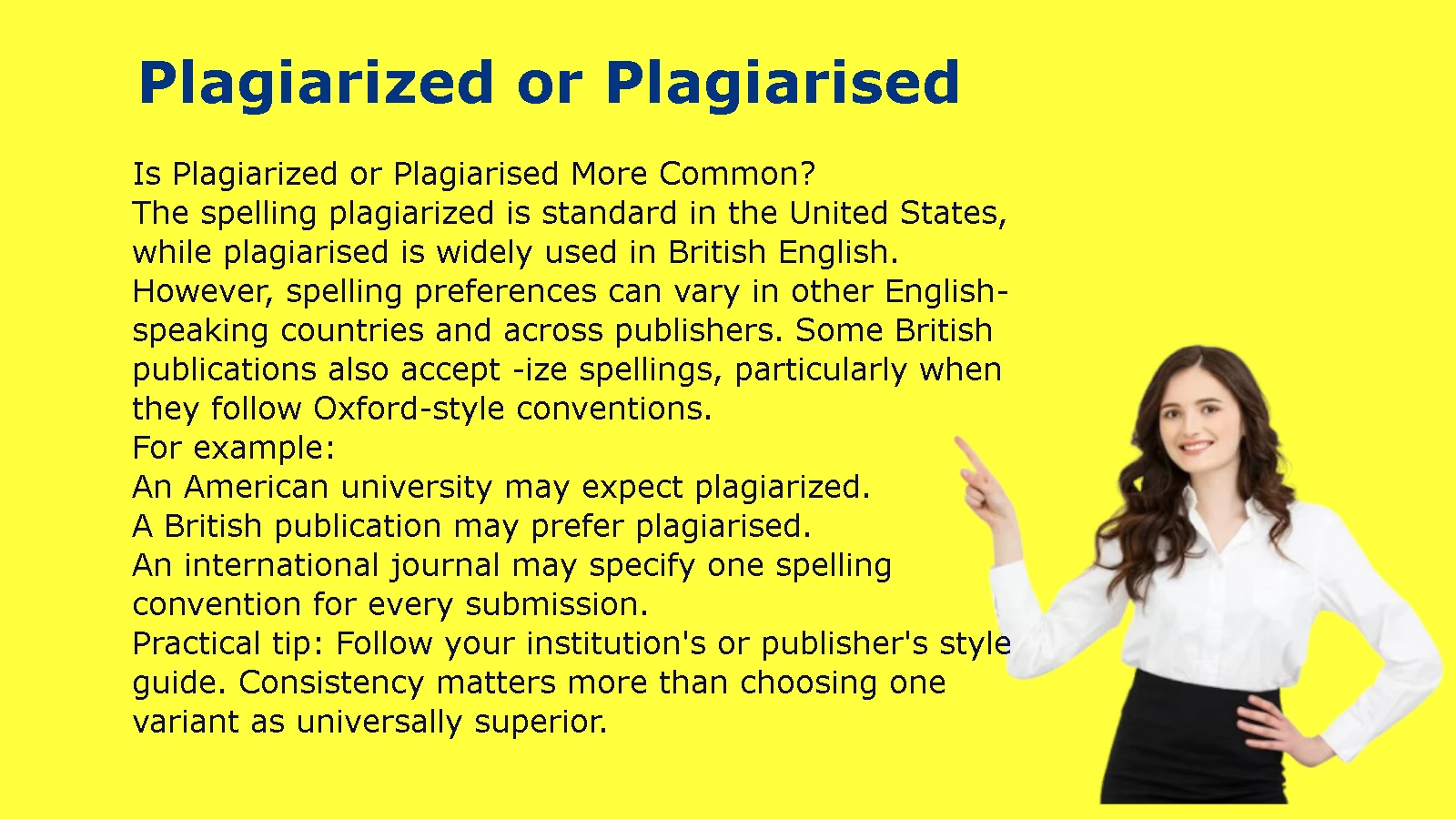
Is Plagiarized or Plagiarised More Common?
The spelling plagiarized is standard in the United States, while plagiarised is widely used in British English.
However, spelling preferences can vary in other English-speaking countries and across publishers. Some British publications also accept -ize spellings, particularly when they follow Oxford-style conventions.
For example:
- An American university may expect plagiarized.
- A British publication may prefer plagiarised.
- An international journal may specify one spelling convention for every submission.
Practical tip: Follow your institution’s or publisher’s style guide. Consistency matters more than choosing one variant as universally superior.
Plagiarize UK Spelling and Related Word Forms
The spelling difference affects several forms of the verb.
| American English | British English |
| Plagiarize | Plagiarise |
| Plagiarized | Plagiarised |
| Plagiarizing | Plagiarising |
| Plagiarizer | Plagiariser |
The same spelling pattern appears in other words, such as organize/organise and recognize/recognise.
Remember that British English does not always replace z with s. The preferred form depends on the word and the applicable spelling convention.
Plagiarize Meaning and Definition
Plagiarize means to use another person’s words, ideas, creative work, or other original material without appropriate acknowledgment, often presenting it as your own. The term commonly appears in education, publishing, journalism, research, and creative industries. Plagiarism can involve copying exact wording or using another person’s ideas without proper credit.
The word is a verb. Its noun form is plagiarism, while plagiarized and plagiarised are past-tense and past-participle forms.
What Does Plagiarized Mean?
Plagiarized means copied, borrowed, or used without proper acknowledgment, especially when someone presents another person’s work or ideas as their own.
The exact meaning depends on the sentence.
Consider these examples:
- Past-tense verb: The writer plagiarized a paragraph from a published book.
- Past participle: The writer has plagiarized material from several websites.
- Adjective: The teacher identified plagiarized content in the assignment.
In the first example, plagiarized describes an action. In the last example, it describes the content.
The word can refer to deliberate copying, but an allegation of plagiarism does not automatically establish intent or prove misconduct.
What Counts as Plagiarism?
Plagiarism occurs when someone uses another person’s work or ideas without giving appropriate credit, depending on the context and applicable rules.
Common examples include:
- Direct copying: Copying sentences from a website without quotation marks or attribution.
- Uncredited paraphrasing: Rewriting someone else’s argument with different words but presenting the idea as your own.
- Using another person’s research: Taking original findings or analysis without acknowledgment.
- Copying creative work: Using another person’s poem, artwork, design, or other creation without appropriate credit.
- Improper collaboration: Submitting another person’s contribution as entirely your own when the assignment requires independent work.
Not every similarity qualifies as plagiarism. Common phrases, standard terminology, and independently developed ideas may overlap without misconduct.
The circumstances, source material, attribution, and relevant academic or professional rules all matter.
Plagiarized vs. Inspired vs. Referenced
These terms describe different relationships with existing work.
| Term | Meaning | Example |
| Plagiarized | Used without appropriate acknowledgment | A writer copies an article paragraph and claims it as original. |
| Inspired | Influenced by an existing idea or style | A designer creates a new poster inspired by vintage art. |
| Referenced | Cited or acknowledged as a source | A student quotes a book and provides a citation. |
Example: A novelist may write a story inspired by classic mythology without plagiarizing it. However, copying distinctive passages from another modern novel without acknowledgment raises a different issue.
Inspiration involves influence. Plagiarism involves inappropriate use or attribution.
How to Use Plagiarize and Plagiarized in a Sentence
Use plagiarize when discussing the act of copying another person’s work without proper acknowledgment. Use plagiarized when describing an action that happened in the past or when forming a participle or adjective.
The sentence structure determines which form fits.
Plagiarize in a Sentence
Here are original examples showing how to use plagiarize naturally.
- Students should never plagiarize another writer’s research.
- The editor warned the contributor not to plagiarize published material.
- Some writers plagiarize ideas because they misunderstand citation rules.
- Researchers must cite sources instead of attempting to plagiarize existing studies.
- A student can avoid plagiarism by documenting borrowed information carefully.
The word often appears after modal verbs or infinitives.
Examples:
- You should not plagiarize.
- They might plagiarize.
- It is wrong to plagiarize another person’s work.
Plagiarized in a Sentence
Use plagiarized when referring to a completed action or describing material.
- The professor found a plagiarized paragraph in the student’s essay.
- She plagiarized two passages from an online report.
- The publisher investigated the claim that the article was plagiarized.
- His paper contained plagiarized material from an earlier publication.
- The researcher admitted that he had plagiarized part of the discussion.
Notice the difference between these two examples:
Verb: The writer plagiarized the article.
Adjective: The writer submitted a plagiarized article.
The first sentence focuses on the action. The second describes the article.
Plagiarize vs. Plagiarized vs. Plagiarism
These related words serve different grammatical purposes.
| Word | Part of speech | Example |
| Plagiarize | Verb | Never plagiarize another writer. |
| Plagiarized | Past-tense verb | She plagiarized the passage. |
| Plagiarized | Adjective | The editor removed plagiarized material. |
| Plagiarism | Noun | The university investigates plagiarism. |
| Plagiarizing | Present participle/gerund | He was accused of plagiarizing the report. |
| Plagiarist | Noun | The article described the person as a plagiarist. |
Grammar note: The past tense and past participle of plagiarize are both plagiarized. British English commonly uses plagiarised for both forms.
Plagiarized Synonyms and Related Words
Common plagiarized synonyms include copied, cribbed, appropriated, and stolen. However, these words do not always mean precisely the same thing. Some describe copying generally, while others suggest improper use, ownership disputes, or deliberate wrongdoing.
Choose a synonym based on the sentence’s meaning.
Common Synonyms for Plagiarized
| Synonym | Meaning or usage | Example |
| Copied | Reproduced existing material | The paragraph was copied from a website. |
| Cribbed | Informally copied, often without permission or credit | The student cribbed a few lines from a guide. |
| Appropriated | Took or used something for one’s own purposes | The writer appropriated another researcher’s ideas. |
| Stolen | Suggests wrongful taking | The artist claimed that someone had stolen her design. |
| Misappropriated | Used something improperly | The report misappropriated confidential material. |
| Imitated | Followed another person’s style or approach | The designer imitated a traditional illustration style. |
Important distinction: Imitated is not always a synonym for plagiarism. Artists and writers can imitate a broad style without copying protected expression or violating attribution standards.
Similarly, stolen can imply legal wrongdoing. Use it carefully when the evidence supports that wording.
Best Synonyms for Plagiarized in Academic Writing
Academic writing often benefits from precise descriptions instead of broad synonyms.
Consider these alternatives:
- Used without attribution: Appropriate when a source was not acknowledged.
- Copied without acknowledgment: Useful when wording was reproduced directly.
- Improperly attributed: Suitable when credit exists but does not accurately identify the source or contribution.
- Uncredited: Concise when a source or creator received no acknowledgment.
- Closely paraphrased without citation: Useful when the writer changed the wording but failed to credit the original source.
For example:
Instead of writing, “The student stole the research,” you could write, “The student used the research findings without attribution.”
The second sentence identifies the specific concern without making a broader accusation.
Plagiarized Antonyms
Some contextual opposites of plagiarized include:
- Original: Independently created or developed.
- Properly attributed: Correctly credited to its source.
- Authentic: Genuine rather than falsely represented.
- Independently written: Produced without copying another person’s expression.
These words are not exact antonyms in every situation.
For instance, properly attributed writing can still contain extensive copying that violates assignment requirements or other rules. Attribution is important, but it does not automatically make every use acceptable.
Plagiarized Pronunciation
Plagiarized is generally pronounced the same way in American and British English. It has four syllables, with the main stress on the first syllable. Its pronunciation begins with the play sound and ends with a zd sound.
IPA: /ˈpleɪ.dʒə.raɪzd/
How to Pronounce Plagiarized
Break the word into four syllables:
PLAY-juh-ryzed
Use this pronunciation guide:
- First syllable: Stress the opening syllable.
- Middle sounds: Keep the unstressed syllables short and connected.
- Ending: Finish with a voiced zd sound.
A common mistake is to place too much stress on the middle of the word.
Practice with a sentence:
“The editor discovered plagiarized content.”
Say the word naturally without separating every syllable.
How to Pronounce Plagiarised
Plagiarised generally shares the same pronunciation as plagiarized.
The final s in the British spelling does not create a different sound. The spelling variation reflects regional convention rather than a change in pronunciation.
The pronunciation can vary slightly between individual speakers and accents.
Is Plagiarized a Verb or an Adjective?
Plagiarized can function as a past-tense verb, a past participle, or an adjective. Its grammatical role depends on how the sentence uses it. A past-tense verb describes an action, while an adjective describes something associated with plagiarism.
Plagiarized as a Verb
Examples:
- The journalist plagiarized several sentences.
- She plagiarized material from an older report.
- They have plagiarized the original research.
- The student was accused of having plagiarized the assignment.
In these examples, plagiarized forms part of a verb phrase.
The passive construction, “The passage was plagiarized,” focuses on the passage rather than the person responsible.
Plagiarized as an Adjective
Examples:
- The editor removed the plagiarized paragraph.
- The professor reviewed the plagiarized essay.
- The website published plagiarized content.
- Investigators examined the allegedly plagiarized material.
The adjective describes the type or alleged status of the material.
When a claim remains unproven, allegedly plagiarized or suspected plagiarism may be more accurate.
Is Plagiarised Grammatically Correct?
Yes. Plagiarised is grammatically correct in British English.
The spelling does not change the word’s grammatical function or meaning.
For example:
- British English: She plagiarised the report.
- American English: She plagiarized the report.
Both sentences use the simple past tense correctly.
What Does Plagiarized AI Mean?
AI plagiarism can refer to plagiarism involving artificial intelligence, including AI-assisted copying, unattributed use of existing material, or submitting work that violates academic or professional attribution rules. However, AI-generated writing is not automatically plagiarized. The source of the content, its originality, attribution, and applicable policies determine how a particular case should be evaluated.
Can AI-Generated Content Be Plagiarized?
Yes, AI-assisted or AI-generated content can involve plagiarism.
For example, a student might use an AI tool to reproduce paragraphs from an existing article without acknowledgment. Another writer might ask an AI system to paraphrase someone else’s research and then submit the result as original work.
These situations raise plagiarism concerns because the writer uses existing material without appropriate credit.
However, AI-generated content and plagiarism are different issues.
A person may violate an institution’s AI-use policy without committing plagiarism. Conversely, someone can plagiarize extensively without using AI.
The distinction matters when evaluating academic work, published content, and professional writing.
Can AI Plagiarism Detectors Prove Plagiarism?
No single detection score can establish plagiarism by itself.
Different tools perform different functions:
- Similarity checkers: Compare submitted text against available sources and identify matching passages.
- AI-writing detectors: Estimate whether text may have characteristics associated with AI-generated writing.
- Human review: Examines source material, citations, context, and writing history.
A similarity score does not automatically mean plagiarism. Properly quoted passages, references, standard expressions, and common terminology can create legitimate matches.
AI-writing detectors also have limitations. Their results can include false positives and false negatives.
A fair assessment should consider original sources, citation practices, assignment instructions, and other relevant evidence.
How to Avoid Plagiarism When Using AI
Follow these practical steps when using AI for research or writing.
- Check the original sources: Verify important claims instead of trusting generated summaries.
- Cite borrowed ideas: Credit the authors whose arguments, research, or wording you use.
- Use quotation marks when needed: Mark exact wording according to the applicable citation rules.
- Write your own analysis: Explain what the evidence means instead of merely rearranging sentences.
- Review AI policies: Follow your school’s, publisher’s, or employer’s requirements.
- Keep useful records: Save source links, notes, drafts, and relevant research materials.
Practical example: Suppose an AI tool summarizes a published study. Rather than copying the summary into your paper, read the original study, verify the claims, cite the source, and explain the findings in your own analysis.
This approach improves accuracy and makes your writing more trustworthy.
Is Powerless Plagiarized?
The question “Is Powerless plagiarized?” needs context because multiple creative works share the title. If the question refers to Lauren Roberts’s fantasy novel Powerless, distinguish online discussions about similarities to other books from substantiated plagiarism findings. Similar themes or tropes alone do not establish plagiarism.
Why Has Powerless Faced Plagiarism Allegations?
Readers sometimes compare fantasy novels because they share familiar storytelling elements, such as:
- A protagonist with unusual abilities or limitations.
- Royal competitions or dangerous trials.
- Forbidden relationships.
- Political conflict and rival factions.
- Characters navigating unequal power structures.
These similarities can lead to online discussions, but shared tropes do not automatically prove copying.
A meaningful assessment would need to examine specific passages, distinctive creative expression, the nature of the similarities, and relevant evidence.
A claim on social media or a comparison between two books should not be treated as a confirmed finding.
Does Similarity Automatically Mean Plagiarism?
No. Similarity can occur without plagiarism.
For example, two fantasy authors may independently write stories involving royal families, magical competitions, or enemies who develop romantic feelings.
These are broad narrative ideas.
However, reproducing distinctive passages, closely copying original expression, or presenting another author’s work as your own raises more serious concerns.
The key distinction: Shared concepts are not the same as copied expression. Context and evidence matter.
Plagiarized Crossword Clue: Possible Answers
A crossword clue involving plagiarized may have answers such as copied, cribbed, or stole. The correct answer depends on the clue’s wording, the number of letters, and the crossing letters. These are possible solutions, not guaranteed answers.
Common Crossword Answers for Plagiarized
| Possible answer | Letters | Meaning |
| Copied | 6 | Reproduced existing material |
| Cribbed | 7 | Informally copied |
| Stole | 5 | Took something wrongfully |
| Imitated | 8 | Followed another person’s example or style |
For a five-letter clue, stole may fit. A six-letter answer might be copied.
However, crossword clues often use wordplay, tense changes, or indirect definitions.
How to Find the Right Crossword Answer
Use these steps to narrow your options:
- Count the squares: Confirm the exact number of letters.
- Check crossing letters: Use letters from the answers you already know.
- Read the clue carefully: Determine whether it asks for a verb, adjective, or synonym.
- Consider tense: A past-tense clue may require a past-tense answer.
- Look for wordplay: Some clues use figurative or humorous meanings.
If the clue includes a letter pattern, such as C_O_I_D, copied may be a strong candidate.
Common Mistakes When Using Plagiarized or Plagiarised
Writers sometimes focus entirely on spelling and overlook meaning, attribution, or grammar. Avoiding these mistakes makes your writing clearer and more accurate.
Mixing American and British Spellings
Switching between spelling systems can make a document look inconsistent.
For example:
“The student plagiarized the essay and later apologised.”
This sentence mixes a common American spelling with a common British spelling.
For a consistently American version:
“The student plagiarized the essay and later apologized.”
For a consistently British version:
“The student plagiarised the essay and later apologised.”
Mixed spelling is not necessarily a grammatical error, but a consistent style usually looks more professional.
Confusing Plagiarism With Copyright Infringement
Plagiarism and copyright infringement can overlap, but they are not identical.
| Plagiarism | Copyright infringement |
| Concerns attribution, authorship, or ethical standards | Concerns rights protected by copyright law |
| Often addressed through academic or professional policies | May involve legal consequences |
| Can involve uncredited ideas or wording | Generally concerns protected expression and applicable legal rights |
| Does not always involve copyright infringement | Does not always involve plagiarism |
For example, someone might fail to credit a source for an idea that copyright does not protect. That can raise plagiarism concerns without necessarily constituting copyright infringement.
Likewise, someone might infringe copyright while acknowledging the creator.
The legal analysis depends on the jurisdiction and circumstances.
Assuming Every Similar Phrase Is Plagiarism
Not every matching sentence or phrase indicates misconduct.
Common expressions, technical terminology, standard definitions, and independently developed ideas may resemble existing material.
Consider these examples:
Example of ordinary similarity:
“Water freezes at 0°C under standard atmospheric pressure.”
This statement communicates a widely known scientific fact.
Example of a potential plagiarism concern:
A writer copies several distinctive paragraphs from another author’s article without quotation marks or acknowledgment.
The second example presents a clearer concern because it involves the use of another person’s expression.
When reviewing suspected plagiarism, examine the source, the nature of the material, attribution, and relevant rules rather than relying only on matching words.
Frequently Asked Questions
Is plagiarized or plagiarised correct?
Both spellings are correct. Plagiarized is standard American English, while plagiarised is standard British English. Both forms have the same meaning and pronunciation.
What is the meaning of plagiarized?
Plagiarized means copied or used another person’s words, ideas, or work without appropriate acknowledgment. It can function as a past-tense verb, a past participle, or an adjective.
What is a synonym for plagiarized?
Common synonyms include copied, cribbed, appropriated, and stolen. Copied is a general alternative, while cribbed is informal. Choose the word that accurately reflects the context.
How do you pronounce plagiarized?
Plagiarized is pronounced with four syllables and stress on the first syllable. Its IPA transcription is /ˈpleɪ.dʒə.raɪzd/. The British spelling plagiarised generally has the same pronunciation.
Is plagiarize British or American spelling?
Plagiarize is the standard American spelling. Plagiarise is common in British English, although some British publications accept -ize spellings under their chosen style conventions.
Can AI-generated writing be considered plagiarized?
Yes, AI-generated or AI-assisted writing can involve plagiarism when it uses another person’s work without appropriate acknowledgment. However, AI use alone does not establish plagiarism. Originality, attribution, and applicable policies matter.
Conclusion: Plagiarized or Plagiarised?
Plagiarized and plagiarised are both correct. The main difference is regional spelling preference:
- Use plagiarized for standard American English.
- Use plagiarised for standard British English.
- Follow your organization’s style guide when writing for a specific audience.
Remember that plagiarize is the verb, plagiarized is its past-tense and past-participle form, and plagiarism is the noun.
If you’re writing an essay, article, or research paper, check your spelling conventions, cite your sources, and review any borrowed material carefully.













