Amortize vs amortise comes down to regional spelling: amortize is the standard American English form, while amortise is commonly used in British English. Both words have the same meaning and pronunciation in most contexts. They describe spreading a debt repayment or a cost over a period, although the exact meaning depends on whether you are discussing loans, accounting, or programming.
Understanding amortized meaning, amortized cost, amortization vs depreciation, and amortized time complexity helps you use the word correctly in different situations. In finance, amortization often describes scheduled loan repayments or the allocation of certain costs. In accounting, amortized cost has a specific technical meaning.
This guide explains the spelling difference, provides original sentence examples, compares related accounting terms, and shows how programmers use amortized time complexity.
Amortize vs Amortise: Which Spelling Is Correct?
Amortize and amortise are both correct spellings. American English generally uses amortize, while British English commonly uses amortise. The difference is regional rather than semantic. Both forms describe spreading a payment, debt, or cost over time, and you can use either form when it matches your audience’s spelling conventions.
Amortize Is the Standard American English Spelling
In the United States, amortize is the standard spelling. American banks, accountants, financial analysts, and software developers use this form in professional writing.
You will commonly encounter it in phrases such as:
- Amortize a loan
- Amortize an intangible asset
- Amortized cost
- Amortization schedule
- Amortized time complexity
For example:
“The company plans to amortize the software development cost over its expected useful life.”
Here, amortize describes allocating a cost over multiple accounting periods rather than recognizing the entire amount as an expense at once.
Another example appears in personal finance:
“The borrower will amortize the mortgage over 20 years through scheduled monthly payments.”
In this sentence, amortization refers to paying down the loan principal over time, usually with interest included in each scheduled payment.
If you are writing for an American audience, use amortize, amortized, and amortization consistently.
Amortise Is the Standard British English Spelling
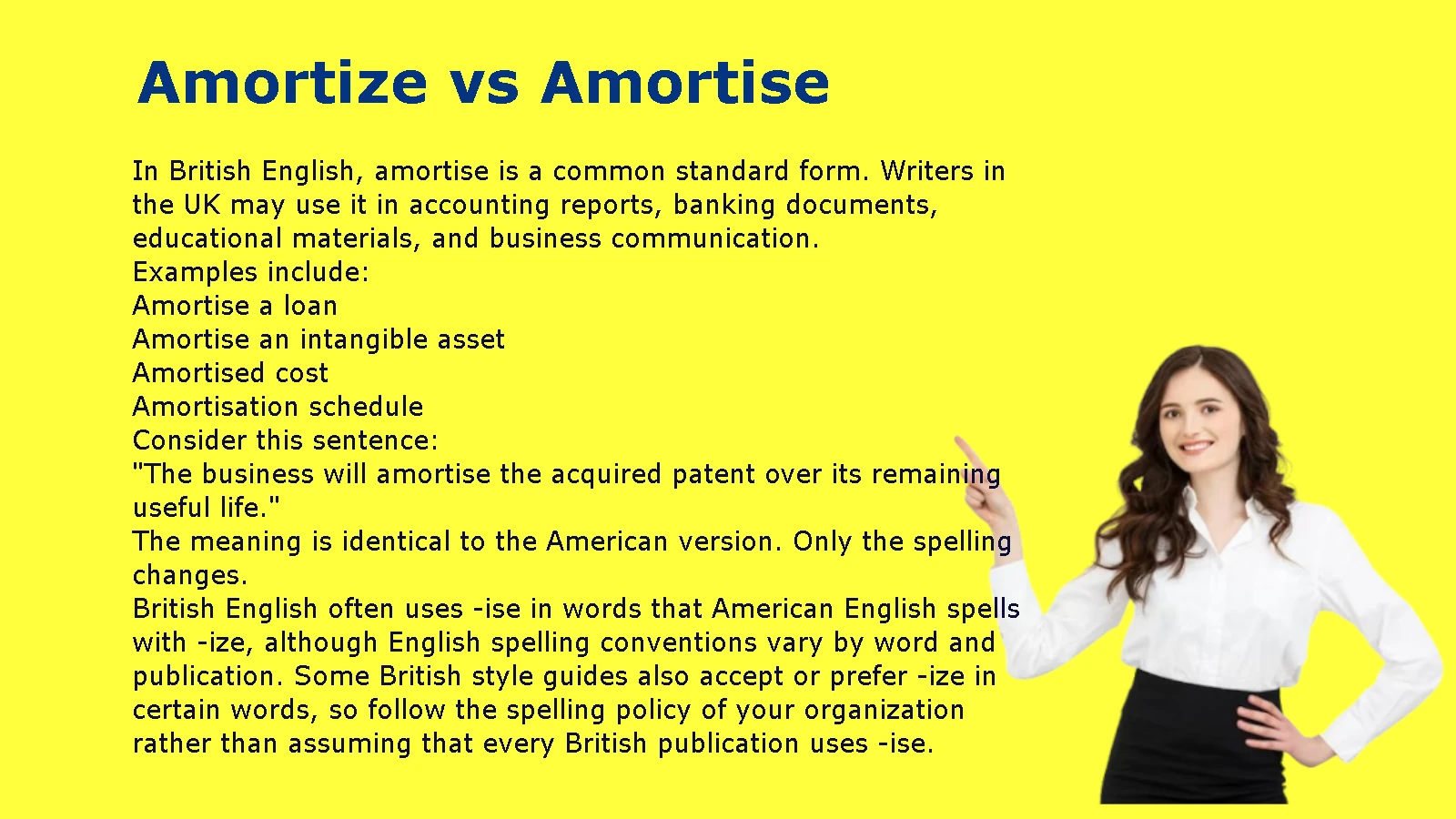
In British English, amortise is a common standard form. Writers in the UK may use it in accounting reports, banking documents, educational materials, and business communication.
Examples include:
- Amortise a loan
- Amortise an intangible asset
- Amortised cost
- Amortisation schedule
Consider this sentence:
“The business will amortise the acquired patent over its remaining useful life.”
The meaning is identical to the American version. Only the spelling changes.
British English often uses -ise in words that American English spells with -ize, although English spelling conventions vary by word and publication. Some British style guides also accept or prefer -ize in certain words, so follow the spelling policy of your organization rather than assuming that every British publication uses -ise.
Amortize vs Amortise at a Glance
| Feature | Amortize | Amortise |
| Common spelling convention | American English | British English |
| Meaning | Spread a debt repayment or cost over time | Same meaning |
| Past tense | Amortized | Amortised |
| Present participle | Amortizing | Amortising |
| Noun form | Amortization | Amortisation |
| Common financial phrase | Amortized cost | Amortised cost |
| Typical example | We amortize the loan. | We amortise the loan. |
The choice does not change the underlying financial or technical concept.
Quick rule: Use amortize for standard American English and amortise when following a British spelling convention that uses -ise.
What Does Amortize Mean?
Amortize means to spread a debt repayment or certain costs over a period rather than treating the entire amount as payable or expensed at once. In lending, it often describes scheduled payments that gradually reduce a loan balance. In accounting, it can describe allocating an intangible asset’s cost over its useful life.
Amortize Meaning in Everyday and Financial English
The meaning of amortize depends on the context. The general idea is to distribute an amount over time, but financial and accounting uses have different details.
In lending, a borrower amortizes a loan by making scheduled payments that reduce the outstanding principal. Many conventional installment loans also charge interest, so each payment covers interest and principal in proportions that change over the repayment period.
In accounting, a company may amortize the cost of an intangible asset over its estimated useful life. For example, a business that acquires a patent may allocate its amortizable cost across the periods that benefit from the patent.
Consider these examples:
- Loan repayment: “Maya will amortize her car loan over five years.”
- Accounting: “The company will amortize the patent over its estimated useful life.”
- Business planning: “The finance team included the amortization expense in its annual budget.”
These sentences use the same core word, but they describe different processes.
A loan amortization schedule tracks how payments reduce a liability. Asset amortization tracks how a qualifying asset’s cost is allocated to expenses over time.
Do not assume that every purchase can be amortized for tax or accounting purposes. The applicable accounting framework, tax rules, asset type, and circumstances determine the correct treatment.
What Does Amortized Mean?
Amortized is the past tense and past participle of amortize. It describes a debt, cost, or financial amount that has been allocated or paid down according to an amortization process.
The exact meaning depends on the noun that follows it.
Examples:
- Amortized loan: A loan repaid through scheduled payments that reduce the outstanding balance.
- Amortized cost: A financial instrument’s carrying amount determined under an applicable amortized-cost accounting method.
- Amortized expense: An amount of an asset’s cost allocated to an accounting period.
- Amortized operation: An operation analyzed as part of a sequence in algorithm analysis.
Here are original sentence examples:
“The bank provided an amortized repayment schedule showing how much of each monthly payment would cover interest and principal.”
“The accountant recorded the period’s amortized cost for the qualifying intangible asset.”
“The developer explained why an array insertion operation has an amortized constant-time cost under the usual resizing model.”
Although these examples share the word amortized, they do not describe the same process.
Amortize, Amortized, and Amortization: Word Forms
Knowing the related word forms helps you write accurate sentences and understand search results.
| Word | Part of speech | Meaning | Example |
| Amortize | Verb | Spread a debt repayment or cost over time | We amortize the loan. |
| Amortizes | Verb | Third-person singular present form | The company amortizes the patent. |
| Amortized | Past tense or past participle | Describes a completed or ongoing amortization result | The loan was amortized over 10 years. |
| Amortizing | Present participle | Describes the process in progress | The company is amortizing the cost. |
| Amortization | Noun | The process or amount associated with amortizing | Amortization reduced the asset’s carrying amount. |
British spelling changes the z to s in the commonly used forms:
- Amortize → Amortise
- Amortized → Amortised
- Amortizing → Amortising
- Amortization → Amortisation
The same regional convention applies throughout a document. Avoid switching between amortized and amortised without a clear reason.
How Do You Pronounce Amortized?
Amortized is generally pronounced the same way in American and British English, despite the spelling difference. The word has three syllables, with the main stress on the first syllable. Regional accents may affect individual vowel sounds, but the -ize and -ise spellings do not normally indicate different pronunciations.
Amortized Pronunciation in American and British English
A common pronunciation guide for amortized is:
uh-MOR-tized
The International Phonetic Alphabet transcription commonly used for American English is approximately /əˈmɔːrtaɪzd/, although exact vowel quality varies by accent.
Pay attention to the following points:
- The first syllable has a relatively weak vowel.
- The second syllable receives the main stress.
- The final syllable sounds like the word tized.
- The ending has a /zd/ sound in the usual pronunciation.
The British form amortised generally follows the same pronunciation pattern.
When speaking about finance, you might say:
“The loan has been amortized over the full repayment period.”
When discussing programming, you could say:
“The dynamic array has amortized constant-time insertion.”
The pronunciation remains broadly the same even though the technical meanings differ.
How to Remember Amortize vs Amortise
Use the audience’s spelling convention as your guide.
For American English:
- Amortize
- Amortized
- Amortization
For British English using the -ise convention:
- Amortise
- Amortised
- Amortisation
A practical way to remember the difference is to compare familiar regional spelling patterns. American English commonly uses organize, recognize, and analyze. British English commonly uses organise, recognise, and analyse, depending on the style guide and word.
However, spelling patterns are not universal rules. Some British publications prefer -ize in words such as organize. For that reason, the safest approach is to check the publication’s house style and apply it consistently.
Amortized Cost Meaning in Accounting
Amortized cost is an accounting measurement used for certain financial assets and liabilities. It generally starts with an initial recognized amount and adjusts that amount over time for items such as repayments, interest recognized using the effective interest method, and qualifying changes or adjustments required by the applicable accounting rules.
This technical meaning differs from simply dividing a purchase price into equal payments.
What Is Amortized Cost?
In financial accounting, amortized cost describes a carrying amount calculated under the relevant accounting framework.
For a qualifying financial asset, the calculation often begins with its initial recognition amount. The amount then changes as the entity recognizes interest income using the effective interest method and receives repayments of principal. Qualifying fees, premiums, discounts, and other adjustments may also affect the carrying amount.
The exact treatment depends on the instrument and the applicable standards.
For example, a company might purchase a bond for an amount different from its face value. The difference may be reflected in the effective interest calculation over the bond’s life, depending on the accounting requirements.
Amortized cost can apply to qualifying financial assets and liabilities, but not every instrument qualifies. Classification and measurement rules determine whether an instrument uses this method or another measurement basis.
Keep these concepts separate:
- Amortized cost: A financial reporting measurement.
- Loan amortization: A process for repaying borrowed money through scheduled payments.
- Amortization expense: An accounting expense that allocates the cost of a qualifying asset over time.
They are related concepts, but they are not interchangeable.
How Amortized Cost Works
Consider a simplified example involving a company that buys a qualifying financial instrument.
The company initially recognizes the instrument at an amount determined by the applicable accounting rules. As time passes, the company recognizes interest income or expense using the effective interest method. Principal repayments, premiums, discounts, and qualifying fees can change the carrying amount.
The basic process looks like this:
- Recognize the instrument initially. Determine the starting amount under the relevant accounting framework.
- Apply the effective interest method where required. Calculate interest income or expense using the applicable effective interest rate.
- Record repayments. Reduce the outstanding carrying amount for principal repayments.
- Adjust for relevant items. Account for qualifying fees, premiums, discounts, and other required adjustments.
- Determine the updated carrying amount. Report the resulting amount in accordance with the applicable standards.
This sequence provides a conceptual overview, not a complete accounting formula for every instrument.
For instance, impairment requirements may affect the reported amount of a financial asset. The details depend on the applicable accounting standards and the instrument’s classification.
A Simple Illustrative Example
Suppose a company recognizes a qualifying financial asset at an initial carrying amount of $9,500. During the next reporting period, it recognizes $570 in interest income using the effective interest method and receives a $1,000 principal repayment.
Ignoring impairment, fees, and other adjustments for simplicity, the carrying amount at the end of the period would be:
| Item | Amount |
| Initial carrying amount | $9,500 |
| Add: Interest income recognized | $570 |
| Less: Principal repayment | $1,000 |
| Ending carrying amount | $9,070 |
The example illustrates how interest recognition and repayments can change the carrying amount. Actual accounting entries depend on the instrument’s terms and applicable reporting requirements.
Amortized Cost vs. Market Value
Amortized cost follows an accounting measurement method. Market value generally reflects the price an asset could command in a market under the relevant valuation assumptions.
The two values can differ because interest rates, credit risk, market conditions, and investor expectations may change after the instrument’s initial recognition.
For example, a company may hold a bond whose carrying amount under the amortized-cost method is $9,070. If market interest rates rise, the bond’s market price might fall below that carrying amount. The market price does not automatically replace the amortized-cost amount when the applicable accounting framework requires amortized-cost measurement.
| Feature | Amortized cost | Market value |
| Main purpose | Accounting measurement | Reflect current market pricing or valuation |
| Main drivers | Initial measurement, effective interest, repayments, and applicable adjustments | Market conditions, interest rates, credit risk, and expected cash flows |
| Changes over time | Follow the accounting method | Respond to market conditions |
| Always identical? | No | No |
The distinction matters when reading financial statements. A reported carrying amount does not necessarily represent the price the company would receive if it sold the instrument immediately.
Amortization vs Depreciation: What’s the Difference?
Amortization and depreciation both allocate the cost of an asset over time, but they commonly apply to different types of assets.
What Is Amortization?
In asset accounting, amortization generally refers to allocating the depreciable or amortizable amount of a qualifying intangible asset over its useful life.
Examples of intangible assets that may qualify include:
- Patents
- Certain acquired software rights
- Copyrights with finite useful lives
- Customer relationships acquired in a business combination
- Certain licenses and contractual rights
The exact treatment depends on the nature of the asset and the applicable accounting framework. Not every intangible asset is amortized. For example, an intangible asset with an indefinite useful life may require a different approach, including impairment testing under the relevant standards.
Suppose a business acquires a patent for $60,000 and expects to use it for six years. If the full amount is amortizable, the useful life is six years, the residual value is zero, and the company uses straight-line amortization, the annual amortization expense would be:
$60,000 ÷ 6 = $10,000 per year.
This simplified calculation assumes that the entire amount qualifies for amortization and that no other adjustments apply.
The purpose is to allocate the asset’s cost to the periods that benefit from its use.
What Is Depreciation?
Depreciation allocates the depreciable amount of a tangible asset over its useful life.
Businesses commonly depreciate assets such as:
- Manufacturing equipment
- Company vehicles
- Office furniture
- Computers and certain hardware
- Buildings, excluding land
Suppose a company purchases equipment for $50,000. It estimates a useful life of five years and a residual value of $5,000. Under the straight-line method, annual depreciation would be:
($50,000 − $5,000) ÷ 5 = $9,000 per year.
This calculation assumes that the equipment is available for use for the full accounting period and that straight-line depreciation is appropriate.
The expense reflects the allocation of the equipment’s depreciable amount over its useful life. It does not necessarily reflect the asset’s current resale price or its physical decline in every period.
Amortization vs Depreciation Comparison Table
| Feature | Amortization | Depreciation |
| Common asset type | Intangible assets | Tangible assets |
| Example | Patent or qualifying software right | Machinery or vehicle |
| Main purpose | Allocate an asset’s cost over time | Allocate an asset’s cost over time |
| Common calculation methods | Often straight-line for qualifying intangible assets | Straight-line, declining-balance, and other permitted methods |
| Residual value | Depends on the applicable rules and asset | Considered when determining the depreciable amount |
| Loan repayment use | Also describes scheduled loan repayment | Not the usual term for loan repayment |
Are Amortization and Depreciation the Same?
No. They share a general accounting purpose, but their application differs.
Amortization commonly applies to qualifying intangible assets, while depreciation commonly applies to tangible assets. Loan amortization introduces another use of the word: it describes how a borrower pays down debt over time.
Consider a business that buys a delivery van and acquires a patent.
- The van’s cost may be allocated through depreciation.
- The patent’s cost may be allocated through amortization.
- A loan used to finance either purchase may have its own amortization schedule.
These processes can appear in the same set of financial records, but they answer different accounting questions.
Do not choose the treatment based on the word alone. Identify the asset or liability first, then apply the relevant accounting rules.
What Does Amortized Mean in Programming?
In programming, amortized describes the cost of an operation when you analyze it as part of a sequence of operations. Amortized analysis accounts for occasional expensive operations alongside many inexpensive ones. It helps developers understand the total cost of repeated actions rather than judging performance from a single operation.
Amortized Meaning in Programming
The meaning of amortized in computer science differs from its financial meaning.
Programmers use amortized analysis to study the total cost of a sequence of operations and establish a bound on the cost per operation. Some operations may take much longer than others, yet the sequence can still have a low amortized cost per operation.
Imagine a dynamic array that stores items in a block of memory. Most insertions can place a new item in the next available position. However, when the array runs out of capacity, the program may need to allocate a larger block and copy existing items into it.
That resizing operation can be expensive. If the array doubles its capacity when it fills up, however, resizing happens relatively infrequently as the array grows. The cost of those occasional operations can be spread across many insertions in the analysis.
This is why an insertion may take (O(n)) time on a particular occasion while append operations still have amortized (O(1)) time under the usual dynamic-array resizing model.
Amortized analysis does not claim that every operation takes constant time. It describes a bound across a sequence.
What Is Amortized Time Complexity?
Amortized time complexity measures the cost of an operation over a sequence of operations, accounting for the expensive steps that occur occasionally. It provides a bound on the total work performed across the sequence and helps estimate the cost per operation without relying on a probability distribution over inputs.
For example, a dynamic array might append thousands of items while resizing only a small number of times. Although individual resizing operations can take linear time, the total cost of all append operations across the sequence remains linear under the usual geometric-growth model.
If inserting (n) items takes (O(n)) total time, the amortized cost per insertion is:
[
\frac{O(n)}{n} = O(1)
]
This does not mean the total operation sequence takes constant time. It means the total cost grows linearly with the number of insertions, giving constant amortized cost per insertion.
Three common methods help analyze amortized time complexity:
- Aggregate analysis: Calculate the total cost of a sequence and divide it by the number of operations to establish a bound on the amortized cost.
- Accounting method: Assign a cost to each operation and save unused credit from inexpensive operations to pay for future expensive operations.
- Potential method: Use a mathematical potential function to track stored work or accumulated capacity across operations.
These methods offer different ways to prove the same type of performance bound.
Amortized Time Complexity Example: Dynamic Arrays
Dynamic arrays provide a clear example of why amortized analysis matters.
Suppose an array begins with capacity one and doubles its capacity whenever it becomes full.
The first insertion fits in the original block. When the second item arrives, the array may allocate a block of capacity two and copy the existing item. Later, another resize may create capacity four, followed by capacity eight, and so on.
The exact behavior depends on the programming language and implementation, but doubling capacity is a common model for explaining the concept.
Consider a simplified sequence:
| Number of items stored | Array capacity after resizing | Potential resize work |
| 1 | 1 | No resize required |
| 2 | 2 | Copy 1 existing item |
| 3 | 4 | Copy 2 existing items |
| 5 | 8 | Copy 4 existing items |
| 9 | 16 | Copy 8 existing items |
The table shows only the growth events, not every insertion. At each event, the array copies the items already stored before adding the new item.
Although a resize may copy many elements, the capacities grow geometrically. Across (n) insertions, the total number of elements copied is bounded by a geometric sum and is (O(n)).
Adding the ordinary insertion work still produces (O(n)) total work across (n) append operations.
Therefore:
- A typical append operation takes constant time when spare capacity exists.
- An append that triggers resizing can take (O(n)) time.
- Append operations have amortized (O(1)) time under the usual geometric-growth model.
- A sequence of (n) append operations takes (O(n)) total time.
Practical lesson: Do not judge a data structure by its most expensive individual operation alone. Examine how often that operation occurs and how the total work grows as the sequence gets longer.
Amortized Time Complexity vs. Average-Case Time Complexity
Amortized analysis studies the total cost of a sequence of operations and establishes a bound across that sequence. It does not require a probability distribution over the inputs.
Average-case analysis estimates expected performance under an assumed probability distribution over inputs or execution scenarios.
For example, amortized analysis can establish that repeated appends to a dynamic array have constant amortized time under a suitable resizing policy. It does not need to assume that the items arrive according to a particular random distribution.
An average-case analysis might instead estimate the expected cost of an algorithm when different inputs occur with specified probabilities.
| Feature | Amortized analysis | Average-case analysis |
| Main focus | A sequence of operations | Expected performance under a probability model |
| Requires input probabilities? | No | Usually yes |
| Handles occasional expensive operations? | Yes, through sequence-wide cost bounds | Yes, if the probability model accounts for them |
| Typical example | Dynamic-array append operations | Expected search cost under an input distribution |
| Main result | Bound on aggregate or per-operation cost | Expected cost under stated assumptions |
Neither method is automatically a replacement for worst-case analysis. They provide different performance guarantees and should be selected based on the question being investigated.
Amortised Synonyms and Alternative Words
The best synonym for amortised depends on whether you are discussing finance, accounting, or programming. In ordinary financial writing, alternatives may include spread over time or paid off gradually. In programming, phrases such as cost distributed across operations explain the idea, but established technical terms should remain unchanged when precision matters.
Synonyms for Amortised in Financial Contexts
Depending on the sentence, these phrases may communicate a similar idea:
| Alternative | Best use | Example |
| Spread over time | General cost allocation | The setup cost is spread over three years. |
| Paid off gradually | Loan repayment | The debt is paid off gradually through monthly installments. |
| Allocated over a period | Accounting | The patent’s cost is allocated over its useful life. |
| Distributed across periods | Business reporting | The expense is distributed across the reporting periods. |
| Repaid in installments | Loan repayment | The balance is repaid in monthly installments. |
These phrases are not perfect substitutes in every sentence.
For example, paid off gradually fits a loan balance, but it does not accurately replace amortized cost in a technical financial statement. Similarly, allocated over a period may explain an asset’s amortization expense, but it does not fully define the accounting measurement of a financial instrument.
Choose wording that preserves the original meaning.
Synonyms for Amortized in Programming
In algorithm analysis, amortized has a specialized meaning. You can explain it in simpler language without replacing the established technical term.
Useful explanatory phrases include:
- Cost spread across a sequence of operations
- Aggregate cost distributed across operations
- Cost analyzed over repeated operations
- Average cost per operation under a sequence-wide bound
For example:
“Dynamic-array append operations have constant amortized time under the usual geometric-growth model.”
A simpler explanation would be:
“The total work of repeated append operations grows linearly with the number of insertions, so the amortized cost per insertion is constant.”
The second sentence explains the result, but it is not a universal synonym for every use of amortized. The technical context still matters.
Amortised vs. Amortized: Which Form Should You Use?
Choose the form that matches your audience and publication style.
Use amortized in standard American English writing:
“The loan has been amortized over 15 years.”
Use amortised when following a British spelling convention that uses -ise:
“The loan has been amortised over 15 years.”
The same rule applies to related words:
- American English: amortization, amortizing
- British -ise convention: amortisation, amortising
For international businesses, a style guide can prevent inconsistent spelling across reports, websites, and financial documents.
If you quote a source or reproduce an official document, preserve its original spelling when appropriate. Otherwise, use the convention established for your own content.
Common Mistakes When Using Amortize and Amortise
The most common mistakes involve mixing regional spellings, confusing accounting terms, and assuming that every use of amortized describes the same process. Checking the surrounding context helps you choose the right spelling and preserve the intended meaning.
Mixing American and British Spellings
Switching between amortized and amortised in the same article can make the writing appear inconsistent.
For example:
“In the United States, companies amortize qualifying assets. The company then calculates its amortised expense.”
The sentence mixes American and British forms without an obvious reason.
A consistent American version would use amortize and amortized. A British version following the -ise convention would use amortise and amortised.
Before publishing a long article, check all related forms, including:
- Amortize and amortise
- Amortized and amortised
- Amortizing and amortising
- Amortization and amortisation
A spelling checker can help, but a regional dictionary or publication style guide provides better control over the final result.
Confusing Amortization With Depreciation
Amortization and depreciation share an accounting purpose, but they usually apply to different asset categories.
A patent with a finite useful life may qualify for amortization. A delivery vehicle is generally considered a tangible asset and may be depreciated.
The distinction is important because asset classification affects the applicable accounting treatment. Do not select the term solely because both processes spread costs across periods.
Also remember that loan amortization is different from both asset amortization and depreciation. It describes the repayment of borrowed money rather than the allocation of an asset’s cost.
Confusing Amortized Cost With Monthly Payments
A loan’s amortization schedule and a financial instrument’s amortized cost are related to the broader concept of amortization, but they are not the same.
A repayment schedule shows how payments are allocated between interest and principal and how the outstanding loan balance changes over time.
Amortized cost, in financial accounting, is a measurement basis for qualifying financial assets and liabilities. Its calculation follows the relevant accounting rules.
When you see amortized cost in a financial statement, do not automatically interpret it as the amount of the borrower’s next installment or the sum of all remaining payments.
Misunderstanding Amortized Time Complexity
A common programming mistake is to assume that every operation with amortized (O(1)) time must individually take constant time.
That is incorrect.
A dynamic-array append operation can trigger a resize that copies many elements. That individual operation may take (O(n)) time. The amortized result comes from analyzing the total work across the full sequence of operations.
Remember the distinction:
- Worst-case cost of one operation: May be (O(n)).
- Amortized cost per append: (O(1)) under the usual geometric-growth model.
- Total cost of (n) appends: (O(n)) under that model.
These statements are compatible because they describe different levels of performance.
Frequently Asked Questions
Is Amortize or Amortise Correct?
Both spellings are correct. Amortize is the standard American English form, while amortise is common in British English. The meaning stays the same, so choose the spelling that matches your audience or style guide.
What Is the Difference Between Amortized and Amortised?
There is no difference in meaning. Amortized follows American spelling, while amortised follows the British -ise convention. Both forms are the past tense and past participle of the verb amortize or amortise.
What Does Amortized Mean in Simple Terms?
Amortized generally means spreading a debt repayment or certain costs over time. For a loan, it often describes scheduled payments that reduce the outstanding balance. In accounting, it can describe allocating an asset’s cost over its useful life. In programming, it describes a cost analyzed across a sequence of operations.
What Is Amortized Cost in Accounting?
Amortized cost is an accounting measurement used for qualifying financial assets and liabilities. It generally reflects an initial carrying amount adjusted over time for items such as effective-interest recognition, repayments, and other adjustments required by the applicable accounting framework. It is not simply another name for monthly loan payments.
What Is Amortized Time Complexity?
Amortized time complexity measures the cost of operations across a sequence. It accounts for occasional expensive operations alongside less expensive ones. For example, dynamic-array append operations have amortized (O(1)) time under the usual geometric-growth model, even though a resize can make an individual append take (O(n)) time.
Is Amortization the Same as Depreciation?
No. Both processes allocate an asset’s cost over time, but amortization commonly applies to qualifying intangible assets, while depreciation commonly applies to tangible assets. Loan amortization is another distinct use of the term and describes how a borrower pays down debt through scheduled payments.
Conclusion: Choose the Right Amortize or Amortise Form
The difference between amortize vs amortise is primarily a matter of regional spelling. Use amortize in standard American English and amortise when following a British spelling convention that uses -ise. Both forms share the same core meaning, but the context determines exactly how the word applies.
In finance, amortization often describes paying down a loan over time. In accounting, amortized cost refers to a specific measurement method, while asset amortization and depreciation generally apply to different types of assets.
Before you publish a document or use the term in a technical report, take three steps:
- Check your audience: Decide whether American or British spelling fits your readers.
- Identify the context: Determine whether you mean loan repayment, asset accounting, financial measurement, or algorithm analysis.
- Keep the terminology consistent: Use the correct word form throughout your document and follow the applicable technical or editorial rules.
If you are writing for an American audience, start with amortize. For a British audience, check the publication’s spelling convention before choosing amortise. Then use the relevant examples and definitions in this guide to make your writing clear and accurate.













