Want vs wants is a common grammar question for English learners, students, and writers. The main difference comes down to subject-verb agreement: use want with I, you, we, and they, but use wants with he, she, it, and singular subjects in the present simple tense. For example, you write “We want to learn English” but “She wants to learn English.”
Understanding this rule also helps you answer questions such as “we want or wants,” “he wants or he want,” “someone want or wants,” and “everyone want or wants.” You’ll also learn how want differs from need, how to form questions and negative sentences, and how to avoid common mistakes in everyday English.
Want vs Wants: What Is the Difference?
Want and wants have the same basic meaning: to desire something, wish for something, or feel that something would be useful or enjoyable. However, their grammatical forms differ according to the subject of a sentence.
Use want with most subjects, including I, you, we, and they. Use wants with third-person singular subjects, such as he, she, it, and singular nouns, when making affirmative statements in the present simple.
| Word | When to use it | Example |
| Want | With I, you, we, they, and plural subjects | They want a bigger house. |
| Wants | With he, she, it, and singular subjects | He wants a bigger house. |
The key is to identify the subject before choosing the verb. The meaning stays the same, but the form changes to match the subject.
What Does Want Mean?
Want is a verb that expresses a desire, preference, or wish for something. It can refer to physical objects, experiences, actions, or situations.
For example:
- I want a glass of water.
- We want to visit New York.
- They want better results at work.
- You want to improve your writing.
- The children want another story.
The word want also appears in questions and negative sentences.
- Do you want some coffee?
- We don’t want to miss the train.
- Why do they want to leave early?
Notice that the verb remains want in these examples. The subject determines the form in affirmative present-simple statements, while auxiliary verbs such as do and does affect the form used in questions and negatives.
What Does Wants Mean?
Wants is the third-person singular present-simple form of the verb want. Use it when the subject is he, she, or it, or a singular noun such as the student, my brother, or the manager.
Examples:
- He wants a new laptop.
- She wants to become a teacher.
- My brother wants to learn Spanish.
- The manager wants a detailed report.
- Everyone wants to feel appreciated.
In each sentence, the subject refers to one person, thing, or grammatically singular entity.
The word wants does not necessarily describe a stronger desire than want. Both forms express the same basic meaning. The difference is grammatical, not emotional.
The Main Grammar Rule for Want vs Wants
The simplest rule is this: add -s to want when the subject is third-person singular in an affirmative present-simple sentence. Use want with other subjects. When you use does, doesn’t, or a modal verb, the main verb normally stays in its base form.
Here is the basic pattern:
- I want
- You want
- We want
- They want
- He wants
- She wants
- It wants
Singular nouns follow the same pattern as he, she, and it.
- My friend wants a bicycle.
- The teacher wants more time.
- This machine wants regular maintenance.
The last example is grammatically possible, although people more commonly say that a machine needs maintenance.
Compare the affirmative form with a question:
- She wants to leave.
- Does she want to leave?
The second sentence uses does to carry the third-person singular marking. Therefore, the main verb returns to want.
Want vs Wants Examples in Everyday English
Examples make the difference easier to remember because they show how the verb changes with the subject.
| Subject | Correct sentence | Why |
| I | I want a break. | Use want with I. |
| You | You want some help. | Use want with you. |
| We | We want to go home. | Use want with we. |
| They | They want more information. | Use want with they. |
| He | He wants a sandwich. | Use wants with he. |
| She | She wants a new dress. | Use wants with she. |
| It | It wants more power. | Use wants with it. |
| My friend | My friend wants a pet. | My friend is singular. |
| My friends | My friends want a pet. | My friends is plural. |
| Everyone | Everyone wants to succeed. | Everyone takes a singular verb. |
A useful habit is to read the subject and verb together. Instead of asking whether want or wants sounds better, identify the subject and apply the rule.
If you Like Our Content Please visit this website: phrasefinesse.com
When Should You Use Want or Wants?
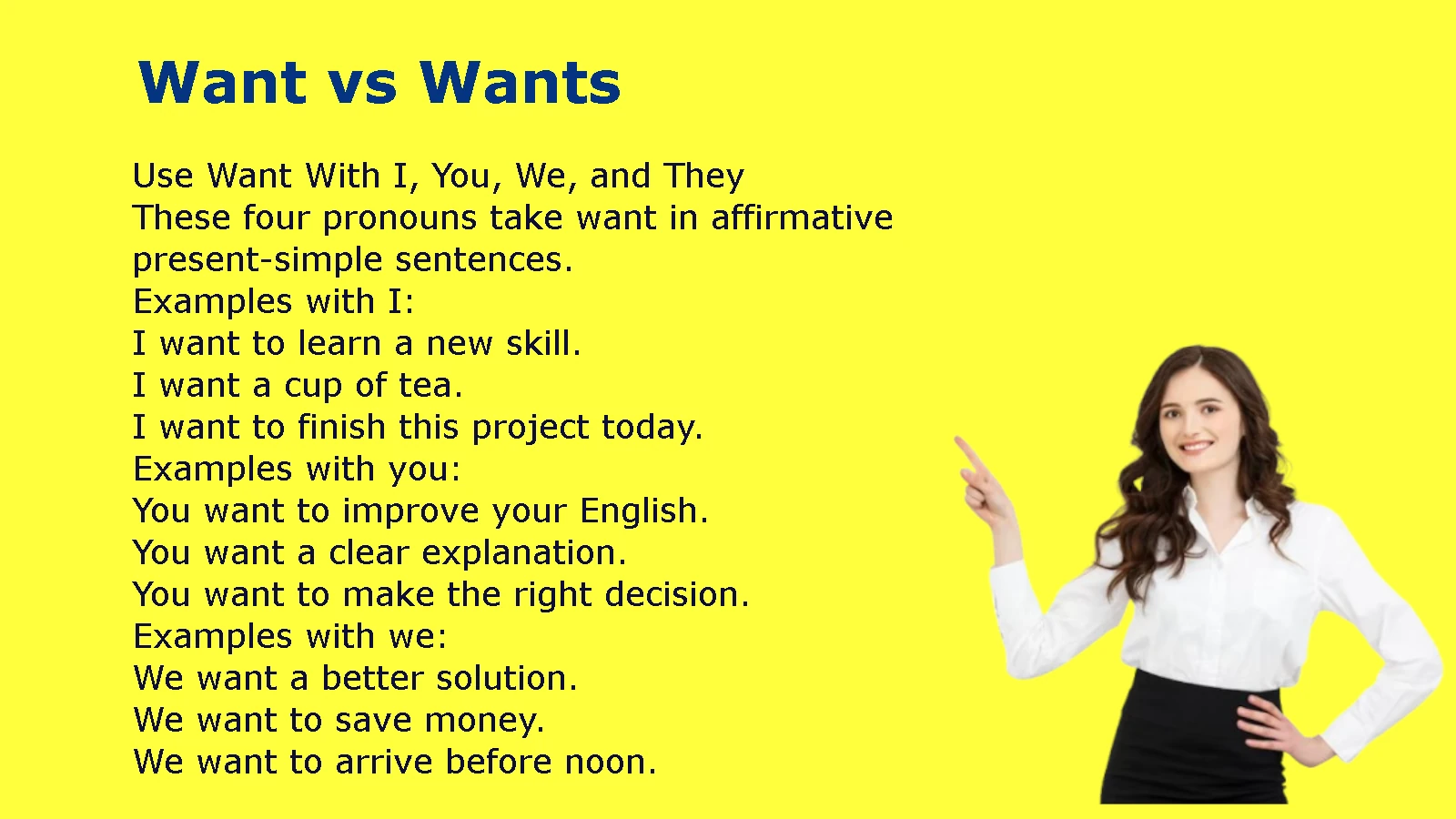
Use want with the pronouns I, you, we, and they, as well as plural nouns. Use wants with he, she, and it, as well as singular nouns and indefinite pronouns such as someone and everyone. This rule applies to affirmative statements in the present simple.
Use Want With I, You, We, and They
These four pronouns take want in affirmative present-simple sentences.
Examples with I:
- I want to learn a new skill.
- I want a cup of tea.
- I want to finish this project today.
Examples with you:
- You want to improve your English.
- You want a clear explanation.
- You want to make the right decision.
with we:
- We want a better solution.
- We want to save money.
- We want to arrive before noon.
Examples with they:
- They want a bigger office.
- They want to travel abroad.
- They want more time to prepare.
Remember that you takes want whether you address one person or several people.
Use Wants With He, She, and It
Use wants when the subject is he, she, or it in an affirmative present-simple sentence.
Examples:
- He wants to buy a car.
- She wants to study medicine.
- It wants more memory to run the program.
- My father wants to retire next year.
- The company wants to hire new employees.
The subject does not need to be a pronoun. Any singular noun can take wants.
For instance, “The customer wants a refund” is correct because the customer is singular. If you change the subject to the customers, you must write “The customers want a refund.”
Use Want With Plural Nouns
Plural nouns generally take want in affirmative present-simple sentences.
Examples:
- The students want extra practice.
- My cousins want to visit us.
- The employees want flexible hours.
- Those dogs want food.
- The new customers want more options.
The same rule applies when a sentence contains a compound subject joined by and.
- Sarah and Daniel want to move abroad.
- My brother and sister want a new television.
- The teacher and the students want a longer break.
These subjects refer to more than one person, so use want.
Use Wants With Singular Nouns
A singular noun takes wants when it acts as the subject of an affirmative present-simple sentence.
Examples:
- The boy wants a toy.
- My neighbor wants to sell his house.
- The doctor wants another test.
- A customer wants to speak to the manager.
- The company wants to expand its business.
One common source of confusion is a singular noun followed by a long descriptive phrase.
For example:
“The student who sits near the window wants to change seats.”
The subject remains the student. The extra words describe the student but do not change the subject’s number.
Why Want Changes to Wants in the Present Simple
English verbs change form to show agreement with certain subjects. In the present simple, most verbs take an -s or -es ending with third-person singular subjects.
The pattern looks like this:
| Base verb | Third-person singular | Example |
| Want | Wants | She wants help. |
| Need | Needs | He needs rest. |
| Like | Likes | It likes warm weather. |
| Work | Works | My father works here. |
| Watch | Watches | She watches television. |
| Go | Goes | He goes to school. |
The rule applies to many other common verbs, so learning it improves your grammar beyond the word want.
However, the main verb does not take the third-person singular ending after does, doesn’t, or a modal verb.
- Correct: He doesn’t want coffee.
- Incorrect: He doesn’t wants coffee.
- Correct: She can want a different result.
- Incorrect: She can wants a different result.
The auxiliary or modal determines the structure, so the main verb stays in its base form.
If you Like Our Content Please visit this website: phrasefinesse.com
We Want or Wants: Which Is Correct?
“We want” is correct in standard English. The pronoun we takes the base form of the verb in affirmative present-simple sentences, so you should not add an -s to want. Write “We want to leave,” not “We wants to leave.”
Why We Want Is Correct
The pronoun we refers to the speaker and at least one other person. It takes the same verb form as I, you, and they for this purpose.
Examples:
- We want to learn together.
- We want a fresh start.
- We want to understand the problem.
- We want a table near the window.
- We want to finish before the deadline.
The word we does not take wants, even when the group consists of only two people.
For example, two coworkers can say, “We want to discuss the proposal.” The verb remains want because the subject is we.
Examples of We Want in Different Contexts
The phrase appears in everyday conversation, workplace communication, education, and formal writing.
In everyday conversation:
- We want to watch a movie tonight.
- We want something to eat.
- We want to visit our grandparents.
At work:
- We want to improve customer service.
- We want to reduce unnecessary expenses.
- We want to review the proposal before Friday.
In education:
- We want to understand the lesson.
- We want more examples of subject-verb agreement.
- We want to improve our writing skills.
In formal communication:
- We want to express our appreciation for your support.
- We want to clarify the terms of the agreement.
- We want to ensure that every participant understands the instructions.
These examples show that the grammar rule remains the same regardless of tone or context.
Common Mistakes With We Want
The most common error is adding -s to the verb because the sentence refers to a group.
Incorrect: We wants to buy a house.
Correct: We want to buy a house.
Another mistake occurs when writers confuse we with a singular group noun.
Compare:
- We want to change the schedule.
- The team wants to change the schedule.
In the first sentence, we takes want. In the second, the team is treated as a singular collective noun in standard American English, so wants is appropriate.
American English generally treats collective nouns such as team, family, and company as singular when referring to the group as a unit. British English sometimes allows plural agreement when the writer emphasizes the individual members.
He Wants or He Want: Which Is Correct?
“He wants” is correct in an affirmative present-simple statement. The pronoun he is third-person singular, so the verb takes an -s ending. However, use want after does, doesn’t, and modal verbs such as can, will, and should.
Why He Wants Is Correct in the Present Simple
The present simple describes habits, general truths, regular activities, and states or preferences.
Examples:
- He wants a new phone.
- He wants to become a doctor.
- He wants to learn how to drive.
- He wants more time to finish the work.
- He wants to move to another city.
The subject he follows the same rule as she and it.
Compare these sentences:
- I want to leave.
- He wants to leave.
The meaning remains almost identical. The verb changes because the subject changes.
Correct Examples Using He Wants
Here are several natural examples that show how to use he wants in different contexts.
Personal preferences:
- He wants a cup of coffee.
- He wants a quieter room.
- He wants to watch the game.
Goals and plans:
- He wants to start his own business.
- He wants to finish college next year.
- He wants to improve his public speaking.
Work and education:
- He wants a promotion.
- He wants to understand the instructions.
- He wants to apply for the position.
Relationships and communication:
- He wants to talk to you.
- He wants to spend more time with his family.
- He wants to explain what happened.
Each example uses wants because he is the subject of an affirmative present-simple statement.
When Want Can Follow He Without an S
Although “he wants” is correct in an affirmative statement, there are several common structures in which he want is grammatically correct.
Questions with does
Use does to form present-simple questions with he. The main verb stays in its base form.
- Does he want to join us?
- Does he want another chance?
- What does he want for dinner?
Do not write “Does he wants?” because does already carries the third-person singular marking.
Negative sentences with doesn’t
Use doesn’t followed by the base form of the verb.
- He doesn’t want to leave.
- He doesn’t want any help.
- He doesn’t want to discuss the issue.
The same pattern applies to she and it.
Modal verbs
Modal verbs such as can, could, will, would, should, and might take the base form of the main verb.
- He can want two different things at once.
- He will want more information.
- He might want to reconsider.
- He should want to help, although he may disagree.
The subjunctive in certain formal expressions
In formal English, want may appear after a verb or expression that requires the subjunctive, although this construction is less common with want than with verbs such as suggest or insist.
For example, “The policy requires that he want no special treatment” uses the base form in a formal subjunctive construction. In everyday English, you will usually encounter he wants, does he want, or he doesn’t want.
If you Like Our Content Please visit this website: phrasefinesse.com
Someone, Anyone, and Everyone Want or Wants?
Someone wants, anyone wants, and everyone wants are the forms used in affirmative present-simple statements. These indefinite pronouns are grammatically singular, even when they refer to people in a broad or general sense. Questions and negatives often use do or does, which changes the structure.
Someone Wants or Someone Want?
In an affirmative present-simple statement, someone wants is correct.
The word someone means an unspecified person. Although the person’s identity is unknown, English grammar treats someone as singular.
Examples:
- Someone wants to speak with you.
- Someone wants your opinion.
- Someone wants to buy this house.
- Someone wants to know what happened.
- Someone wants to borrow my book.
Use want when the sentence contains an auxiliary that requires the base form.
- Does someone want to volunteer?
- Does someone want this seat?
- Someone doesn’t want to participate.
The difference is not about the identity of the person. It depends on the grammatical structure.
Anyone Wants or Anyone Want?
In an affirmative present-simple statement, anyone wants can be correct, although the word anyone often appears in questions and negative sentences.
Examples of affirmative statements:
- Anyone who wants to participate can register.
- Anyone who wants more information can contact us.
- Anyone who wants to join the club must complete the form.
These examples use wants because anyone is the subject of the relative clause beginning with who.
In questions, however, use does anyone want.
- Does anyone want coffee?
- Does anyone want to ask a question?
- Does anyone want to come with us?
The question form is especially common in spoken English. If you’re offering food or asking a group whether somebody is interested, “Does anyone want some?” is natural and correct.
In negative statements, use doesn’t when anyone is the subject.
- Anyone who doesn’t want to participate may leave.
- I don’t think anyone wants to argue.
The second sentence has a different structure. The main clause uses don’t think, while anyone wants appears in the subordinate clause.
Everyone Wants or Everyone Want?
Everyone wants is correct in an affirmative present-simple statement.
The word everyone refers to all the people in a group, but English grammar treats it as singular. This is why it takes wants, just like he or she.
Examples:
- Everyone wants to be respected.
- Everyone wants a fair opportunity.
- Everyone wants to succeed.
- Everyone wants to feel included.
- Everyone wants a clear answer.
Compare the correct question form:
- Everyone wants a break.
- Does everyone want a break?
The first sentence is a statement. The second is a question that uses does, so the main verb becomes want.
This distinction matters because many writers apply the wants rule too broadly. They remember that everyone is singular but forget that auxiliary verbs change the verb form.
Why These Indefinite Pronouns Take Wants
The words someone, anyone, and everyone belong to a group of indefinite pronouns. They refer to people without naming a specific individual or identifying each person separately.
Other indefinite pronouns that normally take singular verbs include:
- Somebody: Somebody wants to see you.
- Anybody: Anybody who wants to enter must register.
- Nobody: Nobody wants to lose.
- Everybody: Everybody wants to feel welcome.
- Each: Each student wants a certificate.
The important point is that grammatical number does not always match the way we think about a group.
For example, everyone refers to many people, but it takes a singular verb. By contrast, they refers to multiple people and takes want.
- Everyone wants a chance.
- They want a chance.
Both sentences can communicate a similar idea, but their subjects follow different agreement rules.
They Want or Wants: Which Is Correct?
“They want” is correct when they serves as the subject of an affirmative present-simple sentence. The pronoun they takes the base form of the verb, whether it refers to multiple people or to one person whose gender is unknown or who uses they/them pronouns.
Why They Want Is Correct
In English, they takes want, not wants, in the present simple.
Examples:
- They want to go home.
- They want more information.
- They want to improve their skills.
- They want to buy a new car.
- They want to speak with the manager.
The rule applies regardless of whether they refers to two people, a large group, or one person who uses singular they.
For example:
“Jordan said they want to join the meeting.”
Here, they refers to Jordan, one person. However, the verb still takes the same form used with plural they.
Examples of They Want in Questions and Statements
In affirmative statements, use they want.
- They want to start early.
- They want a better explanation.
- They want to see the results.
questions, use do they want.
- Do they want to start early?
- Do they want another meeting?
- Why do they want to leave?
- They don’t want to wait.
- They don’t want to spend more money.
- Why don’t they want to participate?
Avoid adding -s to the main verb after do or don’t.
Incorrect: Do they wants to come?
Correct: Do they want to come?
Want or Wants With Other Pronouns
The following comparison helps you remember which pronouns take each form.
| Pronoun | Correct form | Example |
| I | Want | I want to leave. |
| You | Want | You want to learn. |
| We | Want | We want more time. |
| They | Want | They want to participate. |
| He | Wants | He wants a break. |
| She | Wants | She wants a new job. |
| It | Wants | It wants more power. |
A useful memory trick is to focus on the third-person singular pronouns: he, she, and it. In an affirmative present-simple statement, these subjects normally take verbs ending in -s or -es.
Want vs Wants Examples: A Quick Reference Table
A reference table is useful when you need to check a sentence quickly. Instead of memorizing every possible sentence, identify the subject and use the matching verb form.
Want or Wants With Different Subjects
| Subject | Correct form | Example |
| I | Want | I want a new book. |
| You | Want | You want more time. |
| We | Want | We want to learn. |
| They | Want | They want to leave. |
| He | Wants | He wants a car. |
| She | Wants | She wants some water. |
| It | Wants | It wants more energy. |
| Someone | Wants | Someone wants to speak to you. |
| Anyone | Wants | Anyone who wants to join can register. |
| Everyone | Wants | Everyone wants to succeed. |
| Nobody | Wants | Nobody wants to lose. |
| The student | Wants | The student wants help. |
| The students | Want | The students want help. |
| My family | Wants | My family wants a holiday. |
| My friends | Want | My friends want a holiday. |
The table also shows why singular and plural nouns matter. The student wants is correct, while the students want is correct because the subject is plural.
How to Choose the Correct Form in Three Steps
Use this quick method whenever you’re unsure whether to write want or wants.
Step 1: Identify the subject.
Ask who or what performs the action.
Example: “My sister wants to travel.”
The subject is my sister.
Step 2: Check whether the sentence uses the present simple.
The sentence describes a desire or preference that exists now. It is not a question with does or a negative sentence with doesn’t.
Step 3: Match the verb to the subject.
My sister is singular and corresponds to she, so use wants.
Now compare a question:
“Does my sister want to travel?”
The subject is still my sister, but the auxiliary does carries the third-person singular marking. Therefore, the main verb becomes want.
This three-step process works for most everyday uses of the verb.
Want vs Need: Meaning and Examples
Want describes something you desire, while need describes something necessary for a purpose, task, or basic requirement. You might want a new phone because you like its features, but you might need a working phone to perform your job. The distinction depends on the situation and the speaker’s intention.
What Does Want Mean?
To want something means to desire it, prefer it, or wish to have or do it.
Examples:
- I want a new laptop because I like the design.
- She wants to visit Italy.
- They want a larger house.
- We want to try the new restaurant.
A want can be strong or weak. You might want a cup of coffee right now, or you might want to change careers over the next few years.
The word does not automatically indicate whether the desire is necessary, practical, or realistic.
What Does Need Mean?
To need something means that it is required or important for a particular purpose.
Examples:
- I need a laptop to complete my work.
- She needs to take her medication as prescribed.
- They need more time to finish the project.
- We need clean water to survive.
Needs can involve basic necessities, responsibilities, deadlines, or conditions for success.
Like want, the verb need follows subject-verb agreement rules:
- I need help.
- We need help.
- He needs help.
- Everyone needs help sometimes.
The same present-simple pattern applies: need becomes needs with third-person singular subjects in affirmative statements.
Key Differences Between Want and Need
| Feature | Want | Need |
| Basic meaning | To desire something | To require something |
| Example | I want a new phone. | I need a phone for work. |
| Main idea | Preference or desire | Necessity or requirement |
| Common pattern | Want to do something | Need to do something |
| Example with he | He wants a vacation. | He needs a vacation. |
| Example with they | They want more space. | They need more space. |
The difference can change with context. A person might say, “I want to see a doctor,” when describing a preference, or “I need to see a doctor,” when emphasizing a health concern or requirement.
When to Use Want Instead of Need
Use want when you are expressing a preference rather than stating that something is necessary.
For example:
- I want a bigger desk because it looks better.
- We want to eat at a new restaurant.
- She wants to learn another language.
- They want a different color for the walls.
Use need when the situation involves a requirement.
- I need a bigger desk to fit my equipment.
- We need to leave before the traffic gets worse.
- She needs to submit the application by Friday.
- They need a different solution because the current one fails.
Sometimes the same thing can be both a want and a need, depending on the circumstances. A person might want a car for comfort but need reliable transportation for a job that requires travel.
Want vs Need in Everyday Conversations
Consider a short conversation between two coworkers.
Alex: “I want a new laptop.”
Maya: “Do you need one, or do you just want an upgrade?”
Alex: “I need one for the new software, but I want a model with a larger screen.”
This exchange separates the requirement from the preference. Alex needs a compatible laptop to do the job but wants a larger screen as an additional benefit.
That distinction helps in everyday communication, budgeting, planning, and decision-making.
Common Mistakes When Using Want and Wants
Most errors happen when writers forget the subject, add an unnecessary -s, or use the wrong verb form after an auxiliary. Learning the patterns below will help you recognize and correct these mistakes.
Using Wants With We or They
The pronouns we and they take want in affirmative present-simple statements.
Incorrect: We wants to start now.
Correct: We want to start now.
Incorrect: They wants a better result.
Correct: They want a better result.
The quickest fix is to replace the subject with a familiar pronoun. If the subject can be replaced by we or they, use want.
Using Want With He or She in Simple Statements
In an affirmative present-simple statement, he and she take wants.
Incorrect: He want a new job.
Correct: He wants a new job.
Incorrect: She want to learn French.
Correct: She wants to learn French.
However, don’t apply this correction to questions or negative sentences without checking the structure.
- Does he want a new job?
- She doesn’t want to learn French.
Both are correct because the auxiliary carries the required grammatical marking.
Adding an S After Does or Doesn’t
This is one of the most common subject-verb agreement errors.
Incorrect: Does she wants to leave?
Correct: Does she want to leave?
Incorrect: He doesn’t wants coffee.
Correct: He doesn’t want coffee.
Remember that does and doesn’t already reflect the third-person singular subject. The main verb therefore stays in its base form.
The same principle applies to other verbs:
- Does he like it?
- She doesn’t need help.
- Does your brother work here?
Don’t write does likes, doesn’t needs, or does works in these structures.
Confusing Singular Meaning With Plural Grammar
Some subjects refer to many people but take singular verbs.
For example:
- Everyone wants to win.
- Everybody wants to be heard.
- Each student wants a certificate.
By contrast, plural pronouns take want.
- They want to win.
- The students want to be heard.
The meaning may overlap, but the grammar depends on the subject’s form.
A collective noun can also cause confusion.
- The team wants a new coach. (The team is treated as one unit.)
- The players want a new coach. (The players are plural.)
A Simple Trick to Remember Want vs Wants
Use this memory rule:
He, she, it — wants. I, you, we, they — want.
Then check whether an auxiliary verb appears before the main verb.
- He wants help.
- Does he want help?
- He doesn’t want help.
- He can want help without asking for it.
The final three sentences use want because their structures require the base form.
Want vs Wants Practice: Test Your Grammar
Practice helps you apply the rule without relying on guesswork. Choose want or wants for each sentence, then check your answers and explanations.
Fill-in-the-Blank Questions
Complete each sentence with the correct form.
- I _____ to learn how to cook.
- She _____ a glass of water.
- We _____ to finish the project today.
- Everyone _____ to feel respected.
- Does he _____ to join the team?
- They _____ a larger apartment.
- My brother _____ to buy a bicycle.
- Does anyone _____ a cup of tea?
- The children _____ to play outside.
- He doesn’t _____ to talk right now.
Answer Key With Explanations
| Sentence | Correct answer | Explanation |
| I _____ to learn how to cook. | Want | I takes want. |
| She _____ a glass of water. | Wants | She is third-person singular. |
| We _____ to finish the project today. | Want | We takes want. |
| Everyone _____ to feel respected. | Wants | Everyone is grammatically singular. |
| Does he _____ to join the team? | Want | Does requires the base form. |
| They _____ a larger apartment. | Want | They takes want. |
| My brother _____ to buy a bicycle. | Wants | My brother is singular. |
| Does anyone _____ a cup of tea? | Want | Does requires the base form. |
| The children _____ to play outside. | Want | Children is plural. |
| He doesn’t _____ to talk right now. | Want | Doesn’t requires the base form. |
Review any mistakes by identifying the subject and checking for an auxiliary verb. If you can explain why an answer is correct, you’re more likely to remember the rule.
Frequently Asked Questions About Want vs Wants
Is It Want or Wants?
Both forms are correct, but they appear with different subjects and sentence structures. Use want with I, you, we, and they. Use wants with he, she, it, and singular nouns in affirmative present-simple statements.
Examples: “They want to leave” and “He wants to leave.”
Do We Say Everyone Want or Everyone Wants?
Use everyone wants in an affirmative present-simple statement. Although everyone refers to all the people in a group, English treats it as a singular indefinite pronoun.
Example: “Everyone wants to do a good job.”
In a question, use “Does everyone want to participate?”
Is It Someone Want or Someone Wants?
Use someone wants in an affirmative present-simple sentence because someone is grammatically singular.
Example: “Someone wants to speak with you.”
In a question, use “Does someone want to speak with you?” because does requires the base form want.
Is It Anyone Want or Anyone Wants?
Both forms can appear in correct sentences, depending on the structure. Use anyone wants in an affirmative statement such as “Anyone who wants to participate can register.” In a direct question, use “Does anyone want to participate?”
Is It We Want or We Wants?
We want is correct. The pronoun we takes the base form of the verb in the present simple.
Example: “We want to improve our English.”
Avoid “We wants to improve our English.”
Is It He Wants or He Want?
Use he wants in an affirmative present-simple statement, such as “He wants a new phone.” Use want after does, doesn’t, or a modal verb: “Does he want a new phone?” and “He doesn’t want a new phone.”
Is It They Want or They Wants?
They want is correct in an affirmative present-simple statement. The rule applies whether they refers to several people or one person who uses singular they.
Example: “They want to discuss the proposal.”
What Is the Difference Between Want and Need?
Want expresses a desire or preference, while need expresses a requirement or necessity. For example, “I want a new laptop” describes a preference, while “I need a laptop for work” explains a practical requirement.
Both verbs follow the same subject-verb agreement pattern: I need, but he needs.
Conclusion: Remember the Rule for Want vs Wants
The difference between want vs wants becomes simple once you identify the subject and sentence structure. Use want with I, you, we, and they, as well as plural nouns. Use wants with he, she, it, singular nouns, and indefinite pronouns such as someone and everyone in affirmative present-simple statements.
Keep these examples in mind:
- We want to improve.
- They want more time.
- He wants a new job.
- Everyone wants to succeed.
- Does she want to join us?
- He doesn’t want to leave.
Notice the final two examples. Questions and negative statements use want after does or doesn’t, even when the subject is singular.













