Suggest vs Suggests is a common grammar question, especially for English learners and writers who want to create clear, correct sentences. The main difference is simple: suggest is the base verb, while suggests is the third-person singular present-tense form.
You use suggest with subjects such as I, you, we, and they. Use suggests with he, she, it, or a singular noun. However, choosing the correct form also depends on sentence structure, modal verbs, and expressions such as suggest that and suggest doing something.
Understanding subject-verb agreement, suggest vs. suggestion, and the differences between suggest, recommend, propose, and indicate will help you write more naturally in emails, essays, reports, and everyday conversations.
Suggest vs Suggests: What’s the Difference?
Suggest is the base form of the verb, while suggests is its third-person singular present-tense form. Use suggest with I, you, we, they, and plural subjects. Use suggests with he, she, it, and singular third-person subjects. Both forms express similar meanings but follow different grammar rules.
| Word | Grammatical form | Common subjects | Example |
| Suggest | Base verb | I, you, we, they | They suggest a new plan. |
| Suggest | Base verb | After modal verbs | She can suggest an option. |
| Suggests | Third-person singular present | He, she, it | He suggests a new plan. |
| Suggests | Third-person singular present | Singular nouns | The teacher suggests a revision. |
The key difference is subject-verb agreement, not meaning. Both forms can describe offering an idea, making a recommendation, or pointing toward a possibility.
What Does Suggest Mean?
Suggest means to put forward an idea, option, explanation, or possible course of action for someone to consider.
People use the verb when they want to share an opinion without necessarily demanding that someone follow it.
Examples:
- I suggest taking a short break.
- We suggest a different approach.
- Can you suggest a good book?
- The report suggests a possible connection between the two factors.
The word can express different intentions depending on context.
For example, in I suggest calling the client, the speaker offers an idea. In The evidence suggests a problem, the speaker presents an interpretation based on available information.
What Does Suggests Mean?
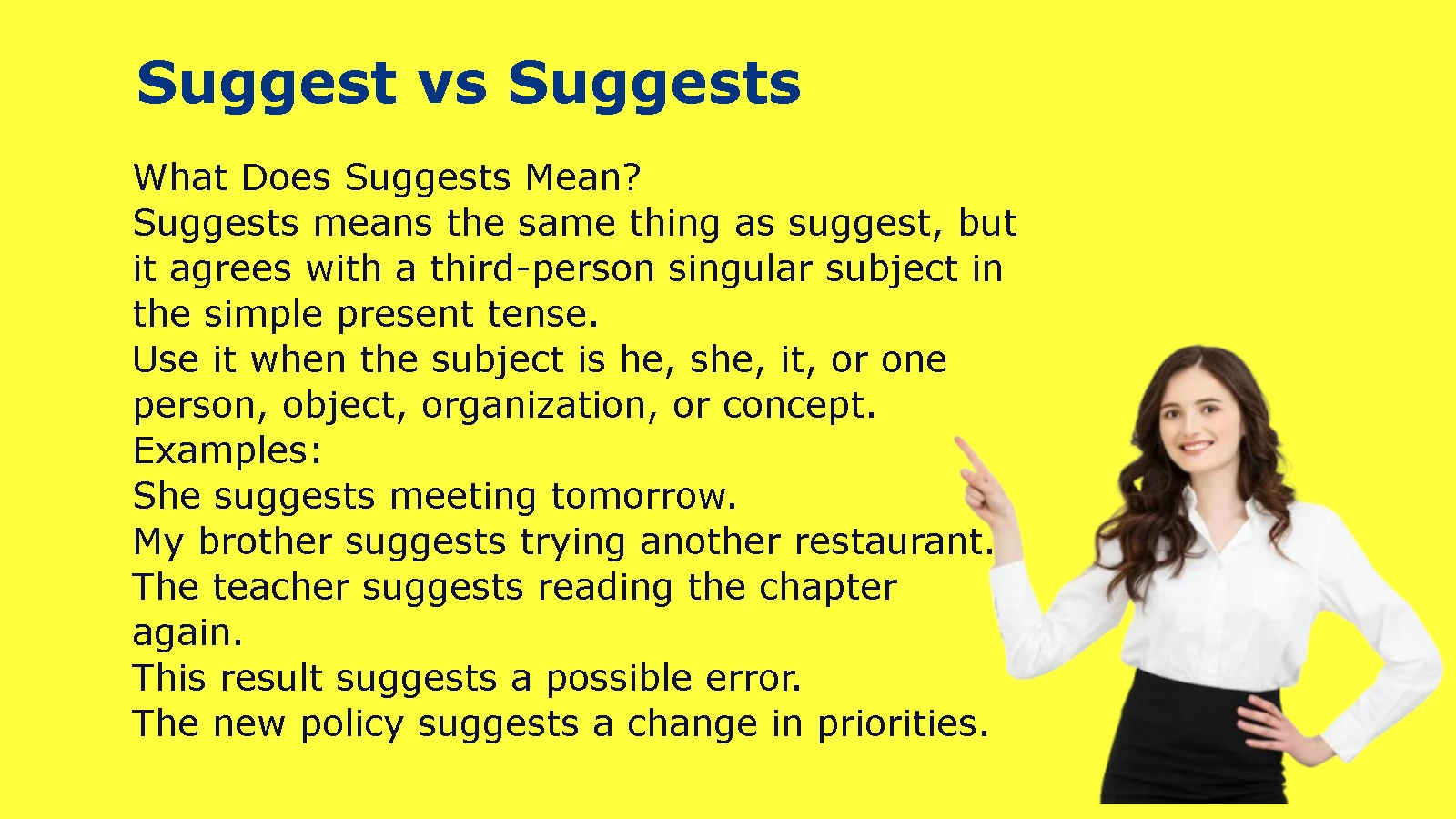
Suggests means the same thing as suggest, but it agrees with a third-person singular subject in the simple present tense.
Use it when the subject is he, she, it, or one person, object, organization, or concept.
Examples:
- She suggests meeting tomorrow.
- My brother suggests trying another restaurant.
- The teacher suggests reading the chapter again.
- This result suggests a possible error.
- The new policy suggests a change in priorities.
Notice that the subject determines the verb form.
In My brother suggests meeting tomorrow, the subject is my brother, which is singular. Therefore, suggests is correct.
Suggest vs Suggests at a Glance
Remember this quick comparison:
| Subject | Correct form | Example |
| I | Suggest | I suggest a change. |
| You | Suggest | You suggest a solution. |
| We | Suggest | We suggest a review. |
| They | Suggest | They suggest a meeting. |
| He | Suggests | He suggests a meeting. |
| She | Suggests | She suggests a meeting. |
| It | Suggests | It suggests a problem. |
| The manager | Suggests | The manager suggests a revision. |
| The managers | Suggest | The managers suggest a revision. |
Important: Suggests does not mean that multiple people suggest something. English does not form this verb’s plural by adding -s. The ending marks third-person singular agreement in the simple present.
When Should You Use Suggest or Suggests?
Use suggest when the subject is I, you, we, or they, or a plural noun. Use suggests when the subject is a third-person singular noun or pronoun. Check the actual subject rather than the nearest noun because extra phrases can make the sentence harder to read.
When to Use Suggest
Use suggest in these situations:
- I: I suggest reviewing the document.
- You: You suggest practical solutions.
- We: We suggest arriving early.
- They: They suggest changing the schedule.
- Plural nouns: The employees suggest new training methods.
The same rule applies when a sentence includes additional information.
Examples:
- The students in my class suggest more discussion time.
- My parents, along with my uncle, suggest taking the earlier flight.
- Both managers suggest reviewing the budget.
In the first sentence, students is plural. The phrase in my class does not change the subject.
In the second sentence, my parents is the subject. The singular noun uncle does not turn it into a singular subject.
When to Use Suggests
Use suggests with third-person singular subjects in the simple present.
Examples:
- My teacher suggests practicing every day.
- The company suggests using a stronger password.
- This article suggests several ways to improve writing.
- Her experience suggests that the plan could work.
- The latest update suggests a change in direction.
A singular subject can represent a person, object, organization, or abstract concept.
For example, The research suggests a link uses suggests because research is treated as a singular, uncountable noun in this sentence.
Suggest or Suggests in a Sentence
Comparing sentences side by side makes the rule easier to remember.
| Suggest | Suggests |
| I suggest leaving early. | He suggests leaving early. |
| We suggest a new design. | The designer suggests a new design. |
| They suggest another option. | She suggests another option. |
| The teachers suggest more practice. | The teacher suggests more practice. |
| You suggest a useful solution. | Your colleague suggests a useful solution. |
The meaning stays nearly the same. Only the subject and verb form change.
Editing tip: When you revise a sentence, identify who or what performs the action before changing the verb.
Common Suggest vs Suggests Grammar Mistakes
These are common errors and their corrections.
Incorrect: She suggest another option.
Correct: She suggests another option.
Why? She is a third-person singular subject.
Incorrect: They suggests a better solution.
Correct: They suggest a better solution.
Why? They takes the base form suggest.
Incorrect: The manager, along with the employees, suggest a change.
Correct: The manager, along with the employees, suggests a change.
Why? The main subject is the manager. The phrase along with the employees does not create a compound subject.
Incorrect: Each of the students suggest a different answer.
Correct: Each of the students suggests a different answer.
Why? Each is singular in this construction.
Another common mistake occurs with compound subjects:
- Sarah and Daniel suggest a revision.
- Either Sarah or Daniel suggests a revision.
In the second example, the subject is singular regardless of which person makes the suggestion.
Why Do We Say I Suggest but He Suggests?
English adds -s to most regular verbs in the simple present when the subject is third-person singular. That’s why we say I suggest but he suggests. The pattern also applies to verbs such as recommend, explain, and indicate.
The Third-Person Singular Rule
The basic present-tense pattern looks like this:
| Subject | Verb form | Example |
| I | Suggest | I suggest a change. |
| You | Suggest | You suggest a change. |
| He/She/It | Suggests | She suggests a change. |
| We | Suggest | We suggest a change. |
| They | Suggest | They suggest a change. |
This pattern applies to many English verbs:
- Recommend → recommends
- Explain → explains
- Indicate → indicates
- Propose → proposes
- Support → supports
However, English has irregular verbs, too. For example, have becomes has, and be changes to am, is, or are depending on the subject.
The verb suggest follows the regular pattern.
Does Suggest Change After Modal Verbs?
No. After a modal verb, use the base form suggest, regardless of whether the subject is singular or plural.
Examples:
- She can suggest a solution.
- He might suggest another option.
- The manager should suggest a deadline.
- They will suggest a new approach.
- My teacher could suggest useful resources.
Do not write She can suggests or He might suggests.
The modal verb already occupies the position before the main verb. The main verb stays in its base form.
Does Suggest Change After To?
Use suggest after to when the sentence contains an infinitive.
Examples:
- I want to suggest a new idea.
- She plans to suggest a revision.
- They hope to suggest a better solution.
The subject does not change the verb after to.
Compare:
- He suggests a new plan.
- He wants to suggest a new plan.
The first sentence uses the simple present. The second uses an infinitive after wants.
Suggest in Questions and Negative Sentences
Questions and negatives with does or doesn’t require the base form of the main verb.
Questions:
- Does she suggest another option?
- Does the manager suggest this approach?
- Does your friend suggest meeting earlier?
Negative sentences:
- She doesn’t suggest that option.
- The manager doesn’t suggest changing the deadline.
- He doesn’t suggest meeting today.
Why does suggests become suggest?
The auxiliary verb does carries the third-person singular marking. Therefore, the main verb stays in its base form.
Compare:
- She suggests a change.
- Does she suggest a change?
- She doesn’t suggest a change.
This pattern is useful when writing questions, reports, and explanations.
Suggest vs. Suggestion: What’s the Difference?
Suggest is a verb that describes the act of putting forward an idea, while suggestion is a noun that names the idea or proposal itself. Use suggest to describe an action and suggestion to identify what someone offers.
Suggest as a Verb
The verb suggest describes what someone or something does.
Examples:
- I suggest taking the train.
- She suggests a shorter meeting.
- They suggest reviewing the figures.
- The evidence suggests another explanation.
You can use it with different sentence patterns, including suggest + noun, suggest + gerund, and suggest that + clause.
Suggestion as a Noun
Suggestion refers to an idea, recommendation, or proposal that someone offers for consideration.
Examples:
- Your suggestion sounds practical.
- I appreciate your suggestion.
- The committee reviewed three suggestions.
- Her suggestion helped us solve the problem.
The noun has two common forms:
- Suggestion: Singular
- Suggestions: Plural
Use suggestion when you refer to one idea and suggestions when you refer to multiple ideas.
Suggest vs. Suggestion Examples
Compare these sentence pairs:
| Verb: Suggest | Noun: Suggestion |
| I suggest taking a break. | My suggestion is to take a break. |
| She suggests a new topic. | Her suggestion is a new topic. |
| They suggest changing the design. | Their suggestion is to change the design. |
| He suggests another solution. | His suggestion is another solution. |
Both structures can communicate similar ideas, but they organize the sentence differently.
For example:
I suggest reviewing the report.
Here, suggest introduces an action.
My suggestion is to review the report.
Here, suggestion names the idea, and the infinitive explains it.
Suggestion vs. Suggestions: Singular and Plural Agreement
The noun suggestion also affects subject-verb agreement.
- This suggestion is helpful.
- These suggestions are helpful.
- One suggestion seems practical.
- Several suggestions seem practical.
Remember that the verb agrees with the noun’s number.
Also, don’t confuse suggests with suggestions. They look similar, but they serve different grammatical roles.
- She suggests a change. (Verb)
- Her suggestions are helpful. (Plural noun)
Suggest vs. Recommend: Meaning and Usage
Suggest often introduces an idea or possible option, while recommend usually expresses a stronger endorsement based on judgment, experience, or suitability. Both verbs can overlap, but recommend often signals that the speaker considers an option particularly worthwhile.
When to Use Suggest
Use suggest when you want to:
- Offer an idea during brainstorming.
- Introduce a possible solution.
- Encourage someone to consider an option.
- Share a possibility without making a strong endorsement.
Examples:
- I suggest moving the meeting to Friday.
- She suggests trying a different approach.
- We suggest adding another example to the article.
- The report suggests a possible improvement.
A suggestion can be tentative, practical, or exploratory.
For example, a team leader might say, “I suggest we test both versions before deciding.” The leader introduces an option without declaring that it must be the final choice.
When to Use Recommend
Use recommend when you want to express a more direct endorsement.
Examples:
- I recommend this book for beginners.
- The doctor recommended getting more rest.
- Our team recommends the updated software.
- She recommends booking a table in advance.
Recommendations often reflect experience, expertise, evidence, or personal preference.
However, recommend doesn’t always mean certainty. Someone can recommend an option without guaranteeing that it will work.
Recommend or Suggestion: Which Word Is Correct?
Recommend is a verb, while suggestion is a noun. They aren’t direct grammatical alternatives, so choose the word based on the sentence structure.
Compare:
- I recommend this course.
- My suggestion is to take this course.
- She recommends reading the guide.
- Her suggestion is to read the guide.
If you need a noun that corresponds to recommend, use recommendation.
For example:
- I recommend this restaurant.
- My recommendation is this restaurant.
The word suggestion can also work, but the tone and sentence structure may change.
Suggest vs. Recommend Examples
| Situation | Suggest | Recommend |
| Brainstorming | I suggest another idea. | I recommend the strongest option. |
| Writing | She suggests adding a paragraph. | She recommends rewriting the introduction. |
| Shopping | He suggests comparing models. | He recommends this model. |
| Workplace | We suggest reviewing the timeline. | We recommend extending the deadline. |
Practical distinction: Use suggest when introducing an option. Use recommend when you want to communicate that you favor an option.
You can use either word when both meanings fit.
Suggest vs. Propose: What’s the Difference?
Suggest generally presents an idea for consideration, while propose often introduces a more formal plan, arrangement, or course of action. The two verbs overlap, but propose can sound more deliberate, structured, or official.
When to Use Suggest
Use suggest for everyday ideas, informal recommendations, and early-stage discussions.
Examples:
- I suggest meeting after lunch.
- She suggests changing the title.
- They suggest a different marketing approach.
The idea might still need discussion or development.
When to Use Propose
Use propose when presenting a plan, formal idea, or arrangement.
Examples:
- The director proposes a new hiring policy.
- We propose extending the project timeline.
- The committee proposes three changes to the rules.
- She proposed a partnership between the two companies.
In business, propose often appears in formal documents, project plans, and negotiations.
For example, a consultant may propose a six-month strategy that includes milestones, costs, and performance targets.
Suggest and Propose in Example Sentences
Compare:
- I suggest reviewing the budget.
- I propose a full budget review next week.
The first sentence offers an idea. The second presents a more defined action.
However, the distinction isn’t absolute.
You can say, “I suggest a new policy” or “I propose a new policy.” Both sentences are grammatically correct. The difference lies mainly in tone, context, and how formally you present the idea.
Indicate vs. Suggest: What’s the Difference?
Indicate often means to point to, signal, or show something, while suggest can express a possible explanation, interpretation, or idea. In analytical writing, indicate often emphasizes signs or findings, whereas suggest can sound more tentative.
When to Use Indicate
Use indicate when something provides a sign, signal, or piece of information.
Examples:
- The survey results indicate a change in customer preferences.
- The warning light indicates a system problem.
- The figures indicate higher operating costs.
- Her expression indicated concern.
The verb often works well in reports, research summaries, technical writing, and everyday descriptions.
When to Use Suggest
Use suggest when presenting a possible interpretation or conclusion.
Examples:
- The survey results suggest that customers prefer simpler designs.
- The figures suggest a possible increase in demand.
- His response suggests that he disagrees.
- The findings suggest a connection between the two factors.
A suggestion based on evidence isn’t automatically a proven fact.
For example, if a small survey shows that customers prefer one design, the results may suggest a preference. They don’t necessarily establish what every customer wants.
Indicate vs. Suggest Examples
| Indicate | Suggest |
| The data indicate a decline in sales. | The data suggest a possible reason for the decline. |
| The sign indicates the exit. | The sign suggests which direction to take. |
| Her tone indicated frustration. | Her tone suggested that she was upset. |
| The results indicate a difference. | The results suggest a possible explanation. |
These verbs sometimes overlap.
Neither word guarantees certainty. The strength of a statement depends on the evidence, the context, and any qualifying language.
For instance, The results indicate a possible association remains cautious, while The results suggest a clear pattern can express relatively strong confidence.
Choose the verb that accurately reflects what the evidence supports.
Sentence Patterns to Know When Using Suggest
The verb suggest appears in several common grammatical patterns. Learning these structures helps you avoid errors and write more naturally, particularly in academic work, professional emails, and formal discussions.
Suggest + Noun
Use suggest + noun when introducing an idea, option, or course of action.
Examples:
- I suggest a revision.
- She suggests a new strategy.
- We suggest a different location.
- The report suggests an alternative explanation.
The noun identifies the proposed idea.
Suggest + Gerund
A gerund is an -ing form that functions as a noun.
Use suggest + gerund when proposing an activity.
Examples:
- I suggest waiting until Monday.
- She suggests reviewing the report.
- They suggest taking a different route.
- We suggest starting with the introduction.
This pattern is particularly useful when discussing actions.
Common mistake: Don’t automatically use an infinitive after suggest.
Less natural or nonstandard for the intended meaning:
- I suggest to wait until Monday.
Better:
- I suggest waiting until Monday.
- I suggest that we wait until Monday.
Suggest That + Clause
Use suggest that + subject + verb to introduce an idea, recommendation, or possibility.
Examples:
- I suggest that we leave early.
- She suggests that he apply again.
- They suggest that the company review its policy.
- The evidence suggests that the system needs an update.
In American English, the subjunctive form often uses the base verb after that when someone recommends an action.
For example:
- I suggest that she take a break.
- We suggest that he review the document.
Don’t add -s just because the clause’s subject is she or he.
The recommendation construction uses the base form.
Suggest Someone Do Something
English commonly uses this construction:
Suggest that + person + base verb
Examples:
- I suggest that Maria check the figures.
- He suggests that James arrive early.
- We suggest that the team review the plan.
American English often uses this subjunctive pattern.
You may also encounter should constructions, which are common in British English and are also used in American English.
- I suggest that Maria should check the figures.
- We suggest that the team should review the plan.
Both patterns can be correct.
The important point is to use a natural grammatical structure rather than treating suggest like every other verb.
Common Incorrect Patterns After Suggest
Some sentence patterns need special attention.
Incorrect for the intended meaning: She suggested me to revise the report.
Better:
- She suggested that I revise the report.
- She suggested revising the report.
- She recommended that I revise the report.
Incorrect: I suggest to change the headline.
Better:
- I suggest changing the headline.
- I suggest that we change the headline.
Incorrect: He suggests that she takes a break.
Better in the American English subjunctive construction: He suggests that she take a break.
The indicative form takes can occur in other contexts or varieties, but the subjunctive is a standard choice for recommendations in American English.
Also, distinguish a suggestion from a statement about evidence:
- The report suggests that the plan works.
Here, suggests means that the report points toward a conclusion. The indicative works is appropriate.
The verb pattern depends on the meaning of suggest.
Quick Editing Guide: How to Choose Suggest or Suggests
You can choose the correct form in seconds by identifying the subject and checking the sentence structure.
A Simple Three-Step Grammar Check
Step one: Find the subject.
Ask who or what performs the action.
Example:
The new employee in our department suggests a different method.
The subject is employee, not department.
Step two: Check whether the subject is third-person singular.
- He, she, it: Singular
- One employee: Singular
- The company: Singular
- They: Takes suggest
- Two employees: Plural
Step three: Check the verb construction.
Use suggests in an ordinary third-person singular present-tense statement.
Use suggest after:
- I, you, we, they
- Plural subjects
- Modal verbs
- To in an infinitive
- Does or doesn’t
- The subjunctive in recommendation clauses
This final check prevents mistakes that subject identification alone might not catch.
Real-World Editing Examples
Incorrect: Your colleague suggest moving the meeting.
Correct: Your colleague suggests moving the meeting.
Why: Your colleague is singular.
Academic writing
Incorrect: The evidence suggest a relationship.
Correct: The evidence suggests a relationship.
Why: Evidence is an uncountable singular noun in this construction.
Team communication
Incorrect: We suggests reviewing the draft.
Correct: We suggest reviewing the draft.
Why: We takes the base verb.
Everyday conversation
Incorrect: My friend suggest trying the new restaurant.
Correct: My friend suggests trying the new restaurant.
Why: My friend is singular.
Mini Practice: Suggest or Suggests?
Fill in each blank with the correct form.
- My sister _____ learning a new language.
- They _____ reviewing the schedule.
- The report _____ a possible improvement.
- You _____ practical ideas.
- Each employee _____ a different solution.
Answer key
- Suggests — My sister is singular.
- Suggest — They takes the base form.
- Suggests — The report is singular.
- Suggest — You takes the base form.
- Suggests — Each employee is singular.
A useful editing habit is to check every third-person singular verb in a paragraph. This small step can catch agreement errors before you publish an article or send an email.
Frequently Asked Questions
Is it suggest or suggests?
Both forms are correct, but the subject determines which one you should use. Use suggest with I, you, we, they, and plural subjects. Use suggests with he, she, it, and singular nouns in the simple present.
Examples:
- We suggest a change.
- She suggests a change.
Is suggest singular or plural?
Suggest is the base form of the verb. It isn’t exclusively singular or plural. English uses it with several subjects, including I, you, we, and they. The form suggests is specifically used with third-person singular subjects in the simple present.
Can I use suggests with they?
No, not in standard simple present-tense agreement. Use they suggest, not they suggests.
This rule applies to both plural and singular they.
Examples:
- They suggest another option.
- My friend said they suggest starting early.
Even when they refers to one person, the verb takes the base form.
Is suggestion the same as suggest?
No. Suggest is a verb, while suggestion is a noun.
- I suggest reviewing the document.
- My suggestion is to review the document.
Use suggest to describe the action and suggestion to name the idea.
What is the difference between suggest and recommend?
Suggest often introduces an idea or option. Recommend generally communicates a stronger endorsement or preference.
For example:
- I suggest comparing these products.
- I recommend this product.
The verbs can overlap, but recommend often signals that the speaker favors a particular choice.
What is the difference between suggest and indicate?
Suggest often introduces an idea or possible interpretation. Indicate often points to a sign, signal, or finding.
For example:
- The results indicate a decline in sales.
- The results suggest a possible reason for the decline.
Both verbs can express uncertainty or confidence, depending on context.
Conclusion: Choose Suggest or Suggests With Confidence
The difference between Suggest vs Suggests comes down to subject-verb agreement.
Use suggest with I, you, we, they, and plural subjects. Choose suggests with he, she, it, and singular third-person subjects in the simple present.
Keep these additional rules in mind:
- Use suggestion as a noun and suggest as a verb.
- Use suggest after modal verbs and doesn’t.
- Use natural structures such as suggest doing something and suggest that someone do something.
- Choose between suggest, recommend, propose, and indicate based on your intended meaning.