Polarize or polarise? Both spellings are correct, but they belong to different English spelling conventions. American English uses polarize, while British English typically uses polarise. Both forms describe dividing people into opposing groups, and they also appear in scientific terms such as polarized light, polarised sunglasses, and polarization in chemistry.
The word has several meanings depending on its context. In everyday conversations, a polarizing person provokes strong reactions from people with different opinions. In physics, polarization describes a property of waves, especially the orientation of light’s electromagnetic field. Understanding these distinctions helps you choose the right spelling and use the word accurately.
Polarize or Polarise: Which Spelling Is Correct?
Polarize is the standard American English spelling, while polarise is the standard British English spelling. Both words have the same meaning, pronunciation, and grammatical function. The difference lies in regional spelling preferences, similar to organize and organise or recognize and recognise.
Polarize Is the American English Spelling
American English generally uses -ize in words such as polarize, organize, recognize, and modernize. This spelling appears in American newspapers, textbooks, business documents, and scientific writing.
For example:
- The debate could polarize the community.
- Social media can polarize discussions about public policy.
- These lenses polarize incoming light to reduce glare.
- The candidate’s remarks polarized voters across the country.
Use polarize when writing for a primarily American audience. American dictionaries and style guides generally favor this form, although individual publications may have their own house styles.
Polarise Is the British English Spelling
British English commonly uses -ise in words such as polarise, organise, recognise, and modernise. This convention also appears in many publications in countries that follow British spelling practices.
For example:
- The proposed changes could polarise the public.
- His comments polarised the audience.
- Polarised sunglasses can reduce glare from water.
- The issue continues to polarise political groups.
Use polarise when writing for a British audience or a publication that follows British spelling conventions. However, British English also accepts some -ize spellings, so the choice depends on the relevant style guide.
Polarize vs. Polarise: Quick Comparison
| Feature | Polarize | Polarise |
| Main spelling convention | American English | British English |
| Meaning | Divide into opposing groups or produce polarization | Same meaning |
| Pronunciation | Same standard pronunciation | Same standard pronunciation |
| Past tense | Polarized | Polarised |
| Present participle | Polarizing | Polarising |
| Scientific usage | Polarized light, polarization | Polarised light, polarisation |
| Example | The issue may polarize voters. | The issue may polarise voters. |
Remember: Neither spelling is inherently more correct than the other. Choose the version that matches your audience, and use it consistently throughout the article or document.
What Does Polarize Mean?
Polarize is a verb that means to divide people into two or more sharply opposing groups, often because they hold different beliefs, values, or interests. In science, the word has more specific meanings related to waves, electrical charge, and chemical systems. The surrounding sentence determines which meaning applies.
Polarize Meaning in Everyday English
In everyday English, to polarize means to cause strong differences of opinion or push people toward opposing positions. The word often appears in discussions about politics, culture, social issues, workplace decisions, and controversial public figures.
Imagine a company introducing a strict return-to-office policy. Some employees welcome the opportunity to collaborate in person, while others believe the policy limits flexibility. If the announcement intensifies the disagreement and creates two opposing camps, it may polarize the workforce.
The word often suggests more than an ordinary disagreement. People may become increasingly committed to their own positions and less willing to understand the other side.
Consider these examples:
- The new school policy polarized parents.
- Her comments polarized the online community.
- The film polarized viewers because of its unconventional ending.
- The proposed changes could polarize employees into opposing groups.
- A controversial advertisement polarized customers rather than attracting a wider audience.
In each example, the subject causes or intensifies division. The verb does not automatically mean that one side is right and the other is wrong.
What Does It Mean When Someone Is Polarizing?
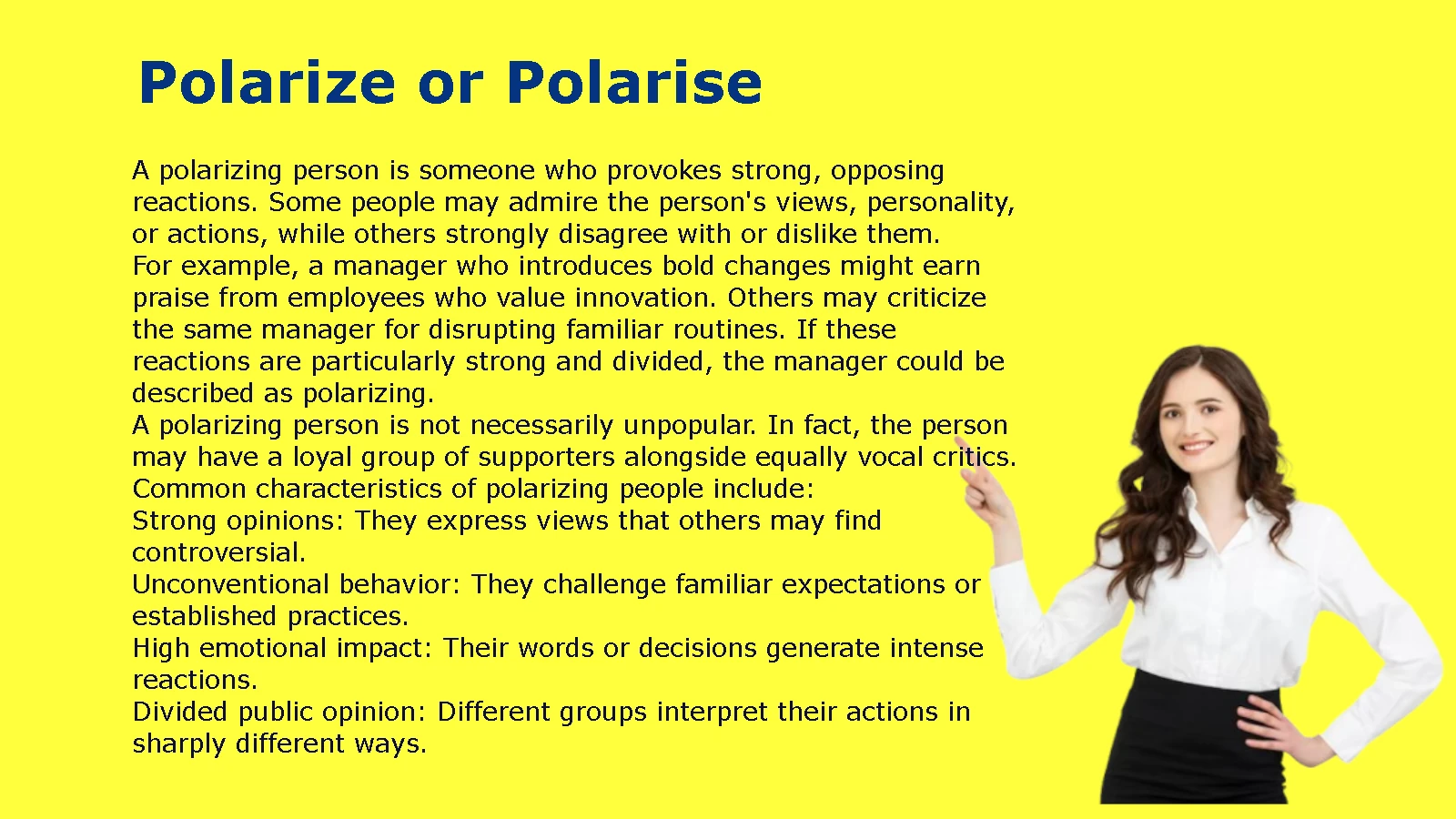
A polarizing person is someone who provokes strong, opposing reactions. Some people may admire the person’s views, personality, or actions, while others strongly disagree with or dislike them.
For example, a manager who introduces bold changes might earn praise from employees who value innovation. Others may criticize the same manager for disrupting familiar routines. If these reactions are particularly strong and divided, the manager could be described as polarizing.
A polarizing person is not necessarily unpopular. In fact, the person may have a loyal group of supporters alongside equally vocal critics.
Common characteristics of polarizing people include:
- Strong opinions: They express views that others may find controversial.
- Unconventional behavior: They challenge familiar expectations or established practices.
- High emotional impact: Their words or decisions generate intense reactions.
- Divided public opinion: Different groups interpret their actions in sharply different ways.
The term can describe politicians, entertainers, business leaders, teachers, influencers, or ordinary people involved in heated disagreements.
Example: “The entrepreneur is polarizing because some people admire his risk-taking, while others question his management style.”
This sentence explains the opposing reactions rather than simply labeling the entrepreneur as good or bad.
How to Use Polarize in a Sentence
Use polarize when a person, event, statement, policy, or decision causes people to develop opposing opinions. The verb often takes a direct object, such as voters, the audience, the public, or the community.
| Example sentence | Context |
| The proposal could polarize the neighborhood. | Community disagreement |
| Her interview polarized viewers. | Media and public opinion |
| The manager’s decision may polarize the team. | Workplace conflict |
| The movie polarized critics and audiences. | Entertainment |
| The election issue continues to polarize voters. | Politics |
| The new policy has polarized the organization. | Institutional disagreement |
| The documentary polarized its audience with competing interpretations. | Film and culture |
| The lenses polarize light to reduce reflected glare. | Physics and optics |
Notice that the subject does not have to be a person. A policy, statement, event, or piece of technology can also polarize people.
You can use the word in different tenses:
- Present: The issue polarizes the community.
- Past: The announcement polarized employees.
- Present perfect: The debate has polarized public opinion.
- Future: The decision may polarize voters.
- Continuous: The controversy is polarizing the audience.
For British English, replace polarize, polarized, and polarizing with polarise, polarised, and polarising.
Polarize Synonyms and Related Words
The best polarize synonym depends on what you want to express. Words such as divide, split, and separate describe division, but they do not always convey the strong opposing reactions associated with polarization.
Synonyms for Polarize in Social and Political Contexts
| Synonym | Meaning | Example |
| Divide | Separate people into groups or positions | The policy divided the community. |
| Split | Cause a group to separate into opposing sides | The decision split the committee. |
| Alienate | Make people feel distant or hostile | The speech alienated several supporters. |
| Antagonize | Make someone feel angry or opposed | The comment antagonized customers. |
| Separate | Move people or things apart | The dispute separated former allies. |
| Disunite | Weaken unity within a group | The conflict disunited the organization. |
| Oppose | Place one position against another | The proposal opposed two competing interests. |
| Divide opinion | Produce sharply different judgments | The ending divided opinion among viewers. |
These words overlap with polarize, but each emphasizes something different.
Divide is broad and neutral. A classroom activity can divide students into teams without creating hostility. Alienate emphasizes losing someone’s support or goodwill. Antagonize suggests provoking anger. Polarize, by contrast, emphasizes the development or strengthening of opposing positions.
For example, a controversial statement may divide an audience, alienate former supporters, or antagonize critics. It becomes especially useful to call the statement polarizing when it produces strong reactions on opposing sides.
Synonyms for Polarize in Scientific Contexts
Scientific uses require more care because everyday synonyms may change the meaning.
| Term | Typical scientific use | Important distinction |
| Align | Arrange in a particular direction | Does not necessarily create polarization |
| Orient | Establish a direction or orientation | Describes position or direction |
| Induce polarization | Cause a system to become polarized | Describes a process, not a universal synonym |
| Separate charge | Create or describe distinct charge distributions | Relevant to electrical and chemical contexts |
| Polarize light | Restrict or establish the orientation of light’s electromagnetic field | Specific to optical polarization |
For instance, a polarizing filter selects light according to its polarization state. Calling the process simply separating light would lose the technical meaning.
Likewise, polarizability is not interchangeable with polarization. Polarizability describes how easily a system responds to an applied electric field, while polarization describes the resulting orientation or distribution, depending on the physical context.
Polarize vs. Divide vs. Disagree
These three terms describe different levels or types of conflict.
| Word | Main meaning | Typical use |
| Polarize | Cause or intensify opposing positions | A controversy polarizes a community. |
| Divide | Separate people or opinions | A decision divides the committee. |
| Disagree | Hold different opinions | Two colleagues disagree about a deadline. |
A disagreement does not always polarize people. Two colleagues can disagree about a deadline and resolve the matter in a few minutes. Polarization implies a more pronounced division, often involving broader groups or increasingly entrenched views.
Writing tip: Choose disagree for an ordinary difference of opinion, divide for a general separation, and polarize when opposing positions become more pronounced.
What Does Polarized Light Mean?
Polarized light is light whose electromagnetic field has a defined pattern of orientation rather than the unrestricted range of orientations associated with unpolarized light. Polarization helps explain how optical filters work, why reflected glare can be reduced, and how certain scientific instruments analyze materials.
Polarized Light Meaning in Simple Terms
Light is an electromagnetic wave. As it travels, its electric and magnetic fields oscillate in directions perpendicular to the direction of travel. Polarization describes the pattern of orientation of the electric field.
For a simple analogy, imagine a rope stretched across a room. If you shake it up and down, the rope moves in a particular plane. If you shake it from side to side, the direction changes. Light polarization is more complex, but the analogy helps illustrate the idea of restricting a wave’s oscillation to a particular orientation.
In linearly polarized light, the electric field oscillates along a fixed direction perpendicular to the wave’s travel. Unpolarized light, such as light from many ordinary sources, contains rapidly varying orientations rather than one fixed linear orientation.
Polarization is useful in several technologies:
- Sunglasses: Polarizing filters reduce certain types of reflected glare.
- Photography: Polarizing filters manage reflections and can improve contrast in suitable conditions.
- LCD screens: Liquid-crystal displays use polarization to control the light that reaches the viewer.
- Microscopy: Polarization techniques help reveal properties of certain materials.
- Optical testing: Researchers use polarization to study surfaces, crystals, and other optical systems.
How Light Becomes Polarized
Light can become polarized through several physical processes. The exact process depends on the source, the material, and the arrangement of the optical system.
Reflection: When light reflects from a nonmetallic surface such as water or glass, the reflected light can become partially polarized. Under particular conditions, the reflected light can be strongly polarized in a preferred orientation.
Polarizing filters: A suitable filter transmits some polarization orientations more readily than others. This allows it to select a particular component of incoming light.
Scattering: Light scattered by molecules or small particles can become partially polarized. This effect contributes to the polarization patterns observed in the sky.
Birefringent materials: Some crystals transmit different polarization components differently, which can alter the polarization state of light.
Light can have several polarization states:
- Linear polarization: The electric field oscillates along a fixed direction.
- Circular polarization: The electric field rotates in a circle as the wave travels, under the appropriate relationship between its perpendicular components.
- Elliptical polarization: The electric field traces an ellipse, the most general form of fully polarized light.
These states are important in optics, imaging, telecommunications, and laboratory measurements.
What Is the Difference Between Polarized and Unpolarized Light?
Polarized and unpolarized light differ in the organization of their electric-field orientations.
| Feature | Polarized light | Unpolarized light |
| Electric-field orientation | Has a defined polarization state or pattern | Has no single stable polarization orientation |
| Common source or process | Polarizing filters, reflection, specialized optical systems | Many ordinary light sources |
| Interaction with filters | Response depends on the relative polarization orientation | A suitable filter transmits a selected component |
| Applications | Optical measurement, glare reduction, displays | General illumination and many natural light sources |
A key distinction is that polarized light is not necessarily brighter, darker, or more powerful than unpolarized light. Polarization describes the orientation behavior of the electromagnetic field, not simply the amount of light.
Unpolarized light can also become partially polarized after reflection or scattering. Therefore, the distinction is not always an absolute division between two perfectly separate categories.
What Does Polarised Sunglasses Mean?
Polarized sunglasses contain a special filter designed to reduce glare from reflective surfaces. The filter blocks a substantial portion of light with a particular polarization orientation, which often includes glare reflected from horizontal surfaces such as roads, lakes, and wet pavement.
In American English, write polarized sunglasses. In British English, polarised sunglasses is common. Both expressions describe the same type of eyewear.
How Polarized Sunglasses Work
When sunlight reflects from a flat surface such as water or a road, the reflected light often becomes partially polarized. A polarizing lens can reduce this reflected component, making the scene more comfortable to view.
Think of sunlight reflecting off a lake on a bright afternoon. The reflection may create a bright, shimmering patch that makes it difficult to see below the surface. Polarized sunglasses can reduce much of that glare, helping the wearer distinguish objects more clearly.
The lens does not eliminate all reflected light. Its effectiveness depends on the angle of reflection, the surface, the lens orientation, and the polarization of the incoming light.
Polarized sunglasses are particularly useful for:
- Driving: They can reduce glare from wet roads and other reflective surfaces.
- Fishing: They can make it easier to see beneath the water’s reflective surface under suitable conditions.
- Boating: They help manage glare from water.
- Outdoor recreation: They can improve visual comfort around beaches, lakes, and bright pavement.
- Snow activities: They may reduce some reflected glare, although the suitability of a lens depends on the conditions and activity.
One important detail: polarization and UV protection are different features. Polarized lenses reduce glare, but you should check the product specifications to confirm that sunglasses also provide appropriate ultraviolet protection.
Non-Polarized vs. Polarized Sunglasses
| Feature | Polarized sunglasses | Non-polarized sunglasses |
| Glare reduction | Specifically reduces certain reflected glare | Does not selectively reduce glare through polarization |
| Brightness control | Depends on tint and lens design | Depends on tint and lens design |
| UV protection | Must be verified separately | Must be verified separately |
| Fishing and boating | Often useful for reducing water glare | May leave more reflected glare |
| Driving | Can improve comfort in bright, reflective conditions | Can reduce brightness but may leave more glare |
| LCD display compatibility | May make some screens harder to see at certain angles | Generally avoids polarization-related screen effects |
Polarized lenses are not automatically the best choice for every situation. Some vehicle displays, phones, instrument panels, and other LCD screens may appear dim or dark at certain viewing angles because the screen and the sunglass filter interact.
For this reason, consider how you plan to use the sunglasses. If glare from water or roads is your main concern, polarization may help. If you frequently read displays outdoors, check screen compatibility before purchasing.
When Should You Wear Polarized Sunglasses?
Choose polarized sunglasses when reflected glare is a major problem.
For example, a person fishing from a sunny riverbank may benefit because the lenses can reduce the bright reflection that obscures the water. A driver on a wet road may also find polarized lenses more comfortable during the day.
However, polarization does not replace good judgment. It does not make every surface easier to see, eliminate all glare, or guarantee safer driving in every condition. The right choice depends on the activity, lighting, lens quality, and other protective features.
What Does Polarize Mean in Physics?
In physics, polarization describes a directional property of waves. For electromagnetic waves such as light, it refers to the orientation and behavior of the electric field perpendicular to the direction of propagation. This technical meaning differs from the everyday meaning of dividing people into opposing groups.
Polarization of Light Waves
Light is a transverse electromagnetic wave. Its electric field oscillates perpendicular to the direction in which the wave travels. Polarization describes the pattern traced by that electric field at a given location as the wave passes.
For linearly polarized light, the electric field maintains a fixed orientation. For circularly polarized light, the field rotates with a constant magnitude under ideal conditions. Elliptically polarized light follows an elliptical pattern.
These distinctions matter because optical materials interact with different polarization states in different ways.
For example, a polarizing filter can transmit one linear polarization component while reducing the perpendicular component. If two ideal linear polarizers are aligned at right angles, the second can block the light transmitted by the first. Real devices have limitations, but this basic principle helps explain their operation.
Polarization is also important in studying materials. A change in polarization can reveal information about reflection, refraction, scattering, stress, or optical properties.
Polarization in Other Types of Waves
Polarization is not limited to visible light. It can apply to other transverse waves, including certain seismic waves and electromagnetic signals.
Transverse waves oscillate perpendicular to their direction of travel, allowing their orientation to be described through polarization. In contrast, ideal longitudinal waves oscillate parallel to the direction of propagation and cannot be polarized in the same way.
A familiar example is sound traveling through air. Ordinary sound waves in air are longitudinal pressure waves, so the concept of linear polarization used for light does not apply to them in the same way.
In seismology, however, transverse shear waves can have different polarization directions. Researchers can analyze these directions to study how seismic waves travel through Earth’s interior.
Practical Applications of Polarization in Physics
Polarization supports several technologies and scientific methods.
- Photography: Polarizing filters can reduce reflections from glass and water and can change the appearance of skies.
- LCD technology: Displays control light transmission through polarization-related optical components.
- Microscopy: Polarized-light microscopy can help identify anisotropic materials, including certain crystals and fibers.
- Stress analysis: Polarized light can reveal stress patterns in transparent materials under appropriate experimental conditions.
- Optical communications: Polarization is one of the properties that engineers may control or monitor in optical systems.
These applications share a common principle: the polarization state of light affects how it interacts with optical components or materials.
What Does Polarize Mean in Chemistry?
In chemistry, polarization often describes a change in electrical charge distribution. Depending on the context, it may refer to electron density within a chemical bond, distortion of an electron cloud, or changes in the behavior of an electrode in an electrochemical system.
The term therefore has several related but distinct meanings. A chemical bond can be polar, an atom or molecule can be polarizable, and an electrode can undergo polarization during an electrochemical process.
Polarization of Chemical Bonds
A chemical bond becomes polar when the shared electron density is distributed unevenly between bonded atoms. This commonly occurs when the atoms have different electronegativities, meaning they attract shared electrons with different strengths.
Consider the bond between hydrogen and chlorine in hydrogen chloride, HCl. Chlorine attracts the shared electron density more strongly than hydrogen. As a result, chlorine develops a partial negative charge, while hydrogen develops a partial positive charge.
Chemists represent these partial charges as δ− and δ+, respectively.
This unequal distribution produces a polar covalent bond. However, bond polarity alone does not determine the overall polarity of a molecule. Molecular shape also matters because the individual bond dipoles can reinforce or cancel one another.
For example, carbon dioxide has polar carbon–oxygen bonds, but its linear shape causes the two bond dipoles to cancel in the ideal molecule. Water has polar oxygen–hydrogen bonds and a bent molecular shape, so the bond dipoles do not cancel.
This distinction is useful when learning about molecular polarity, intermolecular forces, solubility, and chemical reactivity.
Polarizability and Polarization Are Not the Same
Polarizability describes how easily an atom, molecule, or other system’s electron distribution can be distorted by an external electric field. Polarization describes a resulting charge distribution or orientation, depending on the system and the context.
The distinction matters because a substance can be highly polarizable without having a permanent electric dipole.
For example, a large atom generally has a more easily distorted electron cloud than a comparable small atom because its outer electrons are often less tightly held. The precise behavior depends on the atom’s electronic structure.
Here is a simple comparison:
| Term | Meaning | Example |
| Polar bond | Uneven sharing of electrons between bonded atoms | The H–Cl bond |
| Molecular polarity | Uneven overall charge distribution in a molecule | Water is polar |
| Polarizability | How easily an electron distribution responds to an electric field | A readily distorted electron cloud |
| Induced polarization | A charge distribution created or altered by an external influence | An electric field distorting an electron cloud |
These concepts help explain intermolecular attractions, dielectric behavior, and how substances respond to electric fields.
Polarization in Electrochemistry
In electrochemistry, electrode polarization describes changes in an electrode’s potential or electrochemical behavior when current flows or when the system moves away from equilibrium.
Several processes can contribute to electrode polarization, including charge-transfer limitations, the movement of ions, and the availability of reactants near an electrode surface.
For example, during electrolysis, an electrode may require a potential different from its equilibrium value to sustain a particular current. The difference can reflect activation effects, concentration changes, and other electrochemical processes.
Electrode polarization is relevant to batteries, fuel cells, electroplating, corrosion, and industrial electrochemical systems. Engineers study it because it can influence voltage losses, reaction rates, and overall performance.
This meaning differs from the polarization of a chemical bond. Although both involve electrical behavior, they describe different physical processes.
Polarize vs. Polarized vs. Polarizing
The words polarize, polarized, and polarizing belong to the same verb family. Their grammatical roles depend on the sentence, and the American and British spelling differences carry through the related forms.
Polarize as a Verb
Polarize is the base form of the verb. It describes causing or producing polarization.
Examples:
- The controversy may polarize the public.
- Strong disagreements polarize the group.
- Certain optical filters polarize light.
- An electric field can polarize a material.
The British equivalent is polarise.
Polarized and Polarised as Past Forms and Adjectives
Polarized is the American spelling of the past tense and past participle. Polarised is the corresponding British spelling.
As verbs:
- The announcement polarized the audience.
- The dispute has polarized the committee.
As adjectives:
- The device uses polarized light.
- The researcher measured a polarized signal.
- Polarized sunglasses reduce certain types of glare.
In British spelling, use polarised in these examples.
Polarizing and Polarising as Participles
Polarizing is the American present participle and can also function as an adjective. British English typically uses polarising.
Examples:
- The issue is polarizing the community.
- She is known for her polarizing opinions.
- The polarizing filter reduces certain light components.
The adjective polarizing usually describes something that causes division or strong opposing reactions. In a scientific setting, a phrase such as polarizing filter describes a component that produces or selects a polarization state.
Common Mistakes When Using Polarize or Polarise
The most common errors involve mixing spelling conventions, confusing polarization with simple disagreement, and assuming that every scientific use has the same meaning.
Mixing American and British Spelling
Writers sometimes use polarize in one paragraph and polarised in the next. This mixture can make an article look inconsistent, particularly when a publication follows a defined style guide.
Use one convention throughout your own writing:
| American English | British English |
| Polarize | Polarise |
| Polarized | Polarised |
| Polarizing | Polarising |
| Polarization | Polarisation |
If you write for a US audience, choose the American forms. If you write for a British audience, use the forms preferred by the publication’s style guide.
Quoted material, official product names, and source code may retain their original spelling.
Confusing Polarizing With Unpopular
A polarizing person is not necessarily unpopular with everyone. The term suggests that different groups react strongly in different ways.
For example, a public speaker might have a devoted following and an equally vocal group of critics. Calling the speaker polarizing captures this division more accurately than calling the speaker unpopular.
Compare these sentences:
- Unpopular: The policy received little support.
- Polarizing: The policy attracted strong support from some groups and strong opposition from others.
The second sentence emphasizes opposing reactions rather than a general lack of approval.
Confusing Scientific Meanings
The same word family appears in different scientific fields, but the meanings are not interchangeable.
- Social polarization: People or groups develop opposing views.
- Optical polarization: The electric field of light follows a defined orientation pattern.
- Chemical bond polarization: Electron density becomes unevenly distributed between bonded atoms.
- Electrode polarization: An electrode’s potential or electrochemical behavior changes under operating conditions.
- Polarizability: A system’s electron distribution responds to an applied electric field.
When explaining a scientific concept, name the relevant field and define the term in context. This approach prevents readers from confusing social disagreement with a physical process.
Frequently Asked Questions
Is Polarize or Polarise Correct?
Both spellings are correct. Polarize is standard in American English, while polarise is common in British English. The words share the same meaning and pronunciation, so your choice should depend on the regional spelling convention you follow.
What Does Polarize Mean in Simple Words?
To polarize means to divide people into opposing groups or cause them to hold strongly different opinions. In science, it can describe the orientation of light waves or changes in electrical charge distribution. The correct meaning depends on the context.
What Is a Synonym for Polarize?
Common synonyms include divide, split, and separate. In social contexts, alienate or antagonize may fit when the emphasis falls on losing support or provoking anger. Scientific contexts require more precise terminology.
What Does It Mean When a Person Is Polarizing?
A polarizing person provokes strong opposing reactions. Some people may admire the person’s views or actions, while others strongly criticize them. The word does not necessarily mean that everyone dislikes the person.
What Does Polarized Mean in Sunglasses?
Polarized sunglasses contain filters that reduce certain reflected glare by selecting light according to its polarization orientation. They can improve visual comfort around water and roads. However, polarization does not automatically guarantee UV protection, which you should verify separately.
What Does Polarize Mean in Physics and Chemistry?
In physics, polarization describes a wave’s orientation pattern, especially the electric field of light. In chemistry, it can refer to uneven electron distribution, the distortion of an electron cloud, or electrode behavior. These meanings share a connection to electrical properties but describe different processes.
Conclusion: Choose Polarize or Polarise Based on Your Audience
The difference between polarize and polarise comes down to spelling convention, not meaning. Use polarize for American English and polarise for British English, while keeping the related forms consistent throughout your writing.
The word also has a wider range of meanings. It can describe a controversy that divides public opinion, a filter that selects the polarization of light, or a chemical system in which electrical charge distribution changes. Context determines which meaning applies.













