Need vs needs comes down to subject–verb agreement, a basic rule that determines which verb form belongs in a sentence. Use need with I, you, we, they, and plural subjects. Use needs with he, she, it, and singular names such as John or Sarah in ordinary present-simple statements.
For example, you should write “People need clean water” but “A person needs clean water.” The same rule applies when you describe what someone requires, ask questions with do or does, or write negative sentences. However, needs can also function as a plural noun, as in “The family’s needs are simple.”
Understanding the difference between need and needs, along with related expressions such as need vs want, will help you write clearer sentences in everyday conversations, emails, school assignments, and professional documents.
Need vs Needs: What Is the Difference?
Need and needs express the same basic idea of requiring something, but they follow different grammatical rules. In the present simple tense, use need with first-person, second-person, and plural subjects. Use needs with third-person singular subjects in affirmative statements.
Consider these examples:
- I need a glass of water.
- You need more practice.
- We need additional information.
- They need a place to stay.
- He needs medical attention.
- Sarah needs a new laptop.
The meaning stays the same. The subject determines which form you use.
The Basic Rule for Using Need and Needs
In standard English, most present-simple verbs take an -s or -es ending when the subject is he, she, or it. The verb need follows this rule: he needs, she needs, and it needs.
Use the following pattern:
| Subject | Correct verb | Example |
| I | Need | I need a pen. |
| You | Need | You need a pen. |
| We | Need | We need a pen. |
| They | Need | They need a pen. |
| People | Need | People need clean air. |
| He | Needs | He needs a pen. |
| She | Needs | She needs a pen. |
| It | Needs | It needs attention. |
| John | Needs | John needs a pen. |
| John and Sarah | Need | John and Sarah need a pen. |
Remember that this rule applies to ordinary affirmative statements in the present simple. Questions and negative sentences work differently because auxiliary verbs such as do and does affect the main verb form.
For example, write “She needs help,” but write “Does she need help?” In the question, does carries the third-person singular marking, so the main verb returns to need.
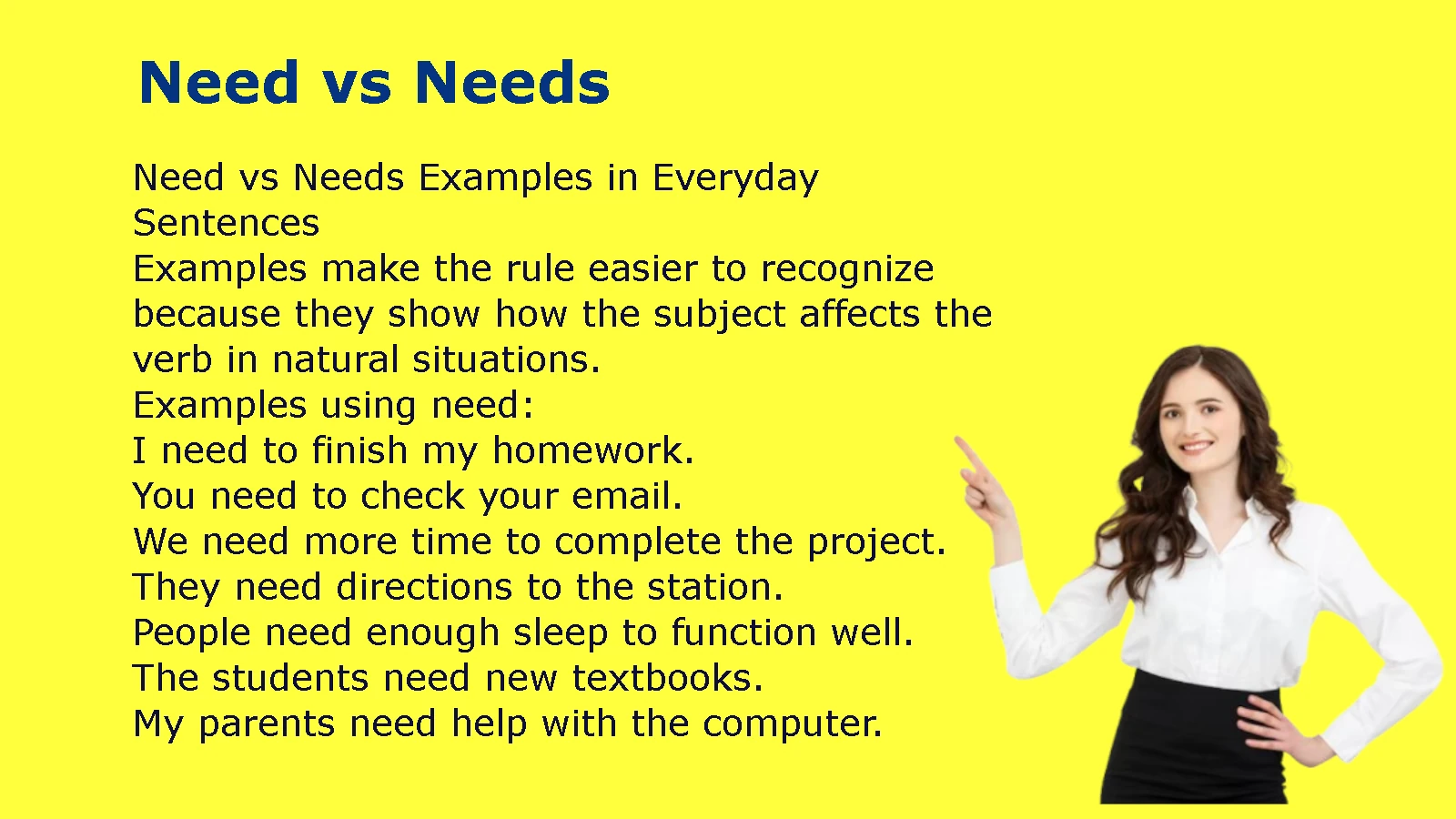
Need vs Needs Examples in Everyday Sentences
Examples using need:
- I need to finish my homework.
- You need to check your email.
- We need more time to complete the project.
- They need directions to the station.
- People need enough sleep to function well.
- The students need new textbooks.
- My parents need help with the computer.
Examples using needs:
- He needs to finish his homework.
- She needs to check her email.
- The company needs more time to complete the project.
- My brother needs directions to the station.
- Every student needs a textbook.
- The machine needs regular maintenance.
- John needs help with his application.
Notice the difference between “The students need new textbooks” and “Every student needs a textbook.” The first sentence has a plural subject. The second uses the singular expression every student, so it takes needs.
Quick Comparison: Need or Needs?
Use this quick reference when you are unsure which form belongs in a sentence.
| Sentence | Correct? | Explanation |
| I need your advice. | Yes | I takes need. |
| You needs more practice. | No | Use need with you. |
| People need clean water. | Yes | People is plural. |
| People needs clean water. | No | Use need with people. |
| He needs a break. | Yes | He is third-person singular. |
| He need a break. | Usually no | Use needs in an ordinary affirmative statement. |
| John needs a new phone. | Yes | John is singular. |
| John and Mark need a new phone. | Yes | The compound subject is plural. |
When Should You Use Need?
Use need with I, you, we, they, and plural subjects when you describe a requirement, necessity, or something that must happen. The form also appears after auxiliary verbs such as do, does, did, and modal verbs such as will, can, and must.
I Need, You Need, We Need, and They Need
The verb need works with several common subjects. You do not add -s simply because the sentence describes a strong requirement or an important action.
I need
Use I need when talking about your own requirements.
- I need a few minutes to think.
- I need to speak with the manager.
- I need more information before making a decision.
You need
Use you need whether you are speaking to one person or addressing several people.
- You need to submit the form today.
- You need a warm jacket for the trip.
- You need to practice regularly if you want to improve.
We need
Use we need when the speaker includes themselves in a group.
- We need a better plan.
- We need to leave before traffic gets heavy.
- We need everyone to understand the instructions.
They need
Use they need when the subject refers to multiple people, animals, or things.
- They need additional training.
- The children need lunch.
- The computers need new batteries.
The important point is that the subject, not the importance of the requirement, determines the verb form.
Why Do People Need Take the Base Form?
The correct expression is “People need,” not “People needs,” because people ordinarily functions as a plural noun in modern English.
For example:
- People need food and water.
- People need time to learn new skills.
- People need clear instructions at work.
- People need reliable information before making important decisions.
Compare these sentences:
| Subject | Correct sentence |
| People | People need support. |
| A person | A person needs support. |
| Many people | Many people need support. |
| Each person | Each person needs support. |
| Most employees | Most employees need training. |
| Every employee | Every employee needs training. |
Expressions such as each person, every employee, and everyone are grammatically singular, even when they refer to many individuals. That is why they take needs in ordinary present-simple statements.
For example, write “Everyone needs a chance to succeed,” not “Everyone need a chance to succeed.”
Need With Plural Nouns
Plural nouns take need when they function as the subject of a present-simple sentence.
Common examples include students, teachers, parents, employees, customers, and friends.
- Students need enough time to prepare for exams.
- Teachers need suitable classroom materials.
- Parents need accurate information about school policies.
- Employees need clear expectations from their managers.
- Customers need helpful answers to their questions.
- My friends need a place to park.
The same principle applies to plural objects and machines:
- The cars need fuel.
- These plants need sunlight.
- The computers need software updates.
- The documents need signatures.
A useful editing trick is to replace the subject with they. If the substitution works without changing the intended meaning, need will usually be the correct form.
For example, “The customers need assistance” becomes “They need assistance.” This test helps you recognize plural subjects quickly.
When Should You Use Needs?
Use needs when a third-person singular subject describes a requirement in an ordinary present-simple affirmative sentence. Common subjects include he, she, it, everyone, each person, and singular names such as John, Sarah, or Michael.
He Needs or Need: Which Is Correct?
In an ordinary affirmative statement, “He needs” is correct. The phrase “He need” is generally incorrect in standard present-day English when the sentence uses the present simple without an auxiliary verb.
Examples:
- He needs more sleep.
- He needs to complete the assignment.
- He needs a reliable internet connection.
- He needs someone to explain the process.
- He needs additional time to recover.
The same rule applies to she and it.
- She needs a new pair of shoes.
- She needs to contact her supervisor.
- It needs a little more attention.
- It needs to be repaired.
However, do not apply this rule mechanically to every sentence containing he. The structure matters.
Compare the following:
| Sentence | Correct? | Why? |
| He needs help. | Yes | Ordinary affirmative statement. |
| He does not need help. | Yes | Does carries the agreement marking. |
| Does he need help? | Yes | The main verb follows does in its base form. |
| He will need help. | Yes | Modal auxiliary will takes the base form. |
| He must need help. | Yes | The main verb follows the modal must. |
| He need not go. | Yes | Need functions as a modal auxiliary. |
The final two examples illustrate why sentence structure matters. In “He need not go,” need is a modal auxiliary rather than an ordinary main verb. This construction is grammatical, although it can sound more formal than “He does not need to go.”
She Needs and It Needs Examples
Use needs with a singular subject even when the subject is an object, animal, organization, or abstract idea.
Examples with people:
- My sister needs a ride to the airport.
- The doctor needs your medical history.
- Sarah needs more time to prepare.
- The new employee needs additional training.
with things:
- The car needs an oil change.
- This phone needs a software update.
- The garden needs more sunlight.
- The report needs a stronger introduction.
Examples with abstract subjects:
- The plan needs further discussion.
- The situation needs immediate attention.
- The proposal needs more evidence.
- The project needs careful planning.
These examples share one feature: each subject is grammatically singular.
A common source of confusion is the difference between the noun closest to the verb and the actual subject.
Consider this sentence:
“The box of old photographs needs cleaning.”
The subject is box, not photographs. Because box is singular, the sentence takes needs. The phrase of old photographs merely describes the box.
John Need or Needs: The Correct Form
When John is the subject of an ordinary present-simple statement, use John needs.
Examples:
- John needs a new laptop.
- John needs to call his parents.
- John needs more time to finish his work.
- John needs help understanding the instructions.
John is a singular name, so it follows the same rule as he.
Compare these examples:
- John needs a ticket.
- John and Michael need tickets.
- John, along with his colleagues, needs a ticket.
- John and his colleagues need tickets.
The third example deserves special attention. The phrase along with his colleagues adds information about John, but it does not turn the grammatical subject into a plural subject. The main subject remains John, so needs is correct.
The fourth example uses the compound subject John and his colleagues. Because the subject includes multiple people, need is correct.
This distinction can help you avoid mistakes in business writing, reports, and longer sentences where the subject and verb do not sit next to each other.
Need vs Needs in Questions and Negative Sentences
Questions and negative statements often use do or does. These auxiliary verbs carry the tense and subject–verb agreement, so the main verb uses its base form, need, rather than needs.
Does He Need or Needs?
The correct question is “Does he need?”, not “Does he needs?”
Examples:
- Does he need a ride?
- Does she need more time?
- Does John need to sign the form?
- Does the computer need a restart?
- Does your brother need help?
The reason is simple: does already marks the third-person singular subject. Adding another -s to need would duplicate that marking in this construction.
Use the same rule with singular names and other third-person singular subjects.
| Incorrect | Correct |
| Does he needs help? | Does he need help? |
| Does Sarah needs a ticket? | Does Sarah need a ticket? |
| Does it needs charging? | Does it need charging? |
| Does the machine needs repair? | Does the machine need repair? |
Compare the statement with the question:
- Statement: Sarah needs a ticket.
- Question: Does Sarah need a ticket?
The verb changes from needs to need because the question uses does.
He Needs or Need Not Go
Both “He does not need to go” and “He need not go” are grammatical, but they use different structures.
The first sentence uses need as an ordinary main verb with the auxiliary does. The second uses need as a modal auxiliary, a construction that often sounds more formal.
Examples:
- He does not need to attend the meeting.
- He need not attend the meeting.
- She does not need to bring her laptop.
- She need not bring her laptop.
- John does not need to explain his decision.
- John need not explain his decision.
In everyday American English, the versions with does not need to or doesn’t need to are generally more natural.
Avoid “He needs not go” when you mean that going is unnecessary. In ordinary modern English, the usual choices are “He does not need to go” and the more formal “He need not go.”
Also distinguish lack of necessity from prohibition:
- He does not need to go: Going is optional.
- He must not go: Going is prohibited or strongly forbidden.
These expressions do not mean the same thing. Confusing them can change the meaning of an instruction.
Need or Needs After Do, Does, Don’t, and Doesn’t
After do, does, don’t, or doesn’t, use the base form need.
| Sentence type | Correct example |
| Affirmative, singular | He needs to leave. |
| Negative, singular | He does not need to leave. |
| Question, singular | Does he need to leave? |
| Negative, plural | They do not need to leave. |
| Question, plural | Do they need to leave? |
| Negative, first person | I do not need to leave. |
| Question, second person | Do you need to leave? |
Contractions are common in conversation:
- He doesn’t need to worry.
- She doesn’t need another appointment.
- We don’t need more chairs.
- They don’t need to arrive early.
- Do you need any help?
Remember this simple pattern:
Needs in an ordinary affirmative statement; need after does or doesn’t.
The same base-form principle applies to other verbs. For example, write “Does he work?” rather than “Does he works?”
Needs Meaning: Verb vs Noun
The word needs has two common grammatical roles. It can be the third-person singular form of the verb need, meaning “requires,” or it can be a plural noun referring to requirements, necessities, or things people must have.
Needs as a Verb
As a verb, needs describes what a singular subject requires.
Examples:
- She needs a break.
- He needs medical advice.
- The car needs fuel.
- The company needs more customers.
- This proposal needs further review.
In each sentence, needs tells you what the subject requires.
You can often replace it with requires to check the meaning:
- She needs a break. → She requires a break.
- The car needs fuel. → The car requires fuel.
- The proposal needs review. → The proposal requires review.
This substitution is not perfect in every context because need often sounds more natural and conversational than require. However, it can help you recognize the verb’s function.
Needs as a Plural Noun
As a noun, needs refers to requirements or necessities. It does not have to follow the third-person singular verb rule because it is not functioning as the main verb.
Examples:
- The charity provides food for families in need.
- The program addresses the needs of local students.
- Good managers understand their employees’ needs.
- The school must meet the needs of different learners.
- The organization focuses on the needs of older adults.
Notice the difference between these two sentences:
- The student needs support.
- The student’s needs are important.
In the first sentence, needs is a verb. In the second, needs is a noun, and are is the main verb.
This distinction matters because the same spelling can serve different grammatical purposes.
How to Identify the Correct Meaning in Context
Look at the role the word plays in the sentence.
| Example | Role of needs | Meaning |
| He needs help. | Verb | He requires help. |
| Her needs are simple. | Noun | Her requirements are simple. |
| The project needs funding. | Verb | The project requires funding. |
| The project addresses community needs. | Noun | The project addresses community requirements. |
| Everyone has different needs. | Noun | Everyone has different requirements. |
Here is a quick test:
- If needs tells you what a subject requires, it is probably a verb.
- If needs names requirements or necessities, it is probably a noun.
You can also check the surrounding words. A phrase such as the needs of customers uses needs as a noun. A sentence such as the customer needs assistance uses it as a verb.
Need vs Want: Meaning, Differences, and Examples
Need describes something necessary or required, while want describes something someone desires. The difference depends on context: water is generally a basic need, while a particular brand of bottled water may be a personal preference.
What Does Need Mean?
As a verb, need means to require something or consider it necessary for a purpose.
Examples:
- I need water because I am thirsty.
- We need a reliable internet connection to work remotely.
- Students need enough time to prepare for exams.
- The company needs a clear budget before hiring more staff.
- You need a valid ticket to enter the event.
The word can also function as a noun:
- Food and shelter are basic human needs.
- The project has an urgent need for funding.
- The school identified a need for additional teachers.
In each case, the word relates to a requirement, although the precise level of necessity depends on the situation.
What Does Want Mean?
Want expresses a desire, preference, or wish. Something you want may be useful or enjoyable without being necessary.
Examples:
- I want a larger television.
- She wants to visit Japan.
- They want a table near the window.
- We want to try the new restaurant.
- He wants a more powerful computer for gaming.
A want can become closely connected to a need in certain circumstances. For example, someone may need a computer for work but want a specific high-end model.
Need vs Want Comparison Table
| Feature | Need | Want |
| Basic meaning | Something required | Something desired |
| Main idea | Necessity | Preference |
| Example | I need food. | I want pizza. |
| Workplace example | We need a budget. | We want a larger office. |
| Shopping example | I need a winter coat. | I want a designer coat. |
| Can it be optional? | Sometimes, depending on context | Usually a matter of preference |
| Related noun | A need or basic need | A want or desire |
Can Something Be Both a Need and a Want?
Yes. A single item can satisfy a practical need while also matching a personal preference.
Imagine that you work remotely and need a computer to complete your job. A basic laptop that runs your work software may meet that need. However, you might want a premium laptop with a larger screen, a lighter design, and more storage.
The computer itself serves a practical need. The premium features may represent wants, depending on your work requirements and budget.
The same distinction applies to housing, transportation, education, and many other areas of daily life.
Understanding the difference helps you describe priorities clearly. It also helps you choose accurate language when explaining why something is necessary rather than merely desirable.
Common Mistakes When Using Need and Needs
Most errors involving need and needs occur when writers overlook the subject or forget how auxiliary verbs affect the main verb.
Saying “You Needs” Instead of “You Need”
The correct form is you need.
Incorrect: You needs to complete the application.
Correct: You need to complete the application.
More examples:
- Incorrect: You needs more practice.
- Correct: You need more practice.
- Incorrect: You needs to call the office.
- Correct: You need to call the office.
Remember that you takes need whether you address one person or a group.
Saying “People Needs” Instead of “People Need”
The correct form is people need because people is normally plural.
Incorrect: People needs access to clean water.
Correct: People need access to clean water.
Compare:
- People need clear instructions.
- A person needs clear instructions.
- Many students need extra time.
- Every student needs extra time.
Words such as every and each can make the full subject grammatically singular, even when the sentence refers to multiple people.
Adding -s After Does
A common error occurs when writers add -s to the main verb after does.
Incorrect: Does he needs help?
Correct: Does he need help?
Incorrect: She doesn’t needs a ride.
Correct: She doesn’t need a ride.
Incorrect: Does John needs to leave?
Correct: Does John need to leave?
The auxiliary does already marks the third-person singular form. Keep the main verb in its base form.
Confusing the Verb Needs With the Noun Needs
The spelling needs does not always indicate a present-simple verb.
Compare these examples:
- The child needs attention. Here, needs is the verb.
- The child’s needs are important. Here, needs is a noun.
- The company needs more staff. Here, needs is the verb.
- The company considers employee needs. Here, needs is a noun.
To avoid mistakes, identify the main subject and verb before deciding which form to use. If needs names requirements rather than describing an action or state of requiring something, it is functioning as a noun.
A Simple Trick to Remember Need vs Needs
The easiest way to remember the difference is to use the he, she, it rule and then check whether the sentence contains an auxiliary verb.
The He, She, It Rule
In ordinary present-simple affirmative statements, use needs with he, she, and it. Use need with I, you, we, and they.
Think of these pairs:
- I need help. / He needs help.
- You need a ticket. / She needs a ticket.
- We need more time. / It needs more time.
- They need instructions. / John needs instructions.
Singular names follow the same pattern as he or she:
- Sarah needs a notebook.
- Michael needs a new password.
- The manager needs more information.
When the subject becomes plural, use need:
- Sarah and Michael need notebooks.
- The managers need more information.
The Does Test
If you are unsure whether to use need or needs, turn the sentence into a question with does.
Start with:
John needs a new phone.
Change it to:
Does John need a new phone?
The main verb becomes need after does. This confirms that needs belongs in the original affirmative sentence, while need belongs in the question.
Try the same method with other subjects:
- She needs more time. → Does she need more time?
- The machine needs repair. → Does the machine need repair?
- Your brother needs help. → Does your brother need help?
This method works for ordinary present-simple statements. It does not replace the separate rules for modal verbs or the formal construction need not.
Practice: Choose Need or Needs
Complete each sentence with need or needs.
- My sister _____ a new pair of shoes.
- We _____ to leave before noon.
- Does your teacher _____ a copy of the report?
- The children _____ help with their homework.
- Everyone _____ time to learn something new.
- John and Sarah _____ to book a hotel.
- The computer _____ a software update.
- You _____ to read the instructions carefully.
- He doesn’t _____ to arrive early.
- The project _____ additional funding.
Answer key
- Needs — My sister is singular.
- Need — We takes the base form.
- Need — The main verb follows does.
- Need — Children is plural.
- Needs — Everyone is grammatically singular.
- Need — John and Sarah form a plural subject.
- Needs — The computer is singular.
- Need — You takes the base form.
- Need — The main verb follows doesn’t.
- Needs — The project is singular.
A Practical Editing Example
Consider this short paragraph:
“John need to finish his report today. His manager needs the report before the meeting, and the other employees needs the figures for their presentation. Does John needs to ask for an extension?”
Several sentences contain subject–verb agreement errors. Here is the corrected version:
“John needs to finish his report today. His manager needs the report before the meeting, and the other employees need the figures for their presentation. Does John need to ask for an extension?”
Each correction follows the same principles:
- John needs because John is singular.
- His manager needs because the manager is singular.
- The other employees need because employees is plural.
- Does John need because the auxiliary does takes the third-person singular marking.
This approach works well when proofreading essays, emails, reports, and other everyday writing.
Conclusion: Choose Need or Needs With Confidence
The difference between need vs needs becomes straightforward once you identify the subject and sentence structure. Use need with I, you, we, they, and plural subjects. Use needs with he, she, it, and singular names in ordinary present-simple affirmative statements.
Remember three practical rules:
- Check the subject: “People need help,” but “A person needs help.”
- Watch for auxiliary verbs: “Does he need help?” and “He doesn’t need help.”
- Identify the part of speech: In “She needs support,” needs is a verb. In “Her needs are important,” needs is a noun.
You can also use the distinction between need and want to describe whether something is necessary or simply desired.













