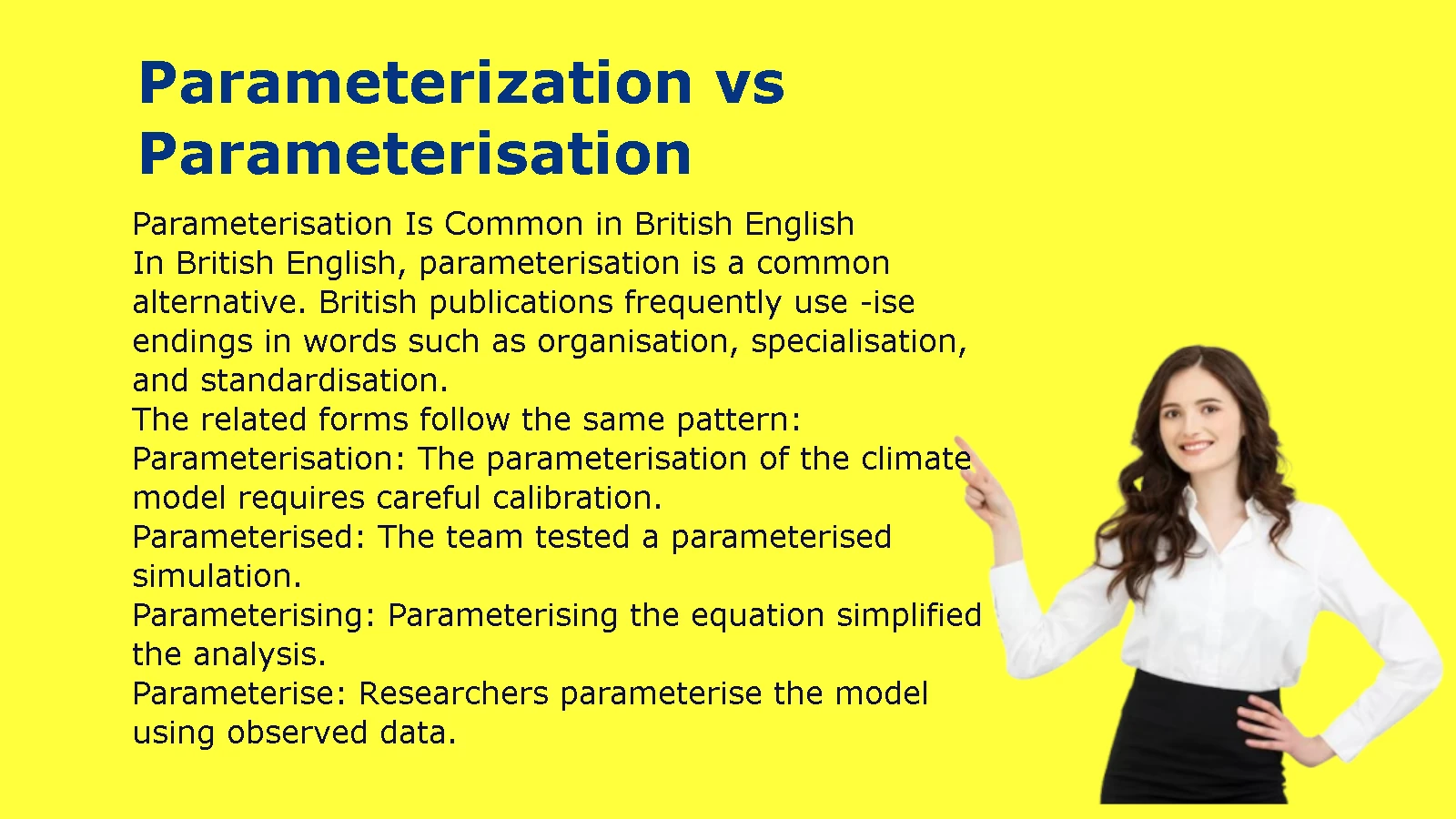
Parameterization vs parameterisation comes down to a difference in spelling between American and British English, but the word has several important technical meanings. Parameterization is the standard American spelling, while parameterisation is common in British English. Both describe the process of defining or controlling something through parameters.
The meaning becomes more specific in different fields. In mathematics, parametrization describes curves and other objects using one or more parameters. In climate models, parameterization represents complex physical processes that a model cannot fully resolve directly.
This guide explains the spelling differences, pronunciation, synonyms, and practical applications of parameterization, with examples to help you use the term correctly in everyday writing and technical work.
Parameterization vs. Parameterisation: Which Spelling Is Correct?
Both parameterization and parameterisation are correct spellings. American English generally uses parameterization, while British English commonly uses parameterisation. The difference reflects a broader spelling pattern involving words that end in -ize in American English and often use -ise in British English.
The two forms have the same meaning and pronunciation in most varieties of English. Neither spelling is inherently more accurate than the other. Your choice should depend on your audience, the style guide you follow, and the spelling conventions used throughout your document.
Parameterization Is the Standard American English Spelling
In American English, parameterization is the standard spelling. It appears in programming documentation, scientific papers, mathematics textbooks, and general technical writing.
American English typically retains the z in words formed with the suffix -ization. The same pattern appears in words such as optimization, standardization, and customization.
Here are examples of the American spelling and its related forms:
- Parameterization: The parameterization of the model improved its flexibility.
- Parameterized: The developer created a parameterized database query.
- Parameterizing: Parameterizing the function made it reusable.
- Parameterize: Engineers can parameterize the simulation to test different conditions.
American readers generally expect these spellings in US-focused publications. If you write for an American software company, university, or technical audience, using the -ize forms will usually provide the most consistent style.
Parameterisation Is Common in British English
In British English, parameterisation is a common alternative. British publications frequently use -ise endings in words such as organisation, specialisation, and standardisation.
The related forms follow the same pattern:
- Parameterisation: The parameterisation of the climate model requires careful calibration.
- Parameterised: The team tested a parameterised simulation.
- Parameterising: Parameterising the equation simplified the analysis.
- Parameterise: Researchers parameterise the model using observed data.
British spelling conventions are not completely uniform. Some UK style guides accept or prefer -ize forms for certain words, so parameterization can also appear in British publications. However, parameterisation remains a familiar and widely used British variant.
When writing for a UK audience, check the publication’s style guide rather than assuming that every British writer must use -ise.
Parameterization vs. Parameterisation at a Glance
The following table summarizes the main differences.
| Feature | Parameterization | Parameterisation |
| Spelling pattern | -ization | -isation |
| Typical usage | American English | British English |
| Meaning | Defining or representing something through parameters | Defining or representing something through parameters |
| Verb form | Parameterize | Parameterise |
| Past tense | Parameterized | Parameterised |
| Present participle | Parameterizing | Parameterising |
| Pronunciation | Generally the same | Generally the same |
| Technical usage | Software, mathematics, science | Software, mathematics, science |
Example in American English: The parameterization of the function allows users to change the input values.
Example in British English: The parameterisation of the function allows users to change the input values.
Both sentences communicate the same idea. The spelling changes, but the grammar and meaning remain intact.
Parameterization vs. Parametrization
Parametrization is another established spelling, especially in mathematics. It refers to expressing a mathematical object, such as a curve or surface, in terms of one or more parameters.
For example, a circle can be represented using the equations:
- (x(t)=r\cos t)
- (y(t)=r\sin t)
Here, (t) is the parameter, and the equations describe points on the circle as (t) changes.
In mathematical writing, parametrization is particularly common when discussing curves, surfaces, and geometric objects. However, parameterization also appears in mathematical texts and can carry the same meaning in this context.
The choice often depends on disciplinary convention and the terminology used by a particular author or publication.
| Term | Common context | General meaning |
| Parameterization | Software, science, mathematics | Defining or representing something through parameters |
| Parameterisation | Same technical fields, especially British English | British spelling of parameterization |
| Parametrization | Especially mathematics | Representing an object using parameters |
Do not assume that these spellings always signal different mathematical procedures. In many contexts, they describe the same underlying idea.
What Does Parameterization Mean?
Parameterization is the process of describing, controlling, or configuring a system using parameters. A parameter is a value that influences how a function, model, process, or application behaves. By changing the parameters, you can adjust the system without rebuilding its entire structure.
For example, a shipping calculator might use package weight, destination, and delivery speed as parameters. The same calculator can produce different prices when those inputs change.
The central idea is flexibility: instead of creating a separate system for every possible situation, you define a reusable structure that responds to different parameter values.
Parameterization Meaning in Simple English
In simple terms, parameterization means setting up something so that specific values control how it works.
Imagine a recipe that serves four people. If you parameterize the recipe by serving size, you can adjust the ingredient quantities for two, six, or ten people without writing an entirely new recipe.
The same principle applies to technical systems.
Consider a basic function that calculates the price of several items:
[
\text{Total Price}=\text{Quantity}\times\text{Unit Price}
]
The quantity and unit price act as inputs. Changing either value changes the result while the underlying relationship stays the same.
Parameterization is useful because it separates a system’s general structure from the values that determine its behavior.
Common examples include:
- Changing the discount rate in a pricing calculator.
- Adjusting the learning rate in a machine-learning model.
- Setting the maximum number of users in an application.
- Defining the dimensions of a geometric shape.
- Specifying assumptions in a climate simulation.
What Is a Parameter?
A parameter is a value that helps define how a function, model, or system behaves. Depending on the field, it may represent a configurable setting, a mathematical quantity, or a characteristic used by a statistical or scientific model.
The exact meaning depends on the context.
In programming, a parameter is often a named input that a function accepts. In mathematics, a parameter can control a family of equations or trace a curve.
Consider a function that calculates a sales tax:
[
T=P\times r
]
Where:
- (T) is the tax amount.
- (P) is the purchase price.
- (r) is the tax rate.
If the purchase price is $100 and the tax rate is 8%, the tax equals $8.
In this example, the tax rate is a parameter that determines the relationship between the purchase price and the tax amount. In programming, the distinction between a parameter and an argument is also useful: a parameter is the named input in a function definition, while an argument is the actual value supplied when the function runs.
For example, in calculate_tax(price, rate), price and rate are parameters. Calling calculate_tax(100, 0.08) supplies the arguments 100 and 0.08.
Parameterization in a Sentence
The meaning of parameterization becomes clearer when you see it in different contexts.
| Context | Example sentence | Meaning |
| Software | Parameterization made the function reusable across several projects. | The function accepts configurable inputs. |
| Mathematics | The parameterization describes the circle using trigonometric functions. | A parameter traces points on a curve. |
| Climate science | The model uses parameterization to represent small-scale cloud processes. | The model estimates unresolved physical effects. |
| Business | Parameterization lets the pricing tool adjust discounts for different customers. | Settings control the calculation. |
| Statistics | The parameterization determines how the probability distribution is expressed. | Parameters define the model’s mathematical form. |
These examples share one principle: a system has a defined structure, and parameters determine how that structure behaves or is represented.
Parameterization in Software and Programming
Software parameterization allows developers to build flexible programs by separating reusable logic from the values that control it. Instead of writing new code for every input, a developer creates a function, query, or configuration that accepts different parameters.
This approach improves reuse and can make applications easier to test and maintain. However, developers must validate inputs and handle security risks appropriately.
What Is Parameterization in Software?
In software development, parameterization means designing code or system behavior around configurable values rather than fixing every value directly in the implementation.
Suppose an online store offers several discount rates. A hardcoded function might always apply a 10% discount. A parameterized function could accept the discount rate as an input, allowing the same function to handle 5%, 10%, or 15% discounts.
This separation makes the software easier to adapt.
A simplified Python example illustrates the concept:
def calculate_discount(price, discount_rate):
return price * (1 – discount_rate)
print(calculate_discount(100, 0.10))
print(calculate_discount(100, 0.20))
The function uses the same logic for both calculations. Only the arguments change.
The outputs are:
90.0
80.0
Here, price and discount_rate are parameters in the function definition. The supplied numbers determine the result each time the function runs.
Software parameterization can apply to:
- Function arguments.
- Database queries.
- API request settings.
- Application configuration files.
- Machine-learning model settings.
- Automated testing environments.
- Report filters and data-processing rules.
Parameterization Examples in Programming
Parameterization appears in several common software tasks. The best approach depends on whether the developer needs to control a calculation, retrieve data, or configure an application.
Example: A reusable function
A developer might create a shipping calculator:
def shipping_cost(weight, rate_per_kg):
return weight * rate_per_kg
print(shipping_cost(5, 2.50))
print(shipping_cost(12, 3.00))
The first call calculates a $12.50 shipping cost. The second calculates $36. The function remains unchanged because the weight and rate are supplied as parameters.
Example: A parameterized SQL query
Database parameterization is particularly important for security.
A database query might retrieve a customer using a supplied customer ID. Instead of inserting user input directly into the SQL string, the developer should use the database library’s parameter-binding mechanism.
A Python example using a database cursor might look like this:
cursor.execute(
“SELECT * FROM customers WHERE customer_id = ?”,
(customer_id,)
)
The placeholder syntax depends on the database driver. Some drivers use %s or named placeholders instead of ?.
The database library binds the supplied value separately from the SQL statement. This helps prevent SQL injection when developers use the binding interface correctly.
Example: Application configuration
A web application might store a page-size setting:
PAGE_SIZE = 25
def get_page_items(items, page):
start = (page – 1) * PAGE_SIZE
return items[start:start + PAGE_SIZE]
Changing PAGE_SIZE changes the number of items displayed per page without requiring a rewrite of the pagination logic.
These examples show that parameterization is not a single programming technique. It is a broader design principle that allows one implementation to support different values and conditions.
Parameterization vs. Hardcoding
Parameterization separates logic from changeable values, while hardcoding embeds fixed values directly into the code. Hardcoding can be reasonable for constants that genuinely never change, but parameterization often works better when requirements vary between users, environments, or tasks.
| Feature | Parameterization | Hardcoding |
| Flexibility | Values can change through inputs or settings | Values require code changes when embedded directly |
| Reusability | One implementation can support multiple cases | Separate implementations may be needed for different cases |
| Testing | Easy to test several input combinations | Testing different cases may require edits or additional code |
| Maintenance | Changes can often happen in one place | Repeated values can create maintenance problems |
| Complexity | May require validation and configuration logic | Simple cases can be easier to understand |
| Security | Parameter binding can protect database queries | Directly concatenated user input can create injection risks |
Consider a reporting application that always retrieves records from January 2026. If the date range is hardcoded, generating a February report may require changing the code.
A parameterized version accepts a start date and end date. The same reporting logic can then process any valid period.
However, parameterization does not automatically make code better. A value that will never change and has no reason to be configurable may not need an extra parameter. The goal is to make genuine variation manageable without creating unnecessary complexity.
Benefits and Limitations of Software Parameterization
Parameterization offers several practical benefits:
- Code reuse: Developers can use the same function with different inputs.
- Maintainability: A single implementation can serve several use cases.
- Testing: Teams can test boundary values and different scenarios without rewriting the code.
- Configuration: Applications can adapt to different environments or customer needs.
- Security: Properly parameterized database queries help separate SQL instructions from user-supplied values.
It also has limitations.
Poorly designed parameters can make a function difficult to understand. Too many configuration options may create unexpected combinations. Invalid input values can produce incorrect results or crashes if the software does not validate them.
Security requires particular care. Parameterized SQL queries help prevent injection attacks, but parameterization does not replace authorization checks, input validation, or other security controls.
Practical rule: Parameterize values that genuinely need to vary, validate those values, and keep the interface simple enough that other developers can understand it.
Parameterization in Mathematics
In mathematics, parameterization or parametrization describes a mathematical object through one or more parameters. Instead of representing every point using a direct relationship between coordinates, you express the coordinates as functions of a parameter.
This approach is especially useful for describing curves, surfaces, and families of geometric objects. It also supports calculus, motion analysis, and computer graphics.
What Is Parameterization in Mathematics?
Mathematical parameterization introduces a parameter that controls the values used to describe an object.
For example, a straight line can be expressed through two coordinate functions:
[
x(t)=1+2t
]
[
y(t)=3+t
]
The parameter (t) determines the point on the line. When (t=0), the point is ((1,3)). When (t=1), the point is ((3,4)). (t=2), the point is ((5,5)).
As (t) changes, the coordinates describe points along the same straight line.
This representation is useful when a direct equation such as (y=mx+b) is inconvenient or when the direction and progression along the line matter.
A parameterization may also represent the same object in several ways. Different parameterizations can trace the same geometric curve at different speeds or in different directions.
Parametrization of a Curve
The parametrization of a curve describes the curve’s coordinates in terms of a parameter, often written as (t).
For a curve in two dimensions, a common representation is:
[
x=x(t), \qquad y=y(t)
]
For a curve in three dimensions, the representation may include a third coordinate:
[
x=x(t), \qquad y=y(t), \qquad z=z(t)
]
The parameter can represent time, an angle, or another quantity chosen to describe the curve conveniently.
Consider a circle with radius (r) centered at the origin. Its parameterization is:
[
x(t)=r\cos t
]
[
y(t)=r\sin t
]
As (t) moves from (0) to (2\pi), the equations trace one complete circle.
This representation has several advantages:
- It describes both coordinates with a single parameter.
- It makes the direction of travel explicit.
- It supports calculations involving velocity and acceleration when (t) represents time.
- It can simplify integrals along curves.
A parameterization does not necessarily describe every point on an entire curve for every restricted parameter interval. The interval matters. For example, letting (t) range from (0) to (\pi) traces the upper half of a circle, including its endpoints, rather than the full circle.
Parameterization Examples With Equations
Here are three examples that show how parameterization works in mathematics.
Example: A straight line
Suppose a line passes through ((2,1)) and moves in the direction ((3,2)). One parameterization is:
[
x(t)=2+3t
]
[
y(t)=1+2t
]
At (t=0), the point is ((2,1)). At (t=1), it is ((5,3)). The parameter changes the position along the line.
Example: A circle
A circle of radius 4 centered at the origin can be parameterized as:
[
x(t)=4\cos t
]
[
y(t)=4\sin t
]
For (t=0), the point is ((4,0)). (t=\pi/2), it is ((0,4)). For (t=\pi), it is ((-4,0)).
The angle (t) determines the position around the circle.
Example: A three-dimensional helix
A helix can be described using:
[
x(t)=a\cos t
]
[
y(t)=a\sin t
]
[
z(t)=bt
]
The first two equations produce circular motion around the vertical axis. The third equation increases the height as (t) increases.
Together, they describe a spiral that rises or falls through three-dimensional space.
These examples demonstrate why mathematical parameterization is useful: it provides a systematic way to represent objects whose coordinates change together.
Parameterization vs. Parametrization in Mathematics
In mathematical writing, parametrization is a common spelling for expressing a curve or another object in terms of parameters. Parameterization is also used, particularly in broader technical contexts.
The intended meaning often overlaps, so readers should pay more attention to the mathematical definition than to the spelling alone.
A related distinction concerns the mathematical object being described. Parameterizing a curve means expressing its points through coordinate functions. Parameterizing a statistical model may mean choosing a particular set of parameters to describe a probability distribution.
For example, a normal distribution can be described by its mean (\mu) and standard deviation (\sigma). Another formulation might use its variance (\sigma^2) instead of its standard deviation. These formulations represent the same family of distributions but use different parameter choices.
This shows that parameterization can refer not only to describing an object but also to selecting how its defining quantities are represented.
Parameterization in Climate Models and Other Scientific Fields
Parameterization in climate models represents the effects of physical processes that a model cannot fully resolve at its chosen spatial or temporal scale. Climate models divide the atmosphere, ocean, and land into computational units, but many important processes occur at scales smaller than those units.
Parameterizations estimate how those unresolved processes influence the larger-scale environment. Their assumptions and limitations affect the results, so scientists evaluate them using observations, physical understanding, and model testing.
What Is Parameterization in Climate Models?
Climate models simulate the Earth’s climate system using mathematical equations and numerical calculations. However, a global model cannot directly calculate every cloud droplet, turbulent movement, or small-scale atmospheric interaction.
Instead, it represents certain processes through parameterizations.
For example, a model grid cell may contain a mixture of cloudy and clear air. The model may not resolve every cloud formation process within that cell. A cloud parameterization estimates relevant effects, such as cloud formation, moisture changes, and energy transfer, based on the information the model can represent.
Parameterizations are not simply arbitrary guesses. They draw on physical laws, observations, theory, and sometimes high-resolution simulations. Nevertheless, they involve assumptions and approximations that can introduce uncertainty.
Parameterization Examples in Climate Science
Several atmospheric and surface processes commonly require parameterization.
Cloud formation and convection: Individual cloud systems can contain small-scale updrafts and downdrafts. A model may estimate how convection transports heat and moisture through the atmosphere.
Turbulence: Air near the Earth’s surface moves through complex turbulent patterns. A model uses parameterizations to estimate the effects of these movements on heat, moisture, and momentum.
Land-surface processes: Models represent interactions between the land and atmosphere, including the exchange of water and energy. The details may depend on vegetation, soil moisture, and surface characteristics.
Radiative effects: Clouds and atmospheric particles influence how radiation travels through the atmosphere. Models represent these effects using equations and assumptions appropriate to their resolution and design.
Each parameterization helps connect processes at smaller scales with the larger-scale quantities the model calculates.
Why Parameterization Matters in Scientific Models
Parameterization affects a model’s behavior because it influences how the model represents processes that shape its results.
For example, a cloud parameterization can affect simulated cloud cover and rainfall. Those changes may influence how much sunlight reaches the surface and how much heat escapes into space.
A useful parameterization should reflect relevant physical relationships and perform reasonably well across the conditions for which scientists intend to use it.
Researchers evaluate parameterizations through methods such as:
- Comparing model outputs with observational records.
- Testing model behavior under different conditions.
- Examining sensitivity to parameter choices.
- Comparing results from alternative parameterization schemes.
- Assessing whether the model reproduces important physical patterns.
One limitation is that a parameterization developed for one resolution or climate regime may not work equally well in another. Model developers must therefore consider how the method interacts with the rest of the simulation.
The key point: Parameterization allows climate models to represent important physical processes at manageable computational cost, but it does not eliminate uncertainty or guarantee accurate predictions.
Parameterization Pronunciation and Word Forms
The pronunciation and related word forms of parameterization remain largely the same across American and British English. The main regional difference concerns spelling: American English typically uses parameterize, while British English often uses parameterise.
Knowing the word family helps you recognize the term in academic papers, programming documentation, and technical discussions.
How to Pronounce Parameterization
Parameterization is generally pronounced with the main stress on the syllable containing -za- in the middle of the word.
A common American English IPA transcription is:
/pəˌræməˌtɚəˈzeɪʃən/
Pronunciation can vary slightly by accent, particularly in the vowels and the treatment of unstressed syllables.
To practice the word:
- Break it into smaller syllables.
- Keep the main stress on the -za- portion.
- Pronounce the final -ization ending clearly.
- Repeat it in a technical sentence, such as: “The parameterization improves the model.”
The British spelling parameterisation generally follows the same pronunciation pattern. Changing the letter z to s in the written form does not normally change the sound of the word.
Parameterize, Parameterized, and Parameterizing
The word family includes a noun, a verb, and several verb forms.
| Word form | American English | Common British English |
| Noun | Parameterization | Parameterisation |
| Base verb | Parameterize | Parameterise |
| Past tense | Parameterized | Parameterised |
| Present participle | Parameterizing | Parameterising |
| Third-person singular | Parameterizes | Parameterises |
Use the noun when discussing the process itself.
Example: “The parameterization of the model took several hours.”
Use the verb when describing the action.
Example: “The developer will parameterize the function.”
Use the past-tense form when describing a completed action.
Example: “The team parameterized the simulation using measured data.”
Use the present participle when the process is ongoing.
Example: “The researchers are parameterizing the model for a new experiment.”
These forms preserve the same underlying meaning. The spelling choice depends on the conventions used in the rest of the text.
Is Parameterised the Correct UK Spelling?
Yes. Parameterised is a standard British English spelling of parameterized. Both forms describe something that has been defined or configured using parameters.
For example:
- British English: “The software was parameterised for different customer groups.”
- American English: “The software was parameterized for different customer groups.”
Both sentences are grammatically correct.
However, some British technical publications use parameterized because their house style prefers -ize spellings or because the terminology follows a particular international standard. If you are preparing a formal report, check the relevant style guide and use the same spelling consistently.
Parameterization Synonyms and Related Terms
The best synonym for parameterization depends on the context. Configuration, specification, and formulation can overlap with the term in certain situations, but they do not mean exactly the same thing in every field.
Choosing the right alternative requires understanding what the process actually does.
Common Synonyms for Parameterization
Here are several related terms and the situations in which they may fit.
| Related term | Meaning | When it may fit |
| Configuration | Arranging settings to control how a system behaves | Software and applications |
| Specification | Defining requirements or characteristics | System design and engineering |
| Formulation | Expressing a problem, model, or relationship in a particular form | Mathematics and scientific modeling |
| Calibration | Adjusting or estimating model settings to improve agreement with observations | Scientific and statistical models |
| Representation | Describing an object or system in a particular form | Mathematics and computing |
| Customization | Adapting something to specific requirements | Software and business systems |
These terms are related, but they are not interchangeable in all cases.
For example, calibration may involve adjusting model parameters, but parameterization refers more broadly to how a model is expressed or controlled through parameters. Likewise, configuration may use parameters without describing the underlying mathematical structure of a model.
When writing for a technical audience, retain parameterization if it is the most precise word for the process.
Parameterization vs. Configuration
Parameterization defines or uses parameters, while configuration sets up a system using chosen settings.
The distinction is especially useful in software development.
A developer might parameterize a function so it accepts a timeout value. An administrator might then configure the application to use a timeout of 30 seconds.
In this case:
- Parameterization makes the timeout configurable.
- Configuration selects the actual timeout value.
The two processes often work together, but they describe different stages.
For example, a cloud application may support a configurable storage limit. The software team parameterizes the limit in the application, and an administrator sets it to 500 GB for a particular customer.
This distinction helps avoid vague technical writing. Use parameterization when discussing the design that allows values to vary. Use configuration when discussing the settings selected for a particular system or environment.
Parameterization vs. Modeling
Modeling is the broader process of creating a representation of a real or abstract system. Parameterization is one way to define or express that model.
A climate scientist, for example, may build a model of atmospheric behavior. The scientist then chooses parameterizations to represent processes that the model cannot calculate directly at its working resolution.
Similarly, a statistician may select a probability distribution to model a dataset and define parameters that determine its shape.
The difference can be summarized as follows:
| Concept | Main purpose | Example |
| Modeling | Represent a system or process | Creating a model of regional rainfall |
| Parameterization | Define the model through specific parameters or relationships | Representing unresolved cloud processes |
| Calibration | Adjust or estimate parameter values using evidence | Fitting model settings to observations |
A model may contain many parameterizations, and those parameterizations may require calibration. The terms describe connected but distinct tasks.
Parameterization Examples Across Different Fields
Parameterization appears in software, mathematics, science, and everyday problem-solving. Although each field uses the term differently, the underlying principle remains similar: parameters allow a general structure to adapt to particular values or conditions.
Parameterization in Software Development
A developer creates a reusable tax calculator that accepts the purchase price and tax rate.
def calculate_tax(price, tax_rate):
return price * tax_rate
print(calculate_tax(100, 0.08))
print(calculate_tax(250, 0.06))
The first calculation returns 8. The second returns 15.
The developer does not need separate functions for every purchase price and tax rate. The parameters allow one function to handle many cases.
In a production application, the developer would also need to consider currency formatting, valid numeric inputs, rounding rules, and whether the tax rate should come from a trusted configuration or an external source.
Parameterization in Mathematics
A circle of radius (r) can be represented by:
[
x(t)=r\cos t
]
[
y(t)=r\sin t
]
The parameter (t) controls the position around the circle. As (t) changes, the equations generate different points on the same geometric object.
This representation is particularly useful when studying motion. If (t) represents time, the equations can describe an object moving along a circular path. Differentiating the coordinate functions then provides information about its velocity.
Parameterization in Climate Science
A climate model may estimate the effects of atmospheric convection even when its grid cannot resolve individual convective motions.
A parameterization uses information such as temperature, humidity, and atmospheric stability to estimate the larger-scale effects of those motions.
The result influences how the model represents heat and moisture transport. Researchers assess the method by comparing simulations with observations and testing how the results change under different assumptions.
This example highlights an important distinction: parameterization helps a model represent a process, but the resulting estimate still depends on the model’s design and supporting evidence.
Parameterization in Everyday Language
Imagine a conference organizer creating a registration form for several events.
The form includes parameters such as:
- Event date.
- Ticket price.
- Maximum attendance.
- Registration deadline.
- Available ticket categories.
The organizer can change these values for each event while keeping the overall registration system intact.
This is an everyday example of the same principle used in software and scientific modeling. A reusable structure handles different circumstances through defined inputs and settings.
Frequently Asked Questions About Parameterization
Is It Parameterization or Parameterisation?
Both spellings are correct. Parameterization is standard in American English, while parameterisation is common in British English. Both forms have the same meaning. Choose the spelling that matches your audience or publication’s style guide, and use it consistently.
What Does Parameterization Mean in Software?
In software, parameterization means designing code, queries, or application settings so that specific values can control their behavior. It helps developers reuse code and adapt applications without rewriting the underlying logic. Parameterized database queries can also help prevent SQL injection when developers use the database driver’s binding mechanism correctly.
How Do You Pronounce Parameterization?
Parameterization is generally pronounced with the main stress near the -ization ending. A common American English IPA transcription is /pəˌræməˌtɚəˈzeɪʃən/. The British spelling, parameterisation, usually has a similar pronunciation.
Is Parameterised the Correct British Spelling?
Yes. Parameterised is a standard British English form of parameterized. The difference follows the common -ise versus -ize spelling pattern. Some British publications use -ize forms, so follow the relevant style guide when writing for a specific organization or audience.
What Is the Difference Between Parameterization and Parametrization?
The terms often overlap. Parametrization is particularly common in mathematics when describing curves, surfaces, and other geometric objects using parameters. Parameterization is widely used in software, science, and mathematics. The intended meaning and the conventions of the field matter more than the spelling alone.
What Is the Parameterization of a Curve?
The parameterization of a curve expresses its coordinates as functions of a parameter, often written as (t). For example, a circle with radius (r) can be represented by (x(t)=r\cos t) and (y(t)=r\sin t). Changing (t) traces points along the circle.
Conclusion: Choose the Right Parameterization Spelling and Meaning
Parameterization and parameterisation have the same meaning, but they reflect different spelling conventions. American English generally uses parameterization, while British English commonly uses parameterisation. The related term parametrization is especially familiar in mathematics.
Beyond spelling, parameterization describes a useful principle across several fields. In software development, it makes functions and queries more flexible. In mathematics, it provides a systematic way to describe curves and other objects.
To use the term correctly, identify your audience, understand the technical context, and select the most precise wording. Keep spelling consistent throughout your writing, and use practical examples to make technical explanations easier to understand.













