Somber vs Sombre is a spelling difference between American and British English, not a difference in meaning. Somber is the standard spelling in American English, while sombre is the preferred form in British English. Both words describe something gloomy, serious, or dark, whether you are talking about a person’s mood, a solemn event, or muted colors.
The two spellings share the same pronunciation and grammatical function. The main distinction comes down to regional spelling conventions, much like center vs. centre, theater vs. theatre, and color vs. colour. Knowing which form to use helps you write consistently for American, British, Canadian, Australian, and international audiences.
Somber vs Sombre: The Quick Answer
Both “somber” and “sombre” are correct English spellings. Use somber when writing for an American audience and sombre when following British English spelling conventions. The words have the same meaning: gloomy, melancholy, solemn, or dark in appearance. Neither spelling is more correct in every context.
Here is the simplest way to remember the difference:
- Somber: Preferred in American English.
- Sombre: Preferred in British English.
- Meaning: The same for both spellings.
- Pronunciation: The same in standard English.
- Part of speech: Both function as adjectives.
For example:
- American English: “The president delivered a somber speech after the tragedy.”
- British English: “The president delivered a sombre speech after the tragedy.”
Both sentences are correct. The choice depends on the spelling convention you follow, not on the seriousness of the speech.
If you are writing a school assignment, business report, news article, or website page, choose the form that matches your audience. Consistency matters more than choosing one spelling over the other.
Somber vs Sombre: US and UK Spelling Differences
The difference between somber and sombre reflects a broader pattern in English spelling. American English often uses -er where British English retains -re in certain words. Both varieties have established spelling conventions, and neither form changes the word’s meaning.
American English: Somber
Somber is the standard American English spelling. American writers use it to describe serious moods, gloomy situations, restrained behavior, and dark or muted colors.
The spelling follows the American preference for -er in several words that end in -re in British English. For example, Americans write center, fiber, and theater instead of the British forms centre, fibre, and theatre.
Here are some examples of somber in American English:
- “The classroom grew somber when the teacher announced the news.”
- “He wore a somber suit to the memorial service.”
- “The documentary presents a somber account of the economic crisis.”
- “The artist chose somber colors to create a feeling of isolation.”
- “Her somber expression told me that the conversation had taken a difficult turn.”
Notice that the word describes different things in these sentences. It refers to an atmosphere in the first example, clothing in the second, a serious portrayal in the third, colors in the fourth, and a facial expression in the fifth.
American publications generally prefer somber even when the subject involves British people or events. The spelling usually follows the publication’s language style rather than the nationality of the person being described.
Practical tip: If you write primarily for readers in the United States, use somber in your articles, essays, product descriptions, and professional correspondence.
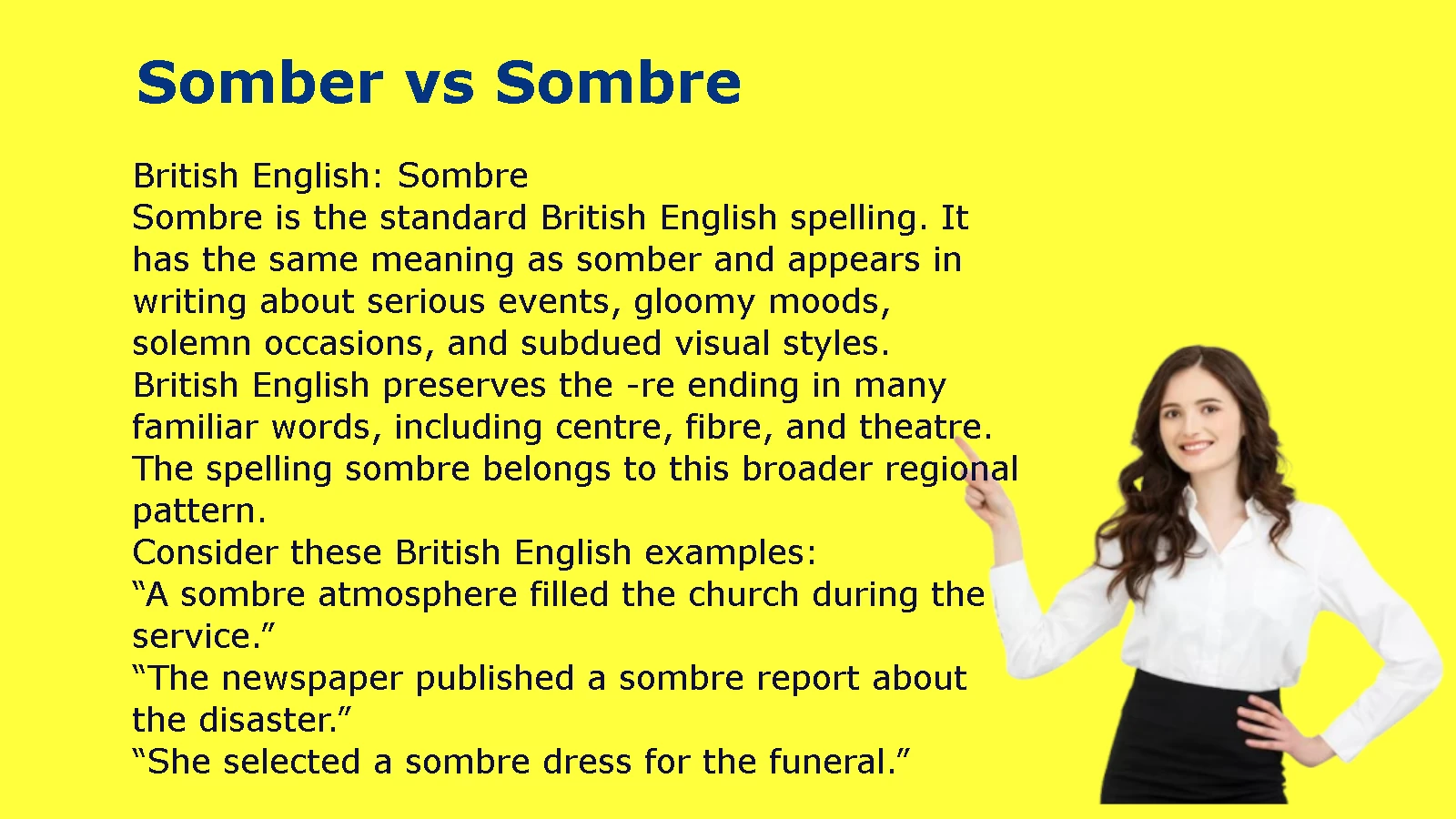
British English: Sombre
Sombre is the standard British English spelling. It has the same meaning as somber and appears in writing about serious events, gloomy moods, solemn occasions, and subdued visual styles.
British English preserves the -re ending in many familiar words, including centre, fibre, and theatre. The spelling sombre belongs to this broader regional pattern.
Consider these British English examples:
- “A sombre atmosphere filled the church during the service.”
- “The newspaper published a sombre report about the disaster.”
- “She selected a sombre dress for the funeral.”
- “The film’s sombre ending left the audience reflecting on its message.”
- “The painter used sombre shades of blue and gray throughout the exhibition.”
In each sentence, sombre communicates seriousness, gloom, or a lack of brightness. It does not automatically mean that someone is unhappy. A sombre atmosphere, for example, may reflect the importance of an occasion rather than personal sadness.
British English writers commonly use this spelling in journalism, literature, academic writing, and everyday communication. Publications that follow British spelling conventions generally prefer sombre over somber.
Practical tip: If your readers are primarily in the United Kingdom, use sombre and apply the same British spelling conventions to related words throughout your writing.
What About Canadian, Australian, and Other English Varieties?
The choice becomes slightly more nuanced when you write for audiences outside the United States and the United Kingdom. English spelling conventions vary by country, publisher, and style guide.
Sombre is commonly used in British, Australian, and New Zealand English. It is also an established spelling in Canadian English, although Canadian spelling practices combine British and American influences and can vary by word.
Use this table as a practical guide:
| Audience | Preferred spelling | Example |
| United States | Somber | The announcement created a somber mood. |
| United Kingdom | Sombre | The announcement created a sombre mood. |
| Australia | Sombre | The announcement created a sombre mood. |
| New Zealand | Sombre | The announcement created a sombre mood. |
| Canada | Sombre is common | The announcement created a sombre mood. |
| International audience | Follow the chosen style guide | Keep the spelling consistent throughout. |
This table shows common preferences rather than an absolute rule for every publisher or individual writer.
For Canadian readers, check the relevant publication’s house style when precision matters. A Canadian organization may prefer British-style spellings in some contexts while using American-style forms in others.
For international websites, the best approach is to choose a primary audience and use its conventions consistently. If your website serves both American and British readers, you can maintain separate localized versions when the benefits justify the extra editing work.
Somber vs Sombre at a Glance
The following comparison summarizes the most important differences and similarities.
| Feature | Somber | Sombre |
| Preferred spelling | American English | British English |
| Part of speech | Adjective | Adjective |
| Meaning | Gloomy, serious, or dark | Gloomy, serious, or dark |
| Pronunciation | Same standard pronunciation | Same standard pronunciation |
| Refers to mood | Yes | Yes |
| Refers to colors | Yes | Yes |
| Suitable for formal writing | Yes | Yes |
| Suitable for creative writing | Yes | Yes |
| Example | A somber expression | A sombre expression |
The important point is that the spelling changes, but the definition does not. You do not need to learn separate meanings for the two forms.
Somber and Sombre: Definition and Meaning
Somber and sombre are adjectives that describe something gloomy, serious, melancholy, or subdued. They can refer to emotions, facial expressions, atmospheres, events, and visual appearances. The word often suggests a lack of cheerfulness or brightness, but its exact meaning depends on the noun it describes.
For example, a somber mood suggests sadness or seriousness, while somber colors refers to dark or muted shades. The same basic idea connects both uses: something lacks the brightness, liveliness, or lightheartedness associated with a cheerful setting.
Meaning 1: Gloomy, Sad, or Serious
The most common meaning of somber or sombre relates to emotions and atmosphere. The word describes a serious, subdued, or melancholy feeling.
You might use it when discussing a difficult announcement, a funeral, a reflective conversation, or a gathering after a tragic event.
Examples include:
- “A somber mood settled over the family after the announcement.”
- “The coach addressed the players in a sombre tone after their defeat.”
- “Everyone became somber when the meeting turned to the company’s financial difficulties.”
- “Her sombre expression suggested that she had received disappointing news.”
- “The room grew quiet and somber as the ceremony began.”
The word does not always indicate intense grief. Sometimes it simply means that a person or situation lacks humor, excitement, or lightheartedness.
For instance, a serious business meeting may have a somber atmosphere because participants are discussing layoffs or declining sales. They may not feel personally sad, but the subject calls for a restrained mood.
Similarly, a sombre speech can be respectful and dignified without sounding hopeless. The speaker may be acknowledging a serious event and treating it with the appropriate level of gravity.
When to use this meaning: Choose somber or sombre when you want to communicate seriousness, quiet sadness, reflection, or an emotionally restrained atmosphere.
Meaning 2: Dark, Muted, or Lacking Brightness
The word also describes physical appearance, especially colors, clothing, decorations, and artistic choices.
In this sense, somber and sombre refer to shades that appear dark, subdued, or lacking in brightness. Common examples include charcoal gray, deep brown, dark navy, and muted black.
Consider these sentences:
- “The designer used somber colors to create a calm, restrained interior.”
- “He wore a sombre jacket to the formal memorial.”
- “The artist painted the landscape in somber shades of gray and brown.”
- “Dark furniture gave the room a sombre appearance.”
- “The film’s somber lighting reinforced its serious atmosphere.”
A somber color scheme does not necessarily look unattractive. It may create elegance, restraint, depth, or a feeling of quiet sophistication.
For example, a designer might use charcoal, navy, and muted green in a corporate office to create a professional atmosphere. A fashion stylist might choose a sombre outfit for a solemn event because the occasion calls for understated clothing.
The word can also describe an artistic mood. A painter who uses dark shades and limited contrast may create a sombre scene even if the subject itself is not sad.
When to use this meaning: Use somber or sombre when describing subdued colors, dark visual tones, restrained clothing, or an appearance that lacks brightness.
Synonyms for Somber and Sombre
Several English adjectives overlap with somber and sombre, but each carries a slightly different meaning. Choosing a precise synonym helps you avoid repetition and express the right emotional tone.
| Synonym | Meaning | Example |
| Solemn | Serious and dignified | The judge spoke in a solemn voice. |
| Gloomy | Dark, sad, or discouraging | The gloomy weather matched his mood. |
| Grave | Serious, often because of importance or danger | The doctor delivered a grave warning. |
| Bleak | Without hope or comfort | The report painted a bleak picture of the future. |
| Dismal | Depressing, dreary, or disappointing | The team had a dismal season. |
| Melancholy | Quietly or thoughtfully sad | A melancholy melody played in the background. |
| Muted | Subdued in intensity, sound, or color | The room featured muted shades of blue. |
| Lugubrious | Excessively mournful or gloomy | His lugubrious speech lasted nearly an hour. |
These words are related, but they are not perfect substitutes in every situation.
For example, solemn often emphasizes dignity or respect. A solemn ceremony may feel meaningful rather than sad. Bleak suggests a lack of hope, while melancholy often describes a reflective kind of sadness.
Likewise, muted works particularly well for colors, sounds, and levels of expression. You might describe a room as having muted colors, but somber colors places more emphasis on the dark or gloomy impression those colors create.
Writing tip: Before replacing somber with a synonym, identify the quality you want to emphasize. Is the scene serious, sad, hopeless, dignified, or visually subdued? The answer will help you select the most accurate word.
How to Use Somber or Sombre in a Sentence
Both spellings work as adjectives, so they usually appear before a noun or after a linking verb such as become, seem, look, or feel.
The choice between somber and sombre does not change sentence structure. You can replace one spelling with the other without changing the grammatical meaning, provided you follow the spelling conventions appropriate to your audience.
Examples About Moods and Emotions
Use somber or sombre when describing a person’s emotional state, facial expression, tone of voice, or general atmosphere.
Examples:
- “The students grew somber after learning that their teacher was leaving.”
- “He answered the question with a sombre expression.”
- “Her normally cheerful voice sounded somber during the phone call.”
- “The family remained sombre throughout the memorial service.”
- “A somber mood spread through the office after the disappointing announcement.”
In these examples, the adjective helps readers understand the emotional tone without requiring a lengthy explanation.
Compare these two sentences:
- “She entered the room.”
- “She entered the room with a somber expression.”
The first sentence describes an action. The second adds an emotional clue. Readers can infer that she may be worried, sad, or preparing to discuss something serious.
However, somber does not tell readers exactly why someone feels that way. If the cause matters, explain it in the surrounding text.
For example: “He looked somber after hearing that the project had lost its funding.” The added detail gives the expression a clear context.
Examples About Events and Situations
The word also describes situations that require seriousness, reflection, or restraint.
Examples:
- “The ceremony began with a somber tribute to the victims.”
- “Officials delivered a sombre warning about the approaching storm.”
- “The documentary offers a somber account of the community’s struggles.”
- “The meeting took a sombre turn when the director announced the closure.”
- “The report presented a somber outlook for the struggling industry.”
A sombre event does not have to be a funeral or memorial. It could be a press conference after a disaster, a discussion about financial losses, or a meeting where participants confront difficult decisions.
Consider a company announcing that it must close one of its offices. Calling the announcement somber tells readers that the event has serious consequences. It also suggests a restrained, possibly sad atmosphere.
The word works particularly well in news reports, formal statements, biographies, and reflective essays because it communicates seriousness without relying on exaggerated language.
Examples About Colors, Clothing, and Design
When the word describes appearance, it often signals dark or subdued visual choices.
Examples:
- “She selected a somber outfit for the memorial service.”
- “The artist used sombre tones to create a feeling of loneliness.”
- “The restaurant’s somber interior featured dark wood and charcoal walls.”
- “His wardrobe consisted mostly of somber shades of gray and navy.”
- “The photographer used low lighting to give the portrait a sombre quality.”
This use is especially common in discussions of art, fashion, architecture, interior design, and photography.
Imagine two rooms. One has bright yellow walls, colorful cushions, and plenty of natural light. The other has dark furniture, muted gray walls, and soft lighting. You might describe the second room as somber if its overall appearance feels restrained or gloomy.
The word describes the impression created by the design, not simply the darkness of an individual object. A dark blue wall is not automatically somber. Its effect depends on the lighting, surrounding colors, and overall atmosphere.
Common Usage Mistakes to Avoid
Although somber and sombre are straightforward words, a few mistakes can weaken your writing.
Mistake: Treating one spelling as universally incorrect.
Incorrect claim: “Sombre is a misspelling in every form of English.”
Better explanation: Somber is standard in American English, while sombre is standard in British English and common in several other varieties.
Mistake: Mixing regional spelling conventions without a reason.
For example, an American article might use somber, center, and color in one paragraph, then switch to sombre, centre, and colour in the next.
A single regional spelling difference is not necessarily a grammatical error. However, inconsistent conventions can make a document look poorly edited.
Mistake: Assuming somber always means sad.
The word can indicate seriousness, solemnity, or visual darkness. A somber presentation may be serious without being emotionally sad.
Mistake: Using somber when a more precise word would help.
If you mean that someone is respectful, solemn may be more accurate. If you mean that a color lacks brightness, muted may communicate the idea more clearly.
Mistake: Using the word without enough context.
“The room was somber” may leave readers wondering whether the room was dark, quiet, gloomy, or associated with a sad event. Add a detail when clarity matters: “The room felt somber, with dim lighting and dark wooden furniture.”
Why Do Somber and Sombre Have Different Spellings?
The spelling difference reflects the history of English and the development of regional writing conventions. English has absorbed words from French, Latin, and many other languages. Over time, spelling preferences have evolved differently in the United States and other English-speaking regions.
The modern distinction between somber and sombre is one example of that broader history. Understanding the pattern can help you recognize other spelling pairs without memorizing every word individually.
The Origin of the Word Somber
The English word is connected to French sombre, meaning dark or gloomy. Its historical development is also linked to the Late Latin form subumbrare, associated with shading or casting a shadow.
The word’s history helps explain why its meanings cover both emotional states and physical appearance. Darkness can describe a literal lack of light, but it can also serve as a metaphor for sadness, seriousness, or uncertainty.
For example, a dark room has limited light. A dark mood suggests sadness or emotional difficulty. The adjective somber connects these ideas by describing something that lacks brightness, cheerfulness, or lightheartedness.
English adopted the word and developed its own spelling conventions. British English retained the -re form, while American English came to favor -er.
This history does not mean that every English word ending in -re should be changed to -er in American writing. Regional spelling patterns have exceptions, so writers should check unfamiliar words rather than applying the pattern mechanically.
The American “-er” and British “-re” Pattern
One of the easiest ways to remember Somber vs Sombre is to compare it with other familiar words that use different regional spellings.
| American English | British English | Example |
| Somber | Sombre | The speech had a somber tone. |
| Center | Centre | The center opens at nine. |
| Fiber | Fibre | The product contains dietary fiber. |
| Theater | Theatre | We went to the theater last night. |
| Meter | Metre | The cable is two meters long. |
| Liter | Litre | The container holds one liter. |
These pairs illustrate a common spelling contrast. The exact conventions can vary by word and region, so treat the pattern as a useful guide rather than an exception-free rule.
The distinction also demonstrates why spelling differences should not be confused with differences in meaning. In most of these pairs, the words refer to the same thing regardless of which regional spelling appears.
For instance, an American might write, “The theater is in the city center.” A British writer would typically write, “The theatre is in the city centre.”
Both sentences communicate the same information. The spelling reflects the variety of English being used.
When editing a document, look for related words together. If you choose American English, check forms such as center, fiber, and theater. If you choose British English, check centre, fibre, and theatre.
Other American and British Spelling Differences
The somber/sombre distinction is part of a larger set of regional spelling differences. Recognizing these patterns helps you edit more efficiently and maintain a consistent style.
| American English | British English |
| Color | Colour |
| Favor | Favour |
| Honor | Honour |
| Organize | Organise |
| Analyze | Analyse |
| Traveling | Travelling |
| Gray | Grey |
| Check | Cheque, when referring to a bank payment |
Some of these pairs follow different historical or grammatical patterns. For example, British English commonly uses -ise in words such as organise, although -ize is also accepted by many British style guides. The noun cheque refers to a bank payment, while check has many other meanings in both varieties.
These differences show why you should avoid treating every spelling choice as a simple rule with no exceptions.
For website owners, editors, and content writers, a style guide can save time. It establishes the preferred spellings for the whole site and prevents unnecessary switching between conventions.
If you publish an article about Somber vs Sombre, related spelling comparisons such as center vs. centre, theater vs. theatre, and color vs. colour also provide useful internal-link opportunities. Readers who search for one regional spelling difference may want to understand others.
A Practical Case Study: Choosing a Spelling for a Website
Imagine that a company publishes a blog about workplace communication. Its audience consists mainly of American readers, but some visitors come from the United Kingdom and Australia.
The editor writes this sentence:
“The announcement created a sombre atmosphere throughout the office.”
The sentence is understandable, but the spelling may not match the site’s American English convention.
An editor following American English would revise it to:
“The announcement created a somber atmosphere throughout the office.”
Now imagine that a British publication uses the same sentence. Its editor would generally retain sombre.
Neither editor needs to change the meaning or rewrite the sentence. The only necessary change is the regional spelling.
A practical editing process looks like this:
- Identify the audience. Determine whether the content primarily serves American, British, Australian, Canadian, or another readership.
- Choose a spelling standard. Use a recognized house style or an established regional convention.
- Check related words. Review terms such as center/centre, color/colour, and theater/theatre.
- Edit consistently. Apply the chosen form throughout the article and related pages.
- Review exceptions. Check names, direct quotations, and official titles before changing their spelling.
This approach works for more than Somber vs Sombre. It can help editors manage spelling differences across entire websites, newsletters, reports, and books.
Frequently Asked Questions About Somber vs Sombre
Is “Sombre” a Correct English Word?
Yes. Sombre is a correct English spelling, particularly in British English and other varieties that follow British spelling conventions. It means gloomy, serious, melancholy, or dark in appearance. American English generally prefers somber, but the two forms have the same meaning and grammatical function.
Is It Somber or Sombre in American English?
Somber is the standard spelling in American English. For example, an American writer would normally write, “The announcement created a somber mood.” The spelling sombre is more closely associated with British English. If you are writing for a US audience, choose somber and use it consistently.
How Do You Spell “Somber Mood”?
The spelling depends on your audience. Write somber mood in American English and sombre mood in British English. Both phrases describe an atmosphere of seriousness, sadness, or reflection. Neither spelling changes the phrase’s meaning or pronunciation.
Do Somber and Sombre Mean the Same Thing?
Yes. Both words describe something gloomy, serious, melancholy, or subdued. They can refer to a person’s expression, the mood of a room, a solemn event, or dark colors. The difference is regional spelling, not meaning.
How Do You Pronounce Somber and Sombre?
Both spellings have the same standard pronunciation in English, commonly represented as SAHM-ber. The final e in sombre does not create a separate pronunciation. Regional accents may affect the exact vowel sound, but the spelling difference itself does not change the word’s standard pronunciation.
What Is the Origin of the Word Somber?
The word is connected to French sombre, meaning dark or gloomy, and has a historical association with the Late Latin form subumbrare. English developed the regional spellings somber and sombre over time. American English generally favors somber, while British English retains sombre.
Conclusion: Somber vs Sombre
The difference between Somber vs Sombre is simple: both spellings are correct, but they belong to different regional conventions. American English generally uses somber, while British English commonly uses sombre. Both describe gloomy moods, serious situations, solemn events, and dark or muted appearances.
Remember these key points:
- Use somber for American English.
- Use sombre for British English and other publications that follow British spelling conventions.
- Keep the spelling consistent throughout your document.
- Choose synonyms such as solemn, gloomy, grave, or muted when they express your intended meaning more precisely.
- Check your publication’s style guide when writing for Canadian or international audiences.
Before publishing your next article, essay, or report, identify your target audience and apply the appropriate spelling convention. If you are building a collection of grammar and spelling resources, consider linking this topic to related guides such as Center vs. Centre, Theater vs. Theatre, and Color vs. Colour. These connections help readers explore related questions while strengthening the organization of your content.