The correct spelling in the Piece vs Peice debate is piece. The spelling peice is a common mistake, not a standard English word with the intended meaning. Whether you are writing about a piece of cake, a piece of advice, or a piece of music, the correct letter order is P-I-E-C-E.
The confusion often comes from the familiar “I before E” spelling rule, which helps explain why some words use ie while others use ei. Understanding the piece meaning, learning how to spell piece correctly, and practicing a few original sentence examples can help you avoid this error. You will also learn the difference between piece of mind and peace of mind, two expressions that writers frequently confuse.
Piece vs Peice: Which Spelling Is Correct?
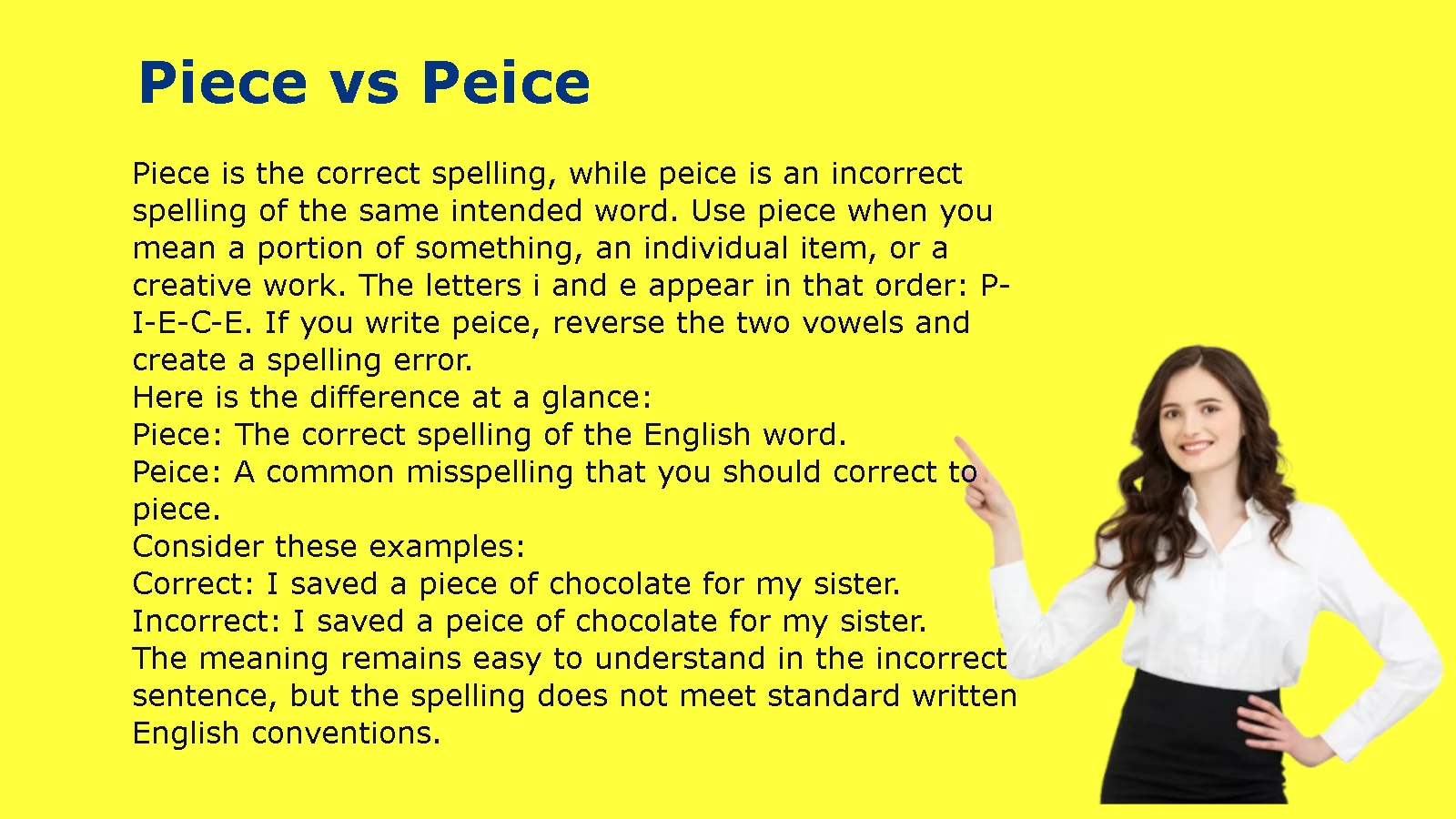
Piece is the correct spelling, while peice is an incorrect spelling of the same intended word. Use piece when you mean a portion of something, an individual item, or a creative work. The letters i and e appear in that order: P-I-E-C-E. If you write peice, reverse the two vowels and create a spelling error.
Here is the difference at a glance:
- Piece: The correct spelling of the English word.
- Peice: A common misspelling that you should correct to piece.
Consider these examples:
- Correct: I saved a piece of chocolate for my sister.
- Incorrect: I saved a peice of chocolate for my sister.
The meaning remains easy to understand in the incorrect sentence, but the spelling does not meet standard written English conventions.
You might see peice in text messages, online comments, school assignments, emails, or social media posts. Its appearance in informal writing does not make it an accepted alternative spelling.
How Do You Spell Piece?
You spell the word piece: P-I-E-C-E. Start with p, place i before e, and finish with c-e. A simple way to remember the sequence is to picture a piece of pie. The word pie appears at the beginning of piece, giving you a useful visual reminder.
For example:
- Please give me a piece of paper.
- Every piece of furniture has a purpose.
- She wrote a short piece about her hometown.
Whenever you hesitate between piece and peice, remember the pie trick and check the order of the vowels.
Why Do People Spell Piece as Peice?
People commonly spell piece as peice because they reverse the positions of i and e. English contains many words with similar vowel combinations, and pronunciation does not always reveal which spelling to use. When someone types quickly or relies on memory alone, the incorrect sequence can slip into a sentence.
Three common reasons explain this mistake.
Confusing the Order of I and E
The letters i and e appear together in many English words, but their order varies. For example, chief, field, and thief contain ie, while receive, ceiling, and deceive contain ei.
Because both patterns exist, writers sometimes remember the right sounds but choose the wrong letters.
Compare these words:
| Correct word | Vowel pattern | Example |
| Piece | ie | I need one piece of cardboard. |
| Chief | ie | The chief spoke to the team. |
| Receive | ei | Did you receive my message? |
| Ceiling | ei | The ceiling needs a fresh coat of paint. |
| Peice | Incorrect | Replace it with piece. |
The key lesson is simple: English spelling patterns can guide you, but you must also learn individual words.
Pronunciation Does Not Always Reveal the Spelling
The word piece has a long “ee” vowel sound. However, English uses several letter combinations to represent that sound. Words such as piece, field, and receive demonstrate why listening to a word cannot always tell you how to spell it.
Imagine hearing someone say, “Please send me a piece of the report.” You can recognize the word from context, but the sound alone will not tell you whether to write ie or ei.
To avoid this problem, combine pronunciation with visual memory and repeated practice. If you often mistype a particular word, write it correctly several times and use it in a sentence. This method helps you remember its letter sequence instead of guessing each time.
Does Autocorrect Make the Mistake Less Important?
Spell-checkers can flag peice and suggest piece, but you should not rely on them completely. Some writing tools miss errors when a misspelled word resembles another valid word or when the surrounding sentence creates ambiguity.
For instance, a spell-checker may not recognize every incorrect word in a sentence if the letters form a valid alternative. Proofreading remains useful even when you use grammar software.
Before submitting an assignment, publishing an article, or sending a professional email, check commonly confused spellings manually. A quick review can prevent small errors from distracting readers from your message.
The “I Before E” Rule Explained
The traditional “I before E, except after C” rule helps writers remember the order of these two vowels in certain English words. The word piece follows the ie pattern because the letters appear in that order after p. However, the rhyme has exceptions, so treat it as a memory aid rather than an absolute rule.
How the Rule Applies to Piece
The familiar spelling rhyme goes:
“I before E, except after C.”
Some versions add another phrase: “or when sounded as A, as in neighbor and weigh.”
The first part suggests that i usually comes before e in certain words. Since piece begins with p and contains no c immediately before the vowel pair, its spelling follows the expected ie sequence.
Break the word into its letters:
- P — the first letter
- I — the first vowel in the pair
- E — the second vowel
- C — the next consonant
- E — the final letter
Together, these letters form P-I-E-C-E.
Compare piece with receive. In receive, the letters ei follow c, matching the exception described in the rhyme. In piece, the sequence is ie, so the two words illustrate different patterns.
Remember that the rule is a starting point. It cannot resolve every spelling question in English.
Why the Rule Has Exceptions
English spelling reflects several historical influences, borrowed words, and pronunciation changes. As a result, the i before e rhyme does not cover every word that contains these letters.
Consider these examples:
| Word | Correct spelling pattern | Example sentence |
| Piece | ie | I found a piece of glass. |
| Believe | ie | I believe your explanation. |
| Field | ie | The children ran across the field. |
| Receive | ei | We receive deliveries every morning. |
| Ceiling | ei | A ceiling fan cooled the room. |
| Weird | ei | That was a weird coincidence. |
| Neighbor | ei | Our neighbor grows tomatoes. |
| Weigh | ei | Please weigh the package. |
Notice that weird uses ei even though it does not fit neatly into the simplest version of the rhyme. This is one reason you should not use the rule as your only spelling test.
A practical approach works better:
- Learn the spelling of common words you use regularly.
- Use the rhyme when it provides a helpful clue.
- Check a dictionary or trusted spell-checker when you are unsure.
- Practice confusing words in complete sentences.
This approach helps you remember piece without assuming that every English word follows one predictable pattern.
Piece Meaning, Definition, and Sentence Examples
A piece is a portion of a larger whole, a separate item, or an individual example of something. The word can describe physical objects, food, writing, music, art, and other creations. It also appears in phrases such as piece together, which means to combine separate details to understand a situation.
The exact meaning depends on the context.
Piece as a Portion or Part
One of the most common uses of piece refers to a section or amount taken from something larger. You might use the word when talking about food, paper, furniture, equipment, or a broken object.
Examples include:
- I ate a piece of chocolate cake after dinner.
- Please cut a piece of string long enough to tie the box.
- She found a missing piece of the puzzle under the table.
- He tore a piece of paper from his notebook.
- The mechanic replaced a damaged piece of equipment.
In each sentence, piece identifies one part, portion, or item.
The word also appears in expressions involving quantities. For example, a piece of information means one item or unit of information. Similarly, a piece of advice refers to one recommendation.
Notice the difference between these expressions:
- A piece of cake: One portion of cake.
- A piece of paper: One sheet or fragment of paper, depending on context.
- A piece of advice: One recommendation.
- A piece of evidence: One item that supports or challenges a claim.
These combinations show why piece is useful in everyday English. It allows speakers to refer to an individual part or unit without describing the entire object or collection.
Piece as an Artistic or Creative Work
The word piece can also describe a complete creative work, rather than a physical fragment. In this context, it refers to an individual composition, article, performance, or artwork.
For example:
- The orchestra performed a beautiful piece of classical music.
- She published an opinion piece about public transportation.
- The gallery displayed a striking piece of modern art.
- He wrote a short piece about his childhood memories.
- The pianist practiced the same musical piece for two hours.
Here, piece does not mean a broken part of something. It identifies a work that can stand on its own.
Writers often use the term opinion piece for an article that presents a viewpoint. Musicians use musical piece or simply piece to refer to a composition. Artists may call a painting or sculpture a piece of art.
Understanding this meaning helps you use the word naturally in academic, professional, and creative writing.
Piece in the Expression “Piece Together”
The phrase piece together means to combine separate facts, clues, memories, or parts to form a clearer understanding of something. People often use it when describing investigations, problem-solving, research, and attempts to reconstruct past events.
Examples:
- The detectives pieced together the events of the evening.
- I used the receipts to piece together my monthly spending.
- She tried to piece together the instructions after losing the first page.
- The researchers pieced together the timeline from several old documents.
The expression creates a useful mental image: imagine assembling a jigsaw puzzle. Each piece provides part of the picture, and the complete image emerges as you put the pieces together.
The word also changes form depending on the sentence:
| Form | Example |
| Piece | I found one piece of the puzzle. |
| Pieces | The box contained several pieces. |
| Pieced | They pieced together the missing information. |
| Piecing | We are piecing together the timeline. |
These forms share the same spelling base. When you use the past tense, write pieced, not peiced.
Piece vs Peice: Quick Comparison Table
The easiest way to distinguish piece from peice is to compare their spelling and grammatical status. Piece is the accepted English word, while peice is an incorrect spelling when you intend to refer to a portion, item, or creative work.
| Feature | Piece | Peice |
| Spelling status | Correct | Incorrect |
| Letter order | P-I-E-C-E | P-E-I-C-E |
| Standard English meaning | A portion, item, or creative work | No standard meaning as the intended word |
| Use in formal writing | Yes | No |
| Example | Please save me a piece of cake. | Write piece, not peice. |
| Plural or related form | Pieces, pieced, piecing | Correct the spelling to the appropriate form of piece. |
How to Correct Peice in a Sentence
When you find peice in your writing, replace it with piece. Then review the surrounding sentence to ensure that the word fits the intended meaning.
Incorrect: The artist created a beautiful peice of pottery.
Correct: The artist created a beautiful piece of pottery.
Incorrect: I need one peice of information before I can decide.
Correct: I need one piece of information before I can decide.
Incorrect: We peiced together the story from old letters.
Correct: We pieced together the story from old letters.
The last example shows why proofreading should cover related forms, not just the basic word. The correct past-tense spelling is pieced, with ie in the same order as piece.
Piece of My Mind vs. Peace of Mind
Piece of my mind and peace of mind are different expressions with different meanings. A piece of my mind refers to speaking frankly or angrily to someone, often to criticize their behavior. Peace of mind describes a feeling of calmness, security, or freedom from worry.
Although the expressions sound similar, you cannot use them interchangeably.
What Does “A Piece of My Mind” Mean?
The expression a piece of my mind usually means that someone intends to express strong disapproval or tell another person exactly what they think. It often suggests anger, frustration, or a direct confrontation.
Examples:
- After the contractor missed three deadlines, the homeowner gave him a piece of her mind.
- If he insults my colleague again, I will give him a piece of my mind.
- The customer gave the manager a piece of his mind after receiving the wrong order.
The phrase is informal and often carries a negative emotional tone. You might use it when someone has behaved rudely, broken a promise, or caused unnecessary frustration.
However, it does not literally mean handing someone a physical portion of your thoughts. It is an idiom, so its meaning goes beyond the individual words.
What Does “Peace of Mind” Mean?
Peace of mind means a state of feeling calm, safe, reassured, or free from persistent worry. People commonly use the phrase when discussing security, financial planning, health precautions, reliable services, and personal decisions.
Examples:
- Installing a smoke detector gives the family peace of mind.
- Keeping copies of important documents provides peace of mind when traveling.
- She felt peace of mind after confirming that her application had arrived.
- An emergency savings fund can offer peace of mind during an unexpected expense.
In these sentences, peace refers to calmness or reassurance. The expression does not involve criticism or confrontation.
The phrase is common in everyday conversation and professional writing. Businesses may use it to describe the reassurance a service provides, while individuals may use it to explain why they feel more comfortable after taking a precaution.
How to Choose the Right Expression
Use the meaning of the sentence to decide whether you need piece or peace.
| Expression | Meaning | Example |
| A piece of my mind | A forceful expression of criticism | I gave the supplier a piece of my mind about the delay. |
| Peace of mind | Calmness or freedom from worry | Tracking the delivery gave me peace of mind. |
| A piece of advice | One recommendation | My teacher offered a useful piece of advice. |
| A piece of cake | A portion of cake; also an easy task in an idiom | The first exercise was a piece of cake. |
A quick memory trick can help: piece often refers to a part or item, while peace refers to calmness.
For example, you can eat a piece of cake, give someone a piece of advice, or speak your mind by giving someone a piece of your mind. However, you enjoy peace of mind when you feel secure and relaxed.
Easy Tricks to Remember the Spelling of Piece
The best way to remember piece, rather than peice, is to connect the spelling with a familiar image. A piece of pie provides a simple visual clue because the letters P-I-E appear at the beginning of piece. You can reinforce this memory by writing the word in original sentences and reviewing it when you proofread.
Use the Pie Trick
Picture a freshly baked pie cut into slices. Each slice is a piece of the whole pie.
Now focus on the spelling:
PIE + CE = PIECE
This is a memory aid, not a literal word-building rule. Still, it works because it connects the correct vowel order to an everyday object.
Try remembering this sentence:
“Please give me a piece of pie.”
The repeated idea links piece with pie, making the spelling easier to recall.
You can also use the trick when writing related expressions:
- A piece of cake
- A piece of advice
- A piece of furniture
- A piece of music
- A piece of evidence
Every example begins with the same correctly spelled word.
Practice with a Short Sentence
Repeatedly seeing and using the correct spelling can help make it easier to remember. Instead of memorizing the letters in isolation, practice the word in sentences that reflect how you actually use English.
Try these exercises:
Fill in the blank:
- I would like a ___ of bread.
- She wrote a short ___ for the school newspaper.
- We need one more ___ of the puzzle.
- The team ___ together the missing details.
Answers: piece, piece, piece, pieced.
Next, write three original sentences using piece in different contexts. For example, use it once for food, once for a creative work, and once in the phrase piece together.
This practice reinforces the spelling while helping you understand the word’s different meanings.
Check the Word Before You Publish
If you regularly write blog posts, essays, emails, or reports, add piece to your personal proofreading checklist.
Before publishing, look for:
- The incorrect spelling peice.
- Related errors such as peiced instead of pieced.
- Confusion between piece and peace.
- Incorrect expressions such as a peice of advice.
- Missing plural endings in sentences that require pieces.
A quick search through a document can catch repeated spelling mistakes. You can also use your word processor’s find feature to locate the sequence peice and check each result.
For longer articles, proofread once for meaning and structure, then review a second time for spelling. Separating those tasks makes it easier to spot small errors.
Frequently Asked Questions About Piece vs Peice
Is Peice a Real Word?
No. Peice is not the standard spelling of the English word piece. If you mean a portion, item, or creative work, write piece. You may encounter peice as a typo online or in informal writing, but it is not an accepted alternative spelling for this meaning.
How Do You Spell Piece?
The correct spelling is P-I-E-C-E. The letter i comes before e. To remember the order, picture a piece of pie: the letters pie appear at the beginning of piece.
What Is the Plural of Piece?
The plural of piece is pieces. Add -s to the singular form.
Examples:
- One piece of fruit.
- Two pieces of fruit.
- Several pieces of furniture.
Although piece is countable, some nouns that follow it, such as furniture, are generally uncountable in standard English. You can say two pieces of furniture rather than two furnitures.
How Do You Spell a Piece of Advice?
The correct phrase is a piece of advice. Spell piece as P-I-E-C-E. The word advice is generally uncountable, so English speakers use a piece of to identify one recommendation.
For example: “My manager gave me a useful piece of advice before the interview.”
You can also say some advice when you do not need to identify one individual recommendation.
Why Is Piece Spelled With IE Instead of EI?
The word piece uses ie because that is its standard spelling. The familiar “I before E, except after C” rhyme can help you remember the pattern, but English has exceptions. Learn the spelling of common words individually when the rule does not provide a reliable answer.
What Is the Difference Between Piece of Mind and Peace of Mind?
A piece of my mind means expressing strong criticism or telling someone exactly what you think. Peace of mind means feeling calm, secure, or free from worry.
For example, “I gave the driver a piece of my mind” expresses frustration, while “The insurance policy gave me peace of mind” describes reassurance.
Conclusion: Always Choose Piece, Not Peice
The correct spelling in the Piece vs Peice comparison is piece. The spelling peice is a common error caused by reversing the letters i and e. Whether you are describing a portion of food, a written article, a musical composition, or a part of a larger object, the correct spelling remains P-I-E-C-E.
Remember the pie trick: a piece of pie begins with pie, just like the word piece. Use the “I before E” rhyme as a helpful clue, but remember that English spelling includes exceptions. Also, keep piece of my mind separate from peace of mind because the two expressions have different meanings.













