Salable vs Saleable is a spelling comparison in which both words are correct. They share the same meaning: capable of being sold, suitable for sale, or marketable. The main difference is regional preference. American English generally favors salable, while British English commonly uses saleable. Both forms appear in business writing, retail, real estate, and financial discussions.
Understanding the difference helps you choose the right spelling for your audience, whether you’re writing product descriptions, evaluating property, preparing a business report, or optimizing a website for regional search traffic. You’ll also learn how sellable, marketable, and merchantable differ in meaning and when each term fits best.
Salable vs Saleable: Which Spelling Is Correct?
Both salable and saleable are correct English spellings. Neither is inherently wrong, and both describe something that can be sold. The choice usually depends on regional spelling conventions and the style guide you follow. If you’re writing for an American audience, salable is generally the natural choice. For a British audience, saleable is common.
Here is a quick comparison:
| Feature | Salable | Saleable |
| Correct spelling | Yes | Yes |
| Meaning | Capable of being sold | Capable of being sold |
| Part of speech | Adjective | Adjective |
| Common regional preference | American English | British English and some Commonwealth usage |
| Business usage | Salable inventory, salable assets | Saleable inventory, saleable assets |
| General synonym | Marketable | Marketable |
| Example | The furniture remains salable. | The furniture remains saleable. |
The distinction is primarily about spelling, not meaning. You can use either word to describe a product that customers might buy, property that could attract a purchaser, or goods suitable for commercial sale.
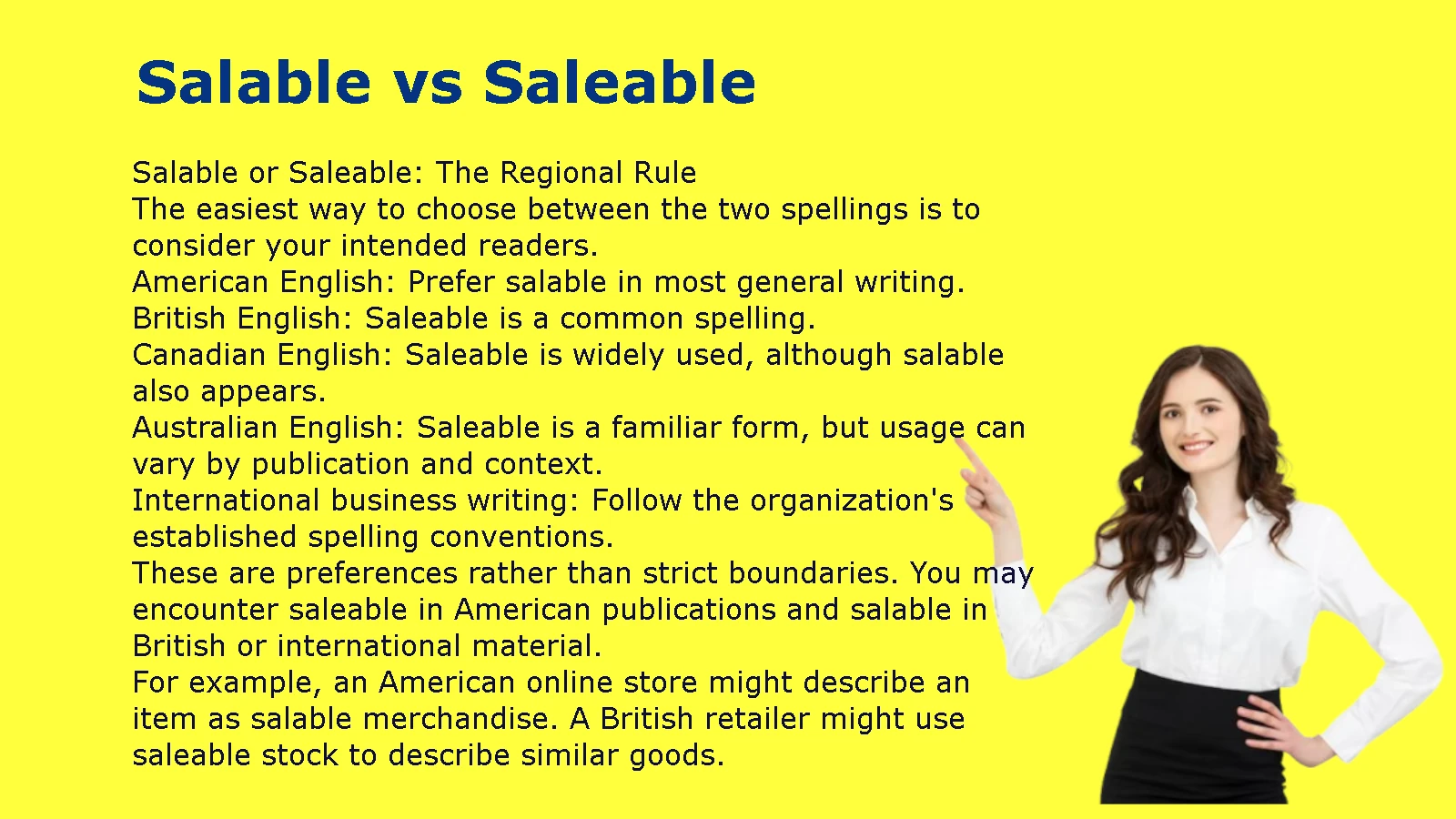
Salable or Saleable: The Regional Rule
The easiest way to choose between the two spellings is to consider your intended readers.
- American English: Prefer salable in most general writing.
- British English: Saleable is a common spelling.
- Canadian English: Saleable is widely used, although salable also appears.
- Australian English: Saleable is a familiar form, but usage can vary by publication and context.
- International business writing: Follow the organization’s established spelling conventions.
These are preferences rather than strict boundaries. You may encounter saleable in American publications and salable in British or international material.
For example, an American online store might describe an item as salable merchandise. A British retailer might use saleable stock to describe similar goods.
The practical rule: Choose the spelling that suits your audience, check your organization’s style guide, and use that spelling consistently.
What Does Salable Mean?
Salable is an adjective that means capable of being sold or considered suitable for sale. It often describes products, merchandise, property, or other assets that have enough commercial appeal to attract potential buyers. Something salable does not necessarily sell quickly or generate a profit; it simply has the potential to be sold.
The word appears frequently in discussions about retail inventory, property valuation, business assets, and product demand.
For example, a furniture company might have 500 chairs in its warehouse, but only 420 may be ready for customers. Those 420 chairs could be considered salable if they meet the company’s requirements for sale.
Examples of Salable in a Sentence
These examples show how to use salable in different contexts.
- The retailer discounted its older products to make the remaining inventory more salable.
- The real estate agent recommended several improvements to make the property more salable.
- The company needed to determine which assets were still salable after restructuring.
- The manufacturer redesigned the packaging to create a more salable product.
- The antique dealer inspected the furniture to identify the pieces that remained salable.
- The damaged electronics were no longer considered salable at their original prices.
- The publisher wanted a more salable book title that would appeal to a wider audience.
- The business sold its salable equipment before closing the facility.
- The seller lowered the asking price to make the vehicle more salable.
- The shop separated its salable merchandise from items that required repairs.
Notice that salable describes the potential for a sale. It doesn’t guarantee that a transaction will happen.
A product can be salable but remain unsold because its price is too high, its marketing is weak, or customers prefer competing products.
What Makes a Product Salable?
A product’s salability depends on several factors. The word describes its potential for sale, but the reasons behind that potential can vary.
| Factor | How it affects salability | Example |
| Price | A competitive price can attract more buyers. | A laptop priced below comparable models may sell more easily. |
| Condition | Good condition increases buyer confidence. | A refurbished phone with a warranty may appeal to budget-conscious shoppers. |
| Demand | Strong demand increases the likelihood of a sale. | Winter coats become more attractive to buyers during cold weather. |
| Quality | Reliable products are easier to market. | Durable furniture may appeal to customers seeking long-term value. |
| Presentation | Clear descriptions and attractive images help buyers assess an item. | A well-photographed online listing may receive more inquiries. |
| Availability | Convenient access can influence purchasing decisions. | An item available for immediate delivery may attract buyers who need it quickly. |
Consider a retailer selling two nearly identical coffee makers. One costs $45 and includes a warranty, while the other costs $70 without additional features. The lower-priced model may be more salable if customers see little difference in performance.
However, salability isn’t determined by price alone. Brand reputation, customer reviews, product features, and the needs of the target audience can all influence a buyer’s decision.
Synonyms for Salable
Several words can replace salable, but their meanings aren’t always identical.
| Synonym | Meaning | Best use |
| Marketable | Suitable for promotion or sale | Products, services, skills, and business ideas |
| Sellable | Capable of being sold | Everyday writing and commercial discussions |
| Commercially viable | Capable of succeeding commercially under relevant conditions | Business plans and product development |
| In demand | Wanted by many potential buyers | Popular products and services |
| Saleable | Capable of being sold | British English and international writing |
| Suitable for sale | Appropriate or ready to be sold | Clear, formal descriptions |
For instance, a new software application might be marketable because it solves a problem that customers recognize. Its commercial viability, however, would also depend on development costs, pricing, competition, and revenue potential.
Similarly, a used car might be salable even if it isn’t particularly desirable. A buyer could still purchase it at the right price.
What Does Saleable Mean?
Saleable is an adjective that means capable of being sold, suitable for sale, or marketable. It has essentially the same meaning as salable. The spelling with an additional e is common in British English and appears in retail, property, inventory management, and commercial writing.
For example, a British retailer might describe undamaged products as saleable stock. An American retailer could describe the same goods as salable inventory.
The difference doesn’t indicate a different level of quality, demand, or commercial value. Both words communicate the same basic idea.
Examples of Saleable in a Sentence
Here are examples of saleable in everyday and professional contexts.
- The retailer inspected the returned items to determine which products were still saleable.
- The company needed to remove damaged packaging before offering the goods as saleable stock.
- The property agent explained which renovations could make the house more saleable.
- The warehouse separated saleable merchandise from products awaiting repair.
- The manufacturer developed a more saleable design after reviewing customer feedback.
- The antique shop placed its most saleable items near the entrance.
- The business sold its remaining saleable assets before shutting down operations.
- The store reduced prices on seasonal products to make them more saleable.
- The supplier returned items that did not meet the retailer’s requirements for saleable goods.
- The designer created a collection of practical, affordable, and saleable products.
Each sentence uses saleable to describe something with the potential to be sold.
How Saleable Is Used in Retail
In retail, saleable can refer to merchandise that meets the requirements for offering it to customers. Those requirements may involve condition, packaging, safety, labeling, and the retailer’s return policies.
Imagine a clothing store receiving 100 shirts from a supplier. During inspection, employees discover that 90 shirts have the correct labels and intact packaging, while 10 have stains or damaged seams.
The retailer might classify the first 90 as saleable and set aside the remaining 10 for repair, return, or disposal.
This classification doesn’t necessarily mean that all 90 shirts will sell. It means they meet the retailer’s requirements for being offered for sale.
That distinction matters in inventory management because saleable stock and sold stock are not the same thing. One describes goods that can be offered to customers; the other describes goods that have already been purchased.
Synonyms for Saleable
The best substitute depends on the situation.
- Marketable: Appropriate when emphasizing a product’s appeal to potential customers.
- Sellable: Useful in everyday business communication.
- Merchantable: Often associated with goods meeting an applicable standard of acceptable quality or fitness for sale, especially in legal contexts.
- Fit for sale: Useful when describing whether goods meet particular requirements.
- Commercially attractive: Appropriate when emphasizing buyer appeal rather than basic eligibility for sale.
For example, a used bicycle might be saleable because someone is willing to buy it. Whether it is merchantable under a particular contract or law is a separate question that depends on the applicable requirements.
Why Do Salable and Saleable Have Different Spellings?
The difference between salable and saleable reflects variations in English spelling conventions. Both words combine the idea of a sale with the suffix -able, which generally means capable of or suitable for something. The difference lies in whether the final e of sale remains before the suffix.
English spelling doesn’t apply one perfectly consistent rule to every word. Regional conventions, historical development, pronunciation, and established usage all influence spelling choices.
Why American English Prefers Salable
American English often favors salable, a shorter spelling that omits the e before -able. This form follows a familiar tendency to simplify certain spellings, although it isn’t a universal rule for all words ending in silent e.
Consider these examples:
| Word | Common American spelling | Common alternative or British form |
| Salable | Salable | Saleable |
| Likable | Likable | Likeable |
| Lovable | Lovable | Loveable |
| Usable | Usable | Useable |
| Movable | Movable | Moveable |
These pairs illustrate a broader spelling pattern: English sometimes drops a final silent e before a suffix beginning with a vowel, but it can also retain the letter.
The pattern isn’t absolute. For example, changeable and noticeable generally retain the e. The reason involves spelling conventions and the need to preserve recognizable word forms or pronunciations in particular cases.
For that reason, it’s better to treat salable as an established American spelling rather than assume that every word must lose its final e before -able.
Why British English Uses Saleable
British English commonly retains the e in saleable, keeping the base word sale visually recognizable.
The spelling is familiar in British retail and business writing. Expressions such as saleable goods, saleable stock, and saleable value may appear in commercial contexts.
However, British English doesn’t preserve the final e in every word that takes -able. Both likable and likeable, for example, are used, although preferences may differ between publications.
The same principle applies to salable and saleable: one spelling isn’t automatically correct everywhere simply because of a country’s general spelling conventions.
The takeaway: Regional spelling preferences can guide your choice, but established usage and the relevant style guide should settle the question.
Is Sellable Also Correct?
Yes. Sellable is also a correct English word. It means capable of being sold and is closely related to the verb sell.
Although sellable, salable, and saleable overlap in meaning, their tone and usage can differ.
| Word | Typical impression | Example |
| Salable | Conventional, often used in American business writing | The remaining equipment is salable. |
| Saleable | Conventional, often used in British business writing | The remaining equipment is saleable. |
| Sellable | Direct and straightforward | The remaining equipment is sellable. |
Sellable can sound more conversational because it comes directly from sell. The other two forms often appear in formal descriptions of merchandise, assets, and marketability.
Still, these are tendencies, not strict distinctions. You can find all three words in commercial writing.
For example:
- Salable: The company identified several salable assets.
- Saleable: The company identified several saleable assets.
- Sellable: The company identified several assets that were easy to sell.
All three sentences communicate a similar idea, although the final example emphasizes ease of selling rather than merely the possibility of a sale.
Salable vs Saleable in Business and Professional Writing
Choosing between salable and saleable is usually a straightforward spelling decision. However, the word’s context matters. Business writers may use it to describe inventory, property, financial assets, or products with commercial potential.
The most useful approach is to distinguish the spelling question from the underlying business question. Whether you write salable or saleable, you still need to explain what makes the item suitable for sale.
E-Commerce and Product Listings
Online retailers use descriptions to communicate product condition, availability, features, and value. The choice between salable and saleable should reflect the audience’s language conventions.
For an American storefront, salable inventory may fit naturally. A British storefront might use saleable stock.
Consistency helps keep product descriptions, category pages, inventory reports, and customer communications aligned.
For example, imagine a retailer operates two regional websites:
- US storefront: The team uses salable inventory in internal reports and relevant product documentation.
- UK storefront: The team uses saleable stock in equivalent documents.
- Shared product database: The team stores a common product status code and adapts the wording for each regional interface.
This approach lets the company maintain consistent inventory data while respecting local language preferences.
The spelling alone won’t make an item more attractive to customers. Product quality, accurate specifications, pricing, images, and customer trust have a more direct role in purchasing decisions.
SEO and Regional Keyword Targeting
Search engine optimization introduces another practical consideration: people in different regions may search for different spellings.
If you’re creating content for an American audience, Salable vs Saleable may be relevant to a spelling comparison page, but your primary wording should reflect the target market. A page aimed at British readers may naturally emphasize saleable.
Use the following process when optimizing content for these terms:
- Identify the target country. Decide whether the page serves American, British, Australian, Canadian, or international readers.
- Check search behavior. Review keyword research data for the target region instead of assuming one spelling has greater search demand everywhere.
- Choose a primary spelling. Use the preferred form in the title, introduction, headings, and relevant examples.
- Explain the alternative naturally. Mention the other spelling because readers may encounter it in dictionaries, documents, and searches.
- Avoid keyword stuffing. Don’t repeat both forms in every paragraph merely to capture additional searches.
- Keep related pages consistent. Follow the same regional spelling policy across relevant articles and landing pages.
A spelling comparison article can also link naturally to related content about sellable vs. saleable, marketable vs. salable, or other differences between American and British English.
For example, a site with a spelling guide might connect this article to a broader explanation of American vs. British spelling differences. That internal link gives readers a path to related information without forcing an unrelated topic into the page.
Don’t assume that using both spellings guarantees rankings for both versions. Search performance depends on the query, page relevance, competition, content quality, and other factors. Regional keyword data can help you make a more informed decision.
Real Estate and Property Valuation
In real estate, salable property and saleable property describe property that can be sold or has the potential to attract a buyer.
A property may be legally available for sale yet difficult to sell at the owner’s preferred price. Location, condition, financing options, comparable properties, and buyer demand all influence marketability.
Consider a homeowner deciding whether to renovate a dated kitchen before listing a property.
The agent may believe that updating the kitchen would make the house more salable. However, the decision should depend on the local market and the likely return on the renovation, not just on the word used to describe the property.
A useful evaluation considers:
- Location: Is the property in an area where buyers want to live?
- Price: Does the asking price match comparable properties?
- Condition: Are repairs or upgrades likely to influence buyer interest?
- Presentation: Do photographs and viewings communicate the property’s strengths?
- Buyer demand: Are enough potential purchasers looking for similar properties?
The word salable doesn’t guarantee a quick sale or a high valuation. It describes the potential for a transaction, while the market determines whether buyers are willing to proceed and at what price.
Legal, Financial, and Accounting Contexts
Both spellings can appear in discussions about business assets, inventory, and liquidation. For example, a company closing a warehouse might assess which equipment is salable or saleable before arranging an auction.
However, salable does not automatically mean legally transferable, compliant, or guaranteed to sell.
Legal and financial contexts require particular care because similar-looking terms may have specific meanings under a contract, regulation, or jurisdiction.
Consider these distinctions:
| Term | General meaning | Important consideration |
| Salable asset | An asset capable of being sold | The asset may still have restrictions, debts, or transfer requirements. |
| Saleable inventory | Goods suitable for sale | The business may have specific standards for condition and packaging. |
| Market value | An estimate of an asset’s value under defined conditions | It isn’t necessarily the price the seller will receive. |
| Merchantable quality | A legal concept concerning whether goods meet applicable standards | The exact requirements depend on the relevant law and circumstances. |
| Liquidation value | An estimate of what an asset may realize in a liquidation setting | The amount may differ from its ordinary market value. |
For example, a company might own equipment that could attract buyers at auction. The equipment may be salable, but a lender’s security interest or contractual restriction could affect how the company can transfer it.
Likewise, inventory may be suitable for sale in ordinary commercial terms but fail a contractual quality requirement.
When a document has legal or financial consequences, don’t treat salable and saleable as substitutes for a defined technical term. Follow the governing contract, applicable law, and relevant professional guidance.
A Practical Case Study: Choosing Salable or Saleable for Two Markets
Imagine a fictional online retailer called Northstar Home that sells furniture in the United States and United Kingdom.
Its US team writes product descriptions using American spelling. Its UK team adapts descriptions for British customers. Both teams need to describe furniture that can be offered for sale after inspection.
The company could follow this process:
| Step | US website | UK website |
| Primary spelling | Salable | Saleable |
| Inventory wording | Salable stock | Saleable stock |
| Product inspection | Check condition and packaging | Check condition and packaging |
| SEO approach | Research US search terms | Research UK search terms |
| Quality claims | Use evidence-based descriptions | Use evidence-based descriptions |
The teams use different spellings but retain the same underlying inventory rules. A chair either meets the company’s requirements for sale or it doesn’t, regardless of the spelling on the report.
This example illustrates an important principle: localize the language, not the underlying facts.
If the product has a damaged frame, changing salable to saleable won’t make it suitable for sale. The business must assess the actual condition of the item.
Likewise, the spelling difference doesn’t establish that American buyers prefer different products from British buyers. Any claim about purchasing behavior would require separate market evidence.
How to Remember the Difference Between Salable and Saleable
A simple mnemonic can help you remember which spelling is generally preferred in each region.
The American A vs. English E Trick
Use this memory aid:
- Salable = A for American English.
- Saleable = E for England and the extra E in the spelling.
This trick is a reminder of common regional preferences, not a strict rule that determines whether a spelling is correct.
Both words are valid, and you may encounter either one outside its most familiar region.
A Simple Rule for Choosing the Right Spelling
When you aren’t sure which form to use, follow these steps:
- Identify your audience. Determine where your readers live and which spelling convention they expect.
- Check your style guide. Follow the organization’s established spelling policy.
- Consider the document type. A marketing page may follow regional house style, while a legal document may require exact wording from a contract or regulation.
- Use one form consistently. Avoid switching between salable and saleable without a reason.
- Review the final copy. Search your document for both spellings to catch accidental inconsistencies.
For example, if you’re writing a US product guide, choose salable and apply it throughout the article. If you’re writing for a British retail audience, saleable may be the better fit.
Consistency makes your writing easier to follow and helps establish a clear editorial standard.
Common Mistakes to Avoid
The spelling difference is simple, but writers sometimes draw incorrect conclusions from it.
Treating One Spelling as Universally Correct
Neither salable nor saleable is universally correct at the expense of the other. Both are accepted spellings.
The best choice depends on regional preference, audience expectations, and the style guide you follow.
Assuming the Words Have Different Meanings
The extra e doesn’t create a meaningful difference in the general definition.
Both words describe something capable of being sold or considered marketable. If a document uses one form, you generally don’t need to interpret it differently from the other.
Switching Spellings Within the Same Document
Using salable inventory in one section and saleable inventory in another can make a document look inconsistent.
This isn’t necessarily a grammar error, but it may signal that the writer hasn’t followed a clear editorial policy.
Choose one spelling and apply it throughout the document unless you’re quoting a source or discussing regional differences.
Confusing Salable With On Sale
The word salable means capable of being sold. The phrase on sale commonly means that an item is available for purchase or, in many retail contexts, offered at a reduced price.
Compare these examples:
- Salable: The retailer believes the product is salable because customers want it.
- On sale: The retailer reduced the product’s price for a weekend promotion.
A product can be salable without being discounted. An item can also be on sale without attracting many buyers.
Assuming Salable Means Profitable
A product may be easy to sell but still generate little profit.
Suppose a retailer buys an item for $80 and sells it for $85. The item may be salable, but the small difference between the purchase price and selling price might not cover shipping, storage, labor, marketing, and other expenses.
Salability concerns the potential for a sale; profitability concerns the financial result.
The distinction matters when writing business reports because the terms describe different aspects of commercial performance.
Assuming Every Salable Item Is Ready for Immediate Sale
An item may have resale potential but still require inspection, cleaning, repairs, or documentation before a business can offer it to customers.
For example, a used laptop may be salable after the seller replaces a faulty battery and removes the previous owner’s data. Until those steps are complete, the seller may not consider it ready for sale.
Always distinguish an item’s potential marketability from its current condition and readiness.
Frequently Asked Questions
Is Salable or Saleable the Correct Spelling?
Both salable and saleable are correct. American English generally favors salable, while saleable is common in British English and some Commonwealth usage. Choose the form that fits your audience and remain consistent.
Do Salable and Saleable Mean the Same Thing?
Yes. Both words mean capable of being sold, suitable for sale, or marketable. The extra e represents a spelling variation rather than a different definition. Neither spelling guarantees that an item will sell or make a profit.
Is Salable American or British English?
Salable is particularly associated with American English. However, it isn’t exclusive to the United States. You may encounter it in international business writing and in other varieties of English.
Is Saleable Preferred in British English?
Saleable is a common British English spelling and is familiar in retail and commercial contexts. Individual publishers and organizations may have their own preferences, so check the applicable style guide when consistency matters.
Is Sellable a Real Word?
Yes. Sellable is an accepted English word meaning capable of being sold. It often sounds straightforward and conversational, while salable and saleable may appear more frequently in certain formal or commercial contexts. The three words overlap in meaning.
Which Spelling Should I Use in Business Writing?
Use salable for most American English business writing and saleable when following a British English convention that prefers it. Check your company’s style guide and preserve exact terminology in legal or technical documents. Most importantly, use one spelling consistently.
Conclusion: Salable vs Saleable
The difference between Salable vs Saleable comes down to spelling preference, not meaning. Both words describe something capable of being sold or considered marketable.
Remember these points:
- Salable is generally preferred in American English.
- Saleable is common in British English and some Commonwealth usage.
- Sellable is another correct alternative.
- Neither spelling guarantees demand, profitability, or legal eligibility for sale.
- Regional audience, document type, and editorial consistency should guide your choice.
If you’re writing a blog post, product listing, property description, or business report, choose the spelling that suits your readers. Then apply it consistently throughout your content.