Edema and oedema are two spellings of the same medical term, meaning swelling caused by excess fluid trapped in the body’s tissues. The main difference is regional spelling: edema is the standard spelling in American English, while oedema is commonly used in British English and other varieties of English.
If you’re searching for “edema vs oedema,” “edema or oedema,” or “oedema meaning,” the choice depends mainly on the type of English you are using. Both words have the same meaning, pronunciation, and medical use. The spelling with oe is more common in British English, while American English generally drops the o and uses edema.
| Question | Answer |
|---|---|
| What is the difference between edema and oedema? | They mean the same thing; the difference is mainly spelling. |
| Is edema American or British English? | Edema is the standard American English spelling. |
| Is oedema American or British English? | Oedema is the standard British English spelling. |
| Which is correct, edema or oedema? | Both are correct. Choose the spelling that matches your variety of English. |
| What does edema/oedema mean? | Swelling caused by excess fluid collecting in body tissues. |
Edema vs Oedema: Quick Answer
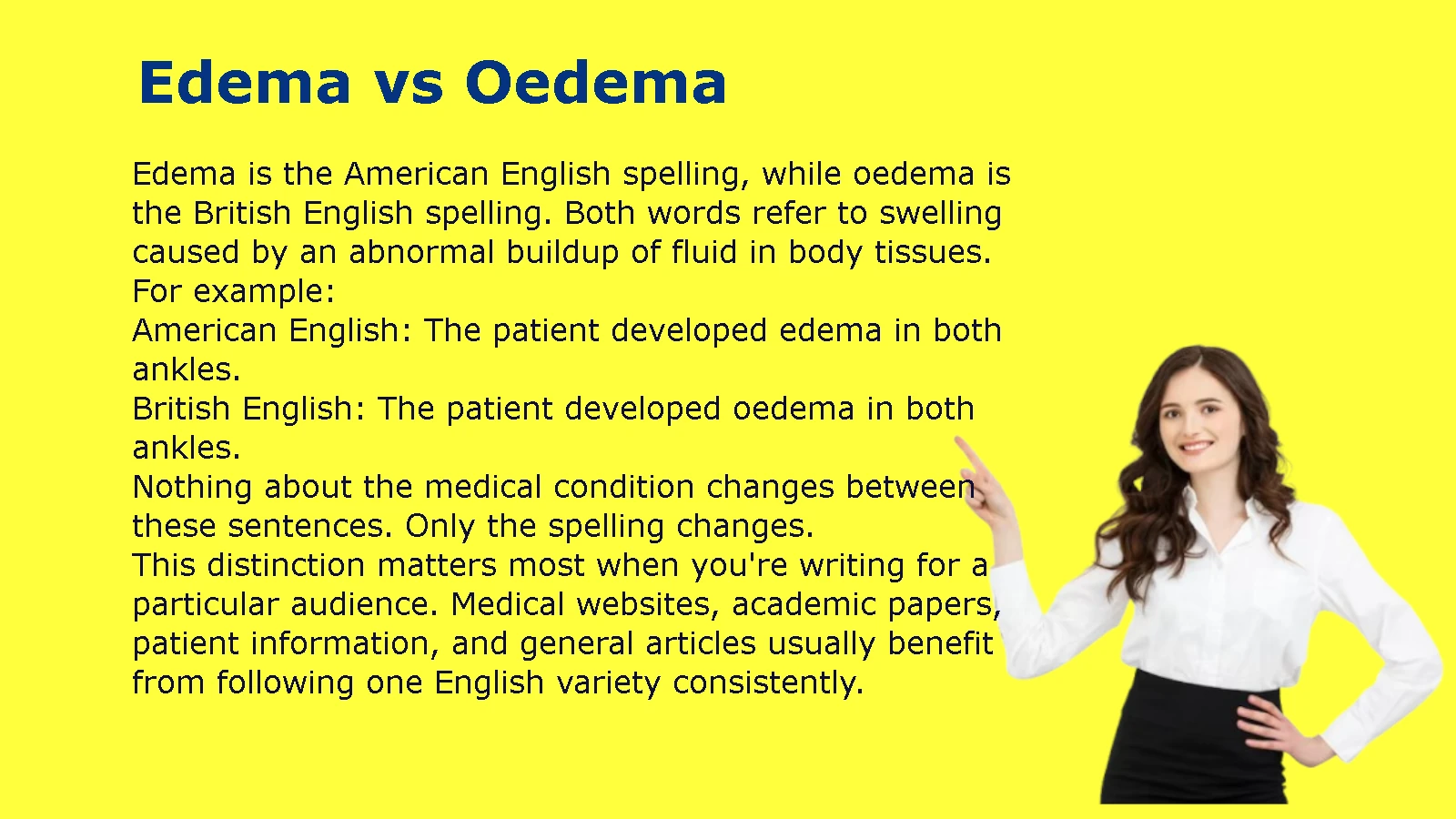
Edema is the American English spelling, while oedema is the British English spelling. Both words refer to swelling caused by an abnormal buildup of fluid in body tissues.
For example:
- American English: The patient developed edema in both ankles.
- British English: The patient developed oedema in both ankles.
Nothing about the medical condition changes between these sentences. Only the spelling changes.
This distinction matters most when you’re writing for a particular audience. Medical websites, academic papers, patient information, and general articles usually benefit from following one English variety consistently.
What Does Edema Mean?
Edema is a medical term for swelling caused by excess fluid collecting in body tissues. It commonly affects areas such as the feet, ankles, legs, hands, and arms, although fluid buildup can occur elsewhere in the body as well.
Merriam Webster defines edema as an abnormal accumulation of fluid in connective tissue or a body cavity. The word has been used in English since at least the 15th century.
In everyday language, people may simply call edema swelling. The medical term is more precise because it points specifically to fluid accumulation rather than every possible cause of enlargement.
For example, a swollen ankle after an injury may involve edema because inflammation causes fluid to move into nearby tissues. On the other hand, not every type of swelling has the same cause or mechanism.
How Edema Happens
Your body constantly moves fluid between blood vessels, tissues, and the lymphatic system. Normally, these systems keep fluid levels balanced.
When that balance changes, more fluid can remain in the tissues than the body can effectively remove. The result is swelling, or edema. Cleveland Clinic notes that edema occurs when fluid builds up faster than it can drain from affected areas.
Several factors can contribute to this process, including:
- Inflammation
- Injury
- Pregnancy
- Certain medications
- Prolonged sitting or standing
- Problems with veins and circulation
- Kidney disease
- Liver disease
- Heart disease
- Some thyroid conditions
- Blood clots
- High sodium intake
The cause matters because edema isn’t itself a single disease. It’s often a sign or symptom of another process happening in the body.
Common Examples of Edema
Edema can appear in different parts of the body and can have different names depending on its location or cause.
Common examples include:
- Peripheral edema: Swelling in the legs, ankles, feet, hands, or arms.
- Pulmonary edema: Fluid buildup in the lungs.
- Cerebral edema: Swelling involving the brain.
- Periorbital edema: Swelling around the eyes.
- Lymphedema: Swelling associated with impaired lymphatic drainage.
- Generalized edema: More widespread swelling affecting multiple areas.
These terms describe different forms or locations of fluid related swelling. They don’t create a different spelling rule. In American English, the base word remains edema. In British English, it remains oedema.
What Does Oedema Mean?
Oedema means exactly the same thing as edema. The only major difference is the spelling convention.
Oxford defines oedema as a medical condition in which liquid collects in spaces inside the body and causes swelling. Oxford labels oedema as British English and gives edema as the North American form.
Cambridge likewise identifies oedema as the UK spelling of edema.
For example:
The patient developed oedema in her lower legs.
In American English, the same sentence would normally use edema:
The patient developed edema in her lower legs.
The underlying meaning remains identical.
Why Does Oedema Have an Extra “O”?
The spelling oedema reflects the word’s historical development. Oxford traces the term through Modern Latin to the Greek word oidēma, meaning “swelling,” from a Greek verb meaning “to swell.”
American English often uses a simplified spelling in words that historically contain oe, while British English has retained the traditional spelling in some cases.
That difference can be seen in other familiar pairs:
| American English | British English |
| edema | oedema |
| estrogen | oestrogen |
| esophagus | oesophagus |
These pairs illustrate a broader spelling pattern, although you shouldn’t assume that every word containing oe follows the same rule.
Edema vs Oedema: Key Differences
At first glance, edema vs oedema looks like a substantial difference. In practice, there are only a few meaningful distinctions to remember.
Spelling Difference
The most obvious difference is the first part of the word:
- Edema → e
- Oedema → oe
American English generally uses edema.
British English generally uses oedema.
That’s the main distinction.
Meaning Difference
There is no meaningful difference in definition.
Both terms describe abnormal fluid accumulation that causes swelling. Merriam Webster explicitly identifies oedema as a chiefly British variant of edema.
So this isn’t a case like affect versus effect, where the words have different meanings. It’s closer to a regional spelling pair such as:
- color / colour
- center / centre
- behavior / behaviour
The important difference is the English variety you’re using.
Pronunciation Difference
Despite the extra letters in oedema, the word is generally pronounced the same way as edema.
Cambridge gives both forms as:
/ɪˈdiː.mə/
The stress falls on the middle syllable:
i DEE ma
The spelling therefore doesn’t add an extra spoken syllable. You don’t pronounce the initial oe as a separate sound.
Regional Usage Difference
Regional usage is where the distinction becomes most useful.
| Writing context | Preferred form |
| United States | edema |
| American medical writing | edema |
| British English | oedema |
| UK medical writing | oedema |
| North American dictionaries | edema |
| British dictionaries | oedema |
This doesn’t mean every writer outside the United States must use oedema. English usage can vary between countries, institutions, publishers, and style guides. The safest approach is to follow the spelling standard required by your audience or publication.
Edema vs Oedema in American and British English
The clearest way to understand this pair is to think of it as a regional spelling choice.
When to Use Edema
Choose edema when you’re writing in American English.
This includes many contexts aimed at readers in the United States, such as:
- American websites
- US school assignments
- American medical content
- US health publications
- American academic writing
- Patient information written in US English
For example:
The doctor examined the patient’s legs for signs of edema.
That spelling fits standard American English.
When to Use Oedema
Choose oedema when you’re writing in British English.
It commonly appears in:
- UK health information
- British medical writing
- British academic publications
- UK hospital materials
- British English textbooks
- Writing that follows British spelling conventions
For example:
The doctor examined the patient’s legs for signs of oedema.
The sentence describes exactly the same condition.
The UK’s National Health Service uses oedema throughout its patient information.
The Most Important Rule: Stay Consistent
Once you’ve chosen a variety of English, keep the spelling consistent.
Suppose an article uses American spellings such as:
- color
- center
- behavior
- edema
Switching suddenly to oedema can make the article look inconsistent.
Likewise, a British English article that uses:
- colour
- centre
- behaviour
- oedema
would normally keep oedema rather than switching to edema halfway through.
Consistency isn’t about declaring one spelling superior. It’s about making the language fit the audience.
Edema vs Oedema Examples
Examples make the distinction much easier to spot.
| American English | British English |
| The patient has edema in her feet. | The patient has oedema in her feet. |
| The doctor diagnosed pulmonary edema. | The doctor diagnosed pulmonary oedema. |
| The medication may cause edema. | The medication may cause oedema. |
| The report mentions peripheral edema. | The report mentions peripheral oedema. |
| The swelling was caused by edema. | The swelling was caused by oedema. |
| Severe edema can require medical evaluation. | Severe oedema can require medical evaluation. |
Notice the pattern: the surrounding sentence doesn’t need to change. In many cases, you simply replace one spelling with the other.
Example in Medical Writing
American English:
The patient presented with lower limb edema after prolonged standing.
British English:
The patient presented with lower limb oedema after prolonged standing.
Both sentences communicate the same information.
Example in General Writing
American English:
Her ankle developed mild edema after the injury.
British English:
Her ankle developed mild oedema after the injury.
Again, the spelling changes, but the meaning doesn’t.
What Causes Edema or Oedema?
Although edema vs oedema is primarily a language question, understanding the medical term helps explain why the word appears in health writing so often.
Edema can have many causes. A temporary case may follow an injury or prolonged inactivity, while persistent or widespread swelling can sometimes signal an underlying medical problem. Cleveland Clinic lists causes ranging from inflammation and pregnancy to heart, kidney, liver, thyroid, circulation, and medication related problems.
Common contributing factors include:
- Injury: Tissue damage can trigger inflammation and localized swelling.
- Prolonged sitting or standing: Gravity can encourage fluid to collect in the lower limbs.
- Pregnancy: Changes in the body during pregnancy can contribute to swelling.
- High sodium intake: Excess sodium can promote fluid retention.
- Medication: Some medicines can contribute to swelling as a side effect.
- Circulation problems: Problems with veins can make it harder for fluid to return efficiently.
- Heart conditions: Certain heart problems can contribute to fluid accumulation.
- Kidney conditions: Kidney problems can interfere with normal fluid balance.
- Liver conditions: Some liver disorders can contribute to generalized swelling.
- Lymphatic problems: Impaired lymph drainage can cause persistent swelling.
The cause determines what happens next. That’s why persistent or unexplained swelling shouldn’t automatically be dismissed as harmless.
What Does Edema Look and Feel Like?
The visible signs depend on where the fluid accumulates and how severe the swelling becomes.
Possible signs include:
- Puffy or enlarged tissue
- Tight or stretched looking skin
- Shiny skin over the swollen area
- Discomfort or soreness
- Shoes, rings, or clothing becoming unusually tight
- Difficulty moving a swollen body part
- Gradual weight gain from retained fluid
Cleveland Clinic notes that edema commonly affects the feet, ankles, and legs but can occur in other areas of the body.
One type is known as pitting edema. When pressure is applied to the swollen area, a temporary indentation can remain after the finger is removed. Healthcare professionals can assess the depth and duration of that indentation as part of evaluating pitting edema.
Not every form of swelling produces this indentation. That’s why the absence of pitting doesn’t automatically mean that swelling isn’t related to edema.
Edema vs Oedema and Related Medical Terms
The spelling difference also appears in words derived from the same base.
| American English | British English |
| edema | oedema |
| edematous | oedematous |
| edemas | oedemas |
| edemata | oedemata |
Merriam Webster identifies oedematous as the chiefly British variant of edematous and lists British plural forms alongside their American counterparts.
Edematous vs Oedematous
Edematous means relating to or characterized by edema.
For example:
The tissue appeared edematous.
In British English:
The tissue appeared oedematous.
Once again, the regional spelling follows the same general pattern.
However, these forms are more specialized than the basic noun. For everyday writing, edema or oedema will usually be the word readers encounter most often.
Is Edema or Oedema Correct?
Both are correct.
The choice depends on which form of English you’re using.
- Edema is correct in American English.
- Oedema is correct in British English.
- Both refer to the same medical condition.
- Both have essentially the same pronunciation.
- Neither spelling represents a different disease.
Oxford, Cambridge, and Merriam Webster all support this regional distinction.
So there is no reason to treat oedema as a misspelling when reading British English. Likewise, edema isn’t an incorrect version simply because it drops the o.
Is Edema the American Spelling of Oedema?
Yes.
Edema is the standard American English spelling of the word that British English commonly writes as oedema. Cambridge explicitly describes edema as the US spelling of oedema.
Is Oedema the British Spelling of Edema?
Yes.
Oedema is the British English spelling of edema. Cambridge identifies it as the UK spelling, while Oxford labels it British English and gives edema as the North American equivalent.
Are Edema and Oedema the Same Condition?
Yes. They refer to the same medical condition involving excess fluid accumulation and swelling.
The difference is linguistic rather than medical.
Are Edema and Oedema Pronounced Differently?
Generally, no.
Cambridge gives the pronunciation for both forms as /ɪˈdiː.mə/.
The extra o in the written British form doesn’t create an additional spoken syllable.
Which Spelling Should You Use in the United States?
Use edema.
For example:
The patient experienced edema after the injury.
This matches standard American English usage.
Which Spelling Should You Use in the United Kingdom?
Use oedema.
For example:
The patient experienced oedema after the injury.
This matches standard British English usage and is also the form used by the UK’s NHS.
Edema vs Oedema: A Practical Writing Guide
If you’re unsure which form belongs in your sentence, use this quick decision process.
Choose Edema If:
- Your article follows American English.
- Your readers are primarily in the United States.
- You’re following a US publication’s style guide.
- The rest of your article uses American spellings.
- You’re writing for an American medical or academic audience.
Choose Oedema If:
- Your article follows British English.
- Your readers are primarily in the United Kingdom.
- You’re following a UK publication’s style guide.
- The rest of your article uses British spellings.
- You’re writing for a British medical or academic audience.
Don’t Mix the Forms Without a Reason
Consistency matters more than choosing one form universally.
For example, this looks inconsistent in American English:
The patient developed oedema after the operation.
If the rest of the document follows American spelling, edema would normally fit better.
Similarly, this may look out of place in a British English document:
The patient developed edema after the operation.
A British style would normally favor oedema.
There are exceptions. A quotation, title, official name, or source may preserve its original spelling. In those situations, reproducing the original form can be more important than changing it for consistency.
A Simple Case Study: Choosing the Right Form
Imagine two health websites discussing the same condition.
Website A: American Audience
The website uses American English throughout:
- color
- center
- behavior
- edema
Its article says:
Swelling in the ankles may occur when excess fluid accumulates in the tissues. This condition is called edema.
That wording fits the site’s language standard.
Website B: British Audience
The second website uses British English:
- colour
- centre
- behaviour
- oedema
Its equivalent sentence says:
Swelling in the ankles may occur when excess fluid accumulates in the tissues. This condition is called oedema.
Both websites can be completely correct.
The important lesson is simple: the audience determines the preferred spelling, not the medical meaning.
Why Edema and Oedema Can Cause Confusion
The confusion usually comes from seeing both forms in reliable sources.
A US medical website might use edema, while a UK hospital website uses oedema. A reader searching for the term may therefore wonder whether the two words describe slightly different conditions.
They don’t.
The same situation occurs with many regional spelling pairs. English has developed different spelling conventions across countries, and medical vocabulary contains several examples.
The extra o can make oedema look like a completely separate word. Once the regional pattern is understood, however, the distinction becomes straightforward.
Edema vs Oedema: Important Facts
Here are the key facts to remember:
- Edema and oedema refer to the same condition.
- Edema is the standard American English spelling.
- Oedema is the standard British English spelling.
- Both forms describe abnormal fluid accumulation that causes swelling.
- The standard pronunciation is essentially the same.
- The British form retains oe.
- The American form uses the simplified e spelling.
- Edematous corresponds to oedematous in the same regional pattern.
- The word comes through Latin from Greek oidēma, meaning swelling.
- Persistent or unexplained swelling can have many causes and may require medical evaluation.
When Swelling Needs Medical Attention
The spelling question is straightforward, but the medical term itself can describe something ranging from temporary localized swelling to a symptom of a more serious condition.
For that reason, unexplained or persistent swelling shouldn’t always be ignored.
The NHS advises seeking medical advice for swelling that doesn’t go away or when the cause isn’t clear. Urgent assessment may be appropriate when swelling is severe, painful, sudden, associated with redness or heat, or affects one limb without an obvious explanation.
Breathing difficulty or chest pain alongside swelling can require emergency attention because serious conditions can sometimes cause these symptoms.
The important point is that edema describes a symptom or physical finding rather than automatically identifying its cause. A healthcare professional can determine what is behind the swelling and whether treatment is necessary.
Edema vs Oedema: Final Verdict
The difference between edema vs oedema is much simpler than it first appears.
Edema is the standard American English spelling.
Oedema is the standard British English spelling.
Both words describe abnormal fluid accumulation that causes swelling. They have the same basic meaning and are generally pronounced the same way. Oxford, Cambridge, and Merriam Webster all recognize the regional relationship between the two forms.
| If you’re writing for… | Use… |
| The United States | edema |
| British English readers | oedema |
| American medical publications | edema |
| UK medical publications | oedema |
| A US English website | edema |
| A British English website | oedema |
The easiest rule is the one worth remembering: use “edema” for American English and “oedema” for British English.
Once you know that, the edema vs oedema debate becomes less of a mystery and more of a simple spelling choice.