The obstructed meaning refers to something that has been blocked or prevented from functioning, moving, or proceeding freely. However, the exact meaning can depend on the context. Words such as blocked, hindered, impeded, restricted, prevented, and congested are related to obstructed but can have slightly different uses.
Obstructed means blocked, stopped, or made difficult to move forward, pass through, or happen normally. If you’ve come across the word “obstructed” and wondered what it means, how it is used, or what someone means when they say that a path, view, passage, or process is obstructed, the term is closely connected to blocking, hindering, preventing, restricting, interfering, and stopping something from progressing.
In this guide, you’ll learn what “obstructed” means, how the word is used in sentences, what it means in different contexts, and how “obstructed” differs from related words such as “blocked,” “hindered,” and “impeded.” You’ll also see clear examples to make the meaning easy to understand.
By the end, you’ll know exactly what obstructed means and how to use this useful word naturally and correctly.
The Quick Answer: What Is the Meaning of Obstructed?
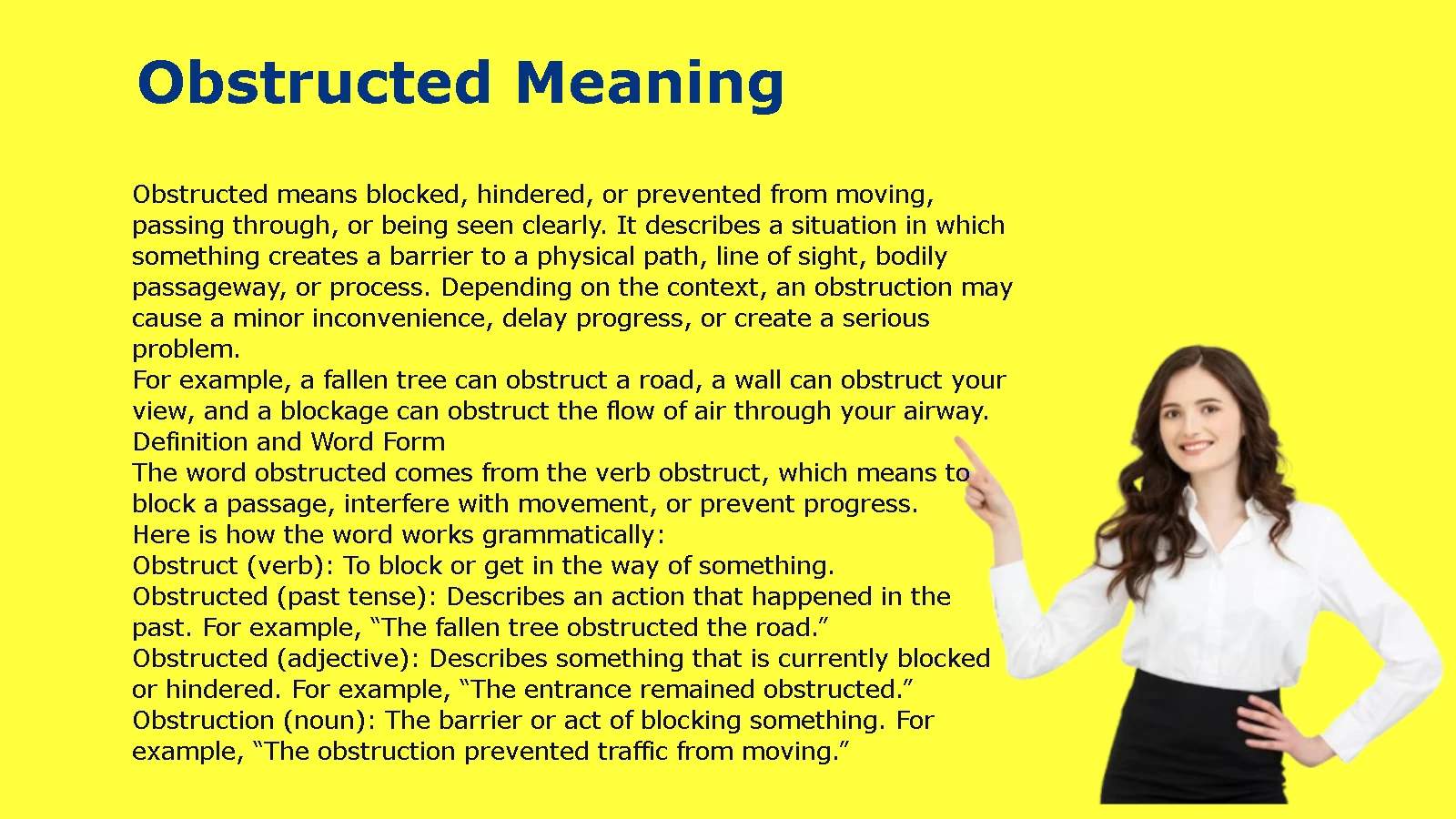
Obstructed means blocked, hindered, or prevented from moving, passing through, or being seen clearly. It describes a situation in which something creates a barrier to a physical path, line of sight, bodily passageway, or process. Depending on the context, an obstruction may cause a minor inconvenience, delay progress, or create a serious problem.
For example, a fallen tree can obstruct a road, a wall can obstruct your view, and a blockage can obstruct the flow of air through your airway.
Definition and Word Form
The word obstructed comes from the verb obstruct, which means to block a passage, interfere with movement, or prevent progress.
Here is how the word works grammatically:
- Obstruct (verb): To block or get in the way of something.
- Obstructed (past tense): Describes an action that happened in the past. For example, “The fallen tree obstructed the road.”
- Obstructed (adjective): Describes something that is currently blocked or hindered. For example, “The entrance remained obstructed.”
- Obstruction (noun): The barrier or act of blocking something. For example, “The obstruction prevented traffic from moving.”
The word traces back to the Latin obstruere, meaning to build against or block up. This origin reflects its central idea: placing something in the way of movement or progress.
In simple terms: If something is obstructed, an obstacle is getting in the way. The obstacle might completely stop movement or simply make it harder to see, breathe, travel, or accomplish a task.
The Three Most Common Contexts for “Obstructed”
The meaning of obstructed becomes clearer when you look at how people use it in different situations. The term commonly describes physical blockages in medicine, interference with legal proceedings, and barriers that affect everyday movement or visibility. Recognizing the context helps you understand whether the word refers to a practical inconvenience, a medical concern, or a potential legal offense.
1. Medical Context: Physical Blockages
In medicine, obstructed describes a passageway, vessel, or organ that a blockage has narrowed or closed. The obstruction may interfere with normal bodily functions, such as breathing, digestion, or blood circulation. Some obstructions resolve with treatment, while others require urgent medical attention.
Medical professionals often use the term to identify where a blockage occurs and how it affects the body. The exact meaning depends on the affected organ, the severity of the blockage, and the patient’s symptoms.
What Does Obstructed Airway Mean?
An obstructed airway occurs when something blocks or restricts the passage through which air travels into and out of the lungs. The blockage may result from food, a foreign object, swelling, an allergic reaction, or another medical condition.
Consider these examples:
- Choking: A piece of food becomes lodged in the airway, making it difficult or impossible to breathe.
- Airway swelling: Inflammation or a severe allergic reaction narrows the passage through which air moves.
- Foreign object obstruction: A small object accidentally enters the airway and interferes with normal breathing.
The severity can range from partial obstruction to a complete blockage. Someone with a partial obstruction may still cough or make sounds, while a person with a complete obstruction may be unable to speak, cough effectively, or breathe.
An obstructed airway can be a medical emergency. If someone cannot breathe, speak, or cough effectively, call emergency services and provide appropriate choking first aid if you know how. For an unresponsive person who is not breathing normally, begin CPR and follow the emergency dispatcher’s instructions.
Example sentence: “The emergency team acted quickly because the patient had an obstructed airway.”
What Does Obstructed Bowel Mean?
An obstructed bowel, also called a bowel obstruction, occurs when something blocks the normal movement of food, liquid, and digestive contents through the small or large intestine.
The obstruction can be partial or complete. Common causes include scar tissue from previous surgery, hernias, certain tumors, and twisting or telescoping of the intestine. The cause varies from patient to patient.
Symptoms may include:
- Cramping or abdominal pain
- Swelling or bloating in the abdomen
- Nausea and vomiting
- Difficulty passing stool or gas
- Loss of appetite
A complete obstruction can prevent intestinal contents from passing at all. It can also damage the bowel’s blood supply, so prompt medical assessment matters.
For example, a medical report might state, “The scan revealed an obstructed section of the small intestine.”
This means the intestine has a blockage that interferes with the normal passage of its contents. It does not, by itself, identify the cause or establish how severe the condition is.
Important distinction: An obstructed bowel is not the same as ordinary constipation. Constipation generally involves infrequent or difficult bowel movements, whereas a bowel obstruction involves a physical or functional blockage that can require urgent treatment. Severe abdominal pain, repeated vomiting, marked swelling, or an inability to pass gas or stool warrants urgent medical evaluation.
Other Medical Uses of “Obstructed”
Medical professionals use obstructed in several other contexts. The word identifies an interruption in a normal bodily pathway, but the consequences depend on the organ involved.
| Medical term | What it means | Why it matters |
| Obstructed artery | Blood flow through an artery is restricted or blocked. | May reduce oxygen delivery to tissues. |
| Obstructed urinary tract | Urine cannot flow normally through part of the urinary system. | May damage the kidneys or cause infection. |
| Obstructed bile duct | Bile cannot flow normally from the liver or gallbladder into the intestine. | May cause jaundice, pain, or other complications. |
| Obstructed nasal passage | Airflow through the nose is restricted. | May cause congestion or difficulty breathing through the nose. |
| Obstructed tear duct | Tears cannot drain normally through the usual drainage pathway. | May cause excessive tearing or discharge. |
These examples illustrate why context matters. An obstructed nasal passage caused by a common cold is very different from an obstructed artery that interrupts blood flow to the heart.
If you encounter the term in a medical report, look at the surrounding words to identify the affected structure. For a diagnosis or treatment decision, ask a qualified healthcare professional to explain what the finding means in your particular case.
2. Legal Context: Obstruction of Justice
In legal settings, obstructed can describe interference with an investigation, court proceeding, or another part of the administration of justice. The related phrase obstruction of justice generally refers to conduct that improperly interferes with the investigation, prosecution, or resolution of legal matters.
The exact definition depends on the applicable law. Not every delay, mistake, or disagreement constitutes a criminal offense.
Common examples of conduct that may amount to obstruction of justice include:
- Destroying evidence: Deliberately disposing of documents or digital records to interfere with an investigation.
- Witness tampering: Improperly pressuring or threatening a witness to influence their testimony.
- Lying to investigators: Making knowingly false statements when the relevant law prohibits that conduct.
- Interfering with legal proceedings: Intentionally disrupting a court process or attempting to prevent the lawful execution of official duties.
For example, a news report might say, “Prosecutors alleged that the defendant obstructed the investigation by destroying relevant records.”
This statement means prosecutors claim the defendant interfered with the investigation. It does not mean the allegation has been proven.
What Does “Obstructed the Investigation” Mean?
The phrase means that an action interfered with investigators’ ability to gather evidence, interview witnesses, follow leads, or determine what happened.
Imagine that investigators are examining a suspected financial fraud. Someone deliberately deletes important records after learning that authorities want to review them. If the conduct satisfies the elements of an applicable offense, it may constitute obstruction.
By contrast, a witness who cannot remember a date or an employee who accidentally misplaces a document has not necessarily committed obstruction. Intent, the surrounding circumstances, and the relevant law all matter.
This distinction is important when interpreting headlines. Words such as alleged, accused, charged, and convicted describe different stages or outcomes of a legal matter. They should not be treated as interchangeable.
Obstructed vs. Obstruction of Justice
The two expressions are related, but they serve different purposes.
- Obstructed: Describes something that was blocked or an action that interfered with progress.
- Obstruction of justice: Names a category of potentially unlawful conduct involving interference with the legal process.
Consider these examples:
- “The officers found an obstructed entrance.” This describes a physical barrier.
- “The defendant allegedly obstructed justice.” This describes alleged interference with the legal system.
- “The investigation was obstructed by missing records.” This describes an impediment to the investigation without necessarily establishing who caused it or whether a crime occurred.
The key takeaway is that obstructed has a broad meaning, while obstruction of justice carries a specific legal significance that depends on the jurisdiction and facts.
3. Everyday and Environmental Context: Physical Barriers
In everyday conversation, obstructed usually describes something that blocks movement, visibility, access, or progress. You might hear it when a road closes after a storm, a delivery truck blocks a driveway, or a building feature prevents someone from seeing a stage.
These situations share one basic idea: an obstacle stands between a person and what they want to reach, see, or do.
What Does “Obstructed View” Mean?
An obstructed view is a line of sight that an object or structure partially or completely blocks. The phrase frequently appears in concert ticket listings, sports stadium seating charts, theaters, and other entertainment venues.



7
For example, imagine buying a ticket for a concert. You expect to see the performer from your seat, but a large pillar stands directly between you and the stage. Your view is obstructed.
Common causes include:
- Support columns or pillars
- Railings and safety barriers
- Walls or architectural features
- Lighting rigs, speakers, or production equipment
- Other structures that block part of the stage or playing field
An obstructed view can be partial or severe. A railing might hide a small portion of the stage, while a large pillar could block the main performer almost entirely.
The label does not always mean that you cannot see anything. Venues use different descriptions, and the degree of obstruction varies by seat.
Before buying a ticket advertised as having an obstructed view:
- Check the venue’s seating map and any available seat-view photographs.
- Read the ticket listing carefully to see whether it identifies the specific obstruction.
- Compare the price with seats that offer a clearer view.
- Check the seller’s restrictions and refund policy rather than assuming you can exchange the ticket later.
For instance, a discounted seat with a slightly blocked corner of the stage may suit you if you mainly want to hear the music. A seat that hides the performer for most of the show may disappoint you if seeing the performance is your priority.
The phrase can also describe ordinary situations: “Overgrown branches obstructed the view from the driver’s window.”
In this sentence, the branches prevent the driver from seeing the road or surroundings clearly.
What Does “Obstructed Roadway” Mean?
An obstructed roadway is a road or street that a physical barrier prevents people or vehicles from using normally. The obstruction may affect one lane, several lanes, or the entire road.






Typical causes include:
- Fallen trees and broken branches
- Traffic collisions
- Construction materials or roadwork equipment
- Floodwater, landslides, or other storm debris
- Disabled or illegally parked vehicles
- Objects that fall from trucks or nearby structures
For example, a local traffic alert might say, “A fallen tree obstructed the eastbound lane, causing delays during the morning commute.”
The sentence tells you that an obstacle interfered with normal traffic flow. It does not necessarily mean the entire road was closed.
The distinction matters because a partially obstructed roadway may allow traffic to pass slowly through an open lane, while a completely blocked road may require a detour.
If you encounter an obstruction while driving, reduce your speed, maintain a safe distance, and follow official traffic instructions. Do not attempt to drive through floodwater or move hazardous debris yourself.
Other Everyday Examples of “Obstructed”
The word appears in many situations beyond roads and entertainment venues.
| Situation | Example sentence | Meaning |
| Building access | “Boxes obstructed the emergency exit.” | The boxes blocked access to the exit. |
| Home maintenance | “Mineral deposits obstructed the shower drain.” | The deposits restricted water flow. |
| Photography | “A branch obstructed the camera’s view.” | The branch blocked part of the scene. |
| Public transport | “A parked car obstructed the bus lane.” | The car prevented normal use of the lane. |
| Workplace | “Missing approvals obstructed the project.” | The missing approvals delayed progress. |
| Personal goals | “Fear of failure obstructed her progress.” | Fear made it harder for her to move forward. |
Notice that the last two examples use obstructed figuratively. No physical object needs to stand in the way. A missing approval, a restrictive rule, or a personal fear can create an obstacle just as effectively in a practical or emotional sense.
Obstructed vs. Hindered vs. Blocked: What’s the Difference?
Obstructed, hindered, and blocked all describe situations in which something interferes with movement or progress. However, each word emphasizes a slightly different idea. Obstructed often highlights an obstacle in a particular path or process, blocked suggests restricted passage or access, and hindered emphasizes difficulty or delay.
| Term | Typical meaning | Main emphasis | Example |
| Obstructed | Blocked or interfered with by an obstacle | An obstacle affecting a path, view, or process | An obstructed artery |
| Blocked | Prevented from passing through or accessing something | A barrier or stoppage | A blocked drain |
| Hindered | Made more difficult or slowed down | Reduced progress or effectiveness | Rain hindered construction |
| Impeded | Made slower or more difficult to proceed | Interference with movement or progress | Debris impeded traffic |
| Hampered | Restricted or weakened in effectiveness | Difficulty performing an activity | Staff shortages hampered the project |
When Should You Use Each Word?
Choosing the right term depends on what you want to emphasize.
Use “obstructed” when an identifiable barrier interferes with something.
For example, “A fallen tree obstructed the entrance.” The sentence focuses on an obstacle that prevents easy access.
Use “blocked” when you want to emphasize a stoppage or restriction.
For example, “The delivery truck blocked the driveway.” This wording directly communicates that the truck prevented normal access.
Use “hindered” when something makes progress more difficult without necessarily stopping it.
For example, “Heavy rain hindered the construction crew.” The workers may continue their work, but the conditions make it harder.
Use “impeded” when you want a slightly more formal word for interference.
For example, “The new restrictions impeded the flow of goods.” This term works well in business reports, academic writing, and formal explanations.
Use “hampered” when an obstacle reduces someone’s effectiveness.
For example, “A lack of reliable data hampered the research.” The missing information limits the team’s ability to work effectively.
Is “Obstructed” Always More Severe Than “Hindered”?
No. Although obstructed can describe a complete blockage, it does not always indicate greater severity than hindered. The context determines the actual impact.
An obstructed view might hide only a small part of a stage. Meanwhile, a problem that hinders emergency response could have serious consequences even if it does not completely stop the response.
Similarly, a blocked drain might cause a minor household inconvenience, while a medical obstruction could threaten someone’s health.
The practical rule: Use obstructed to emphasize an obstacle, blocked to emphasize restricted passage or access, and hindered to emphasize difficulty or delay. Don’t rely on the word alone to judge the severity of a situation.
Synonyms and Antonyms of Obstructed
The best synonym for obstructed depends on what has been blocked and how the obstruction affects it. Some alternatives describe physical barriers, while others emphasize interference, restricted access, or slowed progress.
Common Synonyms of Obstructed
| Synonym | Meaning or nuance | Example |
| Blocked | Prevented from passing through | The doorway was blocked by furniture. |
| Clogged | Filled with material that restricts flow | The kitchen drain was clogged. |
| Hampered | Made less effective or more difficult | Poor communication hampered the project. |
| Impeded | Slowed or made more difficult | Fallen branches impeded traffic. |
| Barricaded | Deliberately blocked with a barrier | Protesters barricaded the entrance. |
| Occluded | Closed, covered, or blocked, often in technical contexts | The scan showed an occluded blood vessel. |
| Restricted | Limited in movement, access, or use | Access to the building was restricted. |
| Interrupted | Stopped or disrupted temporarily | The power failure interrupted production. |
| Hindered | Prevented from progressing easily | A lack of funding hindered development. |
| Impaired | Reduced in quality, function, or effectiveness | Fog impaired the driver’s visibility. |
These synonyms aren’t interchangeable in every sentence.
For instance, clogged works naturally with a drain or pipe, but it usually sounds awkward when describing a legal investigation. Barricaded suggests a deliberate physical barrier, while impeded can describe either physical interference or an obstacle to progress.
Likewise, occluded appears frequently in medical and technical language. In everyday writing, blocked is often easier for readers to understand.
Common Antonyms of Obstructed
Antonyms express the opposite idea: something is accessible, open, clear, or free from interference.
| Antonym | Meaning | Example |
| Clear | Free from obstacles | The road is clear now. |
| Open | Accessible or not closed off | The entrance remained open. |
| Free | Unrestricted or unobstructed | The passage is free of debris. |
| Unblocked | No longer blocked | The drain is unblocked. |
| Accessible | Easy or possible to reach | The building entrance is accessible. |
| Unobstructed | Free from anything blocking the way or view | We enjoyed an unobstructed view of the stage. |
| Unhindered | Able to proceed without interference | The team continued unhindered. |
| Facilitated | Made easier or helped to happen | Better planning facilitated progress. |
One useful distinction is that clear and unobstructed often describe a physical path or view, while facilitated describes something that makes an activity easier.
For example, you might say, “The workers cleared the obstructed road.” You could also say, “The road is now unobstructed.”
The first sentence describes the action that removed the obstacle. The second describes the resulting condition.
How to Choose the Best Synonym
Use these quick guidelines when writing or speaking:
- For physical blockages: Choose blocked, clogged, or barricaded, depending on the object and situation.
- For medical terminology: Use obstructed, occluded, or blocked according to the specific clinical context.
- For delays and difficulties: Choose hindered, hampered, or impeded.
- For legal or official writing: Impeded or obstructed may communicate interference precisely, but use the terminology required by the relevant legal context.
- For the opposite meaning: Choose clear, open, unblocked, or unobstructed.
When in doubt, choose the word that describes the situation most precisely rather than the word that sounds most formal.
Frequently Asked Questions (FAQs)
What does “obstructed view” mean when buying tickets?
An obstructed view means that an object or structure partially or significantly blocks your line of sight to the stage, playing field, or main performance area. Common obstacles include pillars, railings, walls, and production equipment.
The label doesn’t automatically mean you won’t see the event. The obstruction might hide only a small section or block a substantial part of the view. Check seat photographs, venue seating maps, and ticket conditions before purchasing.
What is the psychological meaning of feeling obstructed?
Feeling obstructed means experiencing barriers that make it harder to achieve your goals, make decisions, or move forward in life. These barriers might include fear, self-doubt, limited resources, difficult circumstances, or other people’s actions.
For example, “She felt obstructed by her fear of failure” means her fear made it harder for her to pursue an opportunity.
In this context, obstructed is metaphorical. It describes an internal or external obstacle rather than a physical blockage.
Is an obstructed airway an emergency?
Yes, a completely obstructed airway is a life-threatening emergency because it prevents normal breathing and can deprive the brain of oxygen. A person who cannot speak, breathe, or cough effectively needs immediate emergency assistance.
Call your local emergency number and follow the dispatcher’s instructions. Provide age-appropriate choking first aid if you are trained or can follow recognized emergency guidance. If the person becomes unresponsive and is not breathing normally, begin CPR.
A partial airway obstruction can also become serious. Never assume that a breathing difficulty is harmless simply because the person can still make some sounds.
Does obstructed mean completely blocked?
Not necessarily. Obstructed can describe a complete blockage or a partial restriction. The context determines how much movement, visibility, access, or normal function remains.
For example, a pillar may obstruct only part of your view, while a completely blocked doorway prevents passage altogether.
What is the difference between obstruction and obstructed?
Obstruction is a noun that refers to a barrier or the act of blocking something. Obstructed is the past-tense form of the verb obstruct or an adjective describing something that has been blocked or hindered.
Examples:
- “The fallen tree caused an obstruction.”
- “The fallen tree obstructed the road.”
- “The road remained obstructed until workers removed the tree.”
Each sentence describes the same general situation from a different grammatical perspective.
What does obstructed mean in a medical report?
In a medical report, obstructed generally means that a bodily passage, vessel, or other structure has restricted or blocked flow or movement. The exact meaning depends on the organ or structure named in the report.
For example, an obstructed bile duct affects the normal flow of bile, while an obstructed artery affects blood flow. The term alone does not establish the cause, severity, or appropriate treatment. Ask your healthcare professional to interpret the finding in light of your symptoms and other test results.
Can obstructed be used in a sentence figuratively?
Yes. Obstructed can describe nonphysical barriers that interfere with progress, communication, or decision-making.
Examples include:
- “Bureaucratic delays obstructed the development project.”
- “A lack of funding obstructed the team’s plans.”
- “Conflicting instructions obstructed effective communication.”
- “Her anxiety obstructed her ability to speak confidently.”
In each example, the word describes interference rather than an object physically blocking a passage.
Conclusion: Understanding the Meaning of Obstructed
The word obstructed means blocked, hindered, or prevented from proceeding freely. It can describe a physical barrier, a medical blockage, interference with a legal process, or an obstacle that slows personal or professional progress.
Its precise meaning depends on the context. An obstructed view may affect your concert experience, an obstructed road may disrupt traffic, and an obstructed airway may require immediate emergency care.
When you encounter the word, identify what is being obstructed and consider how the barrier affects it. Choose blocked when you want to emphasize restricted passage, hindered when you mean that progress has become more difficult, and obstructed when an obstacle interferes with a path, view, or process.
Your next step: Use the examples and comparison tables in this guide to recognize the word in context, choose accurate synonyms, and express your meaning more clearly in everyday conversations and professional writing.