Have you ever seen someone hanging around a place without any clear reason and wondered what to call them? If you’re searching for loiterer meaning, what does loiterer mean, or loiterer definition, the word refers to a person who stays in a place for longer than necessary, often without any obvious purpose.
A loiterer is a person who loiters, meaning someone who remains in a particular place without a clear reason or purpose. The word can describe someone lingering outside a store, standing around on a street, or simply staying somewhere when they have no specific reason to be there.
Examples:
- The security guard asked the loiterer to move away from the entrance.
- A loiterer stood outside the building for nearly an hour.
The confusion is understandable. People often search for loiterer meaning in English, what is the meaning of loiterer, loiterer definition and examples, or how to use loiterer in a sentence because the word is closely connected to the verb loiter. However, a loiterer is specifically the person who loiters, while loiter describes the act of staying somewhere without an apparent purpose.
In this guide, you’ll learn the complete loiterer meaning, including its definition, pronunciation, origin, synonyms, antonyms, and usage. You’ll also see clear examples of loiterer in a sentence and learn how to use the word naturally in different situations.
Quick Answer: What Does “Loiterer” Mean?
A loiterer is a person who stays in a place or moves around slowly without an obvious purpose, especially when their presence appears unnecessary.
Loiterer is a noun derived from the verb loiter.
| Word | Meaning | Part of speech |
| Loiterer | A person who loiters | Noun |
| Loiter | To stay or move around without an obvious purpose | Verb |
| Loitering | The act of loitering | Noun |
| Loitered | Stayed or moved around aimlessly | Past-tense verb |
| Loitering | Staying or moving around aimlessly | Present participle |
The word can have a negative or suspicious tone, particularly when someone is lingering in a public place and there appears to be no clear reason for doing so. However, the word itself does not automatically mean that the person is committing a crime.
What Does “Loiterer” Mean?
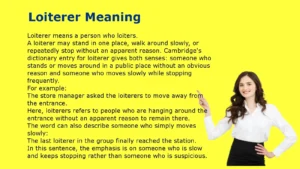
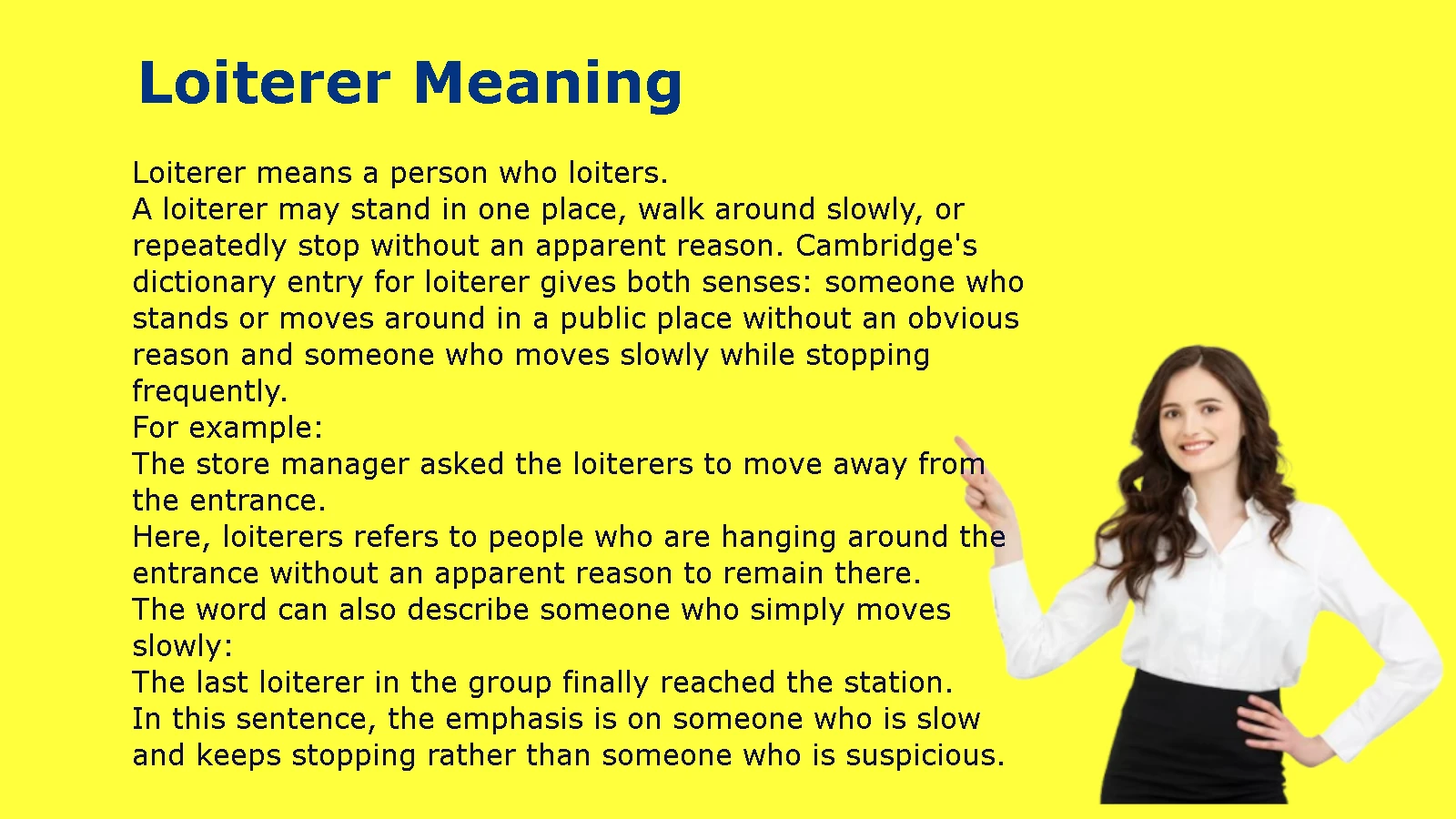
Loiterer means a person who loiters.
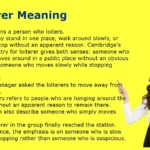
A loiterer may stand in one place, walk around slowly, or repeatedly stop without an apparent reason. Cambridge’s dictionary entry for loiterer gives both senses: someone who stands or moves around in a public place without an obvious reason and someone who moves slowly while stopping frequently.
For example:
The store manager asked the loiterers to move away from the entrance.
Here, loiterers refers to people who are hanging around the entrance without an apparent reason to remain there.
The word can also describe someone who simply moves slowly:
The last loiterer in the group finally reached the station.
In this sentence, the emphasis is on someone who is slow and keeps stopping rather than someone who is suspicious.
The Basic Idea Behind the Loiterer Meaning
The central idea is unnecessary lingering or slow movement.
Three elements often help explain the word:
- Place: The person is somewhere for a period of time.
- Purpose: Their reason for staying may not be obvious.
- Delay: They may remain longer or move more slowly than expected.
Not every example contains all three elements equally. A person can be described as a loiterer because they are moving slowly and making repeated unnecessary stops, even when they are not standing in a public place.
Collins similarly defines loiterer as someone who stands or acts aimlessly or idly.
Loiterer Definition and Part of Speech
Loiterer is a countable noun.
You use a loiterer when referring to one person and loiterers when referring to more than one.
Singular and Plural Forms
- Singular: a loiterer
- Plural: loiterers
Examples:
- A loiterer stood near the entrance.
- Several loiterers were asked to leave the property.
The word is formed from the verb loiter with the noun-forming ending -er. The same pattern appears in many English words:
| Verb | Person noun |
| teach | teacher |
| drive | driver |
| run | runner |
| sing | singer |
| loiter | loiterer |
So, in simple grammatical terms, a loiterer is a person who loiters.
Loiterer Meaning in Simple English
In very simple English, loiterer means someone who hangs around without an obvious reason.
Imagine a person who finishes shopping but remains outside the store for an hour, walking back and forth without buying anything else or meeting anyone. If there is no apparent purpose for the person’s continued presence, someone might call that person a loiterer.
Now consider a different situation.
Someone arrives early for an appointment and waits quietly in the lobby. That person has a clear reason to be there, so calling them a loiterer would usually be inappropriate.
This distinction is important because loiterer does not simply mean “someone who waits.”
Oxford specifically connects loiter with standing or waiting somewhere especially with no obvious reason, while Cambridge describes it as standing in a public place or moving around without an obvious reason.
Loiterer Examples in Sentences
Here are natural examples showing how the word works in different situations:
- The security guard noticed a loiterer near the building entrance.
- The shop owner asked the loiterers not to block the doorway.
- A group of loiterers gathered outside the closed café.
- The teacher told the loiterer to return to class.
- The final loiterer in the group arrived nearly an hour late.
- The police officer spoke to several people who appeared to be loiterers.
- He wandered through the market like a loiterer with nowhere to go.
- The manager became concerned about repeated loiterers near the back entrance.
- She was not a loiterer; she was waiting for her friend to finish work.
- The novel portrays him as a habitual loiterer who spends his afternoons on street corners.
Notice how the surrounding context changes the tone.
In sentence 9, the writer explicitly rejects the label because the person has a legitimate reason to wait. That is an important part of understanding the word.
Loiterer Meaning in Different Contexts
The meaning remains broadly consistent, but the connotation changes with the situation.
Loiterer in Public Places
Public spaces are one of the most common contexts for loiterer.
You might encounter the word when describing someone standing around:
- Outside a store
- Near a building entrance
- On a sidewalk
- In a parking area
- Around a station
- Near a school
- In a park
- Outside a closed business
For example:
The café owner noticed several loiterers outside after closing time.
The sentence does not necessarily prove that the people were doing anything illegal. It simply describes their continued presence as unnecessary or unexplained.
Cambridge uses public-place situations in its definitions and examples of loiter.
Loiterer in Security Contexts
Security writing often uses loiterer when describing someone whose prolonged presence attracts attention.
For example:
The guard approached the loiterer near the restricted entrance.
The important point is that loiterer describes behavior, not criminal guilt.
A person can look suspicious without committing an offense. The label tells readers how the person’s presence was perceived or described; it does not establish what that person intended to do.
Loiterer in Everyday Conversation
In casual conversation, people may use loiterer when talking about someone who hangs around unnecessarily.
For example:
Why are those loiterers still outside the restaurant?
However, many speakers would use the more conversational phrase “people hanging around” instead.
That difference gives loiterer a somewhat stronger descriptive tone.
Loiterer in Fiction
Writers can use loiterer to create a particular image of a person.
For example:
A lone loiterer watched the evening crowd from the corner.
Here, the word can contribute atmosphere. It suggests someone lingering without an obvious purpose and can make the scene feel uncertain or tense.
Dictionary.com provides examples of loiterer from published writing, including literary and newspaper sources, showing that the noun is used beyond everyday conversation.
Is “Loiterer” a Negative Word?
Loiterer can have a negative connotation, but it is not inherently an insult.
The negative feeling comes from the idea that someone is lingering without purpose or remaining somewhere where their presence may be unwanted.
Compare these sentences:
She waited outside the school for her daughter.
This is neutral because her reason for being there is clear.
She loitered outside the school.
This wording suggests that she remained there without an obvious reason.
The difference is subtle but meaningful.
A loiterer may be viewed as:
- Unnecessarily present
- Idle
- Slow to leave
- Suspicious
- In the way
- Hanging around without purpose
However, the context determines which implication is strongest.
Collins defines the noun in terms of someone acting aimlessly or idly, while Cambridge emphasizes the absence of an obvious reason.
Loiterer vs. Loiter
These words are closely connected, but they perform different grammatical jobs.
| Word | Meaning | Example |
| Loiter | To remain or move around aimlessly | They loitered outside the shop. |
| Loiterer | A person who loiters | The loiterer stood near the entrance. |
| Loitering | The act of loitering | Loitering near the entrance was discouraged. |
| Loitered | Past tense of loiter | They loitered after the event. |
Think of the relationship this way:
loiter → loiterer
The verb describes the action, while the noun describes the person performing the action.
How “Loiter” Works in a Sentence
You can use loiter without an object:
Don’t loiter outside the classroom.
You can also describe where the action occurs:
They loitered around the station.
Oxford lists loiter as an intransitive verb and gives the related forms loitered and loitering.
Loiterer vs. Lingerer
Loiterer and lingerer overlap, but they do not always carry the same tone.
A lingerer is someone who stays longer than expected. The word itself does not necessarily suggest that the person has no reason to stay.
A loiterer more strongly suggests aimless or unnecessary lingering.
| Word | Main idea | Typical tone |
| Loiterer | Someone who hangs around without an obvious purpose | Often negative |
| Lingerer | Someone who remains longer than expected | More neutral |
| Dawdler | Someone who takes too long or moves slowly | Usually mildly negative |
| Idler | Someone who is inactive or avoids work | Negative |
| Bystander | Someone present at an event or situation | Usually neutral |
For example:
The lingerer stayed behind to finish the conversation.
There is a clear reason.
Compare:
The loiterer remained outside long after everyone else had left.
The second sentence creates a stronger impression of unnecessary presence.
Loiterer vs. Dawdler
A dawdler and a loiterer can both be slow, but the focus differs.
Dawdle usually emphasizes wasting time or moving slowly.
Loiter emphasizes lingering, aimless movement, or unnecessary stopping.
Collins’ synonymy discussion makes this distinction especially clear: loiter emphasizes aimlessness or lingering, while dawdle focuses more on wasting time and making slow progress.
Compare:
The dawdler took twenty minutes to walk home.
The focus is on slow progress.
The loiterer stayed outside the store after finishing his business.
The focus is on remaining in a place without an obvious purpose.
Loiterer vs. Idler
An idler is someone who is inactive or avoids work.
A loiterer is specifically associated with lingering or moving around aimlessly.
Someone can be an idler without being a loiterer.
For example:
He was an idler who spent most of the afternoon doing nothing.
That sentence does not tell us where he was.
By contrast:
He was a loiterer who spent the afternoon outside the station.
Now the person’s location and lingering behavior are central.
Loiterer vs. Bystander
These words should not be treated as synonyms.
A bystander is someone who is present near an event or situation, often as an observer.
A loiterer is someone who remains or moves around without an obvious purpose.
For example:
Several bystanders watched the accident.
The people have a clear reason for being there: they are watching what happened.
Calling them loiterers would add a different implication that their presence was unnecessary or aimless.
Loiterer Synonyms
Depending on the context, possible synonyms or near-synonyms include:
- Lingerer
- Dawdler
- Laggard
- Idler
- Lounger
- Straggler
- Slowcoach
- Slowpoke
- Loafer
Collins lists dawdler, laggard, slowcoach, and straggler among synonyms of loiterer, while its broader thesaurus also includes words such as lingerer, lounger, and idler.
But these words are not interchangeable in every sentence.
The Closest Neutral Alternative
Lingerer is often the closest choice when you want to describe someone who remains without making the judgment sound as strong.
For example:
The lingerer stayed behind after the meeting.
This sounds less suspicious than:
The loiterer stayed behind after the meeting.
The Closest Word for Slow Movement
Dawdler is often better when the main problem is someone’s slow progress.
Stop being a dawdler and hurry up.
The sentence focuses on speed rather than someone’s unexplained presence.
What Is the Opposite of Loiterer?
There is no single perfect opposite of loiterer in every context.
Depending on what you want to contrast, possible alternatives include:
- Passerby
- Visitor
- Traveler
- Commuter
- Customer
- Guest
- Departing person
The correct choice depends on the reason the person is present.
For example, a customer has a specific purpose in a store. A passerby is moving through an area rather than lingering there. A visitor has a reason to be at a particular place.
Common Mistakes With “Loiterer”
Assuming Every Person Who Waits Is a Loiterer
This is the most important mistake to avoid.
Waiting does not automatically equal loitering.
Someone waiting for a bus, meeting a friend, attending an appointment, or waiting for a family member has a clear purpose.
Confusing Loiterer With Lingerer
The words overlap, but lingerer is usually more neutral.
Use loiterer when the idea of aimless or unnecessary presence matters.
Use lingerer when you simply want to say someone stayed longer than expected.
Confusing Loiterer With Dawdler
A dawdler is primarily slow.
A loiterer is primarily lingering or hanging around.
A person could technically be both, but the words highlight different behaviors.
Assuming Loiterer Means Criminal
This is another important distinction.
Loiterer is not automatically a synonym for criminal.
Cambridge has a separate legal entry for loitering, describing a specialized legal sense involving waiting in a place while appearing to be preparing to do something illegal.
That specialized sense should not be projected onto every ordinary use of loiterer.
Is “Loiterer” Grammatically Correct?
Yes. Loiterer is a standard English noun.
Correct examples include:
- He is a loiterer.
- The guard noticed a loiterer.
- Several loiterers stood outside.
- The store has problems with loiterers.
Incorrect or awkward constructions usually arise from confusing the noun with the verb.
For example:
He loiterer outside the shop. ❌
The correct form is:
He loitered outside the shop. ✅
Or:
He was a loiterer outside the shop. ✅
The distinction is simple:
loiter = action
loiterer = person
Is “Loiterer” Formal or Informal?
Loiterer is standard English and can appear in formal, journalistic, literary, and everyday contexts.
It is not inherently slang.
The word may sound somewhat more formal than conversational expressions such as:
- Hang around
- Hang about
- Stick around
- Linger around
For example, in casual speech, someone might say:
Why are those people hanging around outside?
A formal report might instead use:
Several loiterers were observed near the entrance.
The underlying idea is similar, but the register and tone differ.
Loiterer Meaning in English
For anyone searching specifically for “loiterer meaning in English,” the simplest definition is:
A loiterer is a person who stays somewhere or moves around without an obvious purpose, especially for longer than necessary.
The word comes from loiter, and dictionaries consistently connect the noun with aimless or idle behavior. Collins explicitly describes a loiterer as someone who stands or acts aimlessly or idly.
Loiterer Meaning in Slang
Loiterer is not primarily a slang word.
It is a standard noun found in major English dictionaries.
However, informal speakers may communicate the same basic idea with expressions such as:
- Someone hanging around
- Someone hanging out
- Someone hanging about
- A person just standing around
- Someone wasting time
The tone is different.
For example:
He’s just hanging around outside.
sounds relatively casual.
He’s a loiterer.
sounds more judgmental and may suggest that his presence is unwanted or suspicious.
Loiterer Pronunciation
The word loiterer is pronounced with the same opening sound as loiter, followed by the -er ending.
Cambridge gives the US pronunciation of loiterer as /ˈlɔɪ.t̬ɚ.ɚ/ and the UK pronunciation as /ˈlɔɪ.tə.rə/.
The main stress falls on the first syllable.
The related verb loiter is pronounced /ˈlɔɪ.tər/ in American English and /ˈlɔɪtə(r)/ in British English.
Where Does the Word “Loiterer” Come From?
Loiterer is derived from loiter.
The history of loiter is not completely certain. Oxford traces it to Middle English and says it may come from Middle Dutch loteren, meaning “to wag about.”
Collins similarly traces the word to Middle English and suggests a connection with Middle Dutch. Its American English entry gives a related Middle Dutch form associated with dawdling.
The modern meaning developed around ideas of slow movement, aimless lingering, and wasting time.
That history also helps explain why the modern word can describe both someone who hangs around and someone who moves slowly while making unnecessary stops.
Loiterer in a Sentence: Natural Usage Examples
Here are additional examples that show different shades of meaning.
Public place
The manager asked the loiterer to move away from the entrance.
The person is lingering where the manager does not want them to remain.
School
The teacher noticed a loiterer in the hallway after the bell.
The word suggests that the student should have gone somewhere else.
Store
The cashier became concerned when several loiterers remained outside after closing.
The continued presence creates concern because the business is closed.
Travel
The group waited impatiently for the last loiterer to catch up.
Here, loiterer emphasizes slow progress rather than suspicious behavior.
Fiction
A solitary loiterer watched the crowds from beneath the old streetlamp.
The word helps establish an image of someone lingering without a clear purpose.
Neutral correction
He wasn’t a loiterer; he was waiting for his sister.
This example demonstrates how context can change the appropriate label.
Usage Case Studies: How Context Changes the Meaning
Case Study: The Coffee Shop
Imagine a customer buys a coffee and spends thirty minutes reading at a table. Calling that person a loiterer may sound unfair if the café permits customers to sit and work.
Now imagine someone who has not purchased anything, blocks the doorway, and remains there long after being asked to move. In that context, loiterer becomes more natural.
The location alone does not determine the word. Behavior and purpose matter.
Case Study: The School Hallway
A student standing in a hallway while waiting for a teacher has a clear reason to be there.
A student who repeatedly wanders the halls instead of attending class may be described as a loiterer.
Again, the distinction comes from purpose and behavior.
Case Study: The Train Station
A traveler waiting for a delayed train is not normally a loiterer.
A person wandering around the station without an obvious destination may be described as one.
The same physical location can therefore contain both legitimate waiting and loitering.
Loiterer Meaning vs. Similar Words at a Glance
| Word | Core meaning | Main emphasis | Tone |
| Loiterer | Person who lingers aimlessly | Unnecessary presence | Often negative |
| Lingerer | Person who stays longer than expected | Duration | Usually neutral |
| Dawdler | Person who moves slowly | Slow progress | Negative/mild |
| Idler | Person who avoids activity or work | Inactivity | Negative |
| Laggard | Person who falls behind | Delay or slowness | Negative |
| Straggler | Person who falls behind a group | Separation from group | Usually neutral |
| Bystander | Person present near an event | Observation | Neutral |
| Loafer | Person who avoids work | Idleness | Negative |
Collins lists several of these terms as synonyms or related alternatives, but the distinctions between them depend on the specific context.
Loiterer vs. Laggard
A laggard is someone who falls behind or progresses more slowly than others.
A loiterer may also be slow, but the word emphasizes aimless lingering.
For example:
The laggard struggled to keep up with the group.
The problem is that the person is behind.
The loiterer stopped repeatedly along the way.
The emphasis is on unnecessary stopping or lingering.
Loiterer vs. Loafer
A loafer generally refers to someone who wastes time instead of working.
Oxford defines loafer as a person who wastes time rather than working.
A loiterer, by contrast, does not necessarily avoid work. The person may simply remain somewhere unnecessarily.
That makes loiterer more location-focused and loafer more activity-focused.
Is “Loiterer” Used in The Sims 4?
The term can appear in discussions of The Sims 4 retail gameplay. An EA forum discussion about the game’s retail system, for example, refers to different customer categories such as loiterer, socializer, and customer.
In that gaming context, loiterer retains the ordinary idea of a Sim hanging around rather than behaving like a straightforward customer.
The important distinction is that this is a gameplay use of an established English word, not a separate dictionary meaning of loiterer.
Facts to Remember About the Loiterer Meaning
Keep these points in mind:
- Loiterer is a noun.
- It means a person who loiters.
- Loiter is the related verb.
- A loiterer may stay somewhere without an obvious purpose.
- The word can also describe someone who moves slowly and makes frequent stops.
- Loiterer often has a negative or suspicious connotation.
- It does not automatically mean criminal.
- Lingerer is often more neutral.
- Dawdler focuses more on slowness.
- Idler focuses more on inactivity.
- Context determines whether loiterer sounds neutral, negative, literary, or suspicious.
- The plural form is loiterers.
- The word is standard English, not inherently slang.
Frequently Asked Questions About Loiterer Meaning
What does loiterer mean?
Loiterer means a person who stays in a place or moves around without an obvious purpose, often for longer than necessary.
What is a loiterer?
A loiterer is someone who loiters. The word commonly describes a person who hangs around a public place without an apparent reason.
What does loiterer mean in English?
In English, loiterer means a person who remains somewhere aimlessly or idly. It can also describe someone who moves slowly and stops frequently.
Is loiterer a real word?
Yes. Loiterer is a standard English noun recorded in major dictionaries, including Cambridge and Collins.
Is loiterer a slang word?
No. Loiterer is not inherently slang. It is a standard dictionary word. Informal alternatives include phrases such as someone hanging around or someone hanging about.
What is a synonym for loiterer?
Possible synonyms include lingerer, dawdler, laggard, straggler, lounger, and idler, depending on the context. They are not perfect substitutes in every sentence.
What is the difference between loiterer and lingerer?
A loiterer typically lingers without an obvious purpose and can sound negative. A lingerer simply stays longer than expected and is usually more neutral.
What is the difference between loiter and loiterer?
Loiter is a verb describing an action. Loiterer is a noun describing the person performing that action.
They loitered outside.
They were loiterers outside.
Is loiterer a negative word?
It can be negative, especially when it suggests that someone’s presence is unnecessary, unwanted, or suspicious. The exact tone depends on the context.
Does loiterer mean criminal?
No. Calling someone a loiterer does not by itself establish that the person committed a crime. The ordinary word describes behavior, while specific legal meanings of loitering depend on the relevant law and jurisdiction. Cambridge separately identifies a specialized legal sense of loitering.
What is the opposite of loiterer?
There is no single exact antonym. Depending on the context, passerby, visitor, customer, traveler, or commuter may provide a useful contrast.
Can loiterer describe someone who is simply slow?
Yes. Dictionaries recognize a sense connected with moving slowly and stopping frequently. Cambridge includes this sense, and Collins also connects loiter with slow, idle movement.
Conclusion: Loiterer Meaning Explained Clearly
The loiterer meaning is straightforward once you connect it to the verb loiter.
A loiterer is a person who stays somewhere or moves around without an obvious purpose, particularly when that lingering seems unnecessary. The word can also describe someone who moves slowly and repeatedly stops.
The most important point is that loiterer does not simply mean “someone who waits.” Purpose and context matter. A person waiting for a bus, meeting a friend, or attending an appointment has a clear reason for being there. Someone lingering without an apparent reason is more naturally described as a loiterer.
The word also carries more negative force than lingerer. Meanwhile, dawdler emphasizes slowness, idler emphasizes inactivity, and bystander simply describes someone present near an event.
So, when you see loiterer in a sentence, look for the underlying idea of aimless lingering, unnecessary presence, or slow movement. That context will usually tell you exactly which shade of meaning the writer intends.