Have you ever come across the word gestation and wondered exactly what it means? The term often appears in pregnancy, medicine, and biology, but its meaning can vary slightly depending on the context in which it is used.
Gestation means the period during which a baby or other offspring develops inside the uterus or womb before birth. In humans, gestation usually lasts about 40 weeks, counted from the first day of the last menstrual period. The word can also describe the development period of animals before they give birth or hatch.
Examples:
- The average human gestation period is about 40 weeks.
- The elephant has a much longer gestation period than a human.
The meaning can sometimes be confusing because people search for gestation meaning, gestation period meaning, what does gestation mean, or gestation meaning in pregnancy when they want to understand how the word is used in everyday and medical contexts. And here’s the kicker: gestation doesn’t only apply to humans. Scientists and veterinarians also use the term when discussing the development of offspring in different animals.
In this guide, you’ll learn the complete meaning of gestation, including its definition, pronunciation, origin, gestation period, and usage. You’ll also see clear examples that explain how to use the word correctly in pregnancy, medical, biological, and everyday contexts.
Gestation Meaning
The word gestation refers to the development of offspring inside the body of a pregnant female. In mammals, that development normally takes place inside the uterus. The term can describe both the biological process and the length of time it takes.
The simplest way to understand it is to think of gestation as a developmental countdown to birth.
During this period, the developing organism grows and changes substantially. In human pregnancy, for example, a fertilized egg develops through several stages before birth. Medical sources describe the progression from a fertilized egg to a blastocyst, then an embryo, and later a fetus.
The word appears frequently in scientific, veterinary, agricultural, and medical writing because it gives professionals a precise way to discuss pregnancy and reproduction.
What does gestation mean in simple English?
In everyday English, gestation means carrying a baby or developing offspring before birth.
Consider these examples:
- “The elephant has a very long gestation period.”
- “The veterinarian estimated that the dog’s gestation was nearly complete.”
- “The pregnancy had reached 30 weeks of gestation.”
- “Scientists studied fetal development during gestation.”
Although people often associate the word with humans, gestation applies broadly to animals. It becomes particularly useful when comparing reproductive patterns across different species.
The word can also have a figurative meaning. Someone might say that an idea is in gestation when a plan or project has been developing for a long time before reaching its final form. Cambridge Dictionary notes this broader formal use for ideas, plans, and pieces of work.
For example:
“The novel was several years in gestation.”
Here, nobody is talking about pregnancy. The sentence compares the slow development of a book with the development of offspring before birth.
What Does Gestation Mean?
Gestation means the period or process of development before birth. When the word appears in a medical or biological context, it usually relates to pregnancy.
You might encounter expressions such as:
- gestation period
- gestational age
- weeks of gestation
- length of gestation
- late gestation
- early gestation
- gestational development
These phrases all connect to the same central idea: development during pregnancy.
One important detail can cause confusion. In human medicine, gestational age isn’t exactly the same as the biological age of the embryo or fetus. Doctors traditionally calculate gestational age from the first day of the last normal menstrual period. Since conception usually occurs about two weeks later, gestational age generally runs about two weeks ahead of embryologic age.
That difference explains why someone can be described as being 8 weeks pregnant even though conception happened roughly six weeks earlier.
Gestation Meaning in Pregnancy
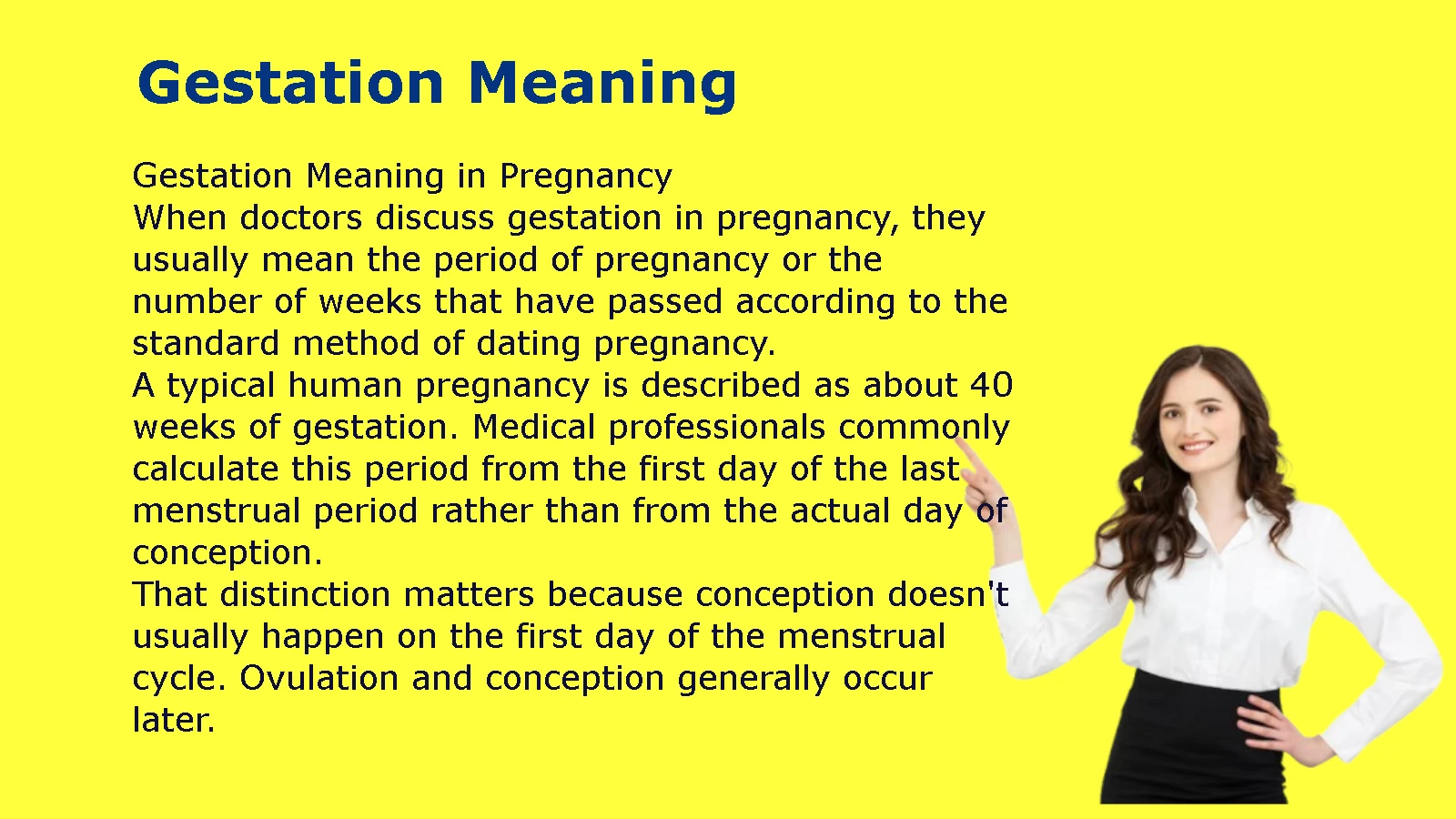
When doctors discuss gestation in pregnancy, they usually mean the period of pregnancy or the number of weeks that have passed according to the standard method of dating pregnancy.
A typical human pregnancy is described as about 40 weeks of gestation. Medical professionals commonly calculate this period from the first day of the last menstrual period rather than from the actual day of conception.
That distinction matters because conception doesn’t usually happen on the first day of the menstrual cycle. Ovulation and conception generally occur later.
Gestation and weeks of pregnancy
You may see a pregnancy described like this:
- 8 weeks of gestation
- 20 weeks of gestation
- 32 weeks of gestation
- 39 weeks of gestation
These descriptions tell you how far the pregnancy has progressed according to the medical dating system.
Medical professionals also use gestational age to describe the maturity of a newborn. For example, birth before 37 weeks of gestation is classified as preterm. A birth from 37 weeks through 38 weeks and 6 days is considered early term, while 39 through 40 weeks and 6 days is full term under the commonly used clinical classification.
Why gestational age matters
Gestational age isn’t just a number on a calendar. It helps clinicians understand fetal development and assess whether a newborn arrived preterm, at term, or postterm.
It can also help doctors interpret:
- fetal growth
- developmental milestones
- expected delivery timing
- newborn size
- prematurity
- prenatal test results
Early ultrasound measurements can also help estimate gestational age. When the menstrual history doesn’t provide a reliable date, an early ultrasound can provide important additional information.
Gestation Meaning in Biology
In biology, gestation refers to the period during which developing offspring grow inside the reproductive tract of a parent before birth.
The concept is especially associated with viviparous animals, which give birth to live young rather than laying eggs that develop entirely outside the parent.
Human gestation provides a familiar example. After fertilization, the developing organism goes through major stages of growth and differentiation. The early stages include implantation and embryonic development. Later, the developing organism is described as a fetus until birth.
Gestation therefore isn’t simply “waiting for a baby to be born.” It involves an active period of biological development.
What happens during gestation?
The exact process differs among species, but gestation can involve:
- implantation or establishment of the developing offspring within the reproductive system
- formation and growth of embryonic tissues
- development of organs and body structures
- exchange of nutrients and gases
- continued growth and maturation
- preparation for birth
In mammals, the placenta plays a major role in supporting the developing fetus. It allows the maternal and fetal systems to exchange substances while keeping their blood supplies largely separate.
The length of gestation varies dramatically across species because different animals have different reproductive strategies, body sizes, developmental patterns, and ecological pressures.
That variation makes gestation an important subject in comparative biology.
Gestation Meaning in Animals
For animals, gestation usually means the period between conception and birth during which offspring develop inside the mother.
Veterinarians and animal breeders often need to know an animal’s expected gestation period because it helps them estimate when birth may occur.
However, the calendar isn’t identical for every species.
A dog may carry puppies for around two months. A horse carries a foal for roughly 11 months. An elephant may carry a calf for nearly two years. The contrast is enormous.
Why do animals have different gestation periods?
There isn’t one universal gestation length because species differ in how their offspring develop before birth.
Several factors can influence the pattern, including:
- species-specific development
- body size
- fetal growth rate
- reproductive strategy
- number of offspring
- placental characteristics
- developmental maturity at birth
For instance, animals that give birth to relatively mature offspring may have longer developmental periods. Other species produce young that require considerable growth and care after birth.
Some species also have unusual reproductive adaptations. Certain mammals can delay implantation, which changes the relationship between mating, conception, and actual fetal development.
The result is a remarkable range of gestation periods across the animal kingdom.
What Is a Gestation Period?
A gestation period is the length of time an animal carries developing offspring before giving birth.
The exact starting point can vary depending on how researchers or veterinarians measure it. In animal reproduction, the date of breeding isn’t always the same as the date of ovulation or conception. That distinction can make an expected birth date less precise.
For example, the MSD Veterinary Manual lists a dog’s approximate gestation as 62 to 64 days from ovulation, while breeding dates can produce a wider apparent range because the exact stage of the reproductive cycle may be unknown.
Gestation period vs. due date
A gestation period gives you an expected time frame, not necessarily an exact birthday.
Many factors can affect the timing of birth. That’s why veterinarians and breeders consider the animal’s reproductive history and the date used to calculate the gestation period.
The same basic principle applies to humans. A due date is an estimate rather than a guarantee that labor will begin on that exact day.
Gestation Period Examples
The animal kingdom offers some striking examples of how much gestation can vary.
| Animal | Approximate gestation period |
| Human | About 40 weeks from the last menstrual period |
| Dog | About 62–64 days from ovulation |
| Cat | About 65 days |
| Horse | About 11 months |
| Elephant | About 660 days |
| Pig | About 114 days |
| Rabbit | About 31 days |
| Goat | About 150 days |
| Sheep | About 150 days |
| Giraffe | About 425 days |
The MSD Veterinary Manual provides approximate gestation periods for domestic and wild animals, including dogs, cats, horses, elephants, pigs, rabbits, goats, sheep, giraffes, and many others.
A closer look at the numbers
Dogs generally have a short gestation compared with humans. When ovulation can be identified, the period is usually around 62 to 64 days.
Cats typically have a gestation period of around 65 days.
Horses need much longer. Their gestation commonly lasts about 11 months, giving a developing foal substantial time to mature before birth.
Elephants take the comparison to another level. Their gestation lasts roughly 660 days, or about 22 months.
These differences show why saying that “gestation lasts about nine months” only works for humans. There is no universal gestation period for all animals.
Gestation Meaning in Agriculture
In agriculture, gestation refers mainly to the pregnancy period of livestock and other animals raised for farming.
Farmers and livestock professionals track gestation because reproduction affects herd planning, animal care, feeding, breeding schedules, and expected birth dates.
For example, knowing the typical gestation period of cattle, goats, sheep, pigs, and horses helps producers estimate when animals may give birth.
Common livestock examples include:
| Livestock | Approximate gestation |
| Cattle | About 9 months |
| Goat | About 150 days |
| Sheep | About 150 days |
| Pig | About 114 days |
| Horse | About 11 months |
| Donkey | About 365 days |
These are approximate values. Individual animals can vary, and the calculation method matters.
Why gestation matters to farmers
A livestock producer may record the breeding date and use the expected gestation period to estimate when an animal will give birth.
That information can help with:
- preparing a suitable birthing area
- monitoring the pregnant animal
- planning veterinary care
- adjusting nutrition
- preparing for newborn care
- organizing labor and farm schedules
- tracking reproductive performance
In other words, gestation is not merely a biological term on a chart. It has practical value in animal management.
Gestation Meaning in Medical Terms
Medical professionals use gestation in several precise ways.
One of the most common is gestational age, which describes how far a pregnancy has progressed. Another is gestation period, which refers to the duration of pregnancy.
Doctors may also describe fetal growth in relation to gestational age.
For example, a newborn can be classified as small for gestational age when their weight falls below the 10th percentile for babies of the same gestational age. A newborn above the 90th percentile can be classified as large for gestational age.
What is gestational age?
Gestational age is the number of weeks of pregnancy counted from the first day of the last normal menstrual period under the standard obstetric dating system.
This method does not represent the exact number of weeks since fertilization. In fact, the embryologic age is typically about two weeks less than the gestational age.
For example, someone described as being 10 weeks pregnant has a gestational age of approximately 10 weeks. The developing embryo or fetus has generally existed for less time than that because the medical clock starts before conception.
Gestational age and ultrasound
Ultrasound can provide valuable information when estimating gestational age. Early pregnancy ultrasound is particularly useful when the menstrual dates are uncertain or don’t match the expected timing.
This distinction matters because accurate dating can influence how clinicians interpret fetal growth and pregnancy milestones.
Gestation vs. Pregnancy
Gestation and pregnancy overlap heavily, but they aren’t always interchangeable in every sentence.
Pregnancy generally describes the condition or state of carrying a developing offspring. Gestation places more emphasis on the developmental period or process.
| Gestation | Pregnancy |
| Emphasizes the period or process of development before birth | Describes the state or condition of being pregnant |
| Common in medical, biological, and veterinary language | Very common in everyday language |
| Appears in terms such as “gestational age” | Appears in phrases such as “pregnancy test” |
| Often describes duration and developmental timing | Can refer to the entire state from conception to birth |
| Common when comparing animal species | Most familiar in everyday human contexts |
For humans, pregnancy is usually the more natural everyday word.
For example, people normally say:
“She is 20 weeks pregnant.”
A medical professional might write:
“She is at 20 weeks of gestation.”
Both expressions refer to the same general stage of pregnancy. The second sounds more technical.
Interestingly, French makes a similar distinction. The Académie française explains that gestation can describe the state of pregnancy and the time between conception and birth, while grossesse is more commonly used for human pregnancy.
Gestation vs. Incubation
Gestation and incubation describe different reproductive strategies.
Gestation generally involves offspring developing inside the parent’s body before birth. Incubation usually describes the period during which eggs are kept under conditions that allow the embryos inside them to develop until hatching.
A bird sitting on eggs provides a familiar example of incubation.
A pregnant dog carrying puppies provides an example of gestation.
The distinction becomes especially useful when talking about animal reproduction because not every species develops offspring in the same way.
Simple comparison
| Gestation | Incubation |
| Developing offspring remain inside the parent | Developing embryos remain inside eggs |
| Common in mammals | Common in birds and many reptiles |
| Ends with birth or live delivery | Ends with hatching |
| Often involves a uterus | Usually involves an egg outside the parent’s body |
| Example: dog carrying puppies | Example: bird keeping eggs warm |
The boundary can become more complicated in zoology because reproductive systems don’t always fit neatly into everyday categories. Still, gestation and incubation should not be treated as simple synonyms.
French reference works make a similar biological distinction by associating gestation with viviparous animals and incubation with species whose eggs develop under different reproductive conditions.
Gestation Meaning in Different Contexts
The meaning stays centered on development before birth, but the emphasis changes depending on where you encounter the word.
| Context | Gestation meaning |
| Pregnancy | The period during which an embryo or fetus develops before birth |
| Biology | A reproductive developmental period involving offspring inside the parent |
| Animals | The period during which a pregnant animal carries developing young |
| Agriculture | The pregnancy period of livestock and other farm animals |
| Medical | The pregnancy period measured through concepts such as gestational age |
| Figurative use | A long period during which an idea, project, or creation develops |
The figurative meaning is worth remembering because it occasionally appears in formal writing.
For example:
“The project was in gestation for several years.”
Here, gestation means gradual development rather than biological pregnancy. English dictionaries recognize this broader sense for ideas, plans, and creative works.
Gestation Meaning in French
The French word for gestation is gestation.
The spelling is identical to English, although the pronunciation differs. In French, gestation can refer to pregnancy or the period during which offspring develop before birth.
For human pregnancy, grossesse is often the more common everyday term. Larousse lists grossesse as a synonym of gestation in this context.
French examples
- la gestation = gestation
- la période de gestation = gestation period
- la grossesse = pregnancy
- l’âge gestationnel = gestational age
The French term also has a figurative meaning similar to English. A project or creative work can be described as being en gestation, meaning it is still developing.
Gestation Meaning in Farsi
In Farsi, gestation can be translated as دوره بارداری (dowre-ye bardari) when the focus is on the pregnancy period.
Another important term is آبستنی (âbestani), which refers to pregnancy or gestation. Persian-English reference sources list دوره بارداری, دوره آبستنی, and related forms as translations for “gestation period.”
The word بارداری is also widely used for pregnancy. Persian dictionary sources define it in connection with pregnancy and carrying a developing offspring.
Useful Farsi equivalents
| English | Farsi |
| Gestation | آبستنی |
| Pregnancy | بارداری |
| Gestation period | دوره بارداری / دوره آبستنی |
| Gestational age | سن بارداری / سن حاملگی |
The best translation depends on the sentence and the level of medical or everyday language being used.
Gestation Meaning in a Sentence
Seeing the word in context makes its meaning much easier to recognize.
Pregnancy examples
- The doctor calculated the patient’s gestational age using her last menstrual period and ultrasound results.
- The pregnancy had reached 30 weeks of gestation.
- Fetal development changes considerably throughout gestation.
Animal examples
- A dog’s gestation period is usually around two months.
- The elephant has an exceptionally long gestation period.
- The veterinarian estimated that the mare was late in her gestation.
Agriculture examples
- The farmer recorded the cow’s breeding date to estimate the expected calving period.
- Farmers monitor livestock during late gestation because nutritional and veterinary needs can change.
Biology examples
- Scientists compared gestation periods across several mammalian species.
- The study examined fetal development during gestation.
Figurative example
- The idea remained in gestation for years before the company finally launched the product.
In that last sentence, the word doesn’t describe pregnancy. It describes an idea slowly taking shape.
Synonyms and Related Words for Gestation
Some words overlap with gestation, but they don’t all mean exactly the same thing.
Pregnancy
Pregnancy is the closest everyday term when discussing humans. It describes the state of carrying a developing embryo or fetus.
Carrying
Carrying is a less technical expression. Someone might say that a pregnant person is carrying a baby.
Development
Development focuses on growth and change rather than the pregnancy period itself. An embryo develops during gestation, but development isn’t a direct synonym for gestation.
Gestational period
Gestational period is closely related to gestation and often refers specifically to the duration of pregnancy.
Incubation
Incubation can overlap conceptually because both terms involve development before a new organism emerges. However, incubation commonly refers to development inside an egg rather than development inside a uterus.
So, although dictionaries and thesauruses may group some of these words together, context matters.
A Simple Way to Remember Gestation
If the word gestation feels technical, use this simple mental picture:
Gestation = development + carrying + before birth.
Think of a pregnant animal carrying its developing offspring until birth. That captures the central meaning.
Then remember the three most common contexts:
- Pregnancy: weeks of gestation
- Animals: gestation period
- Medicine: gestational age
Once those phrases become familiar, the word becomes much easier to understand.
Why Gestation Periods Vary So Much
One of the most interesting facts about gestation is the enormous range between species.
A rabbit’s gestation lasts roughly 31 days, while an elephant’s lasts around 660 days. A dog is around two months, a horse around 11 months, and a giraffe around 425 days.
That variation reflects different biological strategies.
A newborn animal’s condition at birth also matters. Some species produce young that are relatively developed and can move or function soon after birth. Other species give birth to young that require extensive parental care.
Gestation is not simply about body size
It might seem logical that larger animals always have longer gestation periods. Body size can matter, but it doesn’t explain everything.
Evolution has shaped reproduction differently across species. Developmental rate, offspring maturity, reproductive strategy, and physiology all contribute to the timing.
That’s why comparing gestation periods gives biologists useful clues about how different animals reproduce and develop.
A Useful Case Study: Human vs. Elephant Gestation
Humans and elephants provide a striking comparison.
A human pregnancy is typically discussed as about 40 weeks of gestation under the standard medical dating system. An elephant’s gestation lasts roughly 660 days, or about 22 months.
Why does the difference matter?
Elephants give birth to extremely large offspring that need substantial development before they can function in their environment. Their long gestation supports that extended prenatal development.
Human development follows a different biological timetable. After birth, human infants remain highly dependent on caregivers for a long period.
This comparison shows why gestation should always be understood within the biology of the species involved.
Common Questions About Gestation
What does gestation mean?
Gestation means the period or process during which an embryo or fetus develops inside the parent before birth. In humans, the word usually relates to pregnancy. In animal biology and veterinary medicine, it commonly describes the period a female carries developing offspring.
What does gestation mean in pregnancy?
In pregnancy, gestation refers to the pregnancy period and its progression toward birth. Medical professionals commonly express it in weeks, such as 12 weeks of gestation or 30 weeks of gestation.
What does gestation mean in biology?
In biology, gestation describes the developmental period during which offspring grow inside a parent before birth. The exact process and duration vary among species.
What is a gestation period?
A gestation period is the length of time an animal or human carries developing offspring before birth. Different species have dramatically different gestation periods.
What does gestation mean in animals?
For animals, gestation generally means the period during which developing young remain inside the mother before birth. Veterinarians use gestation periods to estimate reproductive timing and expected birth.
What does gestation mean in agriculture?
In agriculture, gestation usually refers to the pregnancy period of livestock. Farmers and livestock professionals use expected gestation lengths when managing breeding, nutrition, veterinary care, and birth preparation.
What does gestation mean medically?
Medically, gestation refers to pregnancy and its duration. A related term, gestational age, describes how far a pregnancy has progressed according to the standard obstetric dating system.
What is the difference between gestation and pregnancy?
Pregnancy describes the state of being pregnant, while gestation often emphasizes the period or process of carrying and developing offspring before birth.
In everyday human conversation, pregnancy sounds more natural. In medical, biological, and veterinary contexts, gestation appears frequently.
What is the difference between gestation and incubation?
Gestation usually involves offspring developing inside the parent, while incubation generally involves embryos developing inside eggs until they hatch. The terms describe different reproductive processes and shouldn’t be treated as exact synonyms.
Final Takeaway
Gestation means the process or period during which developing offspring grow inside a parent before birth.
The word has several closely related uses. In human medicine, it appears in phrases such as weeks of gestation and gestational age. In veterinary medicine and animal biology, gestation period describes how long a species typically carries its young. In agriculture, the term helps farmers manage livestock reproduction and prepare for birth.
The numbers can vary dramatically. Humans have a typical gestational age of about 40 weeks when counted from the last menstrual period. Dogs average roughly two months from ovulation. Horses carry foals for about 11 months. Elephants remain pregnant for roughly 660 days.
One final distinction makes the word much easier to remember: gestation is not simply another word for pregnancy in every context, and it isn’t the same as incubation. It specifically highlights the period and process of development before birth.
Once you connect gestation with development, pregnancy, and the period before birth, its meaning becomes straightforward in medical, biological, veterinary, and everyday contexts.