Have you ever wondered whether burned or burnt is the correct form to use? While Burned vs Burnt may seem like a simple spelling difference, the choice can depend on English variety, sentence context, and the way the word is being used.
Burned and burnt are both accepted forms of the past tense and past participle of burn. Burned is more common in American English, while burnt is especially common in British English. However, both forms can appear in different varieties of English, particularly when describing something that has been damaged by fire or heat.
Examples:
- She burned the toast this morning.
- She burnt the toast this morning.
The confusion is understandable. People often search for burned vs burnt, burned or burnt, which spelling is correct, or burnt meaning in English because both forms are grammatically valid, yet their usage can vary by region and context. And here’s the kicker: the choice between them does not usually change the basic meaning of the sentence.
In this guide, you’ll learn the complete difference between Burned vs Burnt, including their meaning, pronunciation, origin, correct usage, and grammar. You’ll also discover when to use burned or burnt in American English vs British English, along with clear examples to help you choose the right form.
Burned vs Burnt: Quick Answer
Burned and burnt are both correct forms of burn. They can both serve as the past tense and past participle.
| Word | Function | Typical usage |
| burn | Base form / present tense | Don’t burn the paper. |
| burned | Past tense / past participle | She burned the paper. |
| burnt | Past tense / past participle | She burnt the paper. |
The important point is that burned and burnt generally have the same meaning when they function as forms of the verb burn. The difference is mainly one of English variety and style.
Cambridge gives burned and burnt as the past-tense and past-participle forms of burn. Oxford likewise lists both forms.
For American English, however, burned is the more natural default.
Is Burned Correct?
Yes. Burned is completely correct.
It is the standard past-tense and past-participle form preferred in American English.
For example:
- I burned the toast this morning.
- She burned her hand on the pan.
- The fire burned the old shed.
- He had burned the documents.
- The candle burned all night.
In American English, burned works naturally across everyday, academic, professional, and formal writing.
Cambridge’s American Dictionary lists burned as a past-tense and past-participle form of burn, while also recognizing burnt.
Is Burnt Correct?
Yes. Burnt is also correct.
It isn’t a misspelling of burned. It is an established form of the verb burn and is especially common in British English.
For example:
- I burnt the toast.
- She burnt her hand on the oven.
- The fire burnt through the roof.
- He had burnt the old letters.
- The wood had burnt to ash.
Cambridge’s British English material lists burnt and burned as forms used in UK English. Its learner dictionary describes burnt as a past form of burn.
Burned vs Burnt in American and British English
The clearest way to understand burned vs burnt is to look at regional English.
American and British English share most of their vocabulary and grammar. However, they sometimes prefer different forms of irregular or variable verbs. Burned and burnt are a good example.
Burned in American English
If you’re writing American English, use burned as your default.
For example:
- I burned the cookies.
- The candle burned for three hours.
- The fire burned the barn.
- She burned her finger.
- The papers were burned.
This doesn’t mean Americans never encounter burnt. They certainly do. You may see it in British publications, established expressions, restaurant names, product descriptions, or writing influenced by British English.
Still, if you’re creating ordinary US English prose, burned is the cleaner choice.
Cambridge’s American Dictionary gives burned as the standard past form while also recording burnt.
Burnt in British English
In British English, burnt is common and natural.
For example:
- I burnt the toast.
- She burnt her hand.
- The fire burnt the wooden fence.
- He had burnt the old photographs.
- The candle had burnt down.
British English doesn’t make burned incorrect, though. Both forms appear in British usage.
Cambridge’s Essential British English dictionary explicitly gives the UK forms as burnt | burned.
That distinction matters because it’s easy to oversimplify the rule as “burnt is British and burned is American.” A better explanation is:
Burned is preferred in American English, while British English commonly uses both burned and burnt.
That’s the practical rule worth remembering.
Burned vs Burnt as Past Tense
Both burned and burnt can function as the simple past tense of burn.
The simple past describes an action that happened in the past.
Compare these sentences:
- American English: I burned the letter.
- British English: I burnt the letter.
The basic meaning is the same. In both sentences, the speaker says that the letter was subjected to fire in the past.
Here’s another comparison:
| American-style usage | British-style usage |
| She burned the toast. | She burnt the toast. |
| He burned the old papers. | He burnt the old papers. |
| The fire burned the fence. | The fire burnt the fence. |
| I burned my finger. | I burnt my finger. |
There is no major difference in the action itself. The choice largely reflects the variety of English being used.
Oxford lists both burnt and burned as past-tense forms of burn.
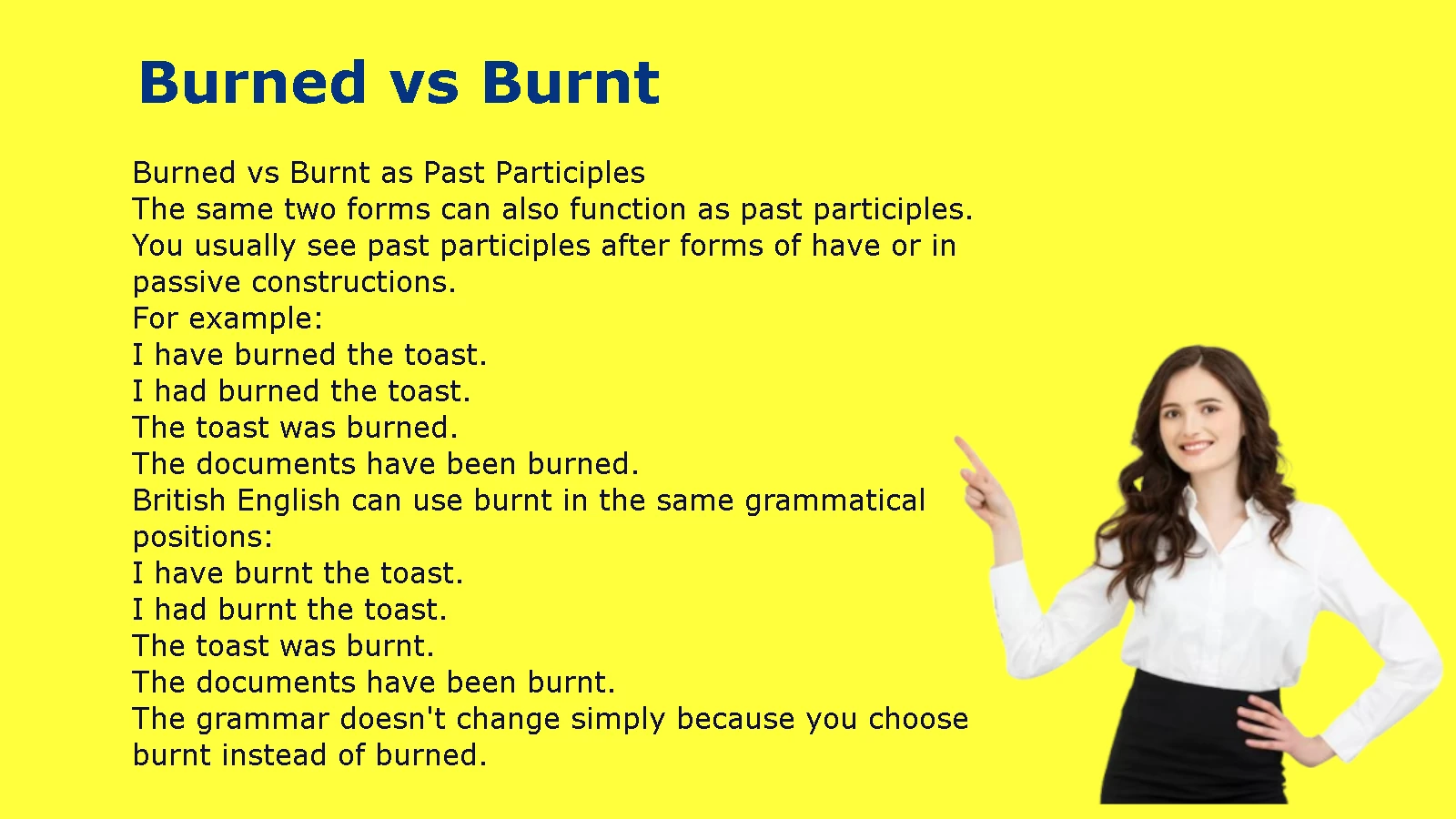
Burned vs Burnt as Past Participles
The same two forms can also function as past participles.
You usually see past participles after forms of have or in passive constructions.
For example:
- I have burned the toast.
- I had burned the toast.
- The toast was burned.
- The documents have been burned.
British English can use burnt in the same grammatical positions:
- I have burnt the toast.
- I had burnt the toast.
- The toast was burnt.
- The documents have been burnt.
The grammar doesn’t change simply because you choose burnt instead of burned.
Present Perfect
The present perfect combines have/has + past participle.
Examples include:
- She has burned the cake.
- She has burnt the cake.
Both are grammatically possible.
Past Perfect
The past perfect uses had + past participle.
Examples:
- He had burned the papers before the police arrived.
- He had burnt the papers before the police arrived.
Again, the regional preference determines which form sounds more natural.
Passive Voice
Both forms can also appear in passive constructions:
- The house was burned in the fire.
- The house was burnt in the fire.
The first is especially natural in American English. The second is common in British English.
Burned vs Burnt as Adjectives
Here’s where the comparison gets a little more interesting.
Burnt can also function as an adjective, particularly when describing something that has been damaged or blackened by fire or heat.
For example:
- burnt toast
- burnt food
- burnt paper
- burnt wood
- burnt sugar
Cambridge defines burnt as an adjective meaning destroyed or made black by fire or heat. It specifically gives burnt toast as an example.
However, burned can also work in similar descriptions, particularly in American English.
For example:
- burned toast
- burned food
- burned paper
- burned wood
Cambridge’s thesaurus guidance on describing food notes that food can be described as either burnt or burned, with burned more common in US English.
Burnt Toast vs Burned Toast
Both burnt toast and burned toast are understandable and grammatically sound.
The difference is mostly regional and stylistic.
American English:
I burned the toast again.
British English:
I burnt the toast again.
As an adjective, you may also encounter:
The kitchen smelled like burnt toast.
The phrase burnt toast is especially familiar because burnt has a strong adjective-like use in descriptions of food.
Still, don’t assume that burned toast is wrong. It is perfectly normal in American English.
When to Use Burned
Choose burned when you’re writing standard American English.
It works especially well when:
- Your audience is primarily American.
- You’re writing for a US-based publication.
- You’re following American English style conventions.
- You’re writing an academic or professional document in US English.
- You want the most straightforward American form of the past tense.
- You’re describing an action that happened in the past.
Examples of Burned
Cooking:
I burned the chicken because I left it in the oven too long.
Injury:
She burned her hand on the hot pan.
Fire damage:
The wildfire burned several acres of forest.
Documents:
He burned the old documents.
Figurative use:
The investor got burned by the deal.
That last example shows that burn doesn’t always involve literal fire. Cambridge also records figurative uses in which someone is burned by an activity or situation, meaning they suffer emotional or financial harm.
When to Use Burnt
Choose burnt when you’re writing British English or when the context naturally favors that form.
It works particularly well in:
- British English prose
- UK-oriented publications
- British dialogue
- Descriptions such as burnt toast
- Certain established phrases and expressions
Examples of Burnt
Cooking:
The toast was burnt around the edges.
Fire:
The fire burnt through the wooden door.
Injury:
He burnt his hand while cooking.
Material damage:
The burnt paper crumbled between her fingers.
Food description:
The restaurant served burnt vegetables with the meal.
Remember, though, that British writers can use burned too. The choice isn’t a strict grammatical boundary.
Burned vs Burnt Examples
Seeing the forms side by side makes the difference much easier to remember.
| Context | American English | British English |
| Toast | I burned the toast. | I burnt the toast. |
| Hand | She burned her hand. | She burnt her hand. |
| Letter | He burned the letter. | He burnt the letter. |
| Fire | The fire burned the fence. | The fire burnt the fence. |
| Past perfect | She had burned it. | She had burnt it. |
| Passive | The house was burned. | The house was burnt. |
| Food adjective | burned food | burnt food |
| Wood adjective | burned wood | burnt wood |
The table shows the central pattern: the meaning stays essentially the same while the preferred form can change with the variety of English.
Burned vs Burnt in Everyday Sentences
Here are more examples across different situations.
Fire:
- The flames burned through the roof.
- The flames burnt through the roof.
Cooking:
- I burned the rice.
- I burnt the rice.
Heat:
- The hot metal burned his skin.
- The hot metal burnt his skin.
Documents:
- They burned the confidential records.
- They burnt the confidential records.
Figurative meaning:
- He got burned by a bad investment.
The figurative example is particularly useful because burned is strongly established in American informal usage for situations in which someone loses money or gets hurt emotionally. Cambridge records this figurative meaning as well.
Burned or Burnt: Which One Should You Use?
The answer depends mainly on the variety of English you’re writing.
If you write in US English, burned is the safest choice.
If you write in UK English, burned and burnt are both acceptable, although burnt is often a natural choice.
A simple rule is:
| If you’re writing for… | Best default |
| United States | burned |
| United Kingdom | burned or burnt |
| General international audience | burned is often the clearer default |
| British-style publication | burnt may fit better |
| American academic writing | burned |
| American business writing | burned |
The key isn’t to treat one form as “correct” and the other as “wrong.” Both have legitimate grammatical roles.
The better question is: Which form fits the English variety and style of the text?
Is Burnt More British Than Burned?
Yes. Burnt is more strongly associated with British English, although British English also uses burned.
Cambridge’s Essential British English dictionary labels burnt as mainly UK and lists it as a past tense and past participle of burn.
Oxford also lists both forms in its verb forms for burn:
- past simple: burnt
- past simple: burned
- past participle: burnt
- past participle: burned
This pattern isn’t unique to burn.
English has several verbs with competing -ed and -t past forms. You may already know examples such as:
- learned / learnt
- dreamed / dreamt
- spelled / spelt
These pairs often show regional or stylistic preferences rather than a fundamental difference in meaning.
Burned vs Burnt in Formal Writing
Both forms can appear in formal writing, but consistency matters.
Suppose you’re writing an American research report and use burned throughout. Suddenly switching to burnt in one sentence can make the document look inconsistent.
For example:
The researchers burned the samples at high temperatures. The burnt material was then examined.
The second sentence isn’t necessarily grammatically wrong. However, if the document otherwise follows American English, burned material may maintain a more consistent style.
For British English, burnt material may fit perfectly naturally.
A Practical Style Rule
Before you start a long document, identify the English variety you’re following.
Then stick with it.
For US English:
burned
For British English:
burned or burnt
This simple approach prevents unnecessary switching between regional forms.
Common Mistakes With Burned and Burnt
The confusion surrounding these words leads to a few recurring mistakes.
Assuming Burnt Is Incorrect
This is probably the most common misconception.
Burnt is not wrong.
It is an established form of burn and is particularly common in British English. Cambridge and Oxford both recognize it as a past form.
So don’t “correct” burnt to burned automatically.
First consider the English variety being used.
Assuming Burned Is Only American
The opposite assumption is also inaccurate.
British English uses burned too.
Cambridge’s British English dictionary gives the forms as burnt | burned.
So the distinction isn’t:
American = burned
British = burnt
A more accurate version is:
American English generally prefers burned, while British English commonly uses both burned and burnt.
Treating Burnt and Burned as Different Meanings
In most ordinary uses, they don’t have different meanings.
Compare:
- She burned the toast.
- She burnt the toast.
Both tell you that she caused the toast to burn.
The difference is primarily form and regional preference, not meaning.
Switching Between Regional Forms
Another problem occurs when a writer mixes regional conventions without a reason.
For example:
The fire burned the fence, and the burnt wood was removed.
There’s nothing inherently ungrammatical about this sentence. However, in a carefully edited American document, you may prefer burned wood for consistency.
Likewise, a British publication may naturally favor burnt.
Consistency gives your writing a smoother rhythm.
Burn vs Burned vs Burnt
Understanding the base verb makes the entire comparison easier.
Burn is the base form.
Burned and burnt are alternative past forms.
| Verb form | Example |
| burn | Don’t burn the paper. |
| burns | The candle burns brightly. |
| burning | The paper is burning. |
| burned | She burned the paper. |
| burnt | She burnt the paper. |
The present participle is burning, not burninged or anything similar.
The important variation occurs in the past and past-participle forms.
Cambridge lists burned and burnt as the past tense and past participle forms in its American English dictionary.
What Does Burn Mean?
Before comparing the past forms, it helps to understand the range of meanings carried by burn.
At its most basic level, burn means to produce flames or heat.
For example:
The logs burned in the fireplace.
It can also mean to damage, hurt, or destroy something with fire or extreme heat:
She burned her hand on the iron.
Cambridge also records uses connected with fuel, calories, and figurative financial or emotional harm.
Physical Burning
This is the most familiar meaning.
- The paper burned quickly.
- The wood burned for hours.
- The fire burned through the wall.
Burning Food
Food can burn when it receives too much heat or cooks for too long.
For example:
I burned the cookies.
Cambridge notes that food can be described as burned or burnt, while burned is more common in US English.
This is why both burned toast and burnt toast are legitimate phrases.
Figurative Burning
English also uses burn figuratively.
Someone can be burned by an investment, for example, meaning they lost money.
He got burned after trusting the wrong business partner.
The fire isn’t literal. The expression compares financial or emotional harm to the pain caused by physical burning.
Burned vs Burnt in Different Contexts
Context can make one form feel more natural even when both are grammatically possible.
Food
Both forms work:
- burned toast
- burnt toast
In American English, burned is generally more common. Burnt remains familiar and can have a distinctly British flavor. Cambridge’s food guidance confirms that both forms can describe food that has cooked too much and turned black.
Fire Damage
Both are possible:
- The building was burned.
- The building was burnt.
American English generally favors burned, while British English can naturally use burnt.
Injuries
Both forms can describe an injury:
- She burned her hand.
- She burnt her hand.
Again, the difference is primarily regional.
Figurative Harm
American English strongly favors burned in expressions such as:
He got burned in the deal.
This doesn’t mean burnt is impossible in every British context. It simply means burned is the natural choice for this common American expression.
A Simple Case Study: One Sentence, Two English Varieties
Consider this sentence:
The chef burned the roast and served the burnt vegetables.
Now imagine two editors working on it.
An American editor might write:
The chef burned the roast and served the burned vegetables.
A British editor might write:
The chef burnt the roast and served the burnt vegetables.
Neither editor has changed the basic meaning.
The difference comes from the preferred regional form.
This example also highlights an important point: real English isn’t always governed by one rigid rule. Usage depends on region, context, editorial style, and the role a word plays in a sentence.
Burned vs Burnt: Key Facts to Remember
If you only remember a few points from this article, remember these:
- Burned is correct.
- Burnt is correct.
- Both can serve as the past tense of burn.
- Both can serve as the past participle.
- Burned is generally preferred in American English.
- Burnt is strongly associated with British English.
- British English also uses burned.
- Burnt commonly appears as an adjective, as in burnt toast.
- American English also uses adjective phrases such as burned toast.
- The two forms generally do not have different meanings.
- The best choice depends largely on regional English and style consistency.
Burned vs Burnt: Frequently Asked Questions
Is burned or burnt correct?
Both are correct. Burned and burnt are recognized past-tense and past-participle forms of burn. American English generally prefers burned, while British English commonly uses both.
Is burnt British or American?
Burnt is more strongly associated with British English. Cambridge’s Essential British English dictionary labels it as mainly UK usage. However, burnt is also recognized in American dictionaries, so it isn’t an exclusively British word.
Do Americans say burnt?
Yes, Americans can use and understand burnt. However, burned is the more common choice in US English, especially in ordinary prose.
Is burnt grammatically correct?
Yes. Burnt is grammatically correct. It can function as the past tense and past participle of burn, and it can also work as an adjective, as in burnt toast.
Should I use burned or burnt in American English?
Use burned as your default choice in American English.
For example:
I burned the toast.
This is the most straightforward US English version.
Should I use burned or burnt in British English?
Either can work. British English commonly uses both burned and burnt. If you’re following a particular publication or style guide, follow its established preference.
Is burnt toast correct?
Yes. Burnt toast is completely correct.
Burnt works naturally as an adjective describing food that has been damaged by excessive heat. Burned toast is also correct, particularly in American English.
Is burned toast correct?
Yes. Burned toast is correct, especially in American English.
For example:
I left the bread in the toaster too long, so I ended up with burned toast.
Is burned the past tense of burn?
Yes. Burned is a past-tense form of burn.
For example:
I burn the toast sometimes.
I burned the toast yesterday.
Burnt can also serve as the past tense:
I burnt the toast yesterday.
Is burnt the past tense of burn?
Yes. Burnt is also a past-tense form of burn. Oxford lists both burnt and burned as past-tense and past-participle forms.
Is there a difference in meaning between burned and burnt?
Usually, no. When they function as forms of burn, they generally communicate the same basic meaning.
The main distinction is regional preference and style.
Which is better for American English: burned or burnt?
Burned is the better default for American English.
It is the form you’ll generally want in US-focused articles, school assignments, business documents, and other standard American writing.
Final Verdict: Burned or Burnt?
The burned vs burnt debate doesn’t have a winner because both forms are legitimate.
The real distinction is one of usage.
Burned is the preferred choice in American English, making it the best default if you’re writing for a US audience.
Burnt is especially common in British English, where it can function as both a past form and an adjective. British English also accepts burned, so the choice isn’t absolute.
The easiest rule is simple:
Use burned for standard American English. Use burned or burnt in British English, depending on the style and context.
So if you wrote I burned the toast, you’re right. If you wrote I burnt the toast, you’re right too. The best choice simply depends on which variety of English you’re using.
For consistent US English, stick with burned. For British English, burned and burnt are both valid options.