Incompetence is the correct word when you mean a lack of ability, skill, or knowledge. Incompetents is the plural noun used for people who are unable to do something properly or effectively. The two words have different meanings and cannot always be used interchangeably.
If you’re searching for “incompetence or incompetents,” “incompetence vs incompetents,” or “which is correct,” the key difference is simple: incompetence refers to a lack of ability, while incompetents refers to people who lack the necessary ability or skill. For example, you can say, “His incompetence caused the problem,” or “The company was run by a group of incompetents.”
| Question | Answer |
|---|---|
| What does incompetence mean? | A lack of ability, skill, or knowledge to do something properly. |
| What does incompetents mean? | People who lack the ability or skill to do something effectively. |
| Is incompetence a noun? | Yes. It refers to a lack of competence or ability. |
| Is incompetents a noun? | Yes. It is the plural form of incompetent when referring to people. |
| What is the difference between incompetence and incompetents? | Incompetence describes a lack of ability, while incompetents refers to people who lack that ability. |
Incompetence or Incompetents: Quick Difference
The fastest way to understand the difference is to compare the words side by side.
| Word | Part of speech | What it means | What it refers to |
| Incompetence | Noun | A lack of ability, skill, knowledge, or effectiveness | A quality, condition, or problem |
| Incompetent | Adjective | Lacking the ability needed to do something properly | A person, organization, action, or performance |
| Incompetent | Noun | A person who lacks the required ability | One person |
| Incompetents | Plural noun | People who lack the required ability | Two or more people |
Cambridge defines incompetence as a lack of ability to do something successfully or as it should be done. Its business definition makes the meaning even more specific by referring to the lack of the skill or knowledge needed to perform a job correctly or satisfactorily.
By contrast, incompetent describes someone or something that doesn’t have the necessary ability. As a noun, it means a person who lacks that ability.
So remember this simple rule:
Incompetence = the lack of ability.
Incompetents = the people who lack ability.
Think of it like this: incompetence is the problem; incompetents are the people displaying the problem.
What Does “Incompetence” Mean?
Incompetence is a noun that describes a lack of the ability, skill, knowledge, or capacity needed to do something properly.
Cambridge defines it as a “lack of ability to do something successfully or as it should be done.”
Merriam Webster similarly defines incompetence as the quality, state, or fact of being incompetent. Merriam Webster records the first known use of the word in 1663.
The word therefore names a condition, not a person.
Examples of Incompetence
Consider these sentences:
- The manager’s incompetence caused unnecessary delays.
- The investigation revealed serious incompetence.
- The company suffered because of managerial incompetence.
- His incompetence became obvious after several major errors.
- The report identified administrative incompetence.
In every example, incompetence describes the lack of ability or effectiveness.
You could often replace it with phrases such as:
- lack of ability
- lack of skill
- inability
- ineptitude
- poor performance
- inadequacy
However, these alternatives aren’t always perfect substitutes. Incompetence specifically focuses on failing to possess or demonstrate the ability needed for a task.
Is “Incompetence” a Countable or Uncountable Noun?
In ordinary English, incompetence is usually uncountable when it refers to a general lack of ability.
That’s why you normally say:
- The company showed incompetence.
- His incompetence was obvious.
- The investigation exposed widespread incompetence.
You generally don’t say:
- an incompetence
- two incompetences
when you’re simply talking about someone’s general lack of ability.
However, specialized or formal contexts can use related forms differently. The closely related noun incompetency can be countable or uncountable, and Merriam Webster gives incompetencies as its plural form.
For everyday writing, incompetence is usually the cleaner choice when you mean the general condition.
What Does “Incompetents” Mean?
Incompetents is the plural form of the noun incompetent.
As a noun, an incompetent means a person who doesn’t have the skill or ability needed to perform a task properly. Therefore:
- an incompetent = one person
- incompetents = two or more people
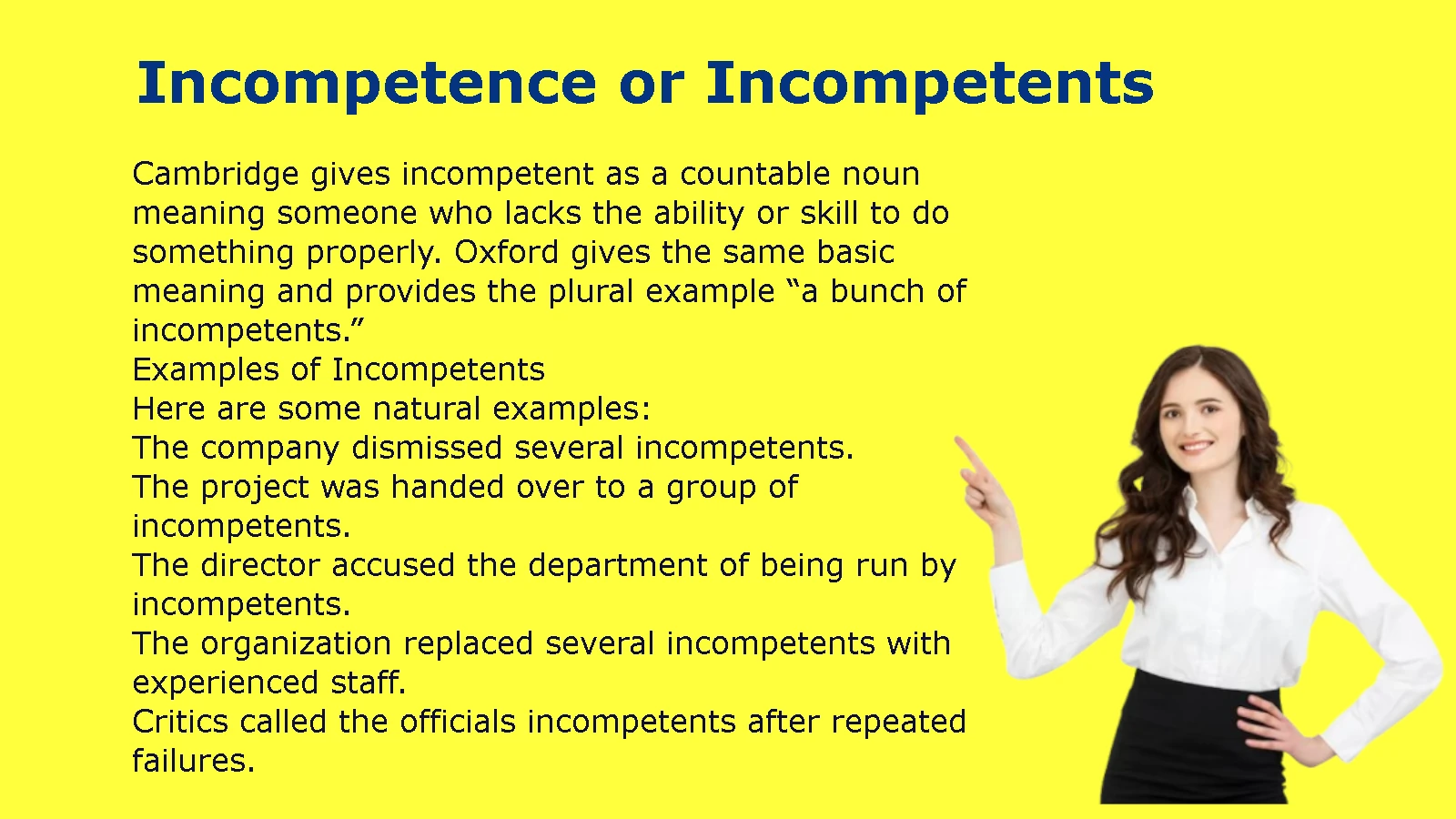
Cambridge gives incompetent as a countable noun meaning someone who lacks the ability or skill to do something properly. Oxford gives the same basic meaning and provides the plural example “a bunch of incompetents.”
Examples of Incompetents
Here are some natural examples:
- The company dismissed several incompetents.
- The project was handed over to a group of incompetents.
- The director accused the department of being run by incompetents.
- The organization replaced several incompetents with experienced staff.
- Critics called the officials incompetents after repeated failures.
Notice what these sentences have in common: incompetents refers directly to people.
That’s the crucial difference.
You wouldn’t replace incompetents with incompetence without changing the meaning:
The company dismissed several incompetents.
This means the company dismissed several people.
The company dismissed several incompetence.
This doesn’t work because incompetence isn’t the plural noun for incompetent people.
Is “Incompetent” an Adjective or a Noun?
Here’s where the word family becomes especially useful.
Incompetent can be both an adjective and a noun.
As an adjective, it describes someone or something that lacks the ability to perform properly:
- an incompetent employee
- an incompetent manager
- an incompetent doctor
- incompetent leadership
- incompetent handling of the situation
As a noun, it refers to the person who lacks the necessary ability:
- He is an incompetent.
- They hired an incompetent.
- The department was led by several incompetents.
Cambridge lists both grammatical functions. It defines the adjective as meaning that someone lacks the ability to do something as it should be done, while its noun definition refers to someone without the necessary ability or skill.
Adjective vs. Noun
Compare these examples:
| Sentence | Role of “incompetent” |
| She is an incompetent manager. | Adjective |
| The manager is incompetent. | Adjective |
| She is an incompetent. | Noun |
| The company hired several incompetents. | Plural noun |
The noun usually appears with an article or another determiner in the singular:
- an incompetent
- the incompetent
- this incompetent
The plural doesn’t need an article:
- incompetents
- several incompetents
- those incompetents
Incompetence vs. Incompetent vs. Incompetents
Understanding the entire word family makes the distinction much easier.
| Word | Function | Meaning | Example |
| Competence | Noun | Ability to perform effectively | Her competence impressed the team. |
| Competent | Adjective | Having the required ability | She is a competent manager. |
| Incompetence | Noun | Lack of ability | His incompetence caused problems. |
| Incompetent | Adjective | Lacking the required ability | He is an incompetent manager. |
| Incompetent | Noun | An incompetent person | He is an incompetent. |
| Incompetents | Plural noun | Incompetent people | The company removed several incompetents. |
This pattern is worth remembering because it shows how English often builds related words.
Competent describes ability.
Incompetent describes the absence of sufficient ability.
Competence names the quality of being capable.
Incompetence names the lack of that quality.
How to Use “Incompetence” in a Sentence
The noun incompetence works naturally in several common sentence patterns.
Talking About a Person’s Lack of Ability
You can use incompetence to describe someone’s poor performance:
His incompetence became obvious during the project.
The sentence doesn’t call the person an incompetent. Instead, it focuses on the quality of his performance.
Another example:
Her incompetence caused the team to miss several deadlines.
This wording can sound more formal than directly calling someone incompetent.
Talking About Management
Incompetence frequently appears with words connected to leadership and administration.
Examples include:
- managerial incompetence
- administrative incompetence
- bureaucratic incompetence
- professional incompetence
- organizational incompetence
For example:
The audit revealed serious managerial incompetence.
Cambridge specifically lists business uses such as administrative, bureaucratic, and managerial incompetence.
Talking About Poor Performance
The word also works when you want to focus on results:
The repeated errors suggested widespread incompetence.
Here, the evidence is the errors, while incompetence describes the underlying lack of ability.
Using “Incompetence” With “of”
A common construction is:
the incompetence of + person, group, or organization
Examples:
- the incompetence of the manager
- the incompetence of the department
- the incompetence of the leadership
- the incompetence of the administration
For example:
The incompetence of the management team created serious operational problems.
This construction works well in formal writing because it focuses on the performance issue rather than relying on a direct personal insult.
How to Use “Incompetents” in a Sentence
Incompetents works when you need a plural noun for people who lack the ability or skill required for a task.
Referring to Multiple People
For example:
The company removed several incompetents from important positions.
Here, incompetents is the direct object of removed.
Another example:
The project suffered because several incompetents were placed in charge.
The noun clearly identifies the people being criticized.
Using “Incompetents” as a Strong Criticism
There’s an important tone issue here.
Calling someone an incompetent is usually much harsher than saying the person made an incompetent decision or performed incompetently.
Compare:
- The manager made a serious mistake.
- The manager handled the situation incompetently.
- The manager was incompetent.
- The manager is an incompetent.
The final sentence turns the criticism into a label about the person.
That’s why incompetents can sound blunt, dismissive, or insulting. Oxford’s example uses the phrase “a bunch of incompetents,” which demonstrates the word’s strongly critical tone.
When “Incompetent Employees” Is Better
In workplace writing, incompetent employees may be clearer and less loaded than incompetents.
Compare:
The department was filled with incompetents.
with:
The department had several incompetent employees.
Both sentences communicate criticism. The second one sounds more professional because it identifies the people by their workplace role instead of turning incompetent into a label.
Incompetence or Incompetents: Which One Should You Use?
Use incompetence when your sentence discusses a lack of ability.
Use incompetents when your sentence discusses multiple people who lack ability.
Choose “Incompetence” When You Mean:
- lack of skill
- lack of knowledge
- inability
- poor performance
- inadequate ability
- ineffective management
- a general condition of being incompetent
Examples:
- The audit exposed incompetence.
- His incompetence caused the delay.
- The organization struggled because of managerial incompetence.
Choose “Incompetents” When You Mean:
- incompetent people
- multiple people who lack the required skills
- people who repeatedly fail to perform adequately
Examples:
- The company replaced several incompetents.
- The critics described the officials as incompetents.
- The project was put in the hands of incompetents.
A Simple Replacement Test
When you’re stuck, try this test.
If you can replace the word with “lack of ability,” choose incompetence.
His incompetence caused the failure.
becomes:
His lack of ability caused the failure.
The meaning still works.
If you can replace the word with “incompetent people,” choose incompetents.
The company dismissed several incompetents.
becomes:
The company dismissed several incompetent people.
Again, the meaning remains clear.
This little test works surprisingly well.
Incompetence or Incompetents: Examples Side by Side
The contrast becomes even clearer when the words appear in similar situations.
| Using incompetence | Using incompetents |
| The manager’s incompetence caused the delay. | The manager hired several incompetents. |
| The investigation revealed incompetence. | The investigation identified several incompetents. |
| The company suffered from managerial incompetence. | The company replaced several incompetents. |
| His incompetence affected the entire team. | His team consisted of several incompetents. |
| The report criticized administrative incompetence. | The report criticized the officials as incompetents. |
| Incompetence can damage an organization. | Incompetents can damage an organization. |
The words can appear in the same general topic, but their grammatical targets differ.
Incompetence describes the condition.
Incompetents describes the people.
Usage Case Study: A Workplace Problem
Consider a fictional workplace example.
A project manager repeatedly misses deadlines, assigns tasks incorrectly, and fails to communicate important information.
You could describe the problem in several ways.
If the focus is the manager’s performance
The manager’s incompetence caused repeated project delays.
Here, the sentence focuses on the lack of ability.
If the focus is the manager as a person
The manager is incompetent.
Here, incompetent is an adjective describing the manager.
If the manager is one person among several
The company hired an incompetent to lead the project.
Here, incompetent is a noun.
If several people share the problem
The project was handed over to a group of incompetents.
Here, incompetents is the plural noun.
The situation stays roughly the same. What changes is what the sentence chooses to name.
That’s the heart of the distinction.
Usage Case Study: Formal vs. Direct Writing
The choice also affects tone.
Suppose an employee makes several serious errors.
A formal report might say:
The review identified significant incompetence in the handling of the account.
A performance evaluation might say:
The employee demonstrated insufficient competence in managing the account.
A direct statement might say:
The employee was incompetent in handling the account.
A much harsher statement might say:
The employee was an incompetent.
All four sentences communicate criticism. They don’t carry the same tone.
Incompetence often lets you discuss a problem without turning the noun itself into a personal label. That’s useful in professional, academic, and analytical writing.
Common Mistakes With Incompetence and Incompetents
These words cause a few predictable errors.
Mistake: Using “Incompetents” to Mean “Incompetence”
Incorrect:
The company suffered from several incompetents.
If the intended meaning is that the company suffered from a lack of ability, this sentence uses the wrong noun.
Better:
The company suffered from widespread incompetence.
If the intended meaning is that the company suffered because of several incapable people, you could write:
The company suffered because of several incompetents.
The second version makes the people the cause.
Mistake: Calling a Person “an Incompetence”
Incorrect:
He is an incompetence.
Correct:
He is incompetent.
or:
He is an incompetent.
Incompetence names the condition or quality. It doesn’t normally name the person who has that quality.
Mistake: Treating “Incompetents” as an Adjective
Incorrect:
They hired incompetents employees.
Correct:
They hired incompetent employees.
Why? Because incompetent is the adjective.
Incompetents is the plural noun.
Compare:
- incompetent employees → adjective + noun
- incompetents → plural noun
That final s changes the grammatical role.
Mistake: Assuming “Incompetence” Is the Plural of “Incompetent”
It isn’t.
The forms are:
- incompetent → singular noun
- incompetents → plural noun
- incompetence → abstract noun
Think of the pattern as:
one person → an incompetent
several people → incompetents
lack of ability → incompetence
Incompetence vs. Incompetency
Another word sometimes appears alongside incompetence: incompetency.
The two are closely related. Cambridge lists incompetency as a synonym of incompetence, while Merriam Webster defines incompetency as incompetence.
For most everyday writing, incompetence is the straightforward choice.
Why Do Both Forms Exist?
Their histories are closely connected.
The word incompetency dates back to the early 1600s, while incompetence developed as a related noun in the 1600s. Etymonline traces incompetence to French incompétence and ultimately connects the word to competence.
You may therefore encounter both:
- incompetence
- incompetency
- incompetencies
However, don’t confuse incompetency with incompetents. They have different grammatical functions.
| Word | Meaning |
| Incompetence | Lack of ability |
| Incompetency | Another noun meaning incompetence |
| Incompetent | A person lacking ability, or an adjective describing one |
| Incompetents | Multiple incompetent people |
The History Behind “Incompetent”
The word incompetent has a surprisingly long history.
Etymonline traces the adjective to the 1610s, from French incompétent and Late Latin incompetentem, built from in-, meaning “not,” and competent. The sense relating specifically to lacking qualification or ability appears by the 1630s. The noun meaning an incompetent person is recorded from 1866.
Merriam Webster gives the first known use of incompetent as 1595.
The word therefore wasn’t originally created simply as an insult. Its history is tied to the broader idea of competence, qualification, suitability, and fitness.
That connection still appears in modern English:
- competent → capable or suitably qualified
- incompetent → not capable or suitably qualified
- competence → the quality of being capable
- incompetence → the lack of that capability
What Is the Opposite of Incompetence?
The direct opposite of incompetence is competence.
Cambridge explicitly lists competence as the opposite of incompetence.
The basic relationship looks like this:
| Positive form | Negative form |
| competence | incompetence |
| competent | incompetent |
For example:
- Her competence impressed the employer.
- His incompetence frustrated the team.
Or:
- She is a competent manager.
- He is an incompetent manager.
This word family makes the meaning easier to remember because the prefix in- creates the negative counterpart.
Synonyms for Incompetence
Depending on the context, several words can express a similar idea.
General synonyms
- inability
- ineptitude
- incapacity
- inadequacy
- inefficiency
- ineffectiveness
- inaptitude
- insufficiency
Merriam Webster’s thesaurus includes inability, incompetency, ineptitude, incapacity, inadequacy, and inefficiency among related terms.
However, each word has its own shade of meaning.
Incompetence vs. Inability
Inability simply means a lack of ability.
His inability to operate the equipment delayed the work.
Incompetence often carries a stronger suggestion that the person should have been capable of doing the job properly.
His incompetence delayed the work.
Incompetence vs. Inefficiency
Inefficiency focuses on poor use of time, resources, effort, or processes.
The department suffered from inefficiency.
Incompetence focuses more directly on insufficient ability, knowledge, or skill.
The department suffered from incompetence.
The two can overlap, but they aren’t identical.
Incompetence vs. Ineptitude
Ineptitude is very close to incompetence and often emphasizes clumsy or ineffective performance.
His political ineptitude became obvious.
His political incompetence became obvious.
Both can work, although the best choice depends on the exact context and tone.
Is “Incompetents” Grammatically Correct?
Yes. Incompetents is grammatically correct when used as the plural noun for incompetent.
For example:
The organization replaced several incompetents with experienced staff.
Cambridge explicitly gives incompetent as a countable noun, and Oxford likewise defines the noun as a person who lacks the skill or ability to do a job or task properly.
Still, grammatical correctness doesn’t automatically make a word the best choice for every situation.
Because incompetent can be a blunt label, professional writing often benefits from more precise wording.
Instead of:
The department is full of incompetents.
you might write:
Several employees lack the skills required for their roles.
The second sentence identifies the issue without turning the people into a dismissive category.
Is “Incompetence” a Better Word in Professional Writing?
Often, yes, especially when the goal is to analyze a problem rather than insult a person.
Compare:
The director is an incompetent.
with:
The review identified serious incompetence in the director’s handling of the project.
The first sentence attacks the person directly.
The second focuses on performance and evidence.
That distinction matters in business reports, workplace communication, academic writing, journalism, and formal complaints. A professional document usually benefits from describing what went wrong, why it went wrong, and what evidence supports the conclusion.
Instead of simply writing incompetence, you can make the claim more useful:
- The team missed three deadlines.
- The manager failed to review the financial figures.
- The department submitted incorrect records on four occasions.
Specific facts are stronger than vague labels.
Frequently Asked Questions About Incompetence or Incompetents
Is “incompetence” a noun?
Yes. Incompetence is a noun meaning a lack of ability, skill, knowledge, or competence. Cambridge classifies it as an uncountable noun in its general English definition.
Is “incompetents” a word?
Yes. Incompetents is the plural noun form of incompetent. It means people who lack the ability or skill required to do something properly.
What is the plural of incompetent?
The plural noun is incompetents.
For example:
The company dismissed two incompetents.
Can “incompetent” be a noun?
Yes. Incompetent can function as both an adjective and a noun.
As an adjective:
He is an incompetent manager.
As a noun:
He is an incompetent.
Cambridge and Oxford both recognize this noun use.
What is the difference between incompetent and incompetence?
Incompetent describes someone or something that lacks the ability to perform properly.
Incompetence names the lack of ability itself.
Compare:
The manager is incompetent.
The manager’s incompetence caused the failure.
What is the difference between incompetence and incompetents?
Incompetence refers to a lack of ability.
Incompetents refers to people who lack ability.
For example:
The investigation revealed incompetence.
The investigation identified several incompetents.
Is “incompetents” rude?
It can be. Calling someone an incompetent or an incompetent person can sound strongly critical. The plural incompetents can sound even harsher when used as a label for a group.
In formal writing, consider describing the specific performance problem instead.
What is the opposite of incompetence?
The direct opposite is competence.
Similarly:
- incompetent ↔ competent
- incompetence ↔ competence
Is “incompetency” the same as “incompetence”?
Generally, yes. Incompetency is a noun meaning incompetence, and major dictionaries recognize it as a synonym or related form.
Can you say “an incompetence”?
Usually, not when you’re talking about a general lack of ability.
Natural:
His incompetence caused the problem.
Less natural for the general meaning:
His an incompetence caused the problem.
If you’re describing a specific instance or specialized use, context can change the grammar. For ordinary writing, however, incompetence is normally used without an indefinite article.
Final Verdict: Incompetence or Incompetents?
The difference between incompetence or incompetents is simple once you focus on what the word names.
Incompetence is the lack of ability, skill, knowledge, or competence. It is a noun that describes a condition or quality.
Incompetents means people who are incompetent. It is the plural form of the noun incompetent.
Remember the three key forms:
Incompetence = the lack of ability.
Incompetent = a person who lacks ability, or an adjective describing that lack.
Incompetents = multiple people who lack ability.
When you’re writing, ask one question: Am I describing the problem or the people?
If you’re describing the problem, choose incompetence.
If you’re describing multiple people, choose incompetents.
That distinction keeps the grammar clean and the meaning precise. It also helps you choose the right tone. In formal writing, incompetence often lets you focus on measurable performance problems rather than simply labeling people. When the people themselves are the subject, incompetents is grammatically correct, although it carries a sharper and more judgmental tone.